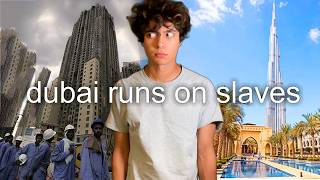
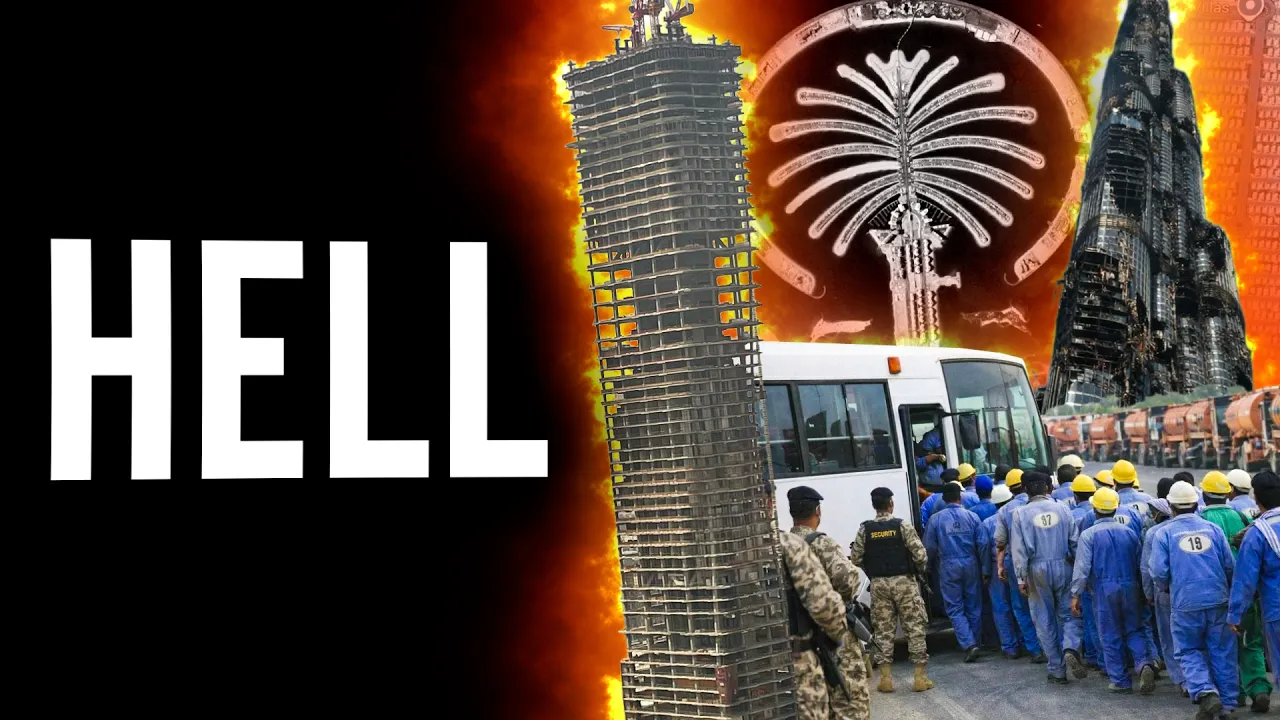
This is Dubai, a tax-free haven of wealth, opportunity, and ultra luxury overflowing with influencers, business elites, anyone craving money and status. And we all know on the surface, it's about insane skylines, fake islands carved into the ocean. But none of that simply magicked itself out of thin air.
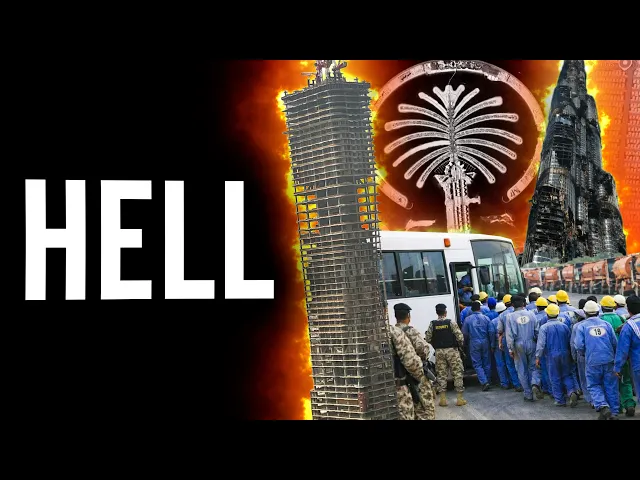
It needs bodies to build and feed it. And if you've ever been yourself, you might have already seen these large, mysterious buses moving through the cities and convoys full of rows of tired faces and work clothes that look like prison uniforms. At special bus stops dotted on the street a little away from the tourist stops, there are sometimes 20, 30, 40 men clustered together, all waiting on the sidewalk, separated from everyone else.
They rise before dawn, wait in guarded camps, work seven days a week, then return by bus with barely enough time to eat or sleep. What you realize is that the entire city is a sandbox, an experimental space sealed off from all the consequences with a working population that service this hidden bubble from plain view. All while the ultra elites rake in huge salaries tax-free for content with the super rich living out their lavish lives in high-end apartments and villas.
But beneath all of that, if you ever ask who's actually living in Dubai, apart from the elites, whose lives are spent sustaining this illusion? Who are the people living in the places nobody shows in Dubai? Well, this is their story.
The true story of how Dubai really works and the lost souls that power its whole system. It begins in a recruitment office in a small city you've never heard of. It could be India, Pakistan, Nepal, or Bangladesh.
Wherever you can sell poor and vulnerable people a better life. At three Raman Cananan, in this case from India, is 34. He's got a wife and a young child and about $20 to his name.
He supports his elderly parents at home. And the recruiter across the desk is wearing a suit that costs more than he makes in a year. And he's making some convincing promises.
He'll be paid $600 a month, good accommodation, food, and paid overtime. A respectable job building the future of the world in Dubai. He says to him he'd be crazy to turn down the opportunity.
The contract is in English and he can't read English very well, but the numbers are clear. He asks about the fee. You have to pay $3,000 upfront just to get started.
So, his wife's jewelry goes first. Then, his brother takes out a loan. His father sells a piece of land they've had for generations.
And it's taken 2 months to scrape together all of this money, but it's worth it. 2 years of work, and they'll have enough to pay back the loans, buy better land, and maybe send the kids to a real school. This is finally their way out of poverty.
When it's time to go, his family throws a small party and they ask when he'll be back. He tells them 2 years, maybe less if he gets good overtime. At the airport, his mother cries and his wife holds his hand until the last possible second.
She whispers a prayer as he walks through security and the back of his head eventually disappears into the crowds. And this is how it begins. The UAE has a network of recruiters who operate wherever the cheapest labor is.
It could be Asia, Africa, Latin America, even some parts of Europe. When he arrives, Dubai airport is way more impressive than any building he's ever seen with chrome and glass and designer shops lining the walls. If you've been there or to any airport in the region, you already know how the luxury oozes from pretty much everything.
To him, it looks exactly like the social media advert said it would. This is truly the next utopia. There's a man with a clipboard waiting at arrivals who says to get on the bus.
There are 30 other men all glancing around nervously. As the doors close, it starts to sink in that this isn't a holiday. They drive for an hour deeper into the suburbs until the skyline bleeds into the desert and eventually they reach a concrete building complex in the middle of nowhere.
It's the world's largest labor camp called Sonapur which ironically means city of gold in Hindi. Inside they're told to line up and one by one they hand over their passports. They're told it's for visa processing and that they'll get it back.
He never sees it again. He's now quickly becoming a cog in a machine way larger than anything he's ever imagined. They never allowed me to go outside.
When they go outside, I have to be with them. And when they go outside, they have to lock me inside the house. >> The labor camps look like prisons and are formed of concrete boxes divided into rooms.
A typical room holds over 10, maybe even 20 men. The heat is lethal in the day with minimal air con. The toilets don't flush properly because there's sewage backing up in the showers.
Work starts at 4:00 a. m. when it's mercifully cool.
By 10:00 a. m. , the temperature is over 40° or 104 F.
By noon, it's 50° or a ridiculous 122 Fahrenheit. The concrete incinerates anything it touches, including even your hands. Every summer, UAE law bans outdoor work between 12:30 and 3:00 p.
m. because of heat related fatalities, but that rule is often ignored for its migrants workers. The working day is truly grueling.
You slave away in the heat with minimal water. Scared of heights? You're totally screwed if you're working on a high-rise.
Lunch breaks are minimal and people regularly report passing out in the sun. In the first month, he's told his pay is late. Second month, still no payment.
Third month, his wife calls from a borrowed phone. The lone sharks are home and now threatening her. Where's the money?
But he has no answer. She's crying. His parents tell him to come home before the phone then just cuts off.
He's now worked 2,000 hours and counting. And yet, he hasn't been paid for a single one of them. Even worse, he's completely trapped.
Leaving without your employer's permission is illegal. It's called absconding, which is actually prohibited under Dubai law. You get arrested, imprisoned, and deported while owing your initial fee and more.
Some think they can simply ask for holiday leave, go home, and simply not return. But real accounts say the employers put a form in front of you and say, "If you do this and don't come back, two of your co-workers will lose their salary for an entire month as a penalty. " And I had my manager and my coworker to sign this paper.
It's mandatory that they have to sign this paper if you want to get your passport back. And if I don't bring the passport back after 1 month's holiday, the hotel will deduct their salary for 1 month. So both my coworker and my manager, they will not get a salary for entire months as a penalty of signing my document and for being responsible of me not coming back.
So he does the only thing he feels is left for him. After waking up and going about his routine as normal, he climbs up to the 147th floor. Below him is everything he and his people built.
The marina, the palm, tens of thousands of buildings, hotels where a single night costs more than he made in a lifetime. Apartments he'll never set foot in. A city he constructed but will never be a part of.
He thinks about his child and he wonders if they'll remember him when they grew up. He wonders if the company will pay his family the life insurance. Maybe if he makes this next move, at least they'll get something.
He looks to the sky, takes a deep breath, and embraces his final moments. This tragically is a true story. On May 10th, 2011, a construction worker jumped from the 147th floor of the Burj Khalifa.
He landed on the 108th floor deck and died instantly. At the time, he was just trying to get emergency leave to visit home for 2 days as his brother had recently passed away. The official statement said he had an argument with his employer about unpaid wages.
The official death toll for the entire six-year construction of Burj Khalifa was this one person which is widely considered to be impossible. Over 100 Indians took their own lives in one year of construction. And then you need to factor in all the other nationalities.
Nearly 15% of all Nepali deaths in Dubai are self-inflicted. Based on what we know now, up to 10,000 migrant workers die in the Gulf States every year. And more than half of those deaths have no explanation.
They're marked as natural causes or cardiac arrest with no investigation. Most are unreported and never even make the news. These men helped create one of the world's great successes.
Now neither the authorities nor their own governments are interested in the Calibalis. Whether they live or die, no one cares. And you've probably never heard about any of this because this is the Dubai they don't want you to see.
And they do an amazing job of hiding this. Just think about how the city status would change if they didn't hide it. If it had a homelessness problem like in the West or its glamorous international events were constantly interrupted by protesters.
But even as these horrifying stories piled up, no one does anything about them. There's little meaningful pressure, no uproar from other governments because they're all entered into the same contracts contributing to the hidden infrastructure designed to serve this exploitative but profitable labor system. It's powered by the Cathol.
And unless you're using it to enslave people or you're one of its victims, you've probably never heard of it. On paper, it looks legitimate. An Emirati company sponsors workers.
The worker gets a visa, the company gets an employee. That's the deal. Except the moment these workers landed a buy airport, their passports then get confiscated.
The company claims it's for processing or safekeeping. But in reality, it's just a hostage situation. The contract they signed back home promising $600 a month, it gets ripped up.
The new one is much lower. You're in way too deep now, though, and there's no easy way to challenge it. That recruitment fee was illegal for the company to charge, by the way.
The UAE banned it multiple times, but it's still happening because nobody enforces the law. The regulations that do exist are basically just theater. I haven't been paid for 6 months, so I can't afford to buy a ticket to go home.
The ticket costs £150, but they can't get hold of their passports or the necessary exit documents either. Poorer countries are targeted the hardest, but there are plenty of stories from people from Italy, Greece, Romania, Spain, and other Western countries being lured into senior roles, only to then also have their passports confiscated and confined to the same labor camps as everyone else. So stop and ask yourself, what might you do in the situation if you're trapped working for virtually nothing in terrible conditions?
You hate it. You left your entire life behind. You see your family every night when you close your eyes, but wake up to the same grim desert every morning.
So here's option one. You could literally run away, but that's illegal. You lose your pay.
You might be in prison for years before you're deported. And you definitely can't flee across the desert to the border. The entire UAE is about 80% sand.
It's about the size of Portugal or a state like Maine or Indiana. And you can't blend into this manufactured fake environment full of Lambos and Louis Vuitton. It's basically its own natural prison.
Here's option two. You could run to the streets and try to make a new life somehow, but you'll almost certainly be rounded up and face deportation after several months suffering in a detention center, which has even worse conditions than the labor camps. The final option, if you still want to live, is to physically fight back.
But you're up against one of the harshest legal systems in the world. There have been a few attempts, but the government shattered them every time. In 2013, workers at Arab, one of Dubai's largest construction firms, went on strike.
They hadn't been paid in months. The police showed up, arrested dozens of them, and had them deported. Then there's the case of the Dubai Expo 2020, where both the workers and activists protesting on their behalf were swiftly silenced and jailed.
It was supposed to be Dubai's big moment, showing the world how sophisticated they'd become. After it was over, Fish was quietly admitted, six workers died, and 72 were seriously injured during construction. The real number is thought to be way higher, seeing as 200,000 people worked on the project day and night with minimal health and safety provisions.
The EU Parliament publicly pressured the city to release the activists. Then when the grotesqually lavish opening ceremony rolled out, that pressure evaporated. In this place, an endless red carpet of politicians and business leaders.
Dubai's huge international events need their own purpose-built infrastructure, but most of it is just for show. Walk through the city at night away from the marina and the tourist spots and you'll see hauntingly empty buildings littered everywhere. Whole apartment complexes with no lights on.
Shopping malls with more staff than customers. It's common for shops and restaurants to open and close within a year with money laundering often cited as the reason. In a cash heavy economy with limited transparency, a short-lived business can cycle large sums through rent, wages, and inventory, then just disappear without a trace.
The point is everything these workers built is vacant while they sleep on the floor away from town. Their visibility is carefully engineered. Male workers are removed from public life.
Female workers are confined to private spaces. For women, it begins exactly the same with promises of good pay, decent conditions, and respect. Instead of a construction site, they're taken to a house with eight other women crammed into a single room.
The agency staff take their phones. They're not allowed to leave. One woman described how women lie together on the floor until someone turns up and buys them.
When a family picks them, they're driven to a villa where they work on a brutal schedule with no days off or breaks. And like the men, payments are kicked down the road or sometimes never even paid at all. Beatings often become routine.
And yes, absconding is illegal. In the most tragic cases, the end result is the same as the construction workers. One woman from the Kamoras Islands was killed with her autopsy showing beatings over weeks and months using fists, bamboo sticks, and low voltage electrical wires.
Human Rights Watch interviewed 99 domestic workers, and almost all reported verbal abuse, being called animals, donkeys, told they were dirty and contaminating. 24 reported physical or sexual abuse. Many aren't paid for months or even years.
One woman worked for nearly 3 years without a single payment. Dubai is a society where you can basically pay for anything or get away with not paying if you have the status to get away with it. Money really is power.
Shopping for these maids is no different as you can readily browse and buy them online. Agencies post ads with women's photos, passport numbers, ages, weights, and complexion. It's essentially a human catalog sorted by race, which somehow seems normal there despite it marketing itself as a western paradise.
And that's when you realize something truly disturbing about Dubai's culture. It's not that people don't ever see the exploitation. It's that the entire city is designed to make it easy not to even care.
The desensitization is built into the infrastructure itself because the city has literally engineered invisible segregation. Surveillance cameras monitor unwanted visitors in affluent areas. Gated communities keep workers out.
Public transport barely reaches the places where migrant workers live. Even the streets in wealthy neighborhoods are designed to be pedestrian unfriendly because walking is what poor people do. It's the definition of living in the shadows.
Workers are everywhere but invisible to the tourists or the rich people's naked eye. Its wealthy inhabitants will say everyone has a choice, but they won't acknowledge that thousands of migrant workers don't have the choice to leave, demand payment, or see their families. Because admitting that means admitting their tax-free paradise is built on taking that choice away from others.
And that's not the vibe. That doesn't fit the brand. So they keep up the pretense to make their own lives feel great when really this is numbness in disguise.
The system isn't just about the physical infrastructure you can see. It's psychological infrastructure you can't see too. An entire ecosystem designed to make privileged people comfortable with being complicit.
Well, you've got to ask what the driving force behind all of this really is. You might be tempted to think this is a Dubai or UAE problem, and you'd partly be right. But you've got to look at who's buying.
Wealthy Emirati, sure, but also rich immigrants, including Western expats and the influencer class. 90% of Dubai's population is immigrants in one way or another. And yes, that includes the influencers who are posting about their amazing Dubai lifestyle.
Someone has to clean those luxury villas and watch those kids while they're creating content. And the truth is that the Western world has lined up to be a part of this. I'm talking about the organizations you hear plaster human rights and social responsibility all over the marketing material.
Even Abu Dhabi, the capital of the UAE, wants to build a cultural district translated to the island of happiness. It featured world-class museums designed by the biggest names in architecture. The French president Emanuel Mcron even attended their grand opening of the Loura and delivered a speech about how their museum embodied the radiance of universal values.
He said it symbolized the fight against the discourses of hatred, but the construction says differently with months of unpaid wages and mass deportations. Human Rights Watch published multiple reports documenting abuses, but the French government practically ignores them all. New York University takes it to another level because they were so adamant it would be progressive and socially conscious.
They published a statement of labor value guidelines that would supposedly protect workers' rights. This turned out to be a total joke. Roughly 6,000 migrant workers built the NYU Abu Dhabi campus between 2010 and 2014 crammed into shipping containers earning about 78 cents an hour.
It was a major scandal, but NYU basically said it was more complex than the media was portraying and brushed it all off. So why did these institutions risk their reputations to build in places with such obvious human rights records? They exported their moral responsibility to somewhere it doesn't exist.
You could call this a form of reverse colonialism. Rather than extracting resources directly, they're using Dubai to extract cheap labor resources from others, making massive vanity projects cheaper and easier to achieve. They'd simply never be allowed to do this in the West.
It's a literal and metaphorical sandbox. A non-destructive experimental environment where ethics and consequences don't apply. Coastlines reshaped into palm trees and continents.
Indoor ski slopes in the middle of a desert. Huge events built for pure optics and dealmaking. Police driving.
A super dark sex industry and widespread blatant corruption and criminal networking. Want to exert your soft power over the Middle East? Want to invest in cheap mega projects for enormous profits?
Well, welcome to Dubai. money, prestige, and the confidence that you'll probably get away with it. They all calculated correctly the Western audiences wouldn't care enough to hold them accountable.
Boycourt faded and the news coverage stopped. I mean, did you even hear of any of this stuff? Everyone shows up for their photo ops and we all move on.
Right now, as you watch this, the city is thriving, marketing itself as where anyone with a choice should aspire to live. It's the most popular destination for Brits to move to, but it's built by those with no choices at all. One is exchanged for the other.
And we've made videos before on how social media is the engine behind its growth. And we've all talked about the horrible things going on there. We mentioned in this video how Dubai pays influencers to come and post about it, earning thousands of times more than migrant workers get for real work.
They even launched something called the hellish sounding influencer academy. A three-month program where they fly influencers out, put them in luxury service departments, pay them a living income, and then train them to create content promoting the city. All so that participants get a nice little certificate to stick on their wall at the end.
And they're not lying. It's not like it's AI generated. The pool is beautiful.
The food is good. The lifestyle is luxurious. The beach clubs are amazing.
The food is great. It's just we don't get to see all the buses running to the building sites or the labor camps an hour outside the city. The system is designed to minimize the problem to a footnote, making it easy to ignore as if it's happening in the periphery and not directly in your field of vision.
Yet, people turn a blind eye or even crave it even more. the crypto bros, the lifestyle influencers, those who don't want to pay a penny of tax, who don't want to contribute to their own countries who are now hiding from the law. There was even a massive boycott campaign called Unfollow the Dubai gang, targeting influencers who promote excessive living in the city.
One influencer responded by posting, "Those who hate us are jealous. We're living the best life from inside and outside. Yes, they're living their best life.
This is just called willful ignorance, and we're all guilty of it. " But Depay takes this to a whole other extreme. But none of this changes the story.
Workers still aren't getting paid. The death toll is still climbing and men and women are suffering in silence. A huge amount of the population is living in literal hell.
The aesthetics changed none of this real reality. And that's not an accident. That's just the product working exactly as designed.
And there's a conveyor belt of innocent people feeding it, hidden away to make sure that product looks as perfect as possible, even as the death toll to make this continues to rise. Before we end the video, I just want to say something important quickly. This year, we're making the Moon channels better than they've ever been.
From Moon to Moon Crime to our upcoming new channel we're excited to announce very soon. But we need you. So, if you're a talented writer watching this, we want you to know that we're hiring.
But we're not just hiring casual freelancers, occasional part-time roles, or hobbyists. We are looking for real writers who understand these videos, understand the storytelling, and want to help build actual meaningful content in a world full of slop. So, if you genuinely love this style of content, if you think you could write scripts that belong on this channel, and if you want to be a part of our team, then I want to hear from you.
We're primarily hiring in South Florida in the Miami Fort Lauderdale area for in-person roles, but we're also open to great remote writers, too, as I know many of you aren't in the US. If you're an amazing writer, there's a link in the description and the pin comment with full details on how to apply.