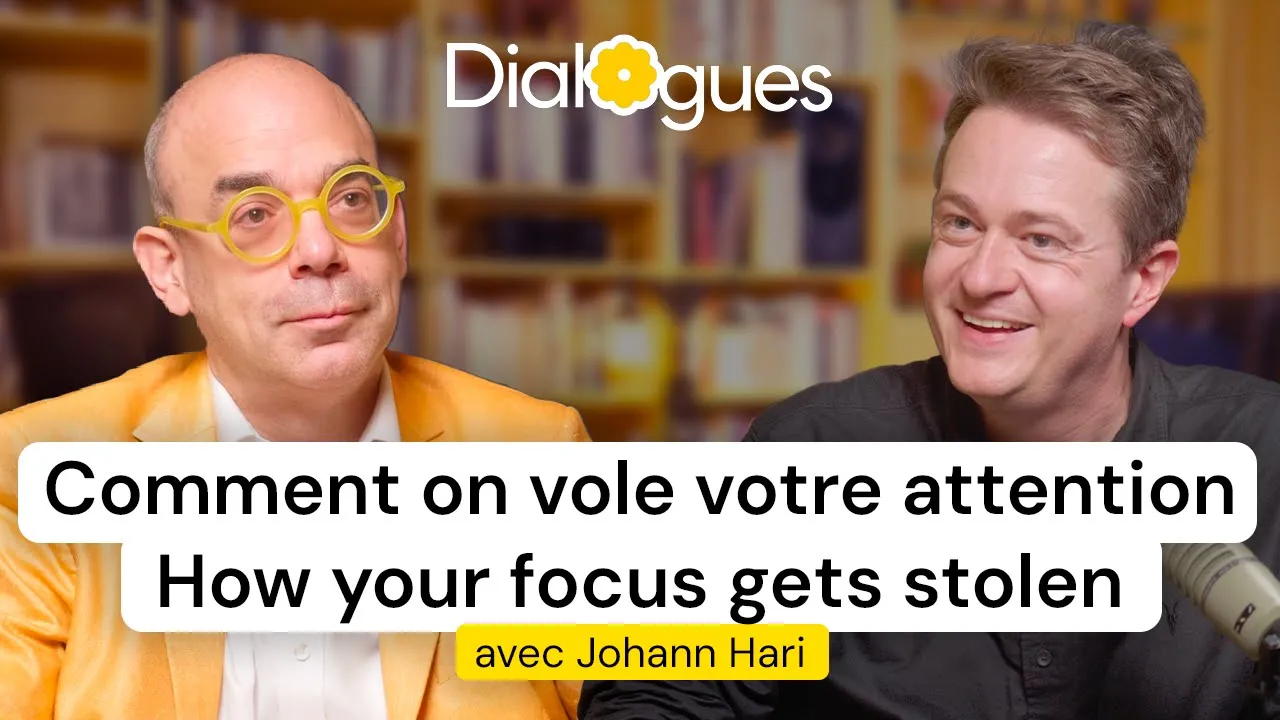
If you're struggling to focus, if your child is struggling to focus, there's nothing wrong with you, there's nothing wrong with your child. There's something wrong with the environment. Your attention did not collapse.
Your attention has been stolen from you by some very big and powerful forces. But once we understand what those forces are, we can begin to get our attention back, to some degree as individuals and to some degree as a society. When your ability to focus and pay attention deteriorates, your ability to achieve your goals deteriorates, your ability to solve your problems deteriorates.
You feel worse about yourself because you actually are less competent when you can't pay attention. Attention is our superpower, and at the moment, it's like we're surrounded by Kryptonite, right? We're surrounded by forces that are undermining our superpower.
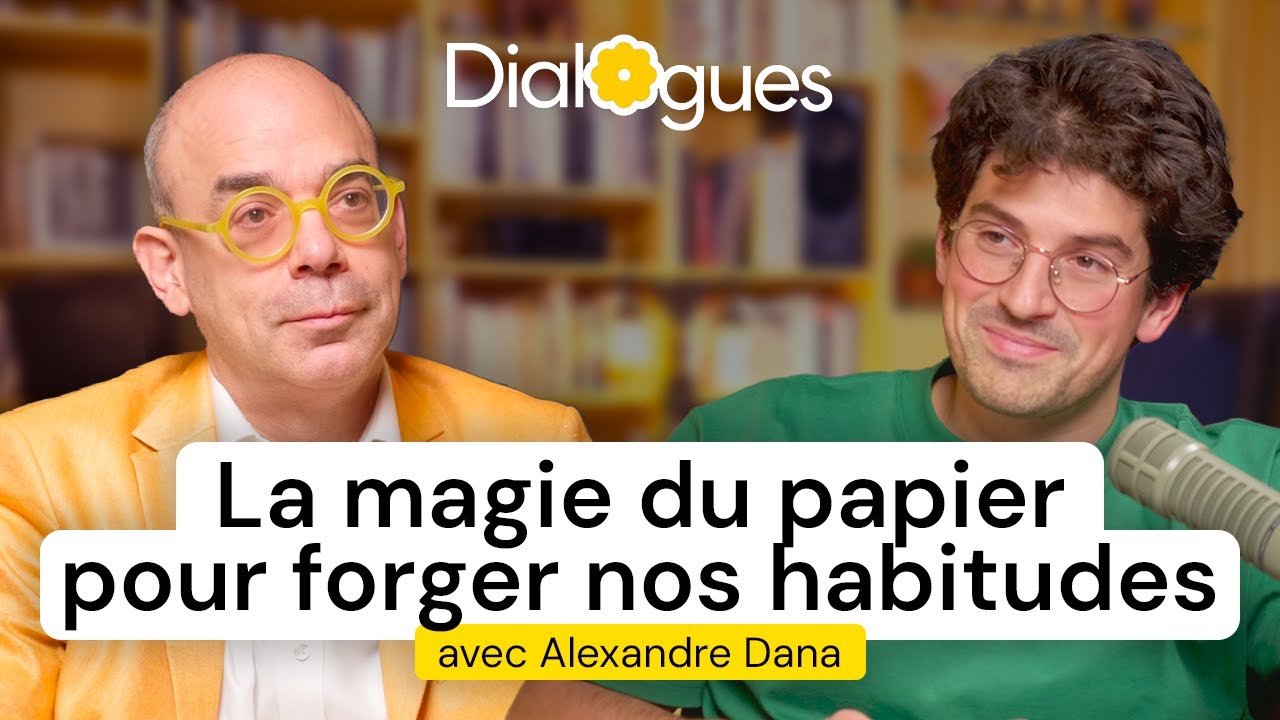
That's why it's so important that we decide and resolve to get our attention back, and to understand what has been done to us. I have to tell you this dialogue for me was completely mind blowing. I'm Fabrice Midal, a philosopher.
In this interview I received Johann Hari and what he's doing is completely surprising. He traveled the whole world, interviewing so many people to understand why we lose our attention and why that destroys our brain, destroys the way we want to achieve any project, our relationships, destroy our children, and have tremendous consequences on our democracy. You will see.
It's amazing. And he's on dialogue and is fascinating. Hi Johann, I'm so happy to be able to talk to you because I found your book absolutely extraordinary.
I've been teaching meditation for more than 20 years, and I find the way people talk about attention or mindfulness is very naive. And reading your book, it's a big survey that you have made in your book, to explain a little bit more clearly, what it means to be mindful. So we will see in many ways why I find your book so important, but maybe.
Thanks, Fabrice, I'm so happy to be with you. I'm ashamed to speak english with you. When I was a child I used to speak french but now I can only read, speaking is too difficult, I'm sorry.
So what was for you the starting point of writing your book? It was really simple. I could feel that my own attention was getting worse with every year that passed.
Things that require deep focus that are so important to me, reading books, having long conversations, even watching films were just getting harder and harder. And I was aware that we were in a kind of attention crisis. You know, the average office worker now focuses on any one task for about 45 seconds, there's been an explosion in children's attention problems.
But to be honest, I didn't want to write about it. I felt kind of ashamed. I thought the reason this was happening was obvious.
I thought, well, I'm just lacking willpower. There's something wrong with me, there's something wrong with everyone else. And there was a moment when I realized, okay, I need to look into this in more detail.
So I've got a godson. And when he was nine, he developed this brief and unbelievably cute obsession with Elvis Presley. And the reason it was so cute is he seemed to genuinely not know that impersonating Elvis had become this kind of cheesy cliché, so I think he was the last person in the history of the world to do a totally sincere version of jailhouse Rock.
And every night when I would tuck him into bed, he got me to tell him the story of the life of Elvis over and over again. And one night I mentioned Graceland, where Elvis lived, and I mentioned that people go and visit it, and his whole face lit up and he said, Johan, will you take me to Graceland one day? And I said, sure, the way you do with nine year olds knowing like next week you'll want to go to like Disneyland or the North Pole or whatever.
And he said, no. Do you really promise one day you'll take me to Graceland? And I said, I absolutely promise.
And I didn't think of that moment again for ten years until so many things had gone wrong. So when he was 15, he dropped out of school and by the time he was 19 - this will sound like an exaggeration, it is not - he spent almost all of his time alternating between his iPad and his iPhone, his laptop and his life was just this blur of WhatsApp, YouTube, pornography. And it was almost like he was kind of spinning at the speed of Snapchat.
Do you know what I mean? And he's a very intelligent person, but it was like nothing could get through to him. And one day we were sitting in my apartment in London, and all day I was trying to have a conversation with him and I just couldn't.
And to be totally honest with you, Fabrice, I wasn't much better. I was staring at my own device, and I remembered this moment all these years before. And I said to him, hey, this is no way to live.
Let's go to Graceland. And he looked at me completely puzzled. He didn't remember this moment all these years before, but I reminded him.
I said, look, let's go on a road trip all over the American South. But you've got to promise me one thing, which is, if we go, you'll leave your phone in the hotel during the day so that you can pay attention to what we see. And he thought about it because he wasn't happy living like this.
And he said, yeah, I want to do it. So two weeks later, we flew to New Orleans, where we went first, and a couple of weeks later we got to the gates of Graceland. And when you get there, and this is even before Covid, there's no human being to show you around anymore.
They hand you an iPad, you put in earbuds, and the iPad shows you around, right? So every room you go in, it says, you know, go left, go right. It tells you a story about that room.
And every room you go in, there's like an image of that room on the screen in front of you. So we're walking around Graceland and everyone is just looking at the screen, not looking at Graceland. I'm getting kind of tense.
And we got to the Jungle Room, which was Elvis's favorite room in Graceland. It's got loads of fake plants in it. And I'll never forget there was this Canadian couple next to us, and the man turned to his wife and said, honey, this is amazing.
Look, if you swipe left, you can see the jungle room to the left, and if you swipe right, you can see the jungle room to the right. And they just stood there swiping back and forth and I, I leaned forward and I said, but sir, there's another form of swiping you could do. It's called turning your head because you realize we're in the jungle room.
You don't have to look at it on the internet. It's all around you. And they looked at me like I was insane and backed out of the room, and I turned to my godson to laugh about it, and he was standing in the corner staring at Snapchat, because from the moment we landed, he couldn't stop.
He literally couldn't stop. And I went up to him and I tried to grab the phone off him. And I said to him, look, I know you're afraid of missing out, but this is guaranteeing that you'll miss out.
You're not present in your own life. You're not showing up in your own existence. This is no way to live.
And he stormed off. And I walked around Memphis on my own that day. And I found him that night in the Heartbreak Hotel where we were staying.
And he was sitting there by the swimming pool, staring at his phone, and I went up to him and I apologized for getting so angry, and he didn't look up, but he said, I know something's really wrong and I don't know what it is. And I realized in that moment we came away to get away from this problem of distraction. But there's nowhere to escape to.
It's everywhere. It's the air we all breathe. And that's when I thought, oh, this isn't a failure of willpower.
There's something deeper going on here. And that's why I ended up going on this big journey all over the world, from Moscow to Miami to Melbourne to here in Paris, to interview over 250 of the leading experts in the world on attention, and to learn about what's really causing this crisis and most importantly, how we can fix it. So the key, one of the key points of your book is if we all lose our attention, if we are all completely slaves of our phone and and of different devices, it's not because there is something wrong with this is we are just caught up by a complete industry.
It's like the obesity problem : if there is so much obesity in the world now, it is not so much that people have not enough will, it's a lot of the industry of food that conditions us to eat too much. Yeah, I think you put that really well. So there's scientific evidence for 12 factors that can make your attention better or can make it worse.
And loads of the factors that can make your attention worse have been hugely rising in recent years. So if you're struggling to focus, if your child is struggling to focus, there's nothing wrong with you. There's nothing wrong with your child.
There's something wrong with the environment. Your attention did not collapse. Your attention has been stolen from you by some very big and powerful forces.
But once we understand what those forces are, we can begin to get our attention back to some degree as individuals, and to some degree as a society. And the reason this matters so much, I would say, to anyone watching or listening. Think about anything you've ever achieved in your life that you're proud of.
Whether it's starting a business, being a good parent, learning to play the guitar, whatever it is, that thing that you're proud of required a huge amount of sustained focus and attention. And the evidence is clear when your ability to focus and pay attention deteriorates, your ability to achieve your goals deteriorates, your ability to solve your problems deteriorates. And you feel worse about yourself because you actually are less competent when you can't pay attention.
Attention is our superpower, and at the moment, it's like we're surrounded by Kryptonite, right? We're surrounded by forces that are undermining that superpower. It's why it's so important that we decide and resolve to get our attention back and to understand what has been done to us.
So it's very important to understand what is happening. Why our attention is stolen, what is happening in our society. So it's a surprisingly broad range of factors.
There's obviously some aspects of our technology, but lots of things that I didn't know about at the start. And the way we eat is negatively affecting our attention. The fact we sleep so much less is affecting our attention.
The way our kids schools are designed, the way our workplaces are designed. There's a whole array of factors going on here, but I'll just start with this, okay? With one that I think will be playing out for literally everyone watching today, right?
I went to MIT, the Massachusetts Institute of Technology, to interview one of the leading neuroscientists in the world, an amazing man named professor Earl Miller. And he said to me, look, there's one thing you need to understand about the human brain more than anything else. You can only consciously think about 1 or 2 things at a time.
That's it. This is a fundamental limitation of the human brain. The human brain hasn't changed significantly in 40,000 years, it's not going to change for us, right?
But what's happened is we've fallen for a kind of mass delusion. The average teenager now believes they can follow 6 or 7 forms of media at the same time, people our age are not so far behind them. So what happens is scientists like Professor Miller get people into labs, and they get them to think they're doing more than one thing at a time, and they monitor them.
And what they discover is always the same. You can't do more than one thing at a time. What you do is you juggle very rapidly between tasks.
You're like, what did Fabrice just ask me? What is this message on WhatsApp? What does it say on the TV there that Trump has just done?
What is this message on Facebook? Wait, what did you just ask me again? Fabrice.
So we're constantly juggling and this juggling comes with a really big cost. The technical term for it, which a term everyone should know, is the switch cost effect. When you switch between tasks, that comes with a cost, a big cost.
You remember less of what you do. You make far more mistakes. You're much less creative.
And this is a really big effect. To give you an example, somewhere in this room hidden away, I have my phone. Right.
So you can well imagine if I had my phone here in front of me, I might get a text message while we're talking. I'll just glance at my text message. What does that takes?
One second. I might even reply. Takes three seconds, right.
What's that? Nothing. There was a study by Professor Michael Posner at the University of Oregon that found : If you're interrupted by something as simple as a text message, it takes you, on average, 23 minutes to get back to the level of focus you had before you were interrupted.
But most of us never get 23 minutes without being interrupted, so we're constantly operating at this lower level of cognitive ability. This is why Professor Miller said to me, we are living in a perfect storm of cognitive degradation at the moment, and that's just one of the 12 factors that are taking place. Why?
Why is Our attention stolen? Because it's not our fault. We are stolen our attention to make money.
You nailed it Fabrice! If you can explain this because it's very important for people to understand. We eat junk food because that makes a lot of money for the industry who makes this junk food.
And it's the same thing. Our attention is stolen because that is a key factor for our whole industry, of our time. I think you're absolutely right.
There's a whole array of forces that are profiting and benefiting from the theft of our attention. But let's start with the most obvious one. I spent a lot of time in Silicon Valley interviewing people who designed key aspects of the world in which we now live.
And the thing that most struck me was how sick with guilt and shame they feel about what they've done. I'll give you an example. There's a great guy called Doctor James Williams who used to work at the heart of Google.
And one day he was speaking to a tech conference where the audience was literally : anyone watching or listening with kids, this audience designed the stuff your kids are using today. And he said to this audience, if there's anyone here who wants to live in the world that we're creating, please put up your hand. No one put up their hand.
He was like, I'm done. He quit and became a really important philosopher of attention. And the people in Silicon Valley kept explaining to me the key mechanism by which our attention is being invaded by this technology and what we need to do about it.
And it seemed to me when they explained it, it's not difficult to understand, but it took me a long time to process for reasons perhaps we could talk about. But so they explained to me, if you open now Facebook, Tiktok, Instagram, Twitter, any of the mainstream social media apps and you begin to scroll. Those companies immediately begin to make money out of you in two ways.
The first way is really obvious. You see advertising, okay. We all know how that works.
The second way is much more important. Everything you ever do on these apps is scanned and sorted by their artificial intelligence algorithms to figure out who you are and what makes you tick : what makes you happy? What makes you sad?
What makes you horny? What makes you angry? It's learning all this about you, it knows far more about you than your neighbors, because your neighbors aren't reading your private messages at 3:00 in the morning, right?
It's learning a huge amount about you, and it's learning this for a few reasons. But the most important is to figure out what to show you next to keep you scrolling as long as possible, because every time you open the app and begin to scroll, they begin to make money because you see advertising. The longer you scroll, the more money they make, because the more ads you see.
Every time you close that app, that's a financial disaster for them, their revenue stream disappears. So all this genius in Silicon Valley, all this AI, all these algorithms, when it's applied to social media, is geared to do one thing and one thing only. To figure out, how do we get you to open the app as often as possible and keep scrolling for as long as possible?
That's it. Just like, to use the analogy you used, the head of KFC may be a very nice man or woman, but all she cares about in her professional capacity is how often did you go to KFC this week, and how big was the bucket of chicken you bought? And if you become obese and you get diabetes, that's not her problem.
In the same way, these companies, the people who worked, had been at the heart of them, explained to me, are machines designed to drill and frack and hack our attention and they are unbelievably good at it. As my friend Tristan Harris said to me, who also worked at the heart of the machine, you can try having self-control, but every time you do, there are 10,000 engineers on the other side of the screen, working very hard to undermine your self-control. It's terrible.
It's sobering. But when you learn that, so the first thing you think is, well, fuck, we're trapped in the matrix, right? When I first learned that, you think, well, how are we ever going to get out of this?
But I think as I explored this more, I realized, I learned for all of the 12 factors that are harming our attention that I write about in my book, Stolen Focus, almost all of them, there are two levels at which I think we have to deal with them. I think of them as defense and offense. There are loads of things everyone watching can do immediately to defend themselves and their children at an individual level from these forces.
I'll give you an example of two. You can go online and google something called a k safe. It's just the letter K and then a safe.
It's a plastic safe. I should have brought one with me. You take off the lid, you put in your phone, you put on the lid, you turn the dial at the top and it shuts your phone away.
Locks it for anything between five minutes and a whole day, however long you tell it to. I use that three hours a day to do my writing. I would never finish my books if I didn't, and I won't have my friends round for dinner unless everyone agrees to put their phone in the phone jail.
And it is hard at first, but I always say to people the pleasure of me paying attention to you and you paying attention to me is so much better than whatever shitty email you're going to have to wait a couple of hours for. So all sorts of things like that we can do to defend ourselves. I'll give you another example.
There's apps like freedom and Opal, which you can download. You can say you were addicted to eBay or Pornhub or Instagram, whatever it might be. You can tell it.
Just don't let me look at those websites for the next five minutes, the next day, however long you want, and after that you can't look at them. I have social media permanently blocked on my phone, because I don't want people at my funeral to stand up and say, Johan spent a lot of time on TikTok. That's just not the life I want to have.
So there's all sorts of defensive measures we can take. There's dozens of them that I talk about in the book, but I want to be really honest with you, because I don't feel most people who are communicating about attention are being honest with the public. I am passionately in favor of these individual changes.
I've done them myself. They will enrich your life. They'll make things better on their own.
They will not fully solve this problem. Because the truth is, like you said, this didn't happen because you had bad habits and I had bad habits. This happened because of some very big and powerful forces.
And at some point, we have to go on offense against the forces that are doing this to us. And there's actually an example of something that happened here in France that you'll remember that I remember and that I think is a really good model for thinking about what we need to do now. So you'll remember, when we were kids, the only form of petrol of gasoline you could buy in France, in Britain, everywhere in the world was gasoline with lead in it leaded gasoline, and it was discovered by scientists that exposure to lead really screws up your brain.
And it actually is particularly bad for children's ability to pay attention. And obviously, if it was in petrol, it was in the fumes, it was in the air. We were all breathing in huge amounts of lead.
So what happened was a group of ordinary mothers here in France got together and said, why are we allowing this? Why are we allowing the lead industry to fuck up our kids brains? Right.
It's important to notice what those mothers didn't say. They didn't say. So let's ban cars.
Let's all go back to the horse and cart. Right? Just like we're not saying let's ban technology.
What they said is, let's get rid of this specific kind of petrol that screws us up and replace it with a different kind of petrol that doesn't screw us up. Right. And it was a big fight.
The lead industry was really powerful, and it followed the classic pattern of all successful political movements that was described by the great Indian leader, Mahatma Gandhi. First they ignored them, then they laughed at them. Then they fought them.
Then they won. As we know, no more leaded petrol in this country. In fact, the whole world has now banned it.
Pretty much as a result, the average French child is five IQ points higher than they would have been had that mother. Those mothers not fought for all of us. Now, to me, that's a really great model for what we have to do now.
There was something in the environment that was harming people's attention. They united politically to get that thing out of the environment and replace it with something that did the same job better. That's exactly what we need to do now with many of these factors, with our technology, with food, with many of these factors.
And I argue that we need to have an attention rebellion. We need to ask ourselves, do we value attention? Do we want our children to be able to read these books, to be able to play outside, to be able to watch films?
Do we want them to be able to think deeply? If we want that, we can get it. The steps to do it are very clear the individual steps and the collective steps, but it won't happen on its own.
Just like the lead industry wasn't going to wake up one day and go, guys, guys, we're screwing up kids brains. Let's stop doing it. They were never going to stop.
They had to be made to do it through democratic processes in the same way Facebook, TikTok, they're not going to stop. They're getting worse. You know, Paul Graham, one of the biggest investors in Silicon Valley, says the world is currently on course to be more addictive in the next 40 years than it was in the last 40.
Think about how much more addictive TikTok is than Facebook, right? We can allow that dynamic to continue and we'll become more and more degraded. Or we can decide we value attention and we can fight to protect it.
And there are lots of measures that I've seen being put into place all over the world that we can we can take to do that. But it has to start with a change in psychology. We need to realize we are not medieval peasants begging at the table of King Musk and King Zuckerberg for a few little, you know, crumbs of attention from their table.
We are the free citizens of democracies, and we own our own minds, and we can take them back if we want to. What you said seems so obvious and why so few people talk about that? Why do people accept this awful situation, why do people accept to lose their attention and like you said, lose their relations, lose their well-being, lose their way of accomplishing themselves, lose the the democracy?
Because how can you have a real democracy if people lose their attention? They just missing it. What I find very important in what you said is not only a disaster for ourselves, it's a disaster for our children and it is a disaster for democracy, for the ability to be together.
And there is a lot of blindness on on this topic. And I think one of the reasons there is blindness is few people make the connection like you make between is a problem for ourselves, but is also a problem for our society. And the way to fight about it is personal and collective.
So that one of the reasons. But why do you think we are so blind? I think there's a few reasons.
It's a really profound question. There's a few reasons. One is people have been made to think it's inevitable.
This is just how the modern world works, right? Yes. You're right.
And like you said, there is a way to make the question become make no sense by are you? You are against modernity. You are against.
And this is not the question to be for or against. It's a question to have an adult relation to this environment. Totally.
And the way Big tech and Silicon Valley want us to think about this debate is they want to frame it as are you pro tech or are you anti-tech? And you hear that and you go, look, I'm not going to give up my laptop. I'm not going to join the Amish.
I must be pro tech. That's not the debate. We're all pro tech, right?
Yes, I love tech. You love tech? Everyone loves tech.
What is technology? A paintbrush is a technology. A violin is a technology.
A laptop is a technology. What we want are technologies that can enhance our lives in the way that a paintbrush and a violin, and in many ways, a laptop does. Right.
What we want are technologies that make enrich us what we currently have in many ways, not every way, are technologies that undermine and degrade us so that a small number of people can get even richer. But our technology doesn't have to work that way. You know, James Williams, who I mentioned before, the guy who used to work at Google said to me, I'll never forget this.
He said, human beings have the axe, you know, for chopping wood. Human beings had axes for 1. 2 million years before anyone said, guys, should we put a handle on this axe?
The entire internet has existed for less than 10,000 days, right? We can fix this if we want to. So there are very clear changes we can make that will massively improve the functioning of the internet, to make it more like a paintbrush, a technology that enhances us and less of a technology that besieges and degrades us.
So it's worth unpacking that a bit, I think. Um, so the people in Silicon Valley kept explaining to me, and indeed, internal documents from Facebook that were leaked also revealed this, show that they're essentially to talk about one of the changes. There's many changes we need to make collectively and societally, but let's talk about one that relates to what we've just talked about and remind me to come back to democracy.
The point you raised, it's really important. And so there are essentially three ways that social media can be funded and paid for. The first way is the form we have now, the technical term for this, which comes from Professor Shoshana Zuboff at Harvard, brilliant professor, is surveillance capitalism.
So if you go into the App Store now and you download TikTok or Facebook or whatever, you appear to get them for free. You don't pay anything, right? But you sign up.
But in return, you pay with your privacy and your attention. They track you, they surveil you. They systematically degrade your attention over time.
So there's some advantages to that model. You don't pay any money up front. That's not you know, that's significant.
That's a real benefit. But I would argue the downstream costs to our attention and to our democracy, which we'll come back to are enormous. So that's one model of funding it.
And what lots of the people in Silicon Valley who had thought deeply about this said to me, is what we need to do to regain our attention is ban that business model. We need to say that is the equivalent of lead in the lead paint. We cannot tolerate it.
It's too degrading. Ban it. And I remember saying to them, Okay, let's assume we do that the next day.
If I opened Instagram, would it just say we've shut down goodbye. They said, of course not. What would happen is they would move to one of the other two business models, and almost everyone watching will have experience of these two business models.
So the second business model is very simple. It's subscription. Think about Netflix.
You pay a small amount of money, in return you get access. The key thing is in a subscription model, all the incentives change. If I'm Facebook and you use Facebook at the moment, all my incentives are to - you're not my customer, right?
Facebook has a customer service department. You can't phone it. I can't phone it.
The advertisers are their customers and they can phone the customer service department. We, our attention, is the product they sell to their customer, right? But suddenly under a subscription model, you are the customer.
Suddenly they're not saying, how do we hack and invade Fabrice's brain to keep him scrolling as long as possible? Suddenly they go, huh? What does Fabrice want?
Turns out Fabrice feels good when he meets up with his friends offline. Let's design our app to maximize him meeting up with people offline. My friends in Silicon Valley could design that in five minutes.
But if the incentives aren't there, they'll never do it. Right. So subscription is one model.
Well, think about another model, which literally everyone watching has experience of. Think about the sewers. Before we had sewers, we had shit in the streets.
People got cholera. It was terrible. I'm reading Victor Hugo at the moment, a lot of people got cholera.
So what do we do? We all pay to build and maintain the sewers together. You own the sewers with your fellow Parisians.
I own the sewers in London with my fellow citizens of London. And now it might be that like we want to own the sewage pipes together, so we don't get cholera, we might want to own the information pipes together, because we're getting the equivalent of cholera for our attention and for our democracies. And now you'd want to be careful about that.
It has the technical term for this is public ownership independent of government. And the last bit independent of government is very important. We would not want Donald Trump or Jair Bolsonaro or any political leader to control the internet.
There's a really great model for this, the BBC, right? Every person in Britain who has a television pays a fee to the BBC. The BBC is owned by the British people and it works for us.
It is not owned by the government. Right? It's not perfect.
BBC has its flaws, but it is the most trusted media institution in the whole world. So we've got models that work really well. Netflix and the BBC are not imaginary creations.
This is not science fiction. They're very concrete things. We can move to those models.
That's one of dozens and dozens of collective reforms that we could make that would restore our attention. But why? If I come back to my question, why altogether, most people don't really see the problem.
This will sound a bit strange, but when I think about the answer to that, I think a lot about my grandmothers who sadly died years ago. I loved my grandmothers, they were amazing people and I'm 45 years old. When my grandmothers were 45, One of them was a Swiss woman living in a village in the mountains, and the other one was a working class Scottish woman.
My grandmothers, when they were the age I am now, neither of them were allowed to have a bank account in their own name because they were married women. It was legal for their husbands to rape them. They weren't allowed to work outside the home without the written permission of their husbands.
And my Swiss grandmother wasn't even allowed to vote. And my grandmothers hated it. Sexism and misogyny meant they never got to be the people they should have been.
But my grandmothers thought, well, this is terrible, but this is just the way the world is, right? This is the way it's always been. Feminism, of course, existed in some parts of the world then, but it didn't exist in the places they were.
So they thought, this sucks, but it's inevitable. What can I do about it? It's just shit.
But now, of course, what happened after my grandmothers is a whole generation of women and some sympathetic men said this is terrible, and it's not inevitable, and it doesn't have to be this way. This is a human construct, and we can change it. And my sister has a daughter, my niece Erin, who I love.
Her life is unrecognizable to my grandmother's life. Today, if the craziest, most far right, uh, local elected official for the Rassemblement national said on Twitter that it should be legal for women to be raped and they shouldn't be allowed to vote, they would have to resign. Right.
So that's happened in three generations. It's a very short amount of time. So I think what we need is the equivalent of the awakening that happened with feminism.
At the moment, I think on attention, we're aware my grandmothers were with with misogyny. It's it's shit. But what can I do?
It's inevitable. There's nothing we can do. This is just the way the world works.
And I'm here to tell you it is shit and it's not inevitable. And we can change it. Fantastic.
And we can take on the forces that are doing this to us. Right. But that requires a very deep conceptualization and a redirection of our anger.
Right? Like I say, we need to stop being angry with ourselves and start being angry with the people who are doing this to us. And just to go back, if it's okay, to the thing you were saying about democracy, because there's many layers to the attention crisis.
You know, when you think about attention, you start and you think, oh, it's a small irritation throughout my day, you know, I went to go and get a Coke from the fridge, and I got a text message, and I was standing in my kitchen and I didn't know why I was there. And I came back and I didn't have the coke. Right.
We think about these small irritations. I can't quite finish a book the way I used to. And of course, that is a very real phenomenon and that is degrading us, and that's degrading our long term capacities.
But when you follow it up, you begin to see this crisis is playing out at every level of our society. So we're speaking a few days after Donald Trump was reelected, I was in Las Vegas that day. I spent a lot of my time in the US.
Even saying those words feels very, um, sobering. And there's an enormous crisis of democracy happening all over the world, here in France, which I'm extremely worried about in, um, in my own country, Britain. Why am I here not as a citizen of the European Union anymore?
Because my country, in my view, fell for these anti-democratic and disturbing dynamics and that this crisis is intimately connected to the attention crisis for lots of reasons. One is just very simple : democracy requires attention, right? Democracy is a form of attention.
We have to be able to think clearly and deeply about questions together. We can't think clearly and deeply in 20 seconds videos, you try making a complicated political case, you know, because the truth is, politics is complicated and you have to explain complex phenomena and, and, you know, and compromises and trade offs and difficult things. That's hard.
That's impossible to do in 20s you can do an angry 20 second Donald Trump fight, fight, fight clip, but you can't do much more than that. But also there's a deeper dynamic, which is, I think, why we need to urgently take some of the steps we've been talking about and many more that I write about in the book. So go back to what we were saying about how these algorithms work.
So the longer you scroll, the more money these companies make. So the algorithms are set up to just figure out what will keep you scrolling. They don't care what you look at, they are completely indifferent to it.
All they care about is that you look at it as long as possible. You scroll as long as possible. So the algorithms were set up to just track what people looked at.
And they discovered an underlying truth about human psychology, actually discovered by a French psychologist many years ago. It's called negativity bias. It's very simple.
People will stare longer at things that make us angry and upset than we will at things that make us feel good. If you ever saw a car crash on the highway, you know what I mean. You stared longer at the car wreck than you did at the pretty flowers on the other side of the street.
This is very deep in human nature. A ten week old baby will stare longer at an angry face than a smiling face. And it's always been part of our psychology.
But when it combines with algorithms that learn you really intimately, it has a terrible effect. So picture two teenage girls who go to the same party, and they go home on the same bus, and they both open TikTok and they make a TikTok video. And the first girl makes a video that says, that was a great party.
We danced to Ariana Grande all night, I loved it. The AI scans the kind of words you use. It'll put that video into a few people's feeds.
Now imagine the other girl opens TikTok and says in the video, Catherine was a whore at that party and her boyfriend's a prick and just angrily denounces everyone at the party. The algorithm is scanning. It knows that words that make people angry keep them scrolling more.
What do you mean? Catherine's a whore? You're a fucking whore.
You can see how it would start a fight, right? It will put the second video into far more people's feeds. Now, that is having a terrible effect on the mental health of teenage girls.
The average teenage girl in the United States now has the same level of anxiety that was displayed by the average teenage girl in 1950, when she was admitted to a psychiatric hospital. That is bad enough at the level of two teenage girls on a bus. But now imagine an entire society where the kind people, the decent people are pushed to the back and silenced or muffled and the meanest, cruelest people are pushed to the front and given a megaphone.
Except you don't have to imagine it, because we're living in a world where Donald Trump is about to become the most powerful person in the world again, where the far right is rising in France, where the far right is rising in almost every country in the world, where when the far right president of Brazil was elected, Jair Bolsonaro, what did the crowd chant at his election rally? Facebook. Facebook.
Facebook. Because they knew why he'd won. Because these algorithms had promoted him.
In fact, Facebook - and don't take my word for it, Facebook's own scientists found this. So in 2016, after Brexit, the disaster of Brexit and the election of Trump, the first election of Trump. Terrible words.
After those events, Facebook secretly set up a group of its own data scientists to investigate, to find, Did we play a role in this? And we only know this because a heroic whistleblower, Frances Haugen, leaked it. Their own scientists said, warned about exactly this effect, they said that Facebook's business model, by maximizing scrolling, inherently maximizes hatred.
They discovered that one third of all the people who joined neo-Nazi groups in Germany joined them because Facebook's algorithm specifically recommended it. And they said the only solution is to abandon the current business model. And Mark Zuckerberg responded by disbanding the group and saying, never bring me a report like this again.
Right. So you see, we've got to we've got to take on these forces for many reasons, for ourselves, for our work. You can't be a good worker if you can't pay attention, alot of my book is about that, for our children.
Everyone can see what's happening to our kids. It's profoundly degrading them. A lot of the book is about that.
But most importantly for me is for our democracy, right? We are at grave risk of, you know, when similar crises are happening in countries as different as Britain, Brazil and Burma. That tells you there's some shared underlying dynamics.
This isn't the only one. There's lots of things going on in the world, obviously, but this is a really big one. We've really got to deal with this.
We've got to save our attention for the sake of our democracies, in my view. Thank you so much. So fantastic to hear you.
Oh, thank you so much. You ask great questions. Thank you.
And your English is very good. You think it's not? But it is.
Thank you. Thank you. I'm going to steal your glasses.
I like them. Thank you so much to have follow this interview. Many of my books are translated in English.
Is one of the few times I can speak to an English speaker. Maybe that will give you the wish to read my books. Thank you so much.