So today's video I wanted to give some updates on my thoughts on publishing typical lowc content books. So things like notebooks and journals and word searches and things like that because I think some of my perspectives may have been slightly wrong in the past and I want to give my updated thoughts on this. So we'll talk about the lowc content book problem in general.
What is the benefits to publishing low content books? I'll take a look at some of my own personal results and the time that I've invested into those low content books. We'll take a look at the advertising strategy that I used.
And then we'll talk about what I would do in 2025 if I was going to be pursuing those typical low content books. So, if you're new to the channel, my name is Chris. I've been self-publishing on Amazon for over 10 years.
So far this year, sold over 13,000 units from apparently over 500 books. But that number seems very high because of what we're going to be talking about in today's video. I'm also the founder of the Rador KDP membership for independent publishers.
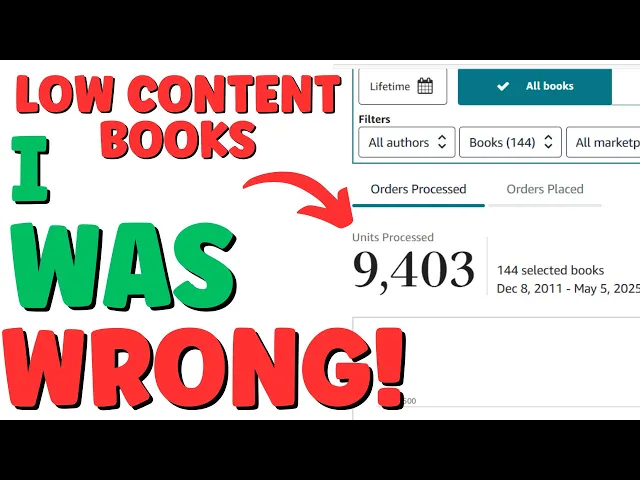
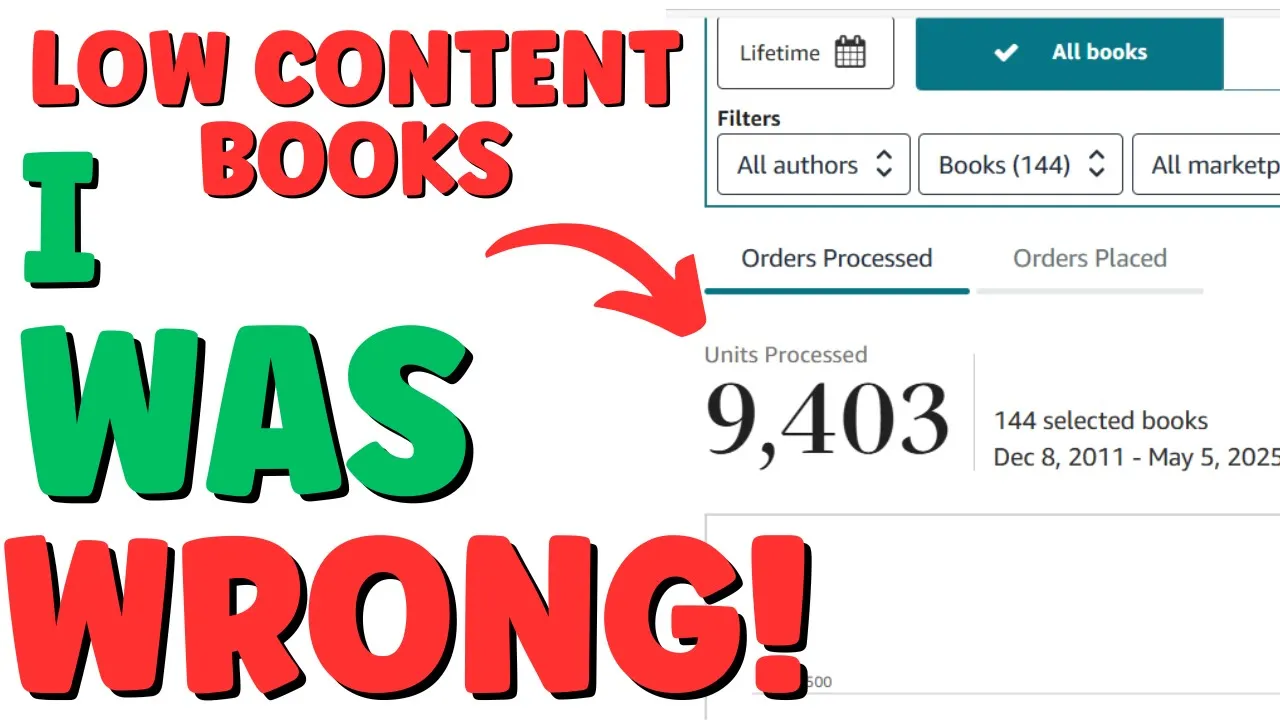
If you get a chance to check this out during or after the video, make sure you do. So, let's get into this and I'll talk very briefly about my low content book lifetime results. So, it says 144 books here.
This is closer to 400 books, I think it is. I've just filtered this here by notebooks. So, it's probably over 10,000 units sold here.
So, around 400 books published in about three months we had here. 9,400 sales in total from the ones that have been selected. 5,000 came from one book, which was a very giftable type of book that was um for made for couples, very, very low content.
The rest of them, or at least half of the rest of them, came from some composition notebooks that I did in 2022. So, these were vintage notebooks. There's tons of these on Amazon.
Um, we didn't run any advertising campaigns for the first book, the what, the giftable one that did very well because it had a swear word on the front of it. It just took off and did very well organically during Q4 and February, um, where it was Valentine's Day, obviously. So, 300 sales came from advertising campaigns for the notebooks.
I'm going to show you the exact campaigns that I set up for these as we go through this video. Now, last year, these 144 books sold 1,312 copies. It's probably a little bit more than that, but this was the the vast majority of the books that did well that were considered typically low low content.
So, most of my income, in fact, pretty much all of it now comes from selling coloring books. And I don't include them as a low content book because the low content book scene is more so kind of around things like notebooks and journals and planners and um all kinds of different weird trackers and guest books and things like that. Briefly without being distasteful, I do want to talk about what I think is the low content book problem and then talk about why I've been slightly wrong in my my own opinion with my perspectives in the past about low content books.
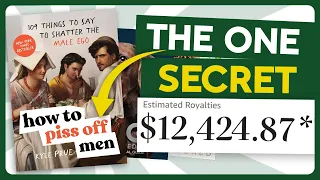
So um in my opinion, my opinion has been my opinion is it has never been the grand opportunity that it is frequently made out to be. So um mockery of an image here of course from clickbait thumbnails from YouTube videos that are just promoting software that's going to help you create the interiors for these type of books. Now there's nothing wrong with the software.
There's nothing wrong with using software. It's great to use all those um places where you can get the templates for your books. It's just the opportunity that is presented alongside of that which I think is pretty terrible and pretty shameful in my opinion.
Now, just one thing again without talking that's not what I'm about with with publishing or anything that involves making money or anything in general, my perspective has always been that you should take advice where something has been consistently proven to work for other people. Now, across consistently across every single YouTube video that is promoting a certain subscription software that helps you create these interiors across every single video, there is not a single income report. There's not a single look at the books.
There's not a single look at advertising campaigns, which makes it pretty evident that it's easier to sell the idea of this than actually doing itself. So, that's my thoughts on that. So, I'm on the fence with recommending people go after the low content niche videos on YouTube to get inspiration.
You can, but I just think all of this needs to be paired with reality and it might be a perfectly acceptable start into your publishing journey. So, what I think one of the problems is is that a huge percentage a huge percentage of people are relying on the niche to make themselves. And that's why these niche videos on YouTube do extremely well.
People like the idea of being able to publish in a niche very quickly and then make $1,000 a week. Um, obviously for most of us that have been paired with reality, this isn't the case. So, I do agree that the niche needs to have confirmed buyer interest to make it worth our time.
But that leads me on to what I think is the actual biggest problem with low content books. And just one thing, if you are feeling, if you've been going the YouTube route, if you've been publishing for a while and you feel like the domain of publishing, especially coming through YouTube videos, is somewhat a little bit shady, there's this kind of air of uncertainty as to what publishers are actually doing, what successful publishers are actively doing. I urge you to check out the the Radar KDP membership.
We have an incredible community. We have in incredible amounts of transparency. even from myself.
I showcase every single book that I release under my main pen name. Um, people can go and check that out whenever they want. People share their books inside of the Discord group where they can get tons of feedback because feedback as a beginner is the single most important thing.
Or if you're struggling with sales or even if you're more so advanced, getting feedback on what you're doing is an absolute gamecher. and we've been changing the game for independent publishers publishing these type of books. Included with the membership from day number one, if you're tired of buying extremely expensive courses, we have all the course content you could possibly need to get started with niche research, keyword research, launching your book ads, metric mastery, some case studies, and the Radog live chat.
So, every single Friday, we do a live group call. And all of those group calls, they get recorded and I tend to when I start releasing new books, I do mini case studies on the new books that I'm publishing as well. I do case studies on my best-selling books.
Um, I take a look at the how I'm building things away from Amazon, the social media side of things, the website side of things. We do tons and tons and tons um of different topics on these calls and they all get recorded and I do stay on after the calls to chat with people individually if we have time as well. That leads me on to what I think is the big problem with publishing these type of books is where is the room for being creative.
So lowc content book interiors are accessible to everyone for free for for most part people can go and get these for free. There's a lot of lowcost um platforms or services that you can use like bookb or tangent templates where you can get all of these interiors and start uploading them onto Amazon which means because so many people have been doing this it means the marketplace has seen and it's already had tested many many many many versions of these books here and of course most of them will fail and that is just going to be a fact and that is because some low content books. In my opinion, they are naturally just harder to add any kind of value to the marketplace.
So, for example, I know you can niche down and do lots of different things with word searches, but people have known about word searches, all the software that can create them for a very, very, very long time. So, it doesn't leave much creativity for for new books coming into the marketplace because I think there's only so much you can do. But I'll talk about what I would be doing in 2025 if I was publishing these type of books.
Okay? So, new books in my opinion, they need to have something that stands out versus the competition. Because while some people might get lucky, some people might get lucky with the books that they upload.
It's illogical to think that if you upload a product that is a much lesser offering than what exists already, it's illogical to think that yours is going to be the one that stands out. And that's the reality. And like I said, this is something, how do I know this?
This is something that I've tested hundreds and hundreds of books. I know people that are publishing low content books. I know people that have been successful with low content books.
And again, it's consistent across um that the things that are working for for people that have been successful are consistent across successful people. But just want to talk about why where I think I've been wrong in the past with low content books. So my stance remains the same.
I think it's hard to get into. I think it's a very misleading get-richqu scheme uh I've seen on YouTube. But I do think I've maybe dismissed some of the benefits in the past for low content books.
So one of the great things obviously that there is a low investment to be had here which is perfect for learning the ropes here. A lot of people what I have found that a lot of people are doing is that they will create one or two books. They will pump thousands of dollars into the interior, into the book cover, into Amazon ads, whilst not having a full understanding of how to do niche research or use keywords um or target niches, for example, or put some angles on their books or put some unique selling points onto their books.
And doing the low content book thing, I think, is a good introduction into publishing. And again, I'm not saying people can't make a lot of money for it. I just think it's the least optimal approach for doing so.
And again, there's lots of different niches that you can target. There's plenty of videos on YouTube that share niches. There's plenty of software that you can use to get niches as well.
You can also start testing some very lowbudget advertising campaigns for those books as well. So, when your initial investment is pretty low, that should leave a little bit of money to test some campaigns as well. You can also create lots of giftable books for Q4 and for other events like Mother's Day, Father's Day, Easter, Thanksgiving, etc.
, etc. Speaking of advertising campaigns, if people want to see the exact type of campaign that I was running for some of the low content books where I was allowed to run Amazon ads. So this is one of the advertising campaigns for the um for the notebooks for the composition notebooks 25% a cost um 1,700 clicks to 185 orders.
This is for 2022 to 2024 185 orders with a clickthrough rate of 0. 93 here. Okay.
So, what I was doing was doing your basic um lottery campaign where we put all the books of the same niche into one campaign and then just start an automatic campaign here. So, all of the books were similar. Of course, they're all just notebooks with a different variation on the book cover.
And for these, I don't feel like they would warrant an individual book launch. So, typically what I will do for the coloring books is I'll take longer to create them. I'll put more money into them.
And I want to give them the best chance possible by doing an individual launch for those books. So maybe willing to put aside $200 at least for each book that is published. Whereas in this case, all six books went into one campaign.
They had a collective budget of around I think it was like $100 that I was willing to spend. Um, and I just let Amazon do its thing. It then kind of picked up on two of the books.
two of the books out of the six were getting the most clicks inside of this campaign here. So, with the budget thing, this is very, very important. This is what I try and teach as many people as possible, especially beginners, is that you need to be monitoring your metrics as you go along.
So, even if you have a budget of $1,000, you should still monitor your metrics probably within the first 300. So, within the first 100, sorry. So, for example, what I could see early on with this advertising campaign is that I was getting good clicks to orders.
And for automatic campaigns, I like to see 1 in 10. The click-through rate is something that I don't care about that much. But the other metrics that I look to like to look at are whether I'm getting some organic sales after the first sort of two to 3 weeks.
And the other thing that I like to look at as well is the cost per click. So if you're selling a $799, $6. 99, or an $8.
99 book, in my opinion, to make advertising campaigns work, you have to get a low cost per click. So, for example, if I was getting a lot of clicks each day, like 20 or 30 clicks every single day for a cost per click of 20 cent, that would probably allow me to reduce the cost per click and continue to get clicks and sales coming in, which ultimately is going to lower your a cost and ultimately bring you toward a profit or break even, more likely a break even or a slight loss. If that didn't quite make sense, we have very short to the-p point uh course content inside of the Radoc membership, inside our ads and marketing and our metrics mastery section as well.
You can also come into the Discord group and you can get feedback on your advertising campaign. So you can post them into the ad section here and people including myself will come take a look take a look at the metrics and see if you should be carrying on running those advertising campaigns or whether it makes sense to stop them and move on to the next project which is incredibly important for every single independent publisher. You need to have a stop point for your books and unfortunately a lot of people get emotionally attached to their books.
They run it and run it and run it and lose a ton of money. Alternatively and ideally alongside that, you can come into the feedback section of our group and get feedback on your book covers, your interiors, the ideas for your niche, whatever you want feedback on. You can come and get feedback from lots of independent publishers um including myself as well, which ultimately is going to help you build a better product, which is ultimately going to help your advertising uh advertising stats going forward.
So, very important stuff. If you want to check it out, it's chrisradog. com.
That's the advertising strategy that I've used for lowc content books. It's very similar to my normal advertising strategies. So I then at this stage once we've got some data back from Amazon, we took the best converting keywords and then we started some manual campaigns for those books.
So the keywords were taking off quite well, converting quite well for two of the books. Then we set up two manual campaigns with those specific keywords for those books and they continued to perform quite well with those campaigns as well. If I was doing low content books in 2025, if I wanted to start again, I would probably start with low content books to be fair if I didn't have much to invest into the coloring books for example, which is where I love creating content.
So that's why I do it. But if I wanted if I love the low content book scene, this is what I would do for 2025 and beyond. So I'm I'm really not one to cry saturation.
I think it is a very defeist statement to make. But over the years like this business model business model has had a lot of exposure and it's been paired with a lot of misleading information as well which has led to the marketplace getting a ton a ton a ton like thousands hundreds of thousands I don't know how many it is there's so many of these books every type of low content book that you can imagine it exists it exists on Amazon YouTube videos pushing the niches niche research software they all gear people toward creating more and more of these books. So unfortunately misses out the most important part which is to add something different or better or unique to the marketplace.
So what I'll be doing, I'll spend more time on each book with a premium design and probably a higher price point as well. So for the notebooks that I were doing, the designs of them were slightly I thought slightly better than what existed on the marketplace already, which is probably why they did quite well. So, show you the exact example of how I would do things.
Um, it might be better if I explain what I wouldn't be doing first. So, for example, going after huge niches. And the reason that I say this, there's nothing wrong with being ambitious.
I just think if you're if you're new and if you really really want to make something like a generic word search work for you, then you can only really offer the best book cover in your niche. So, if you think you can beat the book cover on the screen at the moment, whether you're outsourcing that, whether you're doing the book cover yourself, then maybe you can try it. But the reality is is that most people try and get into these big niches because the the low BSRS or the niche videos and they create something in Canva.
They put it together very quickly and they just get lost in the marketplace instantly because the book just can't compete with things like this. And again, this comes down to the creativity side of things. like what can we really add to a word search that hasn't been done already.
Of course, you can do like a seasonal angle as well, but already people are doing tons of them over the years. Spring word searches, summer word searches. So, you have to really think like what can I add to a word search to actually make it stand out on Amazon's marketplace.
And no, I don't believe that you can just go make a word search, get 100 reviews for it, and that be the factor that makes your book sells. That makes your book sell. I've already seen people fail massively from that pursuit.
It just doesn't work. So, the other type of book here, these books with sayings on the front of them, they can do very well. In fact, one of my best low content books had a saying on the front here.
But what I find that people do is that they get like a notebook or a password log book or something like that and they create the exact same quote that people have done many times before. And the reason that people do this is because there are probably a few people selling with the exact same quote on the front cover, selling quite well. So, I wouldn't be doing that.
There's no point in copying what exists already on the marketplace. Even if a few people have done well with it. And again, same thing here, like these black backgrounds with these sayings on it, things I can't say out loud in meetings.
I just wouldn't do this. I'd be going just a little extra mile to try and create something a little bit better, a little bit more unique. And with the resources that we have today, AI chat GPT especially, it should be much easier than you think to create something that stands out on the marketplace.
I'll give you this example of what I what I would do. So, everyone knows about chat GPT, but what I would be doing and what I did last night when I was testing this is just to ask ChatGpt for 100 giftable niches is the first thing that you can do. Just check on Chat GBT.
I think you can probably do it with the free version. Ask for 100 giftable niches, see how they're performing on Amazon. Pick the ones that you like the sound of, see what their BSRS are looking like on Amazon, and then just go from there.
So, you really don't need to watch any kind of video that is telling you how much money you can make from a niche. You can do it through chat GPT. You can do it through your research tools or whatever.
Um, and then ideally you will assess if the niche is worth getting into, not because someone on YouTube has told you that someone is making $20,000 a month from one book. It's for me it's useless to see what someone else is like one anomaly of a person is of a publisher is doing and how much they're making. Uh what matters is you things like your budget, your attitude to publishing in general, whether you have enough creativity to make something better than what exists already.
Those are the things that really matter in my opinion. So, I would also have a long-term plan to create multiple books because I've always told people and I again consistent across everyone that's been successful, most successful people, every successful person in this domain of publishing on Amazon has a failure percentage of books. X amount of your books aren't going to work.
You test them into the marketplace and then you move on to the next book. That's the way that it has to go. So what I recommend that people do, what I recommend to people in the Radog membership especially is that you work out a system, a simple system that allows you to publish books for a long time.
So for the next 6 months for example, so you have everything planned out. Your next book is always planned out. So you have this path and this system going forward.
So just to briefly touch upon what I do for the coloring books is that I will start a new project in chat GPT for the next coloring book that I am working on. I then also in Canva create the the um exact same project inside of the Canva file and then just start working between chat GPT and Canva just making sure that things are organized between the two. And when I get the images and the ideas and the book covers from chat GPT, they go straight into the Canva file.
I pack out the Canva file with as much as possible. Then I go through the Canva file. I delete all the ones that I don't want.
Then we go and get it touched up by an illustrator. And then that's the book. But we're also working on other projects as well.
Whilst our hands are off of things, whilst the illustrator is doing things or when chat GBT is on a cool down or something, we start the next project. So we start the next portfolio. uh sorry the next project in chat GPT for the next book and then we start the next Canva file for the next book as well.
And whilst it sounds extremely simple, it is obviously it has helped me massively create more books and create them very quickly as well and stay focused on each book before moving on to the next one. Okay, so I would shoot for a premium feeding book cover, which chat GBT can help you with massively. Test higher price points upwards of $10.
Pack out the seasons with as many of these these low content books as you can and also books that are perfect for Q4 as well. And then use lottery campaigns for all the books that are in similar niches. Okay.
So to give you the exact example of what I would be doing now. So we have this from chat GBT. We have this from Amazon.
So what we have here first step was giving me 100 100 giftable lowcontent book ideas. So toward the sort of 60 mark here. We were recommended this gardening journal.
I then went over to Amazon. Went over to Amazon. This took 2 minutes to do this.
Went over to Amazon and looked for any book. Don't over complicate the criteria for a good selling book. It's mostly Create check Amazon for any independently published book that's got a really low BSR.
Really low BSR. Not 500,000, not 400,000. We're talking less than 10,000, less than 20,000, less than 30,000 maybe, but I like to go as low as possible, which means there's a ton of traffic going to this type of book.
So, I found this book here. Aesthetically, I really like it. I think it's good.
It's doing very well. It's independently published. It's got an $8 price point.
Um, it's a simple typical lowc content book. So, next thing that I'll be doing in order to make something better than what exists in the marketplace already was to observe the customer objections. So, going into the one-star, two star, three star, and fourstar reviews for all of the books that you can, all the gardening log books, and see what the customer's objections are.
And then to make your book better, you fix them. You act upon those objections and you make things better. Okay?
So, a typical one to give you an example with what I'm doing at the moment, there's a lot of bad reviews for coloring books on Amazon because they're being used uh because AI is being used and the books look like AI. So, the the reviews are pretty damning and pretty obvious. what people should be changing with those books is that you need to make your coloring books not look like AI.
So that's the reason why I I do the things the way that I do with an illustrator and AI combined for my books is because I act upon the customer's objections to make sure that my books stand out in the marketplace. Okay? So we are stacking everything you should be doing for every single book that you publish.
You should be stacking the odds in your favor, doing everything you can. Even if it's a low content book, everything you can. So, for example, we would give our books a seasonal vibe.
We would be fixing the customer objections. We'd be looking for a low BSR. We'll be looking to add additional value if possible.
So, for example, if the gardening log book that we see here had some customer objections that said, "I would rather there be some sections for money that I spent on seeds or something, then we would add that into our book as well. Also, look at creating the best cover you possibly could in this niche. Have a unique title, which I'm going to show you in just a second.
And actually think about the design of your cover as well. So, I very briefly did this last night, so it doesn't look particularly good. But what I would be creating if I saw that this garden log book was selling well, I'd want to create something a little bit more unique, a little bit something a little bit more premium and try and attach a higher price point to this.
So, for me, having a unique book title that feels a little bit smarter than what exists already. So, if we go back as an example, all of these books here, and I do the same for coloring books as well. All of these books, they just have like a keyword at the top, gardening, log book, and planner.
There's so many. There's so many. And there's so many benefits to having a unique, catchy title for your book, like plant pal.
This is obviously, but if you spent more time to think of something a bit smarter, um, there's a lot of benefits to it. So, the thing is with these book titles, my opinion on this is if someone is looking for books on Amazon and they find a garden log book that they really like and they want to buy it later or they want to recommend it to a friend or they want to go back and check your brand for other things, but they can't remember your pen name. It's much easier to remember something like the plant pow, which specific book that is, which specific book that is versus the ocean of books that are going to be called garden log book or something like that.
I just think it stands out on Amazon. It's memorable. It's marketable.
Um, I would do it for every single book. I do it for all my coloring books as well. So, this was done in chat GPT.
Doesn't look particularly good in my opinion, but you have to have a lot of back and forth with chat GPT. the the paid version to get the book covers that you want. So, I would go one step further.
And again, this is what I do for all the coloring books as well, is to pass it over to an illustrator to touch it up if there's inconsistencies or if the ratio is off, which typically the 8. 5 by11 book covers in chat GPTR. Then create maybe three versions of this book.
do a lottery campaign for these at a low automatic bid and then work, as we spoke about before, work on as many projects as possible. Now, a lot of people work on too many projects, but they're all over the place doing one thing here, one thing over there. If you can work on these multiple projects, especially the way that I've outlined in this video, you can start creating more books consistently every single month.
But of course, it's not 100% obvious for most people if their book covers are good, if their advertising launch has been good, if their niche, their angles, their ideas, their illustrator. It's very hard for a lot of people that are struggling or are beginning with publishing to know if what they're doing is good. So, it's natural, it's normal, of course, for people to start off a little bit slow and then build toward their ultimate financial goal, of course.
And the main thing here is that people progress from one book to the next in some way. You get better and better with every single book that you publish, which is exactly why I set up the Radog membership the way that I have. So, like I said, we have incredibly active and incredibly helpful community of people that are helping each other out getting to that next level, making sure that their books are of a high quality.
Um, we've even got members that have started testing lowcontent books. They've been getting a ton of feedback on their book covers. And one member recently had a number one new release for a low content book, which is absolutely fantastic as well.
And again, this is why I think it's so important for people that are struggling or are beginning with publishing is that you get a ton of feedback on what you are doing, which is exactly what the Discord group can offer for you. And again, inside of the the membership, if you're interested, if you learn through course content, which a lot of people, including myself, do we've got all the course content that you could want and of course the live calls every single Friday. I love to see the publishers, new publishers.
Um, on these calls, we do talk quite a lot about all things publishing related. Um, we tend to have a topic. Well, we do have a topic every single week.
Whether it's advertising, um, whether it's my case studies for my new books, whether it's launching your book, whatever, we do it every single Friday. And then I stay on and talk to people after the the main part of the call as well. And all of these are recorded.
If you want to check it out, you want to be part of what I think is the best place you can be for publishing, it's chrisog. com. It's linked in the description.
That's it for this video. Bye for now.