[Music] A new bombshell study reveals that traditional lurggical practices produces stronger belief in the real presence of the Eucharist. That same study also gave us new insights into the fact that fire is hot and water is wet. Some truly groundbreaking stuff.
Obviously, I say that somewhat in justest and maybe I just benefit from enough experience that this particular conclusion just seems obvious to me that I don't need a peerreview study to tell me so. But for those who do need to be convinced, I'm I'm glad that we now have this extra piece of evidence to make the case for traditional lurggical practices. Because a big culprit, I believe in this debate is that we often seem to be just relying on intuition and our own speculative assumptions.
Like does it really matter if someone takes communion in the hand or or on the tongue? I can forgive someone who who initially approaches a question like that with no prior thought who says honestly it shouldn't matter. That was my attitude for the longest time because I thought really it doesn't matter in the aggregate.
But now having seen how those alternatives actually affect reverence and piety and the significance of what we're doing. I quickly became convinced that it does in fact matter. And I'll say more on this in a second, but but let's just look at the data in the study really quick to see to see what exactly it revealed.
So, one of the first big things it says is that only 57% of those surveyed believe in the real presence. And to say that's unacceptable is just so gravely inadequate because we're not just talking about what people happen to believe about like a particular doctrine of the church. We're talking about people who participate in the church's sacramental ritual of communion.
They receive the eukarist and they do so without believing that it is what the church teaches it is. which means that they're guilty of what St. Paul calls not discerning the body of Christ in communion.
He says this in first Corinthians to which he says that they eat and drink damnation unto themselves. We talk so much in the church. We spend a lot of energy talking about stewardship of the environment, about uh welcoming LGBTQ people, about cidality, about accompanyment, and whatever other buzzwords and buzz concepts seem to be the fashionable thing to be talking about.
Meanwhile, 43% of Catholics are habitually eating and drinking damnation at mass at the very place where they should be eating and drinking salvation. I don't know how adjusting those numbers is anything less than our absolute top priority. If we were a for-profit business, we'd be having emergency board meetings.
We'd be reassuring our investors of our deepest commitment to solving this crisis. We'd be we'd be getting our best people on it. Because if we were a for-profit business, we'd have to admit that we were failing our stakeholders on the most important thing we do because the church's business is salvation through faith.
And we have pretty conclusive hard data that says that we are reprehensively derelictked in allowing people who don't have the prerequisite faith instead of gaining salvation to jeopardize their very souls literally right under the noses of our pastors. And what's worse, there are easy, painfully easy things we could do to fix those numbers. And this study just gives us again hard hard data on what those things are.
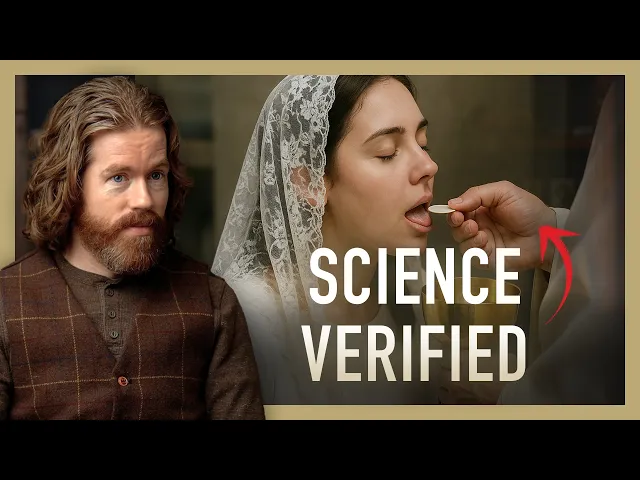
So this study by Natalie Lindamman who is a professor of psychology, she found that receiving the Eucharist on the tongue, attending a parish that rings consecration bells and a parish that offers the traditional Latin mass have a undeniably positive effect on one's belief in the real presence of the Eucharist. So it found that people who receive on the tongue and believe that you should receive on the tongue consistently expressed very strong belief in the real presence while people who believe you should receive on the hand had consistently very low confidence in that belief. The TLM was also a factor with people who attend a parish that offers the TLM having a higher likelihood of belief in the Eucharist.
And in fact, just having a positive view of the TLM meant being much more likely to believe in the Eucharist than those who had a negative view of the TLM who were quite low in their belief in the Eucharist. Which if I can just pause for a second and talk about like the liturgy wars and the debates that go on around these topics, knowing that people who insist on communion on the hand or insist on uh confiscating some of these other practices, knowing that they're more likely to not believe possibly the most essential doctrine of the Catholic creed, uh should kind of disqualify them from contributing to these conversations. that it should at least make us much more skeptical of people who advocate for these things and then try to position themselves as experts or influential people in the lurggical debates.
Okay, so more data from the study. This was an interesting one to me. People who were used to hearing consecration bells at mass were significantly higher in their belief in the Eucharist, which is amazing because I wouldn't have even thought to ask about that.
Uh the study also revealed that for people who applaud when mass is over, every time they clap their hands, it actually adds another year to their stay in purgatory after they die. Okay, so I know some people might be bewildered by some of this data. Like how does reception on the tongue or on the hand?
Or how does hearing a bell make any kind of a difference in a person's faith? There's a lot I could say about that and and I have in other videos. So, if you're up for it, maybe just go search on my channel uh for those topics.
But I'd probably summarize my argument or explanation by saying that our actions are formative in our beliefs. If if we grow up with certain habits, those habits will shape the way we think about what it is that we're doing. So, for example, uh growing up, when my family would go on a road trip, we would invariably have to stop for gas.
But whenever we did so, my dad would always get us gummy candies. And to this day, I love stopping at the gas station on road trips. My wife gets super annoyed because I often want to stop for gas even when we don't need to because I just love stopping at gas stations on road trips.
And when it comes to our lurggical practices, the goal here should be to reinforce the significance of what we're doing, right? Like how often uh do you come face to face with God incarnate? How often do you have physical communion with that same God?
The answer is if you're Catholic and you're lucky only at mass because mass is the summit of all Christian practices. Nothing rises to that level. So don't you think we should underscore the significance of it in how we comport ourselves?
When I'm at the checkout line and and the cashier gives me my change back, I hold out my hand and and they give it to me. When some package is is delivered at my house, I hold up my hands and the driver gives it to me. When the police pull me over for reckless driving and he gives me back my driver's license, I sheepishly receive it back into my hands.
In other words, I have a lot of casual everyday experiences of being handed things that I don't give a lot of thought to. But do you know what I pretty much never do? I never kneel down in front of someone with my hands clasped uh with my eyes closed and my tongue sticking out.
My older brother uh once dared me to close my eyes and open my mouth and and I learned very quickly to never do that again. So there's no other occasion in which I would reasonably do that except at mass. And because that's the only the absolute only place I do that, it ends up reinforcing how unique, how rare, how special this moment in this gift is.
This gift that I don't just take into my hands the way I do change or or uh my Amazon delivery or my demerited driver's license. Those things don't rise to the level importance that communion does. And because I treat it differently, not just in the abstractions of my mind, but in every way I conduct myself, I'm reminded in every cell of my brain how important and how rare this gift actually is.
But if when I receive communion, everything about my body language, my gestures, my attitudes, uh is similar to how it is when I check out uh at the market, um it's going to reinforce the insignificance of what I'm doing. And if I'm a kid conditioned by the habitual reception with this kind of demeanor and when I look around, you know, everyone else is behaving similarly casual, the uphill battle of convincing me that we are in the presence of God is going to be way steeper. And this was a big reason that our family started attending Latin mass.
It has bells. It has communion on the tongue. It has incense.
It does everything it can to accessorize that event and that moment, that encounter with God like nothing else you experience in your daily life because it is like nothing else. And that's the language that kids best understand. The stated goal of of the lurggical revisions was to increase active participation.
And I would add that the maybe the unstated goal was also increasing accessibility and understanding of what is going on. But whether the mass is in Latin or in English or the vernacular, kids aren't drawn to the words that are being said. Kids don't understand the homalies or the high church language, but they do understand the magic of candles and and incense and bells.
They understand that if everyone at church is dressed their best, it must be because we're honoring something or someone special. If the altar is accessorized with beautiful candles, flowers and linens, it must be because something special happens there. Kids also understand iconoclasm, which has been our tendency for the past 60 years of the church's lurggical experimentation.
This habit of of uh stripping everything down to sensory emptiness and insignificance communicates that exact thing. Nothing special to see here, kids. And kids will absorb that message long before they ever have a chance to be taught with words about what is going on.
When they watch people saunter up to communion in casual clothing, with casual attitudes, with hands outstretched like they they're just getting spare change from a cashier, they're being taught by what they see. And it's no wonder that 43% of the people who do stick around, not to mention the people the majority of people who don't stick around into adulthood, that they don't believe in the Eucharist. and are gravely jeopardizing their spiritual health by just taking it anyways.
We spend so much energy and time talking about how we can convince more Catholics of the truth of the eukarist by investing in better catechetical programs, new forms of media messaging, better homalies, inviting atmospheres, and fine like I don't want to take anything away from those efforts. But if we're doing them while completely ignoring the obviously easy things we could be doing, then we're just clearly not serious about this. And this new study is just one more confirmation that if you want to promote the transmission of this ancient faith, then the ancient practices that have stood the test of time are probably the best way to do it.
True renewal in the church and an increase in belief in the Eucharist will come through the recovery of traditional lurggical practices. And if we aren't willing to embrace them, then that says to me that we have leaders more committed to their ideological assumptions than they are to the care of souls. I pray that that we won't continue to see that kind of obstinence as more and more evidence tells us that this is simple and easy uh to renewal and eucharistic piety.
And if we're unwilling to do it, then we obviously don't actually care about those things. And if you happen to be one of those Catholics who routinely receives communion without believing, can I can I just offer some thoughts? The first would be to ask like why why bother?
Why bother showing up and ritualizing your unbelief in that way? Because here's the thing, like if you're right and the Eucharist is nothing special, it's basically just idolatry. Then why participate in it at all?
Like as a Canadian, I don't wake up in the morning and do the pledge of allegiance to the American flag because that would be weird and dishonest. Holy Communion in the Catholic Church is an action that expresses a certain belief. If you don't believe the Catholic religion, then why act out in a way that is inconsistent with what you believe in your head?
So, if you're right, there's no reason to do it. But if you're wrong, then you're playing with with fire. You're you're playing with like the with necessary being with with the uncaused cause with the the singularity of the universe and the riskreward calculation in that like what have you gained by risking offending the God who created the universe?
If you're wrong, there's a lot of reasons not to take it. So if you don't believe, whether you're right or wrong, you just shouldn't take it. But it would be even better if you did believe.
if you got educated about it, if if you got right with God, went to confession, and then received it as a true act of faith. Like, let's assume that you do at least believe in God, and maybe push push the bar up a little bit further to assume that you believe that God wants the best for you. Well, God could easily be present in something like bread using the mechanism of physical nourishment that he invented to also nourish your soul.
It's it's just not out of the realm of a possibility at all. So then the question should become, have you tried to educate yourself about why the church teaches this? Because it has really good reasons.
If not, take that time. You might just find yourself convinced. Read like Scott Han's materials or or Brent Petri's materials or do a search on catholic.
com. We live in a time when it's easier than ever to learn about it. So take that little bit of time and energy and until you do, please just stop receiving communion when you have no good reason to do so.
And for the rest of us who do believe, let's have enough courage to stop pretending like the crisis of faith in the church isn't connected to our novel lurgical practices. Lexor Randandy Lexendi is a timeless maxim of the church, which means the law of prayer is the law of belief. What you do, how you pray affects what you believe.
And this recent study is just it's one more confirmation of that fact. Let's stop talking about it and get to the work of reforming accordingly. Souls are at stake if we don't.
Okay, thanks for watching that. If you want to support the work that I'm doing, here's a great way to do so. So, if you're moving or buying or selling real estate, contact Real Estate for Life.
They have over 1,400 experienced faith-based agents in Canada and the USA because finding a home isn't something to take lightly, which is why you want to have an advocate who understands your values and can help you achieve those goals. So, if you're moving to places like Alberta, where I live, or Texas or anywhere Catholics are moving to, contact real estateforlife. org.
That's real estateforlife. org.