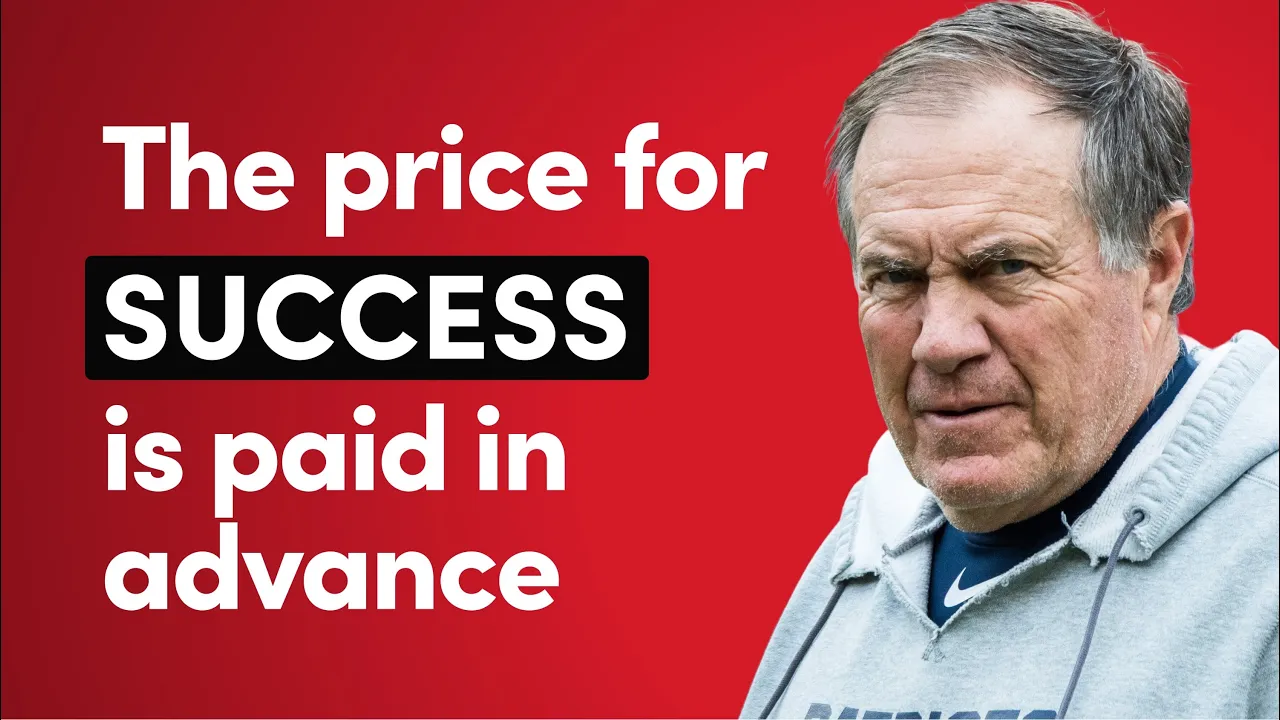
The big thing about preparation success is is the price has to be paid in advance. You have to put in the work before you get any results. If you can eliminate all those things, then you can actually make progress on being a better football player and and winning games. Was there ever a time where you kept a player on the roster who might not have made it from a talent level, but sheer work ethic sort of kept them around not Only because they were improving, but because they made everybody else prepare harder. Yeah, absolutely. Let's
start with Tom Brady. [Music] When I thought about where to start, I think the place that came to mind was the sign you had in the Patriots facility and as every employee walked in, they read these four things. Do your job, work hard, be attentive, and put the team first, right? Why did you want Everybody in the organization to read that on the way into work? Well, that's really our game plan every day. um didn't matter whether it was um a day in the offseason, a day in training camp, or the day before the AFC
Championship game, or the day of the AFC Championship game. Those things never really changed that uh we all had a job to do, whatever that happened to be. And every job was important, every member of the team was important that they do their job well. And being attentive and working hard, uh is really the formula to getting better. That's how you improve. You you figure out what it is you need to do better. And that's by being attentive and listening to um people who can instruct you or or help you get better and then putting
the work in to to make that positive change. Then always thinking team first. Um that's that's always the most important thing. What do we need to do to win? And what can I do to Contribute to the winning cause? And so regardless of what the task was, what was a coach, a player, uh a staff member, um really any employee, it it kind of fit for all of them. So, um, and again, because we played and practiced in the same facility, as I said, it didn't matter whether it was the AFC Championship game or whether
it was a a day in March or a day in June. Um, it it was the same every day. And so, we strove for that consistency. What does It mean to work hard? There was a term in your book that stuck out to me called eyewash. Working hard. Sometimes people can come in and put in their time and check the box. You know, a player can come in, put on his gear, go out, run around, break a sweat, take a shower, and say, "Well, I you know, I practiced today. I Well, but if you don't
really accomplish anything, then that really is not not working hard. It's actually we refer to it as a day off. Um, no days Off actually means, you know, you come to work and you go to work. You don't come to work, check the box, kill the time, and then leave. Uh, you need to be productive while you're there. So, um you know that it's really just a way of saying yes, we're going to put in the work, but we need to accomplish uh the things that we set out to accomplish for that for that day
and then build on those tomorrow. Was there ever a time where you kept a player on the roster Who might not have made it from a talent level, but sheer work ethic sort of kept them around not only because they were improving, but because they made everybody else prepare harder. Yeah, absolutely. Let's start with Tom Brady. Tom Brady was a fourth string quarterback. his rookie year. Uh he had three players ahead of him and um and you know he just he just worked his way up and no no team keeps four quarterbacks at any level,
high school, College, the NFL. It's it's really almost unheard of. Um and he he he would be exhibit A. Um, Steve Neil, you know, a guy who never played high school football, never played college football, was a was a wrestler in college and and then became a, you know, an offensive guard starter for us for seven years. Julian Edelman, who played uh quarterback in college and and then became a receiver and a punt returner, two positions that he never played in College in the NFL. Um, and became very good at them. So, yeah, absolutely. that
work ethic and that day-to-day improvement when you just stack those days together on top of each other for a sustained period of time. Um, you know, it levels out the talent. Um, sure talent's important, but uh, guys with a great work ethic and and who really are committed to improving can catch a lot of players with more talent who don't work as hard. Is there an example of a Player who just had outrageous talent but didn't work hard at all that sort of ended their career a lot earlier or they never made it? you know,
they got to the the big league and then they they sort of just faded away. Um, yeah, sure. I mean, there are lots of them. Um, unfortunately, uh, you know, I referred to one of them in the book that, you know, talked about coming in and being a running back and, you know, being a combination of, uh, you know, two great Running backs that were in the Hall of Fame and, you know, I think he had barely 100 yards in his entire career. So, it's uh uh you know, talent's one thing, but the application of
turning that talent into being a productive football player and a great teammate uh is is it's hard to do. It's not that easy. And and talent gets you through high school. it might get you through um college, but once you get to the NFL level, uh that talent uh that field Levels out and there are only a few players that have such elite talent that they they don't have to work very hard and can stay better than a lot of their competitors. Um, for the other 95% um, if they don't stay on it, they're either
going to get replaced or in a lot of cases, players that don't trade hard will get injured and their careers will get cut short that way because they don't, you know, commit to a good training regimen. Are competitive people Competitive everywhere? I think of like you, Michael Jordan, Tom Brady, and you're always competitive in every everything you're doing. And I'm wondering if that's a trait of hyperco competitive people or just the ones that reach the pinnacle of success. No, I think it's I think it it transcends everything. It's unbelievable how competitive guys are uh literally
over nothing. I mean, it could be for a t-shirt. Um you guys are making millions Of dollars and it's for a for a t-shirt or a um you know uh not having to run a couple sprints or uh an hour later on curfew. uh they'll compete and it and and honestly it isn't even necessarily for the prize at the end. It's just to be able to say, you know, I won. I competed and you know, I I beat you today. Or um even if they don't win, just the the love of the competition, the the
love of the prize, uh and and fighting for that, the the pride to say, "Hey, you know, um we would have a lot of team competitive events like u for example, trivia, you know, or know your teammate." um and you know ask questions about different teammates of um you know maybe what position they played in high school or maybe another sport they play or you know some other random fact about teammates and and play offense against defense or the wide receivers against the DBs or the O line against the Dline and the rookies against the
veterans and You know create different competitions and uh whether it was free throw shooting or cornhole or trivia uh or you know all different things like that. Um guys that like to compete love to compete and and um it was a lot of fun actually to to move some of the targets around for the competition. Um you know some guys are good at free throws, some guys are good at trivia, some guys are good at uh you know uh closest to the hole golf shots, you know, whatever it Is. Um but it's just fun to
see him compete. One of the best things we did, Shane, was we would have usually one of our rookie offensive and defensive linemen uh would compete against each other and to catch a punt, right? And so you put a a you know, an offensive tackle and a defensive tackle back there and and uh you know, you go one at a time and the punter would would punt and you know, we'd make sure that it was at least 4 seconds hang time. So, you know, The ball was up in the air and then um whichever, you
know, whichever guy caught it first um then that group would win and the other group would have to do extra sprints or the group that won would get out of bed check or you know, whatever it was. But it was a good way of team building because all the players were rooting for their their guy who had never caught a punt in his life probably, right? you know, watching Vince Wilfork and Matt Light back there Catching punts, uh, you know, trying to track the ball and catch it and and of course I made him punt,
you know, so the returner had the sun in his eyes, uh, you know, had to deal with that. Uh, but, you know, to watch those guys do something they hadn't done before for some type of a reward, uh, was, uh, you know, it was a great team building exercise and and, um, they but they they do they love to compete. competitors are the guys that really love to compete. Um, you know, are honestly the guys that get the most out of their talent, you know, because they just are are determined to work hard, prepare, and
and go right to the very end. They might not be as talented as somebody else, but they they play and compete, you know, to the max. You mentioned The Last Dance in your book. What What was your reaction to watching that? I mean, I thought it was awesome. And you know, Jordan's one of the greatest competitors in any sport Ever. And um you know, just just, you know, his competitive spirit is, you know, up there with the guys that he played with like Lawrence Taylor at North Carolina. Those guys, they still compete all the time
on the golf course. So, um I I thought it was, you know, a great insight into it. You know, Brady's a tremendous competitor. Julian Edelman, Bruski. Are you talking about Brussi came back from a stroke and and continued to play, you know, some of Those guys. Rodney Harrison, it's just it's it's at an elite level, which it should be in the National Football League, but it's just at an elite level. Most people think the key to a successful business is the product. But often the real secret is what's behind the product, the systems that make
selling seamless. That's why millions of businesses, from household names to independent creators, trust Shopify. I'm not exaggerating about how much I love These guys. I'm actually recording this ad in their office building right now. Shopify powers the number one checkout on the planet. It's simple, it's fast, and with Shop Pay, it can boost conversion rates up to 50%. I can check out in seconds. No typing in details, no friction. It's fast, secure, and helps businesses convert more sales. That means fewer abandoned carts and more customers following through. If you're serious about growth, your commerce Platform
has to work everywhere your customers are. Online, in store, on social, and wherever attention lives. The best businesses sell more, and they sell with Shopify. Upgrade your business and get the same checkout I use. Sign up for your $1 per month trial at shopify.com/nowledgro. All lowercase. Go to shopify.com/nowledge project to upgrade your selling today. Shopify.com/nowledge Project. Most people don't think about their inbox as a system, but I do. Email used to be the thing that helped me run my business. Lately, it felt like the thing getting in the way of it. I'd spend too much
time weeding through low priority messages trying not to miss the one or two that actually mattered and it was draining my focus. Then I started using Notion Mail and everything changed. Notion Mail is the inbox that thinks like you. It's automated, Personalized, and flexible to finally work the way that you work. With AI that learns what matters to you, it can organize your inbox, label messages, draft replies, and even schedule meetings. No manual sorting required. I've created custom views that split my inbox by urgency and topic so I can focus without distraction. And I use
snippets to fire off my most common emails, follow-ups, intros, and scheduling without rewriting anything. The best part is it works seamlessly with my Notion workspace and is powered by Notion, the tool trusted by over half of Fortune 500 companies. Notion is known for powerful connectivity, intuitive functionality, and the ability to supercharge productivity. Get Notion mail for free right now at notion.com/nowledge project and try the inbox that thinks like you. That's all lowercase letters. Notion.com/nowledge project to get Notion mail for free right now. When you use our link, you're supporting our show, too. Notion.com/nowledge project. I
think one thing that surprised a lot of people when I talked to friends who maybe casually follow sports, um it was how much, you know, Jordan's teammates had maybe a not love relationship with him always. And do you think that's true? you know, I wasn't around him enough to, you know, to Comment about that, but um I I think if you don't really like to compete that a top competitor will kind of wear you down and it kind of um I don't want to say resist to it, but you know, just to resist to compete
at that level. Um so I I have seen that from time to time, but the guys that really love to compete love to compete and they just join in there and and compete with them. One of the things you you said in the book is you you cannot win until you keep from Losing. Richie reminds me of inversion from Charlie Munger. What what does that mean in a football context? Oh boy. Uh where do we start? Um anything that anything that prevents you from achieving your best um that you control. So it's not the opponent,
it's it's something that happens internally. Examples would be um you know guys getting uh suspended for uh performance-enhancing drugs or guys that uh uh wouldn't hydrate and would pull Muscle, you know, pull a hamstring, pull a grind, pull a calf, uh because they weren't fully hydrated. Those aren't that's not Buffalo. That's not the Jets. That that's us. That's us. And in the game, um, I'd say two of the biggest examples, well, there's a lot of them, but let's start with penalties. Um, pre- snap penalties. So, penalties that happen before the ball snapped, those are our
fault. You can't blame them on the other team. False start, illegal Motion, too many men on the field, delay a game, like all that. That's that's our inefficiency. That's not our opponents. And really, for the most part, post- whistle penalties, plays that happen after the whistle bl is blown. hitting a guy out of bounds, taunting, illegal celebration, you know, stuff like that where uh you just get carried away emotionally in the moment and and cost your team. You know, personal fouls, roughing a pass or roughing a punter, Stuff like that that that really happens after
the play is over. Those are examples of of beating yourself. You know, you can't win until you keep from losing. Those plays aren't because of what the opponent did. those plays are because of either our lack of concentration, communication, discipline, whatever it happen to be. And I'm not just putting it on the players, I'll put it on the coaches, too. You know, that's our responsibility Um to eliminate those. Um and other things, turnovers, for example, when when the offense turns the ball over uh and the defense doesn't make a good play, it's just the offense
fumbling a snap, fumbling a hand off, ball goes off the receivers's hands, uh pops up in the air, and the defense intercepts it. uh plays like that that don't have anything to do really with good defense. Um the offense just gives the ball away. You know, snap the ball over the guy's head, The quarterback's head, snap it over the punter's head, drop the snap. Um stuff like that. Just plays that are poorly executed by us. So, as you can see, it's a long list, Shane. Uh some of them are off the field and some of
them, you know, some of them are on the field. You know, in college football, it' be, you know, being academically ineligible. I mean, that's, you know, that's not your opponent's fault. That's, you know, that's that's a lack of commitment and And u, you know, doing the required academic work to be eligible to play. So, those would all be examples of you can't win until you keep from roo. If you can eliminate all those things, then you can actually make progress on being a better football player and and winning games. I remember reading something a while
ago, but the difference between um being beaten and losing, and it sounds like what you're saying there is kind of hinting at that. Yeah. Oh, absolutely. Uh, you know, we've always said more games are lost than one in the National Football League. And when I say lost, I'm saying those type of things. Missed opportunities, um, missed assignments, um, poor clock management, just just fumbling the situation more than the other team, um, you know, really really playing well to win. A lot of times if you just kind of get out of the way and let the
other team make a mistake, they'll Make one and and you can capitalize on it and take advantage. Now, not all the time. again, you know, as you go deeper into the season and play play better teams and playoffs and things like that, that happens less frequently. But, um, in a lot of close games, when you go back and really look at the way the game the outcome of the game was, the team that lost really probably should have won or or had had many good chances to win and and just kind of messed it up
And uh, more than, like I said, the winning team going out there making all these spectacular plays. So again, the big thing is, um, you know, number one, keep from losing, and number two, make the plays you're supposed to make. I mean, sure, there's some great plays out there, but before we get to the great plays, let's just make the the plays that, you know, you're supposed to make, just the the regular ones, the normal ones, and that's execution, Concentration, uh, and discipline to to do it all the time. You tell your players to focus
on that the drawer to help them focus on what matters. What is the drawer and how does it help? drawer is a um was a saying that that we used to uh especially at the end of the year like as you get into the holidays, Thanksgiving, Christmas, New Year's and then the playoffs u you know the end of the season's in sight and wherever you Are you know you've put in you know all the work back into the spring training camp you know 10 12 14 regular season games whatever it is and now you're really
coming you know coming down the home stretch and and the drawer was just a way of saying, um, unless it's a a family or personal thing that's really important, um, put it in a drawer, dealing with it after the season. You know, you do you need to go to sign these cards at the mall? Do you need to, Um, you know, go look for a new electronic, whatever it is? Uh, can you put those things aside and just finish the season? Spend that time on preparation for our opponents. Spend that time on um, you know,
rest, recovery, training so that you're your absolute best when we really need you here in these last few stretch weeks. And and as you know, you know, Shane, when you get to a certain point, every it's a one game season. You know, if you Lose, you're done. And if you win, you get to play another week. So when you get into that scenario, put it off until next week. And if you're in it next week, put it off until the week after that. Um, but this is what we've worked all year for. Put those things
in the drawer and then and then open the drawer when the season's over. Now, we would joke about it and, you know, guys would say, "Hey, coach, you know, my drawer is getting pretty full here." Um, so, you Know what, maybe you need a bigger drawer or maybe you need two drawers. Uh but the idea was to to put those things um on the back burner and focus on on the very special opportunity that we had in front of us which was playoffs or or championships. One thing that seems to have evolved since you started
coaching is that time becomes more fragmented now. Players have cell phones, they have more distractions there. You know, I don't have an hour to sit there and do a Meeting. I have all these competing things for my attention. How have how have cell phones changed the locker room culture and made coaching easier or harder or technology in that way? Well, first of all, we don't have cell phones and Apple watches and things like that in our meetings. So, that they're they're not part of the meetings, but when the meetings are over, you know, a lot
of times the guys race to see what, you know, messages and texts and so Forth are there. Um, you know, and my thing on that has always been, again, other than, you know, family and and very personal situations, um, you know, the guys that are most important to to each of us are the guys in that locker room. You know, the guys that you, um, you know, win and lose with and live and die with each day and that you count on them and they count on you. So, uh, it was really very important for
us to to focus on those relationships. And I I Tried to downplay the, you know, how many likes or thumbs ups or whatever you get on different social platforms. I don't even know what those are. Um, but what's more important is what the guy next to you thinks about you and the respect that that you guys have for each other and the trust that you have in each other and and that's something that, you know, in a you know, on a football team, you you just you earn every day. um every day you come to
work Uh as a coach, you know, you earn the trust and respect of your players and and your other coaches by being prepared by showing that you're there to help the team and you can help the team win. And again, it's the same thing for every player. And and when you earn that every day, you build that trust and and you build a cohesive team. And when you don't, you know, those are the players that again that other players don't don't trust as much. Is he going to run The right route? Is he going to
be at the right depth? Is he going to block the right guy? Is he going to be in the right gap? And and that causes uh when you don't know what your teammate's going to do, that causes a lot of hesitation on your part and you're kind of waiting to see what he's going to do instead of knowing what he's going to do. And then you can aggressively do your job because you're confident of the people beside you. And um I learned a Lot about that with the um especially with the Navy Seals, those elite
teams. I mean, you know, Blue Angels would be another example. you know, those guys fly 18 in apart. And, you know, the amount of trust and preparation and and teamwork that's involved in something like that going, you know, 600 m hour, 7, whatever it is, um, is is pretty amazing. But, you know, the SEALs, it's the same thing. Like, everybody's got a job to do and and you learn your Teammate so well that you can even in a dark room, uh, you know, pick out his, you know, his silhouette or or something about him that
identifies him. and and you know each of you count on each other to do their jobs and accomplish the missions and um you know that's obviously that's at the highest level football we're not talking about life and death here but we are talking about the championship level of performance of having that same type of trust and and Um and belief and and confidence in your teammates so that you're never questioning what they do and you can be more aggressive and in in doing your job and there's never that look over your shoulder of is he
where he's supposed to be? You know, if you know he is, then then you can perform better. So, um those are kind of the, you know, the themes that we we try to instill there. I remember talking to a Navy Seal once and he said, you know, when things get Hard, you're doing it for the person next to you when you want to quit or when you want to give up or how much of that is in football, too? I think there's definitely a carryover on that. you're, you know, you're you're playing for the team,
but you're playing for the guy beside you, too, you know, and and uh especially in a sport like football or in a real battle situation like like the Seals are involved in. Um, you know, you're talking about potentially getting Hurt or, you know, or or or worse in a SEAL situation where you know that guy beside you like you have to count on him to to do his job to and you do yours for the same reason to protect each other. one in one of your most famous press conferences, you said Snapface or something and
I I literally spit out my water when I heard you say that. I was listening to the about social media. You're like Snap Face or whatever the hell it is like. Yeah. Well, I've Battled those social media platforms and uh and and now I'm actually on one. So, um you know, college football is uh has kind of changed that a little bit. I mean, I'm not too active on it, but I am on it. But um but again, look, I don't really have anything per se against social media. It's just, you know, prioritizing it and
and as I said, I think that in a football locker room, the relationships between the players, the team, and the coaches are are Paramount uh more so than people you've never met or seen or or heard of before, what their opinions are. And so I always, you know, try to encourage our players to um, yeah, not be too consumed with that, but, you know, worry about the guy next to you. That's the one that matters the most. How is technology changing the way that players prepare and the sense of, you know, the story that comes
to mind is sort of Jaden Daniels last year using VR to get more Reps. H how walk me through how technology is changing and where it's really impacting uh, people who are willing to put in the work. Yeah, that system that Jaden Daniels uh was referring to is one that he used at LSU and and then uh also used at with the commanders last year. Uh it's actually one that we have as well. It's it's uh one that's very hard to get. It's only available very selectively and and so I'm pretty familiar with it. Um
and it's An incredible system. It it enables you to see the game, you know, in a pair of goggles um in real life, in real space. And it it actually feels like you're getting hit. It feels like um you're you're right in the middle of the game, but you're actually able to see things um what you do and then you can program in what your opponents do uh to create a a very realistic picture. And then you're also able to adjust the speed. So you could actually play the game at Let's call it 105 or
110% of the actual speed. Um so that theoretically you're you're having to react even quicker than you would in in a real game situation. So, um I can see, you know, how that could really help, especially uh for skill positions, uh like quarterback or um um you know, positions like like that where you can you you you have to see a lot of things uh very quickly and and identify quickly what you know, what decision you're going to make. That's True of every position, the quarterback especially when you talk about distributing the ball. Um and
and also for a player who's um who's injured, um so let's just say that you had a leg injury and you weren't able to to practice uh or run full speed for a couple of days. Um you could actually see the game through this product and get your recognition, your reads without actually having to run and and you know be involved in a in a Situation uh that physically you're just not you not ready for. Um, but I'd say a lot of the other technology is just, you know, things that maybe make it go a
little bit faster, ways of grouping plays together, grouping situations together that, you know, allow you to to research and and u analyze those things a little bit quicker. But that's probably about across the board about the same for everybody. They all we all have the same opportunity on that. I Mean, ultimately a lot of those situations come down to preparation, but also maybe a gut feel of the way the game is going. You said in your book, the price of success is paid in preparation, but you also said it was a way of working. What
did you mean by that? Well, I think the big thing about preparation success is is the price has to be paid in advance. You have to put in the work before you get any results. So, there's no way to to honestly know How good your preparation is or isn't. Um, that's why I always try to emphasize, keep preparing, keep working. Um, you don't know what the other guy's doing. He might be, you know, working just as hard as you are. And and that preparation, you know, it can't be after the fact or like, oh, I
wish I would have studied more. It's too late at that point. You have to do it on the front end. So, um, getting in condition, um, you know, studying, preparing all your Film and your opponents and all that, like those things are are all have to be done on the front end. And, you know, a lot of times, uh, there's, I would say, a little bit of a tendency to just sort of let up on the preparation. Well, I've watched some film. Well, I've done some extra sprints. Well, I've done this, I've done that. Well,
is but is that enough? You know, is it really enough? And, and if you do more, will it make a difference? um not to the point of Diminishing returns but to the a point of you know comprehensive preparation. So um that that's really what we try to try to um uh emphasize on that. The way that I think about that is sort of that you know the pain of losing is sharp but it's over fairly quickly. But the pain of regret not putting in the work not doing the things you didn't leave it all in
the field that lasts forever. Exactly. That's exactly it. The pain of regret is much more than than the pain Of preparation. Absolutely. I think you had a 24-hour rule sort of after win or losses, you have 24 hours to think about it, and then you you move on. Is that That's right. Yeah. You play the game, you go back, you analyze it, you what do we do well? What do we do poorly? What do we need to do better? What adjustments should we have made? What coaching errors did we make? And so forth. And and
then you you factor all that into, you know, how does that Affect us next week? Sometimes there's a lot of carryover. Sometimes the play team you play the following week is completely different. And some of those lessons may not really become applicable for a week or two weeks or three weeks until you see a, you know, a similar type of opponent. um say like a scrambling quarterback, you know, maybe you play two or three weeks where those quarterbacks aren't too mobile and when you get up against another scrambling Quarterback, you go back and look at,
hey, how, you know, how how do we need to to handle this better uh against this type of an opponent. So, um but yeah, you look at all those things after 24 hours, win or lose or draw, uh you you take your lessons and and you decide how you're going to incorporate any of those things into this week's preparation and practice. uh what we're going to do differently or maybe do more of or do less of whatever it is. Um and then You're done with that and you move on to your opponent and and spend
the next uh 5 days, 6 days, whatever it is of just, you know, digging in on that opponent and and what they do. Talk to me about the relationship between the best talent in the world and, you know, you're playing in the NFL, you're coaching in the NFL and confidence. Well, again, it's all relative, you know, Shane. I mean, as good as um as good as as the players are in the NFL, um the guys on The other side of the ball are pretty good, too. And um you know, I'd say every team, generally speaking,
every team has about, you know, five or six players that are elite, have elite payments, elite contracts. M and then you might have some younger players in their first through fourth year, you know, two or three, four, whatever those that are elite players that just haven't hit those top contracts yet. Um, but they don't necessarily match up in the Same position. You might have a tackle, I might have a guard, you might have a linebacker, I might have a a corner, and so forth. Um, so u the way those elite players match up is is
very um specific from game to game and how you want to match them. your your matches against theirs and how you want to deal with that is, you know, that's a big part of it. I think the confidence thing is really um interesting. I think what really separates the great players um is Their ability to do it even when the bull's eyes on their back every week. Um like it was with Tom Brady, like it was with Lawrence Taylor, like it is with Patrick Mahomes, um like it is with, you know, players like that, Lamar
Jackson and so forth. Every week the the teams are geared towards stopping those players and game planning against them or putting their best guy on them or or however they're going to handle them. And for those players to continue to be Productive um in spite of the game plan attention they get is is what truly makes those players, you know, great and elite. And I I think that um you know when we had Kobe Bryant come in and talk to our team I think it was around 8 2018 19 somewhere in there and you know
Kobe talked a lot about evolving you know and he said um you know look at when I was 22 23 you know I could just get the ball and drive by anybody and and score and he said I can't do that anymore. I still Score, but I found different ways to score, moving without the ball, jump shots, and, you know, being better in pick situations and all those kind of things. Um, that, you know, he said, I found I found ways to evolve my game um because I just couldn't do the things I used to
be able to do as well. Um, but there are other things I found that I can actually do better. And I thought that was a great message for all of us to hear that as we Um you know as as we go through our careers, do the things that are working, do the things that you can do well, but also evolve, continue to learn, continue to you know, find ways to to be productive that are maybe a little out of your comfort zone or um are not um you know, habitual for you now. But if
you can become good at them, um they can be great, you know, great tools for you. Are there any other people that you brought to speak from sort of different Sports that sort of had a different message that resonated with you or the team and just stands out in your mind? Oh yeah, we had a lot of them. Yeah, we had a lot of them and and it was great because you know just the guys you know I hear a lot of football stories but it's good to hear all the ones. Uh, one of the
ones I thought was particularly entertaining, couple of them, one was, uh, Paul Asiante. They won like 14 national championships in a row. They Won like60ome games in a row, matches in a row. I mean, and at the Patriots, we were favored in almost every game, you know, not every game, but most every game for quite a while. And so, you know, I brought coach Asante in. I said, you know, here's a guy that's won like 13 straight national championships. They won 16ome matches in a row. I mean, he talked about being favored now. Like, they're
favored and and and like let's Listen to what that's really like. And he was great. He talked about it. It doesn't matter whether you are or aren't or how many you have or haven't won. Every day is an opportunity. You make the most out of each day and you just get better each day and you don't worry about what you've done in the past. You just you look at today's opportunity and make the most out of it. It was great. So, one of our co one of our players sticks his hand up and said, "Hey,
Coach, I have a question." What's squash? I thought it was a vegetable. Hey, Jimmy Johnson, you know, we were going into the playoffs and and Jimmy came up and he was doing a um you know, a story on somebody and I said, "Hey, would you mind, you know, talking to teams?" Said, "Sure." So, he said, "Yeah, let me tell you a little playoff story here." You know, when I was in Dallas, we were getting ready for the Playoffs and we were in a special teams meeting. I'm standing in the back and I see I see
one of our one of our players back there kind of dozing off and and not paying attention and he said he wasn't a he wasn't a starter but he played in special teams and he said it just really annoyed me and so I went over I flipped on the lights turn the lights on in the meeting and I went over to him I said that's it you fall asleep in this meeting uh we don't want you This is your primary job you take your playbook and and go see the general manager you're done you're cut
and everybody like whoa you know that that woke everybody up and you know it was right before the playoffs. So, you know, any questions? Um, yeah, coach. Um, what would you have done if that had been Troy Aman? Jimmy said, "Well, I wouldn't have turned on the lights. I probably would have gone over to him and nudged him and Said like, "Hey, Troy, pay attention." And the message was if you have a lot of pelts on the wall, you you you might have a little more slack. If you don't have a lot of pelts on
the wall, you don't have any room. You don't have any room. You can't live on what you've done because you haven't done enough. You better know where you are. And until if you're Troy Eggman and Tom Brady, you you he go but he goes, "Those guys would never do that Anyway." But you that you might be able to survive that. But if you if you don't have that kind of resume, you haven't had that kind of production for this team. So you nobody wants that. You're replaceable. They'll find somebody else who will stay awake in
the meetings and who will be more attentive. And uh it's pretty funny. I'd just nudge them and say, "Hey, pay attention." I think a lot about systems, how to build them, optimize them, and make them More efficient. But efficiency isn't just about productivity. It's also about security. You wouldn't leave your front door unlocked, but most people leave their online activity wide open for anyone to see. Whether it's advertisers tracking you, your internet provider throttling your speed, or hackers looking for weak points. That's why I use NordVPN. NordVPN protects everything I do online. It encrypts my
internet traffic so no one, not even my ISP, can See what I'm browsing, shopping for, or working on. And because it's the fastest VPN in the world, I don't have to trade security for speed. Whether I'm researching, sending files, or streaming, there's zero lag or buffering. But one of my favorite features, the ability to switch my virtual location. It means I can get better deals on flights, hotels, and subscriptions just by connecting to a different country. And when I'm Traveling, I can access all my usual streaming services as if I were at home. Plus, Threat
Protection Pro blocks ads, malicious links before they become a problem, and Nord's dark web monitor alerts me if my credentials ever get leaked online. It's a premium cyber security for the price of a cup of coffee per month. Plus, it's easy to use. With one click, you're connected and protected. To get the best discount off your NordVPN plan, go to Nordvpn.com/nowledge project. Our link will also give you four extra months on the 2-year plan. There's no risk with Nord's 30-day money back guarantee. The link is in the podcast episode description box. Most of us are
overpaying for phone service without even realizing it. Why? Because from everything I've seen, Mint Mobile offers the value most people overlook. Premium phone plans for just $15 a month on the nation's largest 5G Network. All plans come with high-speed data and unlimited talk and text. Most people stick with their provider out of habit, but if you looked at your monthly phone bill the way you'd look at any other recurring expense, you'd probably switch. With Mint, you can keep your existing phone, your number, your contacts, and cut your monthly cost to a fraction of what the
major carriers charge. No contracts, no hidden fees, just smarter service. This year, skip Breaking a sweat and breaking the bank. Get your summer savings and shop premium wireless plans at mintmobile.com/nowledge project. That's mintmobile.com/nowledged project. Upfront payment of $45 for three months. 5 Gbit plan required, equivalent to $15 a month. New customer offer for the first 3 months only. Then full price plan options available. Taxes and fees extra. See Mint Mobile for details. Did you treat everybody the Same? I remember one story and maybe it's just uh sort of the press doing the press thing, but
where you sent uh Jerrell Rivas home from practice cuz he was like 2 minutes late or something. Oh, we had a few of those. Yeah, we had a few of those. And honestly, those are tough ones, you know, Shane, cuz when you send a player home, it it hurts the team. It it doesn't just hurt the player, it hurts the team because, you know, you need the timing and and the Communication and the teamwork out there. But I try to treat them all the same. But I I do think Jimmy Johnson I believe that and
and coach Parcels uh you know same thing. Yeah. Did the same thing. There were um certain players got a little more grace than others based on um you know what they had done for us and and they I would say kind of earned that. So um I tried not to do that but there were times when you know when I did but I tried to treat everybody the Same even though they're not all the same. Uh but you certainly want everybody to feel that, you know, we're all team members and it's not um you know,
we don't have an elite society here. We have different ranks and certain players can do some things and other players couldn't. So I try to make it as consistent as possible, but at the same time, uh I think you have to be flexible in in a professional football environment for some latitude and and Maybe for some it's called exceptions to your rules. You sent one player home from the Super Bowl for having somebody in his hotel room. Was that a hard decision or was that a How did you make that? Was that team first and
you violated the rules? You're you're out or you know, I made it very clear before we went down there that, you know, it was a business trip and yeah, we had a great year and and we were all celebrating the the Super Bowl and and uh and what we Had accomplished to get there. Uh, but here are the rules and and you don't have to break the rules. Go to the other person's room if you want to be with them, but our floors are secure and and at the Super Bowl in particular, there's a good
reason for that. Um, you know, with Super Bowl tickets and and guys with valuables and stuff like that, if it's not one of our players on the floor, I don't know whether that person is a friend of our players or an Intruder. There's really no way to know. when no matter you know I mean unless I knew the person for some reason but you know what I mean you just don't know who that person is so our policy was players only on the floor period that's it and so um you know it was unfortunate because
I wasn't trying to say hey you can't have guests or you can't you know be with your friends or your your companions or anything that wasn't it just don't do it on that floor do it Somewhere else I don't care And and again, I was trying to protect the players by not having people on our floor that we didn't know uh that could roam in and out of rooms or could, you know, and and if you don't if you don't remove those people, then you end up with, you know, potentially somebody leaves their room, then
that person walks in and then you have a big mess on your hands. So that was our policy, not just in that game, but everywhere. But Unfortunately um because that game was you know we were there for 5 days um I just felt like it was a a blatant violation of our rule. I want to come back to confidence for a sec. One of the follow-ups I meant to ask was there ever a moment where you had your confidence shaken and how did you handle that? Oh plenty of times. Um I I mean honestly Shane
there were times when you know I I wasn't sure if we were Going to win another game the entire year you know and you know we ended up winning a lot of them you know but sometimes you just see um problems and and maybe you want to fix them but you just don't have the resources to fix them or you've tried a couple different things and it still isn't really uh the way you want it and you can see in the future or some real problems coming up with your opponents and some matchups and whatever
the case might be and and You're like I mean I don't know like I I mean I'm trying to fix this but I just don't feel very confident that that we actually are going to be able to handle it the way we need to. And u and ultimately you know in most cases um it wasn't maybe as bad as what I thought it might be. I was expecting the worst and and that usually didn't happen. So, that's a good thing. But, um, yeah, I don't know if that's a lack of confidence or or I don't
what the Exact word is, but yeah, you definitely have those apprehensions. And certainly opening day is a is a is a difficult day because you don't know very much about your team. You don't really know very much about your opponent's team. Um, and and unless you have a really veteran team, you don't know exactly how the team is going to react in certain situations, particularly tough and critical and competitive situations. Um, so, you know, even though you have a Good team, how are they going to react when, you know, you're really in a in a
really a tight ball game? And that's that's something that you don't know until you've been in a few. Unless you've been in a few with those guys and it's the same guys. When you first started in the NFL, you worked for nothing. You were you worked part-time for nothing and then you switched to full-time for nothing. Yeah. And one of the things that you said was, "I did anything and everything." And I think of this as like a taste for saltwater. You do the hard things, but you were snapping the football, but you were like,
"Oh, the benefit was I got to listen to the coach talk to the QB." and and walk me through like how that's changed today and what people miss when they hyper specialize. Well, I think one thing that that I see with, you know, some of our younger staff members, coaches, and things like that is they're They're very concerned about their title. You know, can I be the can I get this title? Can I get that title? And the coaches of, you know, can I be the run game coordinator? Can I be the blitz coordinator? Can
I be the zone coverage coordinator? Can I be the I mean it's like what are those titles for? Like they don't impress me. I know what your job is. I mean do you need that title to you know validate what you're doing or is it for somebody else and I'm not Really interested in helping somebody else. I mean we we all know what we do here. I mean honestly I was a general manager um for almost 30 years of my NFL career and I never had a general manager title. That was never important to me.
um doesn't care about what the title is. You just you do the job that you have to do. So I see that. But for me, when I look back at it retrospectively, um Shane, the big thing was I was so low on the totem pole that I did all the jobs At the very bottom of the organization. I shot film. I lined the fields. I moved equipment out there. I ran off Xerox copies. I, you know, made notebooks. I sharpened pencil. I did all those things. And as you move up in the organization, it really
helped me because I understood how everything functioned, you know, at the, you know, at the at the level of, you know, making things work, you know, deliveries and, you know, mail and stuff like that. I Mean, all those things that needed to happen. Um, I understood kind of the process of it, how it worked and what was hard about those jobs and what wasn't hard about those jobs. And and as I, you know, gained more responsibility in the organization, I was always able to show appreciation for the people that were doing those like, "Hey, I
know this is really hard." Or, "Hey, I know this is a tough week. I I could sense what you're going through." And and I think That built some, you know, camaraderie and trust there, but also it helped me understand how everything worked. And there were multiple times when people would come to me and say, "Oh, coach, we can't do this. You know, we can't do this. We can't do that." And I say, "Wait a minute. I've done that job before. We can do that. Here's how you do it. here's this is how you make this
work. And and so I I felt very confident about all the aspects of the Organization, how they fit together and you know scouting and coaching and like I said equipment and video and security and travel and all those things because I was a part of those um in one form or another at at different points in my career. So, I I think, you know, for a lot of of people, you know, when I talk about we need to start at the bottom and you really need to understand how the organization works, there's a lot of
I want to skip those steps. There's I Want, you know, I just want to jump up and and coach the line linebackers or the tight ends or whatever it is. And like I that's okay, but it would really help you to understand what happens in the entire organization. And if you want to really move up and become a coordinator and a head coach, those will be very valuable for you because you'll understand, you know, the the different uh intersections of of various departments and how the organization Works and and where the conflicts are, you know,
and sometimes there you just, you know, kind of two people doing the same thing or nobody doing one thing and you you miss that intersection somehow. And and that's just part of it. But you know how do you avoid those and how do you make that more efficient? So um I really try to encourage our our the younger people you know to do those jobs and embrace them. Don't how quickly can I get done with this so I can go do Something else. No, embrace the job and embrace the process and and you know understand
it because it's going to help you in the long run. And the other thing is, you know, as I mentioned a couple times in the book with um you know, Josh McDaniels and Nick Asacerio and Brian Dable, um if somebody has one of those jobs and they're really good at it, and they say, "Well, I want to move you. You know, I want to move to more responsibility." And I said, "Well, I Want you to move to more responsibility, too. But first, you got to train somebody to do your job because what you're doing is
really valuable." And that's when Brian Dable hired Josh McDaniels to replace him. And that's when Josh McDaniels hired Nick Cacerio to replace him. And so, uh, but it forced those guys to make sure that the person that was replacing them was not only good, but they trained them to do the things the way they needed to be Done. And, and that really heightened our efficiency, but also enabled them to move up to uh, responsibility, move up in responsibility. And so, um, that really worked out well. I was, you know, uh, I thought that that was
for me that was a good way to handle it because those guys were very invested in making sure their replacement did a good job cuz they knew they were going back to do that job if if that person if their replacement failed. A lot of people when You ask them to do sort of the unglorious task, they just look at you and say, "That's not my job." Yeah. Yeah. it's not my job or or I'll get to it, you know, tomorrow or I'll get to it next week or whatever. And those are, you know, I
I mean, I don't like to have those type of people, you know, around. And sometimes it's it's inevitable. You have to put something off. I mean, I get that. But, um, the Quicker you get it done, the quicker you can move on to something else and be more productive and, you know, the more you procrastinate it, then, you know, it it just slows everything down. So, um, there's got to be a priority system. I mean, I'm fully aware of that, but, um, you know, but people that want to put stuff off and and kind of
hope that it won't need to get done, um, they didn't do very well in our organization. One thing you mentioned that stands out to Me, I think of this like stepping stones where people have a job, but they see it as a stepping stone to the next job. So, they're never fully present in the job that they're doing because they're always looking ahead. And those people don't actually tend to do very well at the next level. Absolutely. And and like I said, then they miss some of the things that they really need to understand at
the level that they're at. And again, that's just part of do your Job, you know, that's just part of it is is everybody has an important job to do. And if you're trying to do somebody else's, then you're probably not doing yours well enough. And um you know be patient and you know your your opportunities will come um as long as you know you show that you can handle the responsibilities that you currently have. But you're right, a lot of times there's a big rush to move ahead and and that um a lot of times
also brings Sloppy work, incomplete work um and honestly just a a feeling that I don't not really confident promoting that person because you know they're more interested in what they are going to be doing than what we need to do right now. How would you define discipline? Discipline is is is doing the right thing over and over again. Doing it every time. It's just continuing to do it every time. In the National Football League, The players are very skilled and talented and and I would say, you know, all of them can do something. Um, they
can all go out there and produce, you know, plays at a very high level. Um, the discipline is what is what really separates the players is their their consistency and their discipline to do it over and over again. Um, so you can count and depend on them. um you know at at a very high at high rate. Are there any stories in your mind that stand out About discipline or consistency involving players you've coached? Well, I mean I told the story of Edelman, you know, catching balls before the Super Bowl, tennis balls and stuff like
that. I mean th those kind of things that um you know that players do. They have a routine and you know if a guy's played 8 n 10 whatever years um if they skip a day in their routine I mean is it going to be the end? Probably not. But they're just so disciplined and so consistent to Just continue to do it. Uh and maybe even do just a little tiny bit more um to to make sure that they're prepared for the game. uh especially the big games that um that's that's just who they are.
So I mean I I really I really respect that. But you know it's it's a little bit like the shopping cart you know um when nobody's looking are you going to take the shopping cart back and put it in the you know where it belongs or just leave it there in the middle of The parking lot. And it's the same thing with a really disciplined uh player and teammate. um is is he going to be disciplined to you know go in and get treatment after practice um you know even though it's 2 days before Christmas
or you know whatever it is where is he just disciplined to not let something get in the way of of his productive routine and that's um you know the the guys that do that um I would say have for the most part have had very long and Productive careers and and the guys that haven't have careers that that go to a certain point with talent uh but they don't have the same the same kind of uh longevity and consistency uh of a player like Matt Slater or Devin McCordi or Tom Brady or guys like that
that people keep saying you just keep waiting for those guys to drop off. Well, they're a year older, they're a year older, they're a year older, but you don't see the drop off because their routine and their and Their discipline is so consistent that they're able to they're able to sustain that level of performance um you know, far longer than really what the expectations in some cases are. Do you believe you can motivate people and if so, how? Oh, I think you can definitely motivate them and and it depends on the person. I think there
are different types of motivation. Um, you know, we could, uh, there were times where I think you could really, you know, Motivate a player by just, you know, flat out challenging them, um, based on something that, you know, somebody else said or intimated or something that might have happened in the past. Uh, I think you can, you know, motivate people by, um, uh, you know, especially, you know, sometimes maybe a more selfish type of player, you could motivate by, you know, making him see, uh, what the reward is for himself as opposed to the team.
Um, an example I like to use, Shane, is if you have a receiver and you want the receiver to come in and block on a running play and come in and block a safety, which is a hard job. Um, you know, some receivers don't really want to do that. They're really not too excited about that. They want to catch passes. Um, but if you say, "Well, look, if you come in and block this guy, um, and we need you to block him as a team. We need you to block him. You come in and block
this guy. Um, then the next Time we come in and and you'll do the same thing, but fake it and we'll be able to throw you a a pass when the defense comes up and solve the play." Well, the player's not coming in to block him because you asked him to block him and we really need you to block him. Um, Julian Edelman would do that, but not everybody would necessarily do that. Uh, but when they understand, okay, if I come in and do it this time, that opens up an opportunity for me the next
time. Uh, then they might do it right. And so now I get what I want, he gets what he wants. Um, there's some management and motivation in there, but in the end, um, both parties are able to accomplish their goals. I get the team goal, the player gets the individual goal, he sacrifices for the team, but for the other reasons. Um, so uh I again I think there are different methods of doing that. It really depends on you know how the player is wired and and Maybe what circumstances you know you can use. Certainly when
you've lost to a team previously um that's a pretty good motivator for for most of these guys um because you know you you take those losses personally and since we lost as a team that is everybody it's not you know one guy got a pass caught on them or one guy got tackled or I mean it's it's a full team loss so a lot of times you can you know you can generate a lot of um uh energy towards your opponent by um you Reference in that, you know, that that loss or situation that might
have happened in a previous encounter. As a leader, how did you know when to be hard on players and when to sort of back off? And I'm thinking, you know, when a player makes a critical mistake in a game and they know they've made a mistake, what's your role in that moment? Well, again, Shane, I think it depends on the mistake. You know, if it's um sometimes, you know, something That kind of unexpectedly happens and maybe the player made a bad decision or maybe he did something that, you know, he's caught that pass 100 times
and and he's dropped it once and this is the one time. Um, you know, some of those are are a little easier to handle. Um, I'd say the ones where, you know, you've told the player 10 times, this is what you need to do when this happens, and then they don't do it. I'd say the reaction is a little bit different in That situation. You know, how many times do you have to be told and you know what, maybe maybe you know, you just don't want to do it. We'll put somebody else in there to
do it as I can see that you know, you're not you know, you just don't care enough to to follow your assignment. So, um you know, it kind of depends on those. I I think one of the biggest things in football is correcting mistakes and we all make a lot of them. Um but when during the game when time is Of the essence and and you don't have much time um you need to figure out what went wrong pretty quickly and fix it. So uh let's say defensively we came off the field and we'd given
up a 20 yard run um and maybe a 15 yard pass and another third down conversion and you say okay I like what are the issues on these plays? Well, let's say the 15 yard run would be if one person knows that that they messed the play up and just says, "Hey, it's my fault. I messed it up." Like, That was we were in good shape. I was right there. I shouldn't have made the tackle. I just missed the tackle. I'll make that play the next time. Well, great. That clears it up for everybody. We
all know we're going to do the same thing we did the last time. and and this time I know that you know my teammate's going to make the tackle versus um you know kind of a blame game where I was here I you I don't know I should have been there and should I do this and Should I do that and was I too deep and this and that and then it's you know what's the issue how do we fix it right and so if you know you did something wrong just own it all right
admit it and and let's move on um sometimes it's not that simple sometimes you kind of have to figure out Well, I did what I thought I was supposed to do. You did what you were supposed to do. He did what he was supposed to do. We still had a problem. Okay, now that needs to be fixed. And So, um, but again, identifying mistakes and fixing them quickly is really the name of the game. And and if as a coach, you know, when I would say, um, look, that was that play was that was a
bad call. I shouldn't have called that defense against uh that personnel group or against that formation. Uh, that's my fault. It's on me. I'm not going to do that again. Forget about that play. It's not going to come up again cuz I won't call it again in that situation. Okay. Well, then all right. Well, so stop worrying about that play and let's worry about something else. So, owning up to those mistakes and and making the corrections is key. If you don't know what it is exactly, then then that's when you have to figure it out
pretty quickly, whether those are players or coaches or some combination. Because if you don't, you're just going to keep, you know, you keep dealing with the same issue over and over again. And you know, None of us want that. When I say the words on to Cincinnati, what does that mean to you? On to Cincinnati. Well, it it first of all means it was a long night in Kansas City. Um, you know, we got we got totally beaten in that game. Um, out coached, outplayed, out everything. They were just a far superior team than we
were. And as a head coach, you have to look at that and say, you know, I didn't have our team, you know, where they should have been. And we didn't play well. We didn't do anything well and it starts with me. Um, but that game's in the books. It's over and there's nothing we can do about it. We can't get it back. So, we just got have to move on to Cincinnati and make sure that we don't perform next week like we did last week. You know, don't let one game become two bad games. Don't
let it become three bad games. Don't let it become a habit. Um, change the things that we need to change. So, um, we Played Cincinnati the following week and, you know, our players, uh, did a great job of putting the Kansas City game behind us and focusing on what we needed to improve on and and and do better and get ready for Cincinnati, who was, you know, a very good football team as well at that time. And so, um, you know, we're able to do that. And you know, it it became, you know, one of
those one of those catchphrases, but uh really the idea of it was move on and Let's start getting ready for next week. It's kind of similar to the situation we had in uh 2001, uh Shane, where we buried the ball. You know, we we lost to Miami. We we didn't play very well. Obviously didn't coach very well. And we came back and, you know, we just took the team out there. I got a shovel. I dug a hole. I took the ball. Uh, you know, we we put it in the ground. We put the dirt
on the ball. We stomped on it. We spit on it. We kicked it. We, you Know, took our frustrations out. But that was the funeral. Game's over. It's done. We lost. Buried the ball. Buried our feelings. Move on. I'm not saying that was, you know, this great thing, but visually it it sort of the point of it was put the game out of your mind. It's over. We've had the funeral. Life goes on. I've heard you say we're building a team, not collecting talent. What's the difference? The difference is it's so it fits together so
that the That the team is functionally as efficient as it can be. Um not just a bunch of guys wearing the same same uniform uh with different numbers, but um a group of people who function well together, you know, as a team. And when you think about football, um Shane, football is a is a team of teams, right? You you have the offense, you have a defense, you have a hands team, you have a punt return team, you have a nickel defense, you have a dime defense, you Have a goal line offense, and so forth.
You have all these teams and they all come together to form one championship team. And so, you know, the idea is whichever team you're on, um, you need to be the very best team that you can be in that situation. If it's a hands team, if it's a punt return team, whatever it is, like that is critical to our success. and you have your responsibilities on that team. I have my responsibilities on some different Teams, but ultimately we all come together and and those shared responsibilities and those shared teams um so that we can operate
together functionally as a team are are really what we're trying to accomplish. So, it's not just getting a bunch of guys who, you know, can do have good skills um and can run fast and jump high or whatever. I mean that helps of course but they have to be able to operate as a team and as a team of teams and you know A lot of that is a mentality is a willingness to uh to communicate and work with and and efficiently uh cooperate with your teammates so that collectively we can accomplish our goals when
when our units out on the field. How has coaching changed in the past five years? You know outside of rules changes and and things like that. um uh you know there are some trends and you know I think as look when you're on defense You have to react to the offense right if the offense have three has three tight ends on the field you're not going to be playing the same defense that you have when they have three receivers on the field. Um, so defensively a lot of what you you have to deal with now
you can say look we're going to play the same thing and make them adjust to us but I mean there are certain matchups that just become um you know difficult to to sustain that philosophy. So um Again what I'd say is it's important to defensively be able to adapt to what the offense is doing because ultimately you don't control who they put on the field. You just have to stop them. you know, offensively, um, you know, you take the talent that you have and try to make the most of it. So, um, I would say
in college football, which is where we get our resources from in the NFL, um, you know, some of that's a function of of what's available, you Know, what's coming out, uh, what they're teaching in college, what type of players they're developing, um, because that's really what you have to choose from. So, I do think there are some trends, but fundamentally it it really comes down to, you know, having good solid fundamentals um and doing the little things right that will enable you to win your one-on-one matchups. And I'd say I don't think those have changed
um too dramatically over the years. Uh on The way out of the building, you had a sign that read, "Ignore the noise, manage expectations, speak for yourself, and don't believe the fuel or hype." Can you walk me through those? Yeah, absolutely. Absolutely. Um, well, speak for yourself is is, you know, pretty obvious. Um, you know, if you have any comments to make, just make them, you know, personally, you know, don't say things like, "Well, Shane's looking really good This year. I mean, he should probably have 15 sacks the way he's he's rushing the passer, you
know, and start making expectations and predictions for other people, things like that. Ignore the noise. I mean, there's so much um airtime that's filled uh whether it's uh on the radio, on the internet, on TV of people talking about football, all right, and players and matchups and everything. And again, with all due respect, and and look, I've been part of That, too, so I understand. But, um you know, with all due respect, the the people that talk about it haven't been in our building. They haven't watched us practice. They haven't watched us prepare for the
game. They don't know what our matchups are. They don't know what, you know, they don't know what our game plan is. Um, so with all due respect, what they say as it relates to us, it doesn't matter. If other fans want to listen to him, I mean, that's Great. But, you know, when they say, well, you know, Shane Parish has got to shut down Bellich or they're going to lose, that's, you know, it's just hot air. So, ignore the noise. is just ignore what other people who aren't really know don't know what they're talking about
are saying and focus on what the people in our building in this room are saying what your teammates are saying how they can how you can communicate with them how you can Anticipate a play and and help them react to it and that kind of thing um you know don't feel the hype you know when things are going good I mean people can't wait to you know you're 3 and 0 and they're selling Super Bowl tickets and they're already talking about, you know, repeats and all this stuff. And our thing was, don't don't add into
that. If other people say it, we can't control that. Once we say it, now now we have to own it, you know. And so, uh, Bellich says, you know, um, uh, we should be in the AFC Championship game and we've only played four games. Well, then everybody else has to react to that. Shane, what do you think about what Bellich said? Tom, what do you think about what Belich said? Grank, what do you think about, you know, you it just creates a distraction. So, um, fueling the hype or believing the hype that four games into
the season, we're talking about an AFC Championship game Is, you know, ridiculous and it's just way too premature. So, you know, don't deal with that one. What was the last one? Ignore the noise. Don't feel the hype. Speak for yourself. Manage expectations. Manage expectations, right? And so like what are realistic expectations this week? It's to beat the team we're playing. Like our focus is on beating Buffalo this week. That's who we play. That's where we're at. Um you know, in terms of winning the Division, you know, which is eight weeks away from now. Don't talk
about man win the division. Like that's not an expectation. We can't achieve that right now. Even if we wanted to. It's only the fourth game of the year. Now, if this was the game to win the division, then okay, let's talk about winning the division. But until we get to that point, you know, manage the expectations. The expectations are have a good day today, have a good week, and To win this game. Those are our weekly, you know, am expectations, you know, not where we're going to be in January, who we're going to play in
the playoffs, or um again, managing expectations of like, oh, this guy should go out and, you know, he should have 200 2,000 yards receiving. Why don't you just worry about what you're going to do and, you know, stop talking about what other people what your expectations are for them? that's speaking for yourself, but That's also uh managing expectations or or a player saying, "Well, I expect to, you know, I expect to go to the Pro Bowl." Well, is that your goal to go to the Pro Bowl or is our goal to win a championship? And
let's go back here for a minute. You know, what what are our expectations? Like, let's let's think about what's first things first. Put the team first, you know, and that's, you know, team teammate, self. That was the Whole, you know, um, progression of, you know, trying to put the priorities in order for for each of us. I want to end, uh, I usually end with one question about success, but I actually want to change that a little bit here and flip that around and I want to talk about the Atlanta Super Bowl. You're down 28-3.
And the thing that astounded me as a fan, uh, who's watched a lot of football and a lot of games, uh, was that nobody was sort of like hanging Their head. You know, you look at Brady on the sideline, you're down 25 points and he still had confidence. Yeah. You know, Shane, it's funny. Sometimes you play a game and you feel like you have control of the game, but you don't have control of the score. And that was that game. Um, I felt like we had pretty good control of the game, but we didn't have
control of the score at all. There are other games where you have control of the score and you don't have control of The game. you know, maybe you're ahead by 10 points, but you know, they fumbled, they threw an interception, you got a lucky break and and you're ahead, but you really haven't been able to move the ball. You really haven't been able to stop them. Um, they've just fumbled it away a couple times and and you kind of maybe got a lucky play to to, you know, get your points and so you feel like
you don't have control of the game, but you're ahead on the scoreboard. And What you really want, of course, is to have control of the game and control the score. Um but in that game we had a real confidence at halftime when it was 21 to3 that um you know we given up a touchdown on a third and goal from the 12. We gave up a pick six. We fumbled going in. Um you know we missed some opportunities uh to you know maybe be tied or could have even been ahead in the game at halftime
107 or maybe 1010 something Like that. And so, yeah, the score was bad, but we felt like we were had control of the game. Well, then they go out and score, make it 28-3, and now I'm thinking, you know, we might have control of the game at 25 points is a lot to make up. And and there's a lot of things that have to go right. Um, so two two-point conversions and a strip sack and two kickoffs where we tackled them inside the 15 yd line, so they couldn't get Into field goal range. um and
another sack and another holding penalty and literally everything went right for us in the last, you know, 20 minutes of the game. There was no lack of confidence because we actually felt like we had control of the game. We were moving the ball. We were playing good defense, but we just had a couple of bad plays in there that that skewed us and skewed the score. Um but once that kind of settled down, you know, we we were okay. And um And then once we kind of got rolling again, we had some plays that we
needed to make and and we made them, you know, um on both sides of the ball handling the kicking game on those kickoffs. So, um everything had to go right and it did and we were very fortunate in that one. I really appreciate you taking the time today, Coach Bellich, and thank you for writing uh The Art of Winning. I loved reading it. It was a great read. Thanks, Shane. I appreciate it. Thanks for the Opportunity to be on. Uh it was a pleasure. enjoyed speaking with you and um I look forward to catching up
down the road. You know, I just would be remiss if I didn't, you know, say how much uh you know, Michael Lombardi has contributed to to my career and indirectly to this book. I mean, a lot of the things that that we talk about and I talk about here are things that I share with Mike or that Mike helped me do and um you know, it's great to be Able to work with Mike uh you know, at North Carolina. Um but he's a um a great motivator, very well organized, uh very efficient, and you know,
is an excellent partner to, you know, to build the program down there. So, um I really appreciate all of uh not only Mike's help, but his guidance and and you know, his uh the daily coach and and the um you know, the motivation that he puts out on a daily basis is something that, you know, we all uh look forward to and Enjoy at Carolina. I'm looking forward to getting down there and watching it again. I look forward to having you, Shane. It's rookie year. Uh he had three players ahead of him and um and
thanks for listening and learning with us. Be sure to sign up for my free weekly newsletter at fs.blog/newsletter. The Farnum Street website is also where you can get more info on our membership program, which includes access to episode transcripts, My repository, ad free episodes, and more. Follow myself and Farnum Street on X Instagram and LinkedIn to stay in the loop. If you like what we're doing here, leaving a rating and review would mean the world. And if you really like us, sharing with a friend is the best way to grow this community. Until next time.