I still remember the exact moment everything changed. The office looked the same. The humming of computers, the stale scent of printer paper, the morning sun casting golden stripes across my desk.
But nothing was the same. Because the man who now stood in front of us wasn't my boss. He was my boss's son, and he had just inherited the company.
Good morning everyone," he said, clapping his hands together like he was starting a motivational seminar. As of this morning, I'm the new CEO. A polite, scattered round of applause followed.
I didn't clap, not because I was bitter, at least not yet, but because I already knew what kind of person he was. I had worked at Hamilton Tech Solutions for 17 years. I was there before his father even bought the building.
I had helped build the infrastructure, wrote the very code the company ran on, designed the internal systems, and trained every new IT staff member myself. I wasn't just an employee. I was the backbone.
But to Jason Hamilton, I was just another face in the crowd. An outdated relic from a time he wanted to erase. His father, Richard Hamilton, was nothing like him.
Richard was old school but fair. He believed in loyalty and he appreciated dedication. He wasn't a tech genius, far from it, but he knew the value of the people who made things run.
When his health started declining, he stepped back and left the company in good hands. At least that's what he thought. I watched Jason as he strutdded through the office like he was doing us a favor by existing.
Designer suit, hair sllicked back, jaw tight with smug ambition. He had a point to prove and unfortunately that meant cleaning house. Some changes are coming, he said with a fake smile.
Efficiency, optimization, streamlining, the usual. Some of you may not fit into the new vision of Hamilton Tech. I felt the eyes of my team drift toward me.
They knew Jason never liked me. Not because I did anything wrong. On the contrary, I had caught one of his disastrous coding attempts during an internship he barely showed up for.
I saved the company from a major system breach he nearly caused. I didn't throw him under the bus back then. Maybe I should have.
Later that afternoon, I got the email. Meeting at 4 p. m.
CEO's office, Jason Hamilton. I didn't panic. Not yet.
I gathered my notes and calmly walked in. He didn't even look up when I entered. "Sit," he said coldly.
I sat. He closed his laptop with a smug little flourish and leaned back. "Lisa, you've been here a long time.
" "Yes, almost two decades," I said. He smirked. "Exactly.
A long time to be doing what exactly? Patching legacy code? Babysitting the system?
" I stayed silent. I knew where this was going. He leaned forward, his voice sharper now.
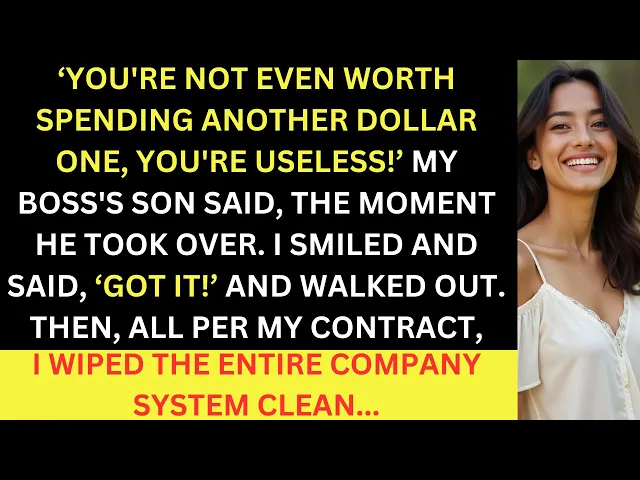
I won't spend another dime on a worthless employee. You're done here. I nodded slowly, my heart pounding, but my face calm.
Got it. Jason blinked as if he expected me to beg or argue. When I didn't, he smirked again.
Smart. At least you're not dramatic. I stood up, pushed the chair back gently, and turned to leave.
Oh, and HR will reach out about severance, he added, almost as an afterthought. I paused at the door. Per the contract I signed with your father, severance is automatic.
But you might want to check the terms of that agreement. He looked confused, but I didn't wait for a response. I walked out, not just from his office, from the entire building.
And when I got home, I opened my laptop because there was something Jason didn't know. When Richard promoted me to head systems architect 3 years ago, he added a very specific clause to my contract. One Jason hadn't bothered to read.
One that gave me control. Control over every internal system, every access point, every security layer. And if I was ever terminated without just cause, I had the legal right to wipe the slate clean.
I wasn't vengeful by nature. But what Jason had done wasn't just cruel. It was stupid.
Because now he'd have to learn very quickly what this worthless employee was actually worth. I didn't sleep that night. Not because I was upset.
I had long since learned not to take corporate betrayal personally, but because I was preparing. Every system, every line of code, every security protocol I had designed over the years was now in my hands. Jason had no idea what he'd signed off on.
3 years ago, when Richard promoted me to head systems architect, I told him something very specific. If I'm going to take full accountability for every system this company depends on, I need protection. Richard agreed.
He trusted me. He valued me. So together with the company's legal team, we drafted a clause that most CEOs would never allow.
If I were ever terminated without just cause or severance, as defined by the contract, I had full authority to revoke my access, shut down all administrator rights, and remove proprietary system integrations. In short, I could wipe it clean. The clause was buried halfway through the contract under emergency system governance.
I doubted Jason had read past the title page. The next morning, I woke up, brushed my hair, made some coffee, and sat down at my desk with a deep breath. I opened the remote systems dashboard.
Every critical platform was still tied to my credentials. Jason hadn't even reassigned permissions. HR hadn't contacted me.
No exit interview, no formal handover. He really thought I'd just vanish quietly. I hovered my mouse over the emergency lockdown protocol tab and clicked.
Immediately, a chain reaction began. Employee portal deactivated payroll access. Locked internal messaging platform.
Shut down CRM and client contact systems. Frozen servers still active but restricted from internal access. One by one, I watched the lifeblood of the company pulse and then flicker out.
I didn't delete anything. That would have been illegal. But per the clause, I had the right to disable access until a legal resolution was reached.
It was a nuclear option designed for worst case scenarios. This qualified. By noon, my phone was buzzing.
Block number, then again, then a message from someone I hadn't spoken to in months. Mark, senior IT analyst. Hey, something's wrong with the system.
Everything's going dark. Did you do something? Jason is losing it.
I didn't respond. A few minutes later, a call came in from the company's front desk. I ignored it.
Then finally, Jason called. I stared at the screen for a moment. Then I answered, calm as ever.
Lisa speaking. What did you do? He barked, not even pretending to be civil.
I could hear panic in the background. Phones ringing, people shouting, the hollow tone of someone who had completely lost control. I followed the contract, I said simply.
You should read it sometime. You shut down the entire system, he shouted. No, I said, I locked access to it.
There's a difference. You're insane. No, Jason, I'm prepared.
You made a decision without understanding the consequences. That's on you. I could hear him pacing now.
He was furious, but underneath that, he was scared. He didn't understand how the systems worked. He thought firing me was just crossing off a name.
He never realized how much I had built. "How do I fix this? " he asked, his voice sharp, but quieter now.
"You don't," I replied. "You're not authorized to make changes. " There was a long pause, then quietly.
"So, what do you want? " I could have said money. I could have demanded a massive payout or an apology or even my job back.
But none of that mattered anymore. This wasn't about revenge. It was about respect.
I want you to admit you were wrong. I said publicly, not just to me, to your team, to your board, to the people who watched you dismantle a company you weren't ready to lead. He laughed bitterly.
You think I'm going to humiliate myself over this? I smiled even though he couldn't see it. I think you don't have a choice.
Then I hung up. I spent the rest of the day answering messages from my former co-workers. Some were stunned.
Others were quietly cheering me on. They had seen the writing on the wall the moment Jason took over. But none of them knew what was coming next because Jason had just made the biggest mistake of his short career.
And by the end of the week, he would be begging for help. Two days. That's all it took for chaos to spread through Hamilton Tech like wildfire.
The systems I had locked down weren't just a convenience. They were the company's central nervous system. Payroll didn't process.
Client accounts became inaccessible. Customer service couldn't reply to tickets. Even the office coffee machine was glitching because it ran on the same cloud linked admin panel I had architected.
By the third morning, I got a text from an unknown number. The board is calling an emergency session today. Jason's in trouble.
Just thought you'd want to know. No name, but I had a good guess. Mark, maybe, or someone from accounting.
I had quietly earned the trust of more people in that office than Jason ever realized. Meanwhile, I was back to my freelance consulting work, my own clients, my own hours, my peace. But as much as I tried to ignore it, a part of me kept refreshing the news alerts and company chatter.
Because this wasn't just about justice anymore. This was about watching a house of arrogance fall brick by brick. Later that afternoon, the call came, not from Jason this time.
From a private number. Miss Carter, this is Diane Hart from the board of directors. We need to speak with you.
Her tone was crisp, measured. The voice of someone used to holding power, but trying to stay polite. Of course, I said, "When?
" "As soon as possible. We'd like to meet over video in the next hour if you're available. " She wasn't asking.
I joined the call in a crisp black blazer, hair tied back, the same way I used to look when giving quarterly IT updates. Six board members sat in sleek chairs behind polished mahogany tables. In the center of the screen, Jason looking like a deflated version of himself, collar loose, eyes red, his swagger had vanished.
"Lisa," Diane began. "We understand there's been a disruption to our internal systems. " "That's correct," I replied evenly.
"And you were the architect behind those systems? " "I was," I said, "for the past six years. And per the clause in your executive contract, you had authority to revoke access in the event of wrongful termination?
Only under specific conditions? Yes, I said, leaning slightly forward. One of which was termination without severance.
Jason shifted. I could tell he wanted to interject, but he didn't. He couldn't.
And you were offered no severance? Diane asked. I was not.
Jason called me into his office, told me I was worthless and that he wouldn't spend another dime on me. Silence. A few board members exchanged glances.
Someone coughed awkwardly. Diane turned to Jason. Is that true?
Jason cleared his throat. Look, I didn't think she'd actually answer the question. He glanced away.
I didn't review her contract fully. I thought it was boilerplate. I raised my eyebrows.
It wasn't. Diane took a slow breath. So, just to clarify, the systems are not deleted, but access is restricted.
Correct, I said. They're secure. No data loss.
I followed the protocol exactly as written. And what would it take to restore access? I paused.
I wanted to make this clear, not just for them, but for Jason. an official retraction of my termination, a signed letter acknowledging the breach of contract, and a formal public apology from Mr Hamilton Jason's head snapped toward the camera. "Are you serious?
" "I'm very serious," I said. "You publicly humiliated me. You terminated me without cause, without severance, and without any understanding of the systems I designed.
You don't just get to press undo. " Diane was quiet for a moment, then she nodded. We<unk>ll take your terms under advisement.
Thank you, Miss Carter. I logged off. That evening, I took a walk.
The sky was low with gray clouds, the kind of soft overcast that made the street lights glow like halos. 17 years. That's how long I gave that company.
Through late nights, system failures, mergers, and panic mode deadlines, I stayed. I delivered. I never asked for more than what I earned.
And Jason dismissed all of it with a single sentence. But now, now he was learning something his father had understood from day one. Loyalty is earned, not inherited.
I didn't want to destroy the company, but I wasn't going to save it at my own expense. And if Jason wanted to keep pretending he was in control, he was going to watch the entire machine fall apart without me. Jason didn't apologize.
Not that day. Not the next. Not even after the company's main clients began to pull their contracts.
He was still convinced he could fix it. I heard through a friend in accounting, off the record, of course, that Jason had brought in an external IT firm. They promised they could regain system access within 72 hours.
What they didn't know was that I had built it like a fortress, not to be vengeful, to be secure. Because the kinds of systems Hamilton Tech relied on housed sensitive data, legal documents, employee records, payroll structures, internal audits, client contracts. When Richard gave me full autonomy, he also trusted me to design protections in case of a breach.
Ironically, I became the breach Jason hadn't seen coming. By the fourth day, the board was under pressure. Key vendors were threatening legal action.
The finance department couldn't process invoices, and several government contracts, ones that required stringent security compliance, were on the verge of cancellation. That evening, my phone rang again. It wasn't Diane.
It was Richard. Yes, Richard Hamilton, the founder, Jason's father. Lisa," he said, his voice slower than I remembered, but firm.
I heard what happened. "Hello, Mr Hamilton," I said, surprised. I wasn't expecting your call.
I should have called earlier. I've been out of it lately. But Diane briefed me.
I read everything, including the contract you and I signed. There was a pause. He cleared his throat.
I want you to know I stand by that agreement. I gave you that power because you earned it and I see now how necessary it was. Thank you, I said softly.
That means more than you know. He hesitated. Would you be open to a meeting?
Just you and me. No board, no Jason. I agreed.
The next afternoon, I met him at a quiet cafe just outside the city. He looked older, frailer, but his eyes were still sharp. "I trusted Jason to lead with wisdom," he said after we sat down.
"Instead, he led with ego. " He looked directly at me. "You were the one person I knew would protect the foundation of what we built, and now you're the one person who can save it.
" I didn't reply right away. I watched him sip his tea, the cup trembling slightly in his hands. I'm not asking you to forgive him, he said.
I'm asking if you'll help fix this for the sake of the company, for the people who still depend on it. My jaw tightened. He called me worthless in front of his staff, terminated me like I was nothing.
If I come back, I want it to mean something. Richard nodded. I understand, and I think it's time we talk about that.
He slid a document across the table. It was a formal offer, not for reinstatement, but for partnership, co-ownership, permanent rights to the system I built, a public acknowledgement of my role in Hamilton Tech's growth, and full authority to oversee the transition to new leadership. Jason, I asked, eyebrows raised.
We'll be stepping down, Richard said firmly. After the board meeting tomorrow, he doesn't know yet, but it's already in motion. I blinked.
And who replaces him? Richard smiled. We're open to nominations.
It didn't hit me right away. But when it did, I shook my head. I don't want to run the company.
I didn't say you had to, he replied. But you should be the one helping choose who does. That night, I reviewed the documents.
Everything was real. The contract was airtight. And for the first time since I walked out of that building, I had peace.
But I also had one more decision to make. The next morning, I stood in front of the board again. This time, not as a disgraced employee or a desperate contractor.
I stood as someone whose value had finally been acknowledged. Jason was there, too, eyes hollow, shoulders heavy. He didn't speak.
Diane turned to me. Lisa, do you wish to restore the system? I nodded.
Yes. Under one condition, which is that the entire IT department receives backay for the hours they've worked trying to clean up someone else's mess, and that every engineer under my former team gets a raise and permanent status. Diane looked impressed.
Done. I entered the admin panel on my laptop, typed a few commands, hit execute. The lights flickered on at Hamilton Tech.
The heartbeat returned. I looked at Jason one last time. He wouldn't meet my eyes.
I didn't need him to. This wasn't his story anymore. The system was back online.
Emails were flowing. Salaries were processed. Clients returned.
From the outside, it looked like the storm had passed. But inside me, something still lingered. I should have felt triumphant.
I should have felt powerful. But all I felt was tired. 17 years.
17 years of late nights and early mornings. Of eating lunch at my desk, of fixing what others broke, of holding up a company that never once made the effort to hold me back. And when I thought of how quickly Jason had tossed it all away with one sentence.
I won't spend another dime on a worthless employee. A quiet ache settled behind my ribs. It wasn't about revenge anymore.
It was about worth and how easily the world can pretend not to see it. I spent the next week transitioning the IT systems over to a new team, one I personally helped hire. I didn't want my name to be the only one holding up the infrastructure anymore.
If I had learned anything, it was this. No one should ever be a single point of failure. Not even me.
One afternoon, I found myself back in the old server room. The hum of machines, the blinking lights, the faint chill of recycled air. It was all exactly how I remembered it.
Except now I wasn't there to fix anything. I was there to say goodbye. Mark, my former colleague, found me there.
I heard Jason moved out of the executive suite today. He said softly. I nodded.
About time. He never said a word to anyone. Just packed up and left.
Did you expect him to? I asked. Mark shrugged.
Number. But I hoped maybe he'd at least say something to you. I don't need his words, I said.
He already gave me a silence when it mattered. Mark smiled faintly. You know, we all watched what you did.
Every single one of us. And we weren't just impressed. We were proud.
That caught me off guard. Proud? Yeah.
He said, "You stood up for all of us. For every employee who's ever been undervalued. For every woman who's ever been told she's just something.
For everyone who's ever been discarded by someone who thought a title meant intelligence. " I blinked. My throat tightened unexpectedly.
"You made us believe again, Lisa," he added. I had no words, just a quiet, grateful smile. That weekend, I visited my parents' grave.
I hadn't been in months. They were both teachers, modest people who believed in effort over ego. When I first got the job at Hamilton Tech, they celebrated like I'd won the lottery.
When I worked late into the night, they brought me food. When I was overlooked for promotion after promotion, they told me to keep going. I sat down between the headstones and rested my palms on the grass.
I did it, I whispered. Not just for me, for everyone like me. For every person who was told they weren't enough.
For every worker who got laid off with nothing but an empty box and a forced smile. For every unseen genius sitting in the back of a cubicle making everything run while someone else took the credit. I stayed for a while, just breathing, listening to the wind in the trees, letting the silence wrap around me like a coat.
The following Monday, I returned to the company one last time. Richard had asked me to come in, not for work, but for a formal ceremony. They wanted to honor me.
I had hesitated, but eventually said yes. The entire company gathered in the main atrium. There were speeches, clapping, even a few tears.
Then Richard stepped forward. He handed me a glass plaque etched with gold lettering. It read, "For 17 years of dedication, brilliance, and unshakable integrity, Lisa Carter.
" The applause that followed was long, loud, and sincere. But what moved me most was the line of employees who waited afterward just to shake my hand. Young engineers, admin staff, janitors, managers, people from every department.
One woman, fresh out of college, held my hand a moment longer than the others. I want to be like you someday, she said. I smiled.
Then be better than me. Start with that. That night, I went home, lit a candle, made some tea, and finally, for the first time in years, I slept without setting an alarm because I knew the company would be fine.
And more importantly, so would I. Two months had passed since the day I restored Hamilton Tech Systems. Life had returned to normal, at least on the surface.
The company was running again, its operations smooth, its future no longer dangling by a thread. But Jason Hamilton had vanished from the tech world almost as quickly as he'd stormed into it. Word got around fast.
Investors pulled out. Clients questioned the company's leadership. board members whispered about the embarrassment he had caused.
And just like that, the golden boy who once smirked at me from behind a mahogany desk was gone. No new title, no shiny venture, just radio silence. I didn't celebrate, not out loud.
I didn't post about it. I didn't gloat because I didn't need to. People like Jason implode all on their own.
They think power is inherited, not earned. They think people are replaceable. They think they'll never fall until they do.
And when they finally crash, it's not the sound of impact that matters. It's the silence that follows. One afternoon, while sipping coffee in my home office, I got a message from someone unexpected.
Hey, it's been a while. Can I call Jason? I stared at the message for a long time.
I didn't owe him anything, but curiosity got the better of me. I answered. His voice was quieter than I remembered.
No arrogance, no smirk in his tone, just exhaustion. I know I'm probably the last person you want to hear from, he began. You're not wrong, I said calmly.
There was a pause. I just wanted to say I was wrong about everything. I didn't reply.
I let the silence stretch. Let it sting a little. I didn't understand what you did, how much you carried.
I thought, I don't know. That tech was just tools, replaceable. I thought loyalty was optional.
It's not, I finally said. It never was. I've lost everything, he admitted.
Even my dad doesn't return my calls anymore. That's between you and him, I said. Not my business.
he sighed. You don't have to forgive me. I just needed to say it.
Then say it clearly. He took a breath. I'm sorry, Lisa, for disrespecting you, for underestimating you, for not reading the damn contract.
You didn't deserve any of that. I let his words hang there for a moment before answering. Apology accepted, I said.
But don't mistake that for forgetting. I wouldn't dare. And that was it.
He hung up. I closed my eyes and let out a breath I hadn't realized I was holding. Not because I needed his apology, but because hearing it reminded me how far I'd come.
A few weeks later, I stood at the ribbon cutting ceremony for my own company's new office. Carter Systems. It wasn't flashy.
No marble floors, no glass walls, just clean desks, fast computers, and a team of sharp, passionate engineers. Some of them from my old Hamilton team. Others fresh graduates with eyes full of wonder.
I gave a short speech. Nothing grand, just the truth. I built my career in the shadows, I said.
I was called just an employee, overlooked, undervalued, underpaid. But I kept building because I believed in what I could do even when others didn't. I paused, looked around the room.
If there is one thing I've learned, it's this. Your worth is not determined by who sees you. It's determined by what you create, how you show up, and how you carry yourself when no one's watching.
The applause that followed wasn't loud, but it was real. And in that moment, I didn't feel tired anymore. I felt whole.
Today, I spend my days mentoring young tech professionals. I teach them not just how to write code, but how to write contracts, how to protect themselves, how to say no, how to demand respect. Hamilton Tech still exists, but it looks different now.
Richard quietly retired. A new CEO, a woman named Dana, took over. She reached out to me for guidance during the transition.
I told her one thing. Take care of your people and they'll take care of the company. It's a lesson some never learn and for others it changes everything.
As for Jason, last I heard he was living in a studio apartment on the edge of the city. No one calls him Mr Hamilton anymore. And in the tech world, his name is rarely spoken.
But mine, it's on contracts now, on invoices, on systems, on the front door of a company I built from the ground up. Lisa Carter. Not a worthless employee, not a forgotten name, but a builder, a fighter, a woman who rewrote her own ending.