In this segment of the lecture, we'll examine the rules that determine how long US copyrights last. You're probably thinking, well, this will be a short segment. How complicated can it be?
The answer, unfortunately, is quite complicated. The reason for the complexity is that the relevant rules in the United States have been amended several times. But the amendments have been only partially retroactive.
The result is that there are several subsets of copyrighted works that are governed by different sets of duration rules. Here's how I'll try to untangle this knot. I'll begin by reviewing the history of the pertinent laws.
I'll then start over and consider the impact of that history on the duration of different groups of works. The slide in front of you should by now be familiar. This shows the way things worked under the original version of the 1909 copyright statute.
As we've seen, the first term of federal protection lasted for 28 years after the date of publication. If the copyright was properly renewed, it lasted for another 28-year term, commonly known, for obvious reasons, as the renewal term. Here are a few more details we have not yet discussed.
The application for renewal could be filed any time during the year preceding the expiration of the initial term. If the author was still alive at that time, he or she was the person presumptively entitled to apply for and receive the renewed copyright. If the author had died, his or her surviving spouse or children could do so.
If there were no surviving spouse or kids, the author's executor had the right, if the author had left a will. If he or she had not left a will, then his or her next of kin had the renewal right. A technical point that, as we'll see later had some important practical effects, the renewal term was not thought of as a continuation of the initial term.
It was said to be a new term-- a new estate-- that belonged to the person who applied for and received it. With respect to works first published under the auspices of the 1909 statute, this basic structure has remained intact. But the length and mechanics of the renewal term have been adjusted several times.
In 1976, the renewal term was extended from 28 to 47 years. In 1998, as part of the Copyright Term Extension Act, it was extended from 47 to 67 years. In 1992, the renewals of works that at the time were still in their first term was made automatic rather than voluntary.
The result is that copyrighted works ceased falling into the public domain at the end of their initial 28-year terms. The 1976 general reform of the copyright statute, which became effective as we've seen at the start of 1978, instituted a radically new regime. As we've seen, works created thereafter acquired federal copyright protection immediately, which lasted for the life of the author plus 50 years.
The Copyright Term Extension Act in 1998 extended that term to its current duration-- the life of the author plus 70 years. Measuring duration by the life of the author would not work for anonymous works, pseudonymous works, and works for hire, so these were given terms of years that were meant to approximate the duration of regular copyrights-- a century from the date of creation or 75 years from first publication, whichever happened first. The Copyright Term Extension Act in 1998 also extended those terms by 20 years.
Lurking in these details are two general themes. The first, I've already mentioned-- the gradual transition from an opt-in to an opt-out system. The second, probably obvious, is that copyrights keep getting longer.
They never, even prospectively, get shorter. OK, now let's adopt a precedents stance. It's 2013, how long do US copyrights last?
The answer depends upon when and how they were born. More specifically, you need to differentiate five different categories of copyrighted works. The simplest group consists of works published before 1923.
Some of these got the benefit of the extension of the renewal term from 28 to 47 years. But all of them fell into the public domain before the Copyright Term Extension Act could rescue them. And the Copyright Term Extension Act did not lift them back up.
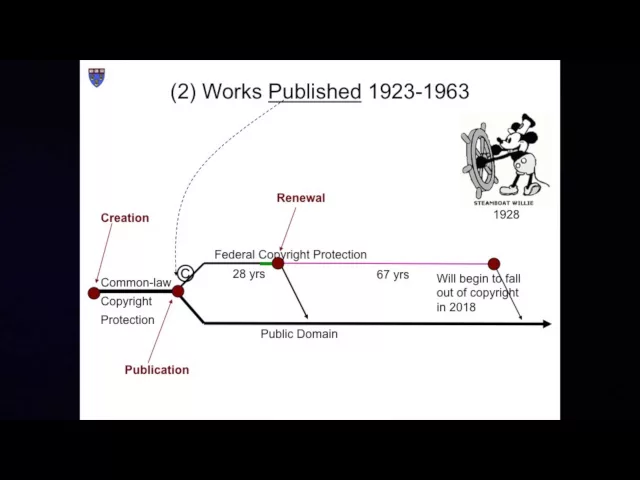
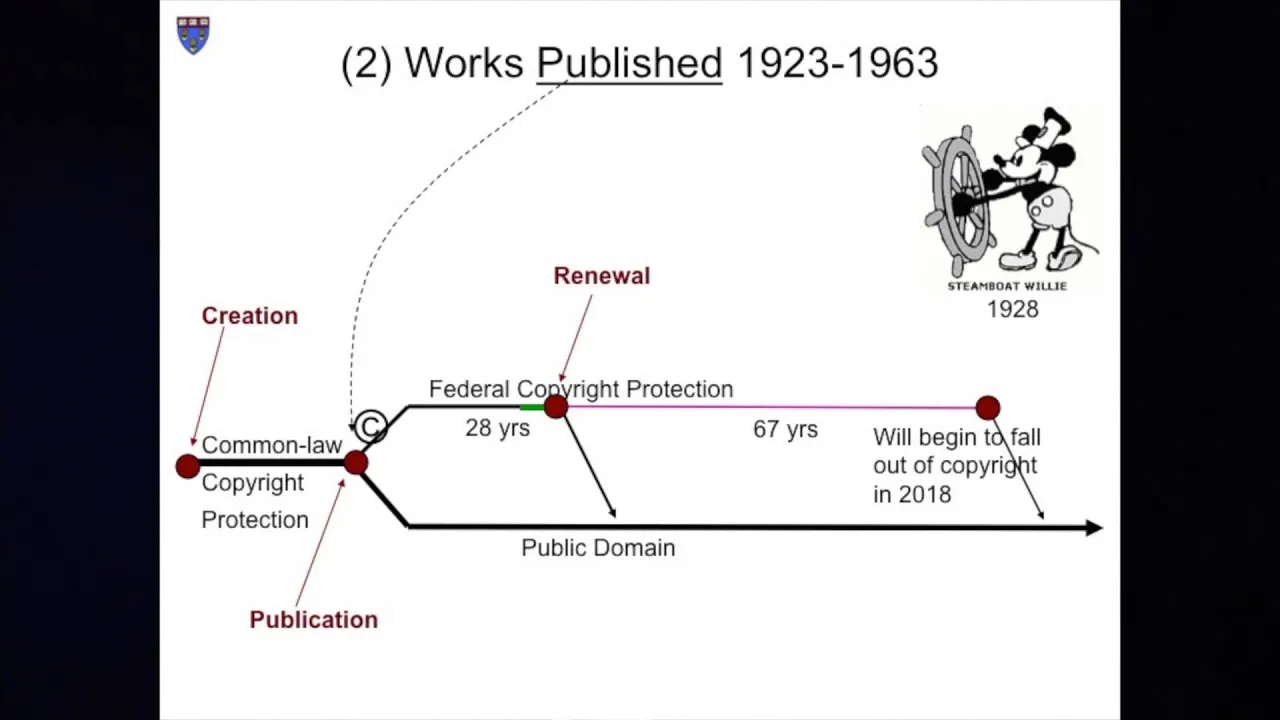
The upshot is that the copyrights on these works have expired. The second category consists of works published between 1923 and 1963. These were rescued before their expiration by the Copyright Term Extension Act.
The most famous and influential member of this group is Mickey Mouse-- a copyrighted character, who first appeared publicly in the 1928 cartoon, Steamboat Willie. Copyrights in these works will begin to expire in 2018, 95 years after their first publication. Mickey Mouse, himself, will fall into the public domain on or about 2023, unless yet another amendment of the statute rescues him again.
Not all works published during this interval is still alive, however. Only those who were properly renewed, by people eligible to renew them, survived. As we've seen, the large majority of works registered during this interval were not renewed.
The net effect is that most of the work copyrights in this category of works have expired. Not so with respect to works first published between 1964 and 1977. These get the benefit of the change from voluntary renewal to automatic renewal.
Who owns these copyrights? Presumptively, the same person or persons who are eligible to apply for renewal onto the previous regime. Another important footnote, just because these copyrights are subject to automatic renewal doesn't mean that they cannot be voluntarily renewed.
And the system contains some important incentives for people who voluntarily renew. The upshot, as you might imagine, is that voluntary renewal remained common after 1992. The key point for our present purposes is that works in this third category have not yet fallen into the public domain.
They will begin to do so in 2018, like their surviving older cousins. Works in the fourth category overlap the fundamental change in the copyright system caused by the general reform of the statute in 1976. These were created but not published before 1978.
Federal copyright protection for these last for the lives of their authors plus 70 years or the end of 2002, whichever is later. In addition, if they were published by the end of 2002, they got an extra lease on life until, at a minimum, the end of 2047. The purpose and effect of this provision was to nudge the heirs of the authors of such things to publish them.
We come, finally, to the newest set of works, those created in 1978 or later. These, as you now know, last for the life of the author plus 70 years. That means that they will start expiring in 2048 at the earliest.
As we've seen, anonymous works, pseudonymous works, and works for hire get treated differently. They will begin to expire in 2073 at the earliest. So that's where things stand.
The bottom line, if you need to know the status of a particular US work, first ascertain which of these five categories it falls into. Works in the first box are in the public domain. Works in the second box probably are in the public domain, but you need to check whether the copyrights were timely renewed.
Works in the third box are most likely not in the public domain, unless of course they were published without the required copyright notice. But their copyrights will begin to expire in 2018. Works in the fourth box could be in the public domain, unless they were published before 2002.
You need to check. And finally, works in the fifth box are probably not in the public domain. The exceptions to this last proposition are those published between 1978 and 1989, without the required statutory notice and that defect was not cured within five years, and works published recently subject to cc-zero proclamations.
Otherwise, these works will not begin to fall until 2048 at the earliest. Messy, very messy.