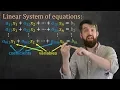
consider the equation y equals x squared what this does is it has two different variables Y and X and it expresses some relation between them and I could imagine an equation that had more variables than just the two here for example the equation x1 squared plus cosine X 2 minus 2 e to the power of X 3 equals 5 that's just some messy equation in three different variables x1 x2 and x3 now these kinds of so-called nonlinear equation equations with Exponential's and signs and squares in them they're very complicated you can study them but the
study of them is very messy and in our course in linear algebra we're going to look at equations that have multiple variables but we're going to restrict ourselves to a specific type we're gonna study in this course are these linear equations equations where every variable like X 1 X 2 X 3 it just occurs to the power of 1 I might multiply those variables by various coefficients numbers like 2 and minus 1 and 1 and 8 but any variable is only going to occur to the power of exponent 1 then a solution to a linear
equation is just me telling you what the X 1 the X 2 and the X 3 values are going to be if I specify some list of numbers for example here 2 times 2 is 4 minus minus 1 is 5 plus 3 is 8 if I plug those numbers into the equation then it does indeed satisfy it so that is a solution to a linear equation and one thing to note is that often these linear systems have multiple different solutions for example X 1 is 4 X 2 is 0 and X 3 is 0 is
also a solution that also satisfies this equation 2 times 4 is 8 plus 0 plus 0 is equal to 8 ok so that was linear equations which is nice but now let's upgrade let's look at linear systems of equations and in a linear system of equation what we're gonna have is multiple lines of our equations and the key point is that all of these equations that I have they're true at the same hi a solution to the system of all three equations must solve each equation individually so for example if we look at that 2
minus 1 3 well if I plug that in everywhere I have an X 1 and X 2 and X 3 indeed it does satisfy and we can plug it in and check that all of those numbers are indeed equalities but I don't want to note something here remember the solution for 0 0 just to the top row but that still is a solution to the top row for 0 0 is a solution the top row but it is not a solution to the bottom row any longer it is not the case that every solution to
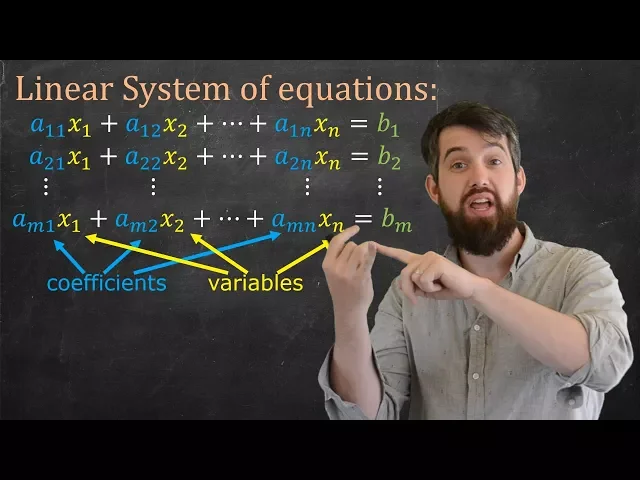
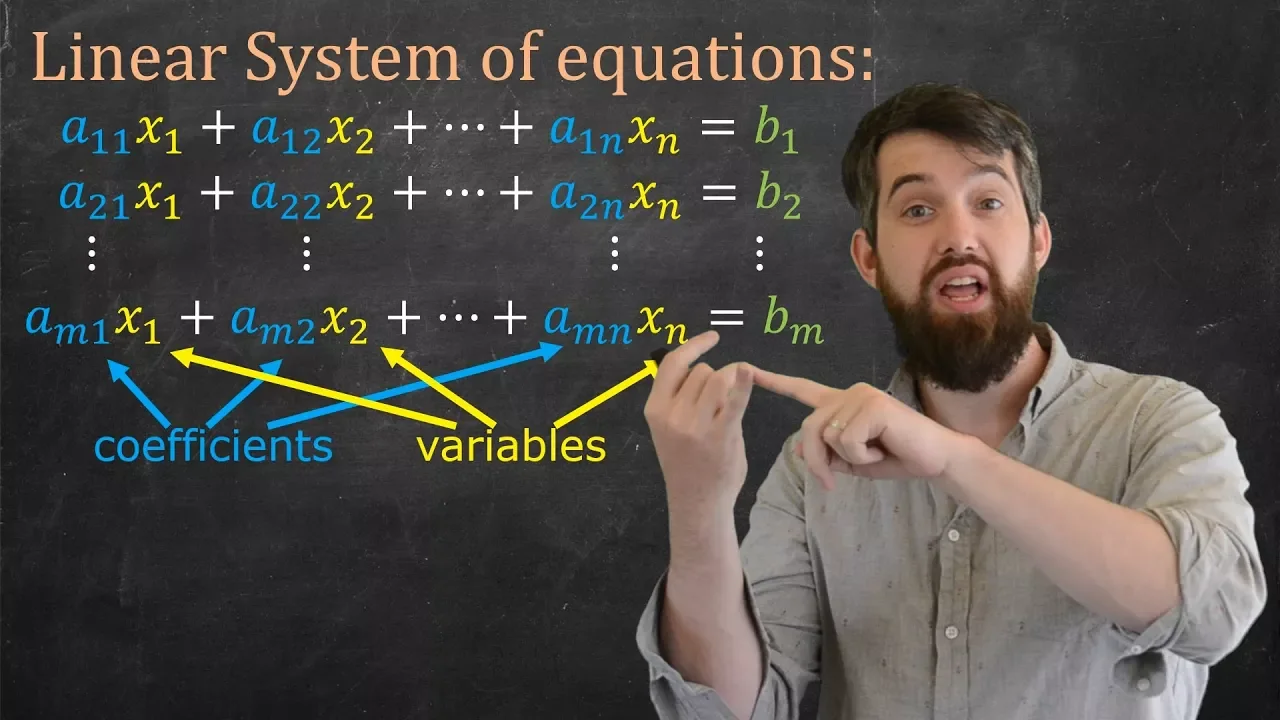
an individual equation solves the entire system it has to solve all three equations now linear systems can get big and complicated they're getting many different rows if you mean a different variables so we want a systematic way to express it in our systematic way is this is using something called a I J notation so what I have all of the blue all of these are my coefficients they're just some number like 3 & 7 0 a minus 1 and pi and whatever you might like and then the X 1 down at the X n those
are going to be my variables that's the thing I'm trying to solve for and then the B 1 down to the B M these are also just numbers but because they're not associated to a variable they don't have a variable attack to them I got a call a bit of a different name I'll call the the bees constants and I'll call the AI J's coefficients so what do I have in this system I have n different variables by X 1 - my X n and I have any different equations B 1 down to BM enumerated
the different rows in my linear system and then the way to refer to the a IJ notation is that a IJ represents the 8th row and the jth column so for example a 1 2 well that's going to be this one right here it's the first row and the second column when I reference a 1/2 alright so what is a solution to this linear system well I have to tell you what the x1 done to the xnr that is a solution is going to be a list of numbers an s-1 down to the SN for
solution corresponding to the x1 down in the X and the variables a list of numbers where if I take those numbers and then I just everywhere there's an X I'm gonna put them in there and now I have everything in terms of my specific values my solutions my s one out of the SN it has to satisfy every single equation so those are linear systems of equations that's the big topic that we want to deal with in this course but just writing the mud is a bit boring the big question for the future that we're
gonna answer pretty quickly here but there'll be a lot of new ends to it is this how do I solve a linear system of equations how do I find such a solution so that question we're gonna answer pretty soon but in the next video we're gonna answer the question how do I look at this geometrically as opposed to algebraically which is what I did in this video