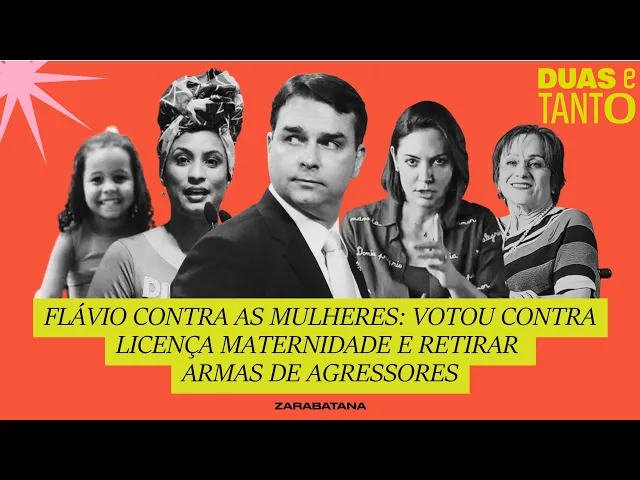
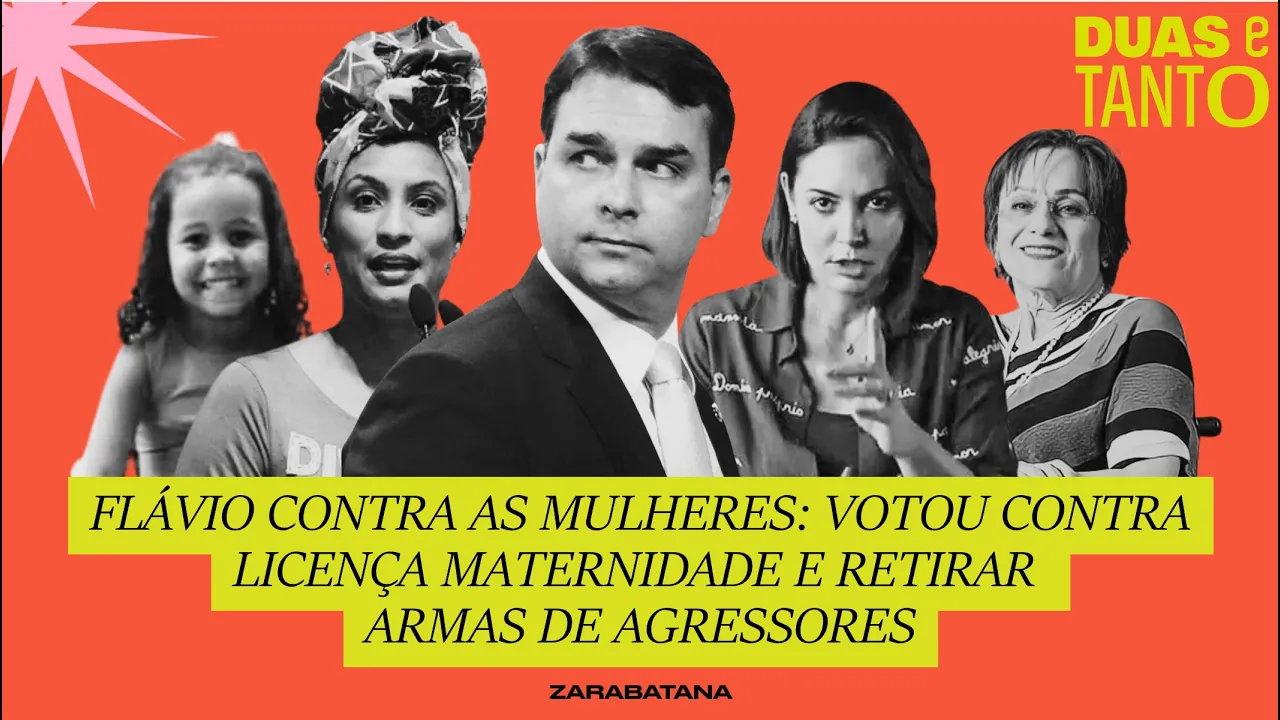
Hi, friend. >> Hi, friend. >> I'm calling to tell you how Flávio Bolsonaro votes when it comes to women's rights.
And I'll give you a heads-up, he voted against taking guns away from police officers accused of assaulting their partners. He voted against extending maternity leave for public servants in Rio de Janeiro. He voted against honoring Black women in the assembly, but went to prison to honor a militia member.
Let’s go, >> let’s go. >> I'm Carol Pires. >> I'm Marina Dias.
And this is Duas e Tanto. >> This is Duas e Tanto. Every Tuesday and Thursday, Carol and I get on the line to talk about a trending political topic in a fast, easy, and accessible way so everyone can join the debate.
Follow us on Carol's YouTube channel @piriscarol. Follow us on Instagram @duitanto and on all audio platforms. Duas e Tanto is a Zarabatana Studio production.
Folks, a super quick message. The end of the 6-to-1 work schedule was approved in the Senate yesterday, quite late. Five months ago, we made an episode explaining what the bill is.
So you can search for the title: Eyeing the election, the government wants to approve the end of the 6-to-1 schedule. This subject will cause quite a stir, it will have repercussions, and it will surely impact the election, because Flávio is against it. So, we will talk about this next week, but today we’ve prepared a special episode.
So, friend, Flávio Bolsonaro has been in politics for almost 24 years. He was a state representative in Rio from 2003 to 2019 , and he has been a senator ever since. So I looked into how he has voted on important matters, and I can tell you, he has accumulated votes and statements against women's rights.
So, over all these years, he presented 306 proposals regarding women's safety. It was only three. This is a survey by Agência Pública.
And I bring exclusive information here for those who follow us on Duas e Tanto. In the Rio de Janeiro Assembly, a bill to take guns away from police officers accused of assaulting their partners was approved there without resistance, but Flávio was against it. So, only one representative went to the microphone to make a point of registering that, even though that bill had been approved , he was against it.
And that was Flávio Bolsonaro. According to him, because the women could be lying. This is in a country where femicide, which is the murder of a woman by someone who thinks she is worth less, a second-class being, is an epidemic.
And many of the killers are security agents . So I’m going to tell you about this and other votes where Flávio Bolsonaro voted against women's rights, against increasing maternity leave for public servants, and against honoring Black women. But I think before that, you can provide some electoral context, because the women's vote can decide this election.
>> Women can decide the election because we are the majority of the population and the majority of the Brazilian electorate. Women represent almost 53% of voters in Brazil. Mathematically, we are the majority, we can decide any election, but women are also able to influence the vote of those around them , because many women are heads of households, caregivers, they work, study, take care of the home, all at the same time.
And so they talk to people in all these places, and a woman's voice is trusted in their social and community circles. In this year's elections, women were also more undecided than men when choosing a presidential candidate. On the eve of the first round, in the spontaneous Datafolha poll, where the person has to say who they intend to vote for without having the names of candidates in front of them, 17%of women were undecided, while 10%of men were undecided.
And the two candidates in the runoff, Lula and Bolsonaro, know that women are a very important segment of the electorate and are going after them, right? I did a report during the 2022 elections to understand a bit about these women who have been caught between Lula and Bolsonaro since 2018. They are more conservative women, often evangelical, they are working women, right?
So, many of them are in the labor market, but they also take care of the home all at the same time and right now. So they have little time to think about politics and end up deciding who they will vote for at the very last minute. In 2018, many of these women helped elect Jair Bolsonaro, but in 2022 they moved to Lula because of Bolsonaro's aggression, his defense of weapons, and , especially, his terrible handling of the pandemic, which left more than 700,000 dead in Brazil.
Brazilian women have not forgotten what Bolsonaro did during the pandemic. I >> have Covid. When you are there.
>> Man, who talks about "I'm not a gravedigger," you see? I regret the dead. I regret it.
We are all going to die one day here. Everyone is going to die. There’s no use running from it, running from reality.
We have to stop being a country of sissies. Geez, >> I didn’t get the vaccine. Because of my athletic background.
If I were infected by the virus, I wouldn’t need to worry. I wouldn’t feel a thing, or at most, I’d have a touch of the flu or a little cold. >> We’re going to have to face it.
Face it like a man, damn it. He mocked people, he pretended he was suffocating , he made jokes, he didn’t want to buy vaccines, he minimized the pandemic and people suffered, died, and many women in Brazil haven’t forgiven that . Jair Bolsonaro, when he was president , shut down the Women’s Secretariat and cut 90%of the funds allocated to combat violence against women.
And in the 2026 election, my friend, the runoff polls are still showing these women divided. Lula has the majority, 53%among women, and Flávio Bolsonaro has 45%. So, what about their strategy, right?
Why do these numbers continue to fluctuate? Flávio Bolsonaro started the campaign trying to appear moderate, right? A different version than his father’s.
And he himself said it was a nod to the female electorate. He wore "Girl Dad" t-shirts, appeared on TV shows next to his wife, Fernanda, saying how important she was to his formation as a man. In July, Flávio Bolsonaro even repudiated a major ally, the blogger and fugitive from justice Paulo Figueiredo, who said in an interview that women vote poorly.
Where Flávio does worst is precisely with the female electorate. Women statistically vote very poorly. Especially single women; married women generally tend to follow their husband's vote.
You can pull the pubic hair out of your panties, do whatever you want, especially the feminists who have more pubic hair. >> But then, in the heat of the campaign, Flávio Bolsonaro couldn’t maintain that moderate stance, right? And he was accused of misogyny and contempt against women by his own stepmother, Michelle Bolsonaro, Jair’s wife.
Let’s remember that Michelle Bolsonaro recorded a video saying that Flávio was very harsh with her on a phone call, that he disrespected her, mistreated her, and said that she had " arrived yesterday," her quote, and didn't understand anything about politics. He was very harsh, disrespected me, and mistreated me on the phone. And I hadn’t done anything against him.
He said it would be better if I stayed out of party decisions. He said I had arrived yesterday and didn’t understand anything about politics. >> So, my friend, he had to sweat it out to try and make peace with Michele, at least public peace, right?
He knows that Michele is a very strong leader among women, especially evangelical women. She was elected senator for the Federal District on October 4th, as the most voted candidate, with almost 1 million votes. And so after this first round, the two are treating the fight as a closed chapter.
But the fact is that Michele is playing dead, isn't she ? She isn't engaging in his campaign. She has known Flávio for 20 years, right?
Since she's been with Jair since 2007 and she is the person who said: " He despises my role as a woman in politics. " Including the fact that this video isn't circulating the way it should, right? Because it's his father's own wife saying who he is, she knows him intimately, and this video has sort of disappeared, right?
What is clear from what we understand of the father's and Flávio's history is that it's not just today that they've been against women's rights, right? >> I was the only vote against the domestic worker amendment. It reaches the point of absurdity here.
If my nanny, for example, has a child under 6 years old, I have to pay for daycare for my nanny's child. >> Rights that we don't want any extra of. We want gender equality.
And that is why it's necessary to correct distortions and injustices that are rooted in society. I'm going to bring exclusive information here for you. I will first explain this bill about removing weapons from police officers accused of violence.
In 2008, the then state representative Inês Pandeló introduced this bill 1442 in the ALERGE , which made it easier to take the weapon from a police officer accused of domestic violence. This was voted on February 12, 2009. And this is a real problem.
Last year, according to a cross-reference by the Fogo Cruzado Institute, police officers committed or attempted to commit at least 62 femicides in Brazil. 62. So, in the Rio metropolitan area, which is Flávio Bolsonaro's base, almost half of the women who were victims of femicide were killed by their partners, a police officer, military personnel, or another security agent.
This was a survey by Ponte Jornalismo. Returning to the vote , the bill was giving the Rio state government the power to immediately confiscate a police officer's weapon, because the Maria da Penha Law allows a judge to disarm an aggressor. But that depends on a legal process, and the process takes time.
So, it was a vote, a bill to speed things up, to make women more protected, more quickly. And the vote was symbolic. A symbolic vote is when there's a consensus, you don't even need each deputy to go press yes or no.
So that was it, it was approved by consensus. But Flávio Bolsonaro asked for the floor just to let it be known, he insisted on having it recorded that he was against it. And I’m going to read his vote which is in the Alerge transcript.
Quote. Many police officers can be victims of situations where, in reality, there isn't all that blame declared by a wife or an ex-wife, and they end up losing their work tool, which is their weapon. What is Flávio saying?
That the woman might be lying. So, for him, it’s better to leave the police officer accused of assault armed at home than to believe a woman's word. Flávio is much more concerned with a tiny, anecdotal number of women who might make a false report versus the number in the thousands of cases of violence against women.
In 2019, already as a senator, look at how he continues with this line of thinking. In 2019, already a senator, Flávio presented a bill to toughen the penalty for those who make false reports of heinous crimes, a category that includes rape. So, women's advocacy groups warned, obviously, that this could intimidate victims from reporting.
The bill was never actually voted on. Look at how, ten years later, he maintains the same reasoning. For him, the danger is the woman who reports it, not the guy who is being reported.
And I think it's important to remember this now because he is the candidate who defends arming the population, as if his father wasn't enough, who more than doubled the number of guns in civilian hands, it was 1 million. 3, it went up to almost 3 million. These are data from the Sou da Paz Institute.
And in a country that broke records for femicide for the fourth year in a row. There were more than 1,500 women killed in 2025, and attempted femicides are growing. He thinks it’s fine to leave a weapon in the hands of a man who has already been accused of assault.
A weapon inside the home is one of the main risk factors for the death of women. And there is this culture of authoritarian masculinity in Brazil at the root of the security forces, which we know spreads through the militias. And this must be combated.
I’m going to digress for a moment to mention that Bruno Paes Manso, a journalist and researcher, wrote about this in "Nem Toda Mulher," which is the newsletter I have with psychoanalyst Veria Conelli on Substack. Read it there; he talks precisely about this authoritarian masculinity at the root of the militia and these far-right populist leaders. Getting back to Flávio Bolsonaro, I’ll talk about another project that also reveals a lot about who he is.
Someone who supports Flávio Bolsonaro might say: "Oh, no, in that first project he’s just defending the police, right? " And then I ask: is he defending the police or neglecting women? Because look, in 2009, the Alerj voted on a constitutional amendment from then-state deputy Marcelo Freixo, which extended maternity leave for state employees from four to six months .
And the law was passed by 54 votes to one. The only vote against it was from Flávio Bolsonaro, and in his justification, he reasoned from the businessman's point of view—according to him, let's quote Flávio Bolsonaro. "Do you think he, in this case the businessman, will prefer to hire a woman between 18 and 25 years old or someone of the male sex?
" Deputy Cidinha Campos immediately rebutted him , saying: "We are here voting for public service, and Your Excellency is afraid of what will happen in the private sector? " Because the project was for public servants. It is the government that pays for their leave.
There isn't a single businessman involved in this story. So, what Flávio did was vote against mothers, even though they would be supported by the state itself. And this is an extension of what Jair Bolsonaro, his father, thinks, right?
Let’s remember that interview of his with the newspaper Zero Hora, which caused quite a stir, where he said: "I feel sorry for the businessman in Brazil, because it is a disgrace to be a boss in our country with so many labor rights. " I want to reinforce the obvious here, friend. Extended maternity leave protects mothers and children; it protects families.
Studies associate breastfeeding and this care in early childhood with better child development , which will impact school performance and the person's income as an adult, right? There is even a calculation by Nobel laureate in economics James Heckman, who calculated that quality early childhood programs yield a return of 7 to 13%per year. So, maternity leave is not an expense; it is protection for families and an investment in the country's economy, an investment in the future—it’s a national vision, not an immediate cost.
Now, I’ll move on to the third vote I found regarding Flávio Bolsonaro, which reveals a lot about who he is, which was the following: "So, at the Alerge, Flávio was the only one to vote against the creation of the Latin American and Caribbean Black Woman Diploma, which was proposed by representative Beatriz Santos for Black Women, right? " Resolution project 707 of 2008. "And Flávio Bolsonaro justified it as follows:" Look, I want to mark my position regarding this segregation of society into races.
"" And then he continued, why can't the white woman be honored? "" Why not change the diploma to 'exemplary woman, ''model woman'? "There are already, Mr Senator—at the time he was a representative—several honors for women.
But anyway, besides being racist , this narrow-minded reasoning of his shows that he doesn't like to honor women, but he loved using the Alerge to honor militiamen. I'll remind you that we talked about this in this past Tuesday's episode, right? In 2005, Flávio even went to prison to deliver a Tiradentes Medal, which is the highest honor of the Alerge, to Adriano da Nóbrega, imprisoned for homicide and later pointed out by the Public Prosecutor's Office as the head of the" Crime Office, "which is a group of hitmen.
So, Black women didn't deserve a diploma, but a militiaman even got a medal in prison, right? And so, not to fail to mention the strength of Black women, we also talked about this in the last episode, but I will remind you, right, that in November 2023 Flávio allocated nearly 200,000 reais to an amendment for an institute in Taquara, there in Rio de Janeiro, which is a stronghold of the Brasão brothers, who are those convicted of the death of councilwoman Marielle Franco. According to the Federal Police, the one who negotiated with Flávio Bolsonaro's aide was this Robson Calisto, a militiaman known as" Peixe, "who was later also convicted by the Supreme Court for being part of the same criminal organization as the Brasãos, the masterminds behind the assassination of Marielle Franco, who was the only Black councilwoman in Rio de Janeiro when she was killed in 2018.
Flávio Bolsonaro's resistance to the presence of women in politics is, oh friend, old. I'll do a quick chronology here. On August 18, 2004, in a speech at the Alerge against quotas in universities, Flávio said the following:" Soon there will be a quota for homosexuals, a quota for Jews, a quota for women.
"That's unheard of. Then, on April 14, 2009, he went on to mock the idea of having women on the Supreme Court, right? Then he said:" There should be quotas too.
"One year it had to be a dark-skinned person, the next year an Indigenous person, then a homosexual, then a woman, and so on. That’s how he treats the inequality of representation of Brazilians in the judiciary. As a senator, Flávio Bolsonaro also voted against the ministerial reform that recreated the Ministry of Women.
He voted against keeping the fight against sexism among the principles of the General Sports Law. He did not attend the two rounds of voting on the constitutional amendment that made femicide an imprescriptible crime, which was passed unanimously. He was present at the session, but did not vote to include services for women victims of violence as essential services during the pandemic.
And he voted in favor of the amnesty bill, which cleared parties of fines for failing to meet gender quotas in elections. He did, however, vote in favor of the bill against misogyny, but also said it was a trap by the PT and asked the Chamber to archive the project. So, he voted so it wouldn't be on record that he didn't want to fight misogyny, but later he said what he really thinks about it.
And Flávio isn't alone in this, it's a family thing. You even mentioned this, didn't you, friend? When Jair was president, he vetoed free sanitary pads for poor girls.
He cut 90%of the funding to combat violence against women, right? That’s not counting all the atrocities he has said about women. I don't even know if it's worth repeating here, but Jair Bolsonaro started gaining popularity.
Look how crazy, right? When he went viral saying he wouldn't rape Congresswoman Maria do Rosário because she doesn't deserve it . >> I am a rapist now.
Look, I would never do that to you because you don't deserve it. Give it here, I'll give you another. Give it here, I'll give you another.
Give it here, I'll give you another. Give it here, I'll give you another. Give it here, I'll give you another.
>> Later, in an interview with the newspaper Zero Hora, he added that she was too ugly. In 2017, he said that this" femicide "talk had to end. To him , the solution to femicide is more guns , right?
Remembering that speech he also gave at the Hebraica club, in Rio, when he said he had four sons and that his only daughter came from a" weak moment. " >> A weak moment. >> A weak moment, right?
There were four men. The fifth one was a weak moment, a woman came along. >> And Flávio recently said that women are for taking care of the elderly, and that’s why he had two daughters, right?
>> I had two daughters exactly for that. When I get old, I'll have someone to take care of me. One thinks women are a " weakness, "the son thinks women are there to take care of him.
Eduardo Bolsonaro, who isn't even here, follows the same line. Let’s remember that on February 18, 2020, he gave a" banana " gesture to the congresswomen who had shown solidarity with journalist Patrícia Campos Melo, who was offended by Jair Bolsonaro with a sexual innuendo. >> She wanted to get a scoop at any price.
Against me. a" banana "in the name of all women. A" banana "on behalf of all women, okay?
>> In 2021, Eduardo Bolsonaro went on Twitter to call the congresswomen of the Constitution and Justice Committee, quote," people who have a vagina. "And in 2022, after sharing a video that associated a crater at a subway construction site in São Paulo with the hiring of female engineers, that is what the Bolsonaro family thinks about women. >> Friend, as you keep talking, I swear, I just want to cry.
Look at these people they talk about. Can't the people not see this? >> And as a candidate for President of the Republic, what does Flávio Bolsonaro say about women?
Well, he spent the entire first round without detailing any of his proposals, neither on women, nor the economy, nor anything. He didn't go to the debates, he ran away from questions that asked for more details on what he wanted to do. But he said what he thinks about women, right?
That gave clues as to what he will do if he actually becomes president of Brazil. Well, in July, at a meeting of the PL, his party, in Vitória, Espírito Santo, he was defending harsher penalties for crimes, which is part of his agenda, when he called the Maria da Penha Law a" piece of paper. " >> This piece of paper that is the Maria da Penha [Law] is not what will defend women.
>> A law that protects women from physical , psychological, and financial violence . A law that guarantees protection for millions of women in Brazil. Flávio Bolsonaro minimized it and called it a piece of paper.
He said:" This piece of paper that is the Maria da Penha Law is not what will defend women. "Less than 48 hours earlier, he had launched his program for women. And among these promises by Flávio Bolsonaro for women are: Women's Centers and Internet for women.
" But let's remember that a reporting channel for women already exists. In 2024, the police were called via 190 for domestic violence over 1 million times, meaning two calls per minute. So what actually works?
We know that 70 women were murdered in 2025, even with protective measures in place, that is, one in every nine victims. So, protection on paper isn't enough, we lack structure. And that is something he hasn't proposed yet.
>> Violence against women will only decrease when women stop being treated as second-class citizens. And that starts with education in schools and very much in public discourse. This arena where Flávio Bolsonaro is making it very clear how he thinks, how he votes, and how he believes laws should be.
And as soon as the first round ended with him ahead of Lula, Flávio Bolsonaro began behaving as if he were already elected and said, pay attention , he will change Brazil's Constitution. And he didn't explain what change he will make, but we know that our basic rights are in the Constitution, the basic rights of women, the right to vote, the right to maternity leave, the right to the SUS. So, with the majority of Congress in his hands and this whole track record, why should women feel at ease with a Flávio Bolsonaro government?
>> Exactly, my friend. Let's leave the question there for everyone to answer. We'll talk on Tuesday.
>> We'll talk on Tuesday. See you later. >> Zaraã.
>> Na >> batatã. >> Zarabatã. Okay.