Inner Mongolia is China’s Montana. Its winters are cold, its summers, hot, and its wide open spaces isolated and unforgiving. …Which makes it a very strange place to build a giant 200-foot-tall red Victorian palace.
Sure, the rich and famous have been known to make some… unorthodox architectural decisions. But way out here near the Gobi desert, you won’t find any tennis courts, golf clubs, or art museums… nevermind a Trader Joe’s. In fact, the only amenities include a highway interchange to nowhere, a non-functional airstrip, and an Indiana Jones-style cardboard-cutout city.
This place was never meant to be lived in. It was built as target practice, on China’s largest military base. And the People’s Liberation Army clearly had a very specific mission in mind.
This is that 200-foot-tall palace in the desert. And this is Taiwan’s Presidential Office Building in downtown Taipei. Lest you mistake the replica for a mere roadside attraction, state media released footage of Chinese troops using it to simulate an invasion.
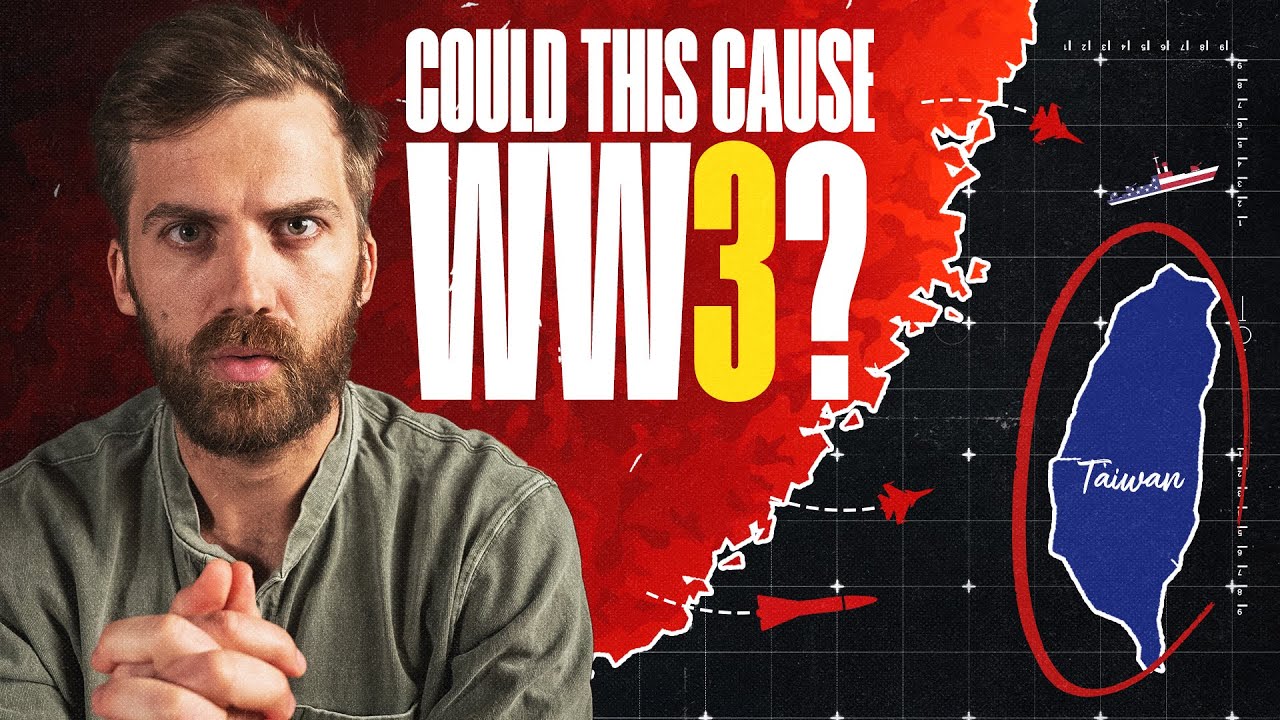
Needless to say, this is deeply unsettling. That the Chinese military is actively practicing an invasion of its small, democratic neighbor should attract the world’s attention and outrage. …And… it’s not evidence of an imminent plan to attack.
We know that because it was built nine years ago. Yet the failure of our worst fears to materialize hasn’t prevented the same dire warnings from being recycled year after year since. Just a few months ago, for example, U.
S. Air Force General Mike Minihan wrote a memo to his 50,000 subordinates that began with “I hope I am wrong. My gut tells me we will fight in 2025”.
Another ‘Mike’ from the U. S. military – Admiral Mike Gilday – made headlines last year for saying he “couldn’t rule out” a Chinese attack in 2022 or 3.
Each time, the evidence simply accumulates. Every authoritative prediction or alarmist headline reinforces the perception that war is inevitable or even imminent. “Where there’s smoke, there must be fire.
” But Taiwan has now been “on the brink of war” for most of a decade. Which means we’re long overdue for some reflection. Sponsored by “China, Actually”, my 6-part series available only on Nebula.
Let’s start with what we know… First, few countries have transformed so completely as China since 1949. Yet, despite these 74 years of continuous tumultuous change – during which not even the written language survived untouched – on one issue China has been remarkably consistent. Every leader since Mao has reaffirmed the importance of unification.
Despite having never governed Taiwan, the Party defines itself as the rightful heir to and guardian of Chinese history, culture, and, more problematically, the Han ethnicity. America’s involvement in the region and Taiwan’s growing national identity certainly add insult to injury, but the mere existence of another government that claims the label “Chinese” is already perceived as a threat. Second, we know that in the last two decades, China has rapidly modernized its military.
Truthfully, neither the size of its fleet nor its budget are perfect measures of anything. Chinese ships are generally smaller and its budget, easily distorted. Besides, how does one accurately discount the abilities of an army that hasn’t fought a single major war for nearly half a century?
But although experts disagree about the relative strength of the Chinese and American militaries, there’s no doubt the gap between them is shrinking. What was once a guaranteed U. S.
victory is now uncertain. Finally, we also, of course, know that – despite its explicit intent and growing capability – China hasn’t yet invaded. The question, and where facts become speculation, is why not?
One interpretation is that China is waiting to cross some threshold of tactical superiority. Once it does – which could be any day now – war is inevitable. The advantage of this theory is its simplicity.
When Xi Jinping says Taiwan, quote, “must and will be reunited with China”, it doesn’t take a wild imagination to hear “we can and will invade”. When he repeatedly mentions the year 2049 as the target for China’s “rejuvenation”, it’s not outlandish to interpret this as a hard deadline for unification. After all, it isn’t as if this increasing assertiveness is confined to words.
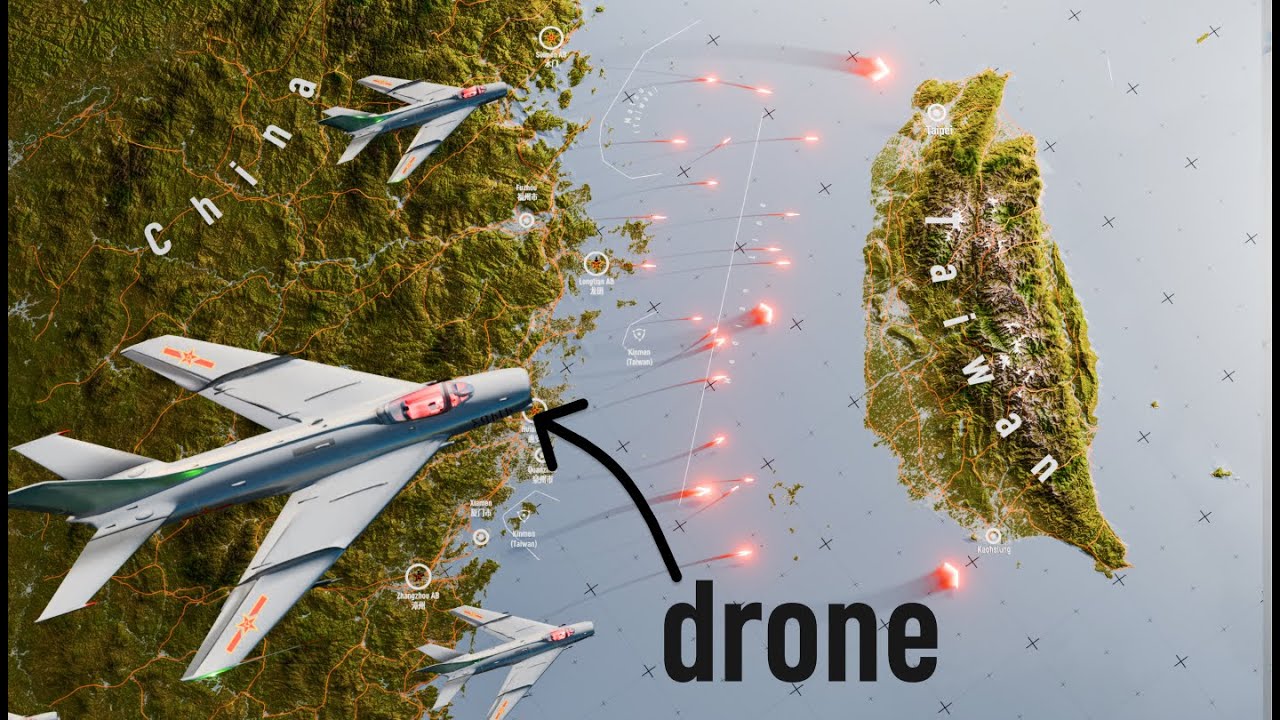
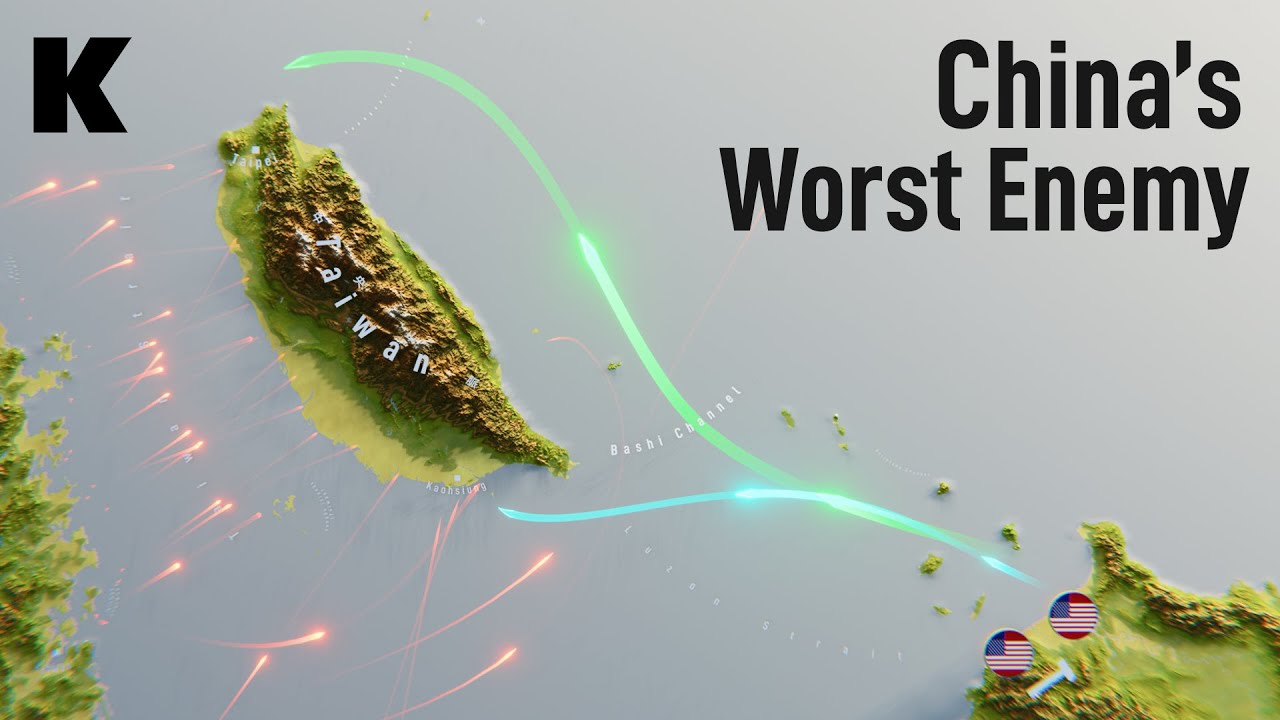
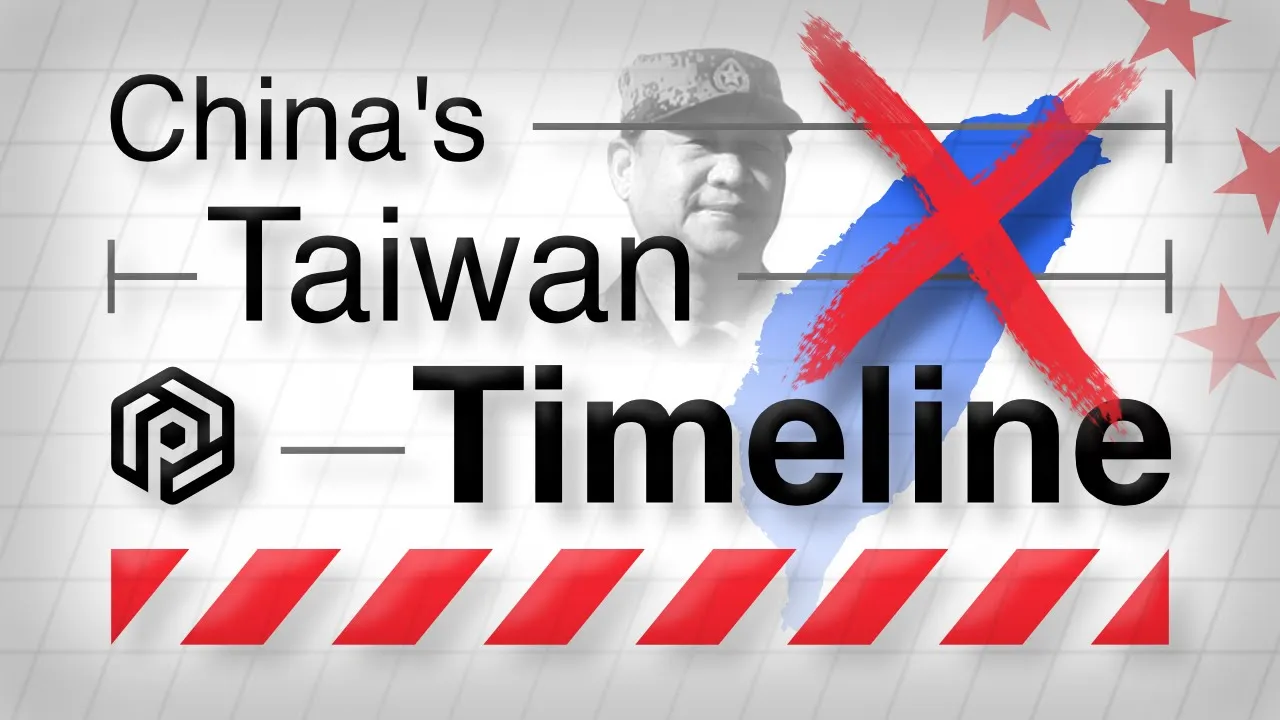
Here’s a timeline of recent Chinese “gray zone” tactics aimed at Taiwan – coercive activities that fall somewhere between normal diplomacy and outright war. For instance, in 2016 it suspended all communication. In 2019, its fighter jets flew closer to the island than they had in the previous two decades.
And the next year, Beijing stopped importing Taiwanese pineapples, one of its largest industries. Clearly, proponents of this theory aren’t hallucinating – tensions are undeniably growing. But although intuitive, this theory is not without its weaknesses.
Namely, if war is inevitable, why give your opponent a specific timeline? Generally speaking, politicians prefer to keep their options open. Why needlessly impose on yourself a deadline?
At a time when the U. S. and Taiwan are looking for reasons to increase their defense budgets, why give them the literal and rhetorical ammunition they need?
China’s best hope for success would involve quick, decisive action, giving America little time to respond. Yet, not only does China not hide its intentions, it releases footage of its replica presidential building online! If that first theory sees the current moment as a critical turning point where China is on the verge of finally following through on its promises, a second one sees as much continuity as it does change.
Sure, China has recently become more aggressive. But this timeline only goes back to 2016, during which Taiwan has only had one president and one ruling party. Now watch what happens when we extend the timeline to the year 2000.
From then until 2008, Taiwan was led by the “green” Democratic Progressive Party, which is skeptical of engagement with China. The DPP, at that time, inched closer to declaring independence than it ever has. …Close enough that, after China protested, George Bush stepped in to warn the island not to proceed.
Following this incident, Beijing enacted an “Anti-Secession Law” in 2005, which made explicit its longstanding threat to invade if Taiwan declared independence. All this changed in 2008, when the DPP lost to the “blue” Kuomintang, or KMT, which promotes engagement with China and is strongly opposed to independence. For the next eight years, its relations with China were the warmest they’ve ever been.
The two presidents met, shook hands, and signed a free trade agreement. Today, it may feel like a lifetime away, but less than a decade ago, many laughed at the idea that China would invade an economy it was investing billions of dollars in. Then, in 2016, the DPP returned to power.
While it no longer advocates independence, it has strengthened its unofficial relationship with the United States. In response, China cut off all communication, banned many Taiwanese imports, and conducted increasingly elaborate military exercises. Now, it’s impossible to prove whether China would’ve become more hostile even if the KMT had remained in power, but this timeline certainly suggests a clear relationship between the Taiwanese government and China’s approach.
This is not at all to blame Taiwan – Beijing chooses its reactions. It does, however, suggest a logic to this reprehensible aggression. Think of China’s position as a spectrum.
On one side is its ideal outcome – unification. On the other side are its “red lines”. Most believe that China would invade today if Taiwan declared independence.
In between is a range of more and less tolerable scenarios. With the KMT in charge, independence is off the table. China relaxes, and uses carrots to gently pull Taiwan toward unification.
When the DPP is elected, China switches to a coercive “stick” approach to push Taiwan away from its red lines. When viewed this way, Xi’s speeches sound a lot more like threats than announcements. When he seems to contradict himself by saying, quote, “We will continue to strive for peaceful reunification… but we will never promise to renounce the use of force.
”, you could stress the “force” part and dismiss the word “peaceful” as nakedly disingenuous. After all, China has been disingenuous about Hong Kong and Xinjiang and the South China Sea. You could also do the opposite and ignore what’s obviously a threat.
But there’s a third possibility: these two promises aren’t contradictory. China genuinely means both. On one hand, the idea of promising not to use force is seen as a dangerous concession.
Because it’s the only thing preventing Taiwan from declaring independence, it would forever close the door to unification. At the same time, waging an actual war would be extraordinarily costly. Taiwan produces roughly 92% of the world’s most advanced semiconductors.
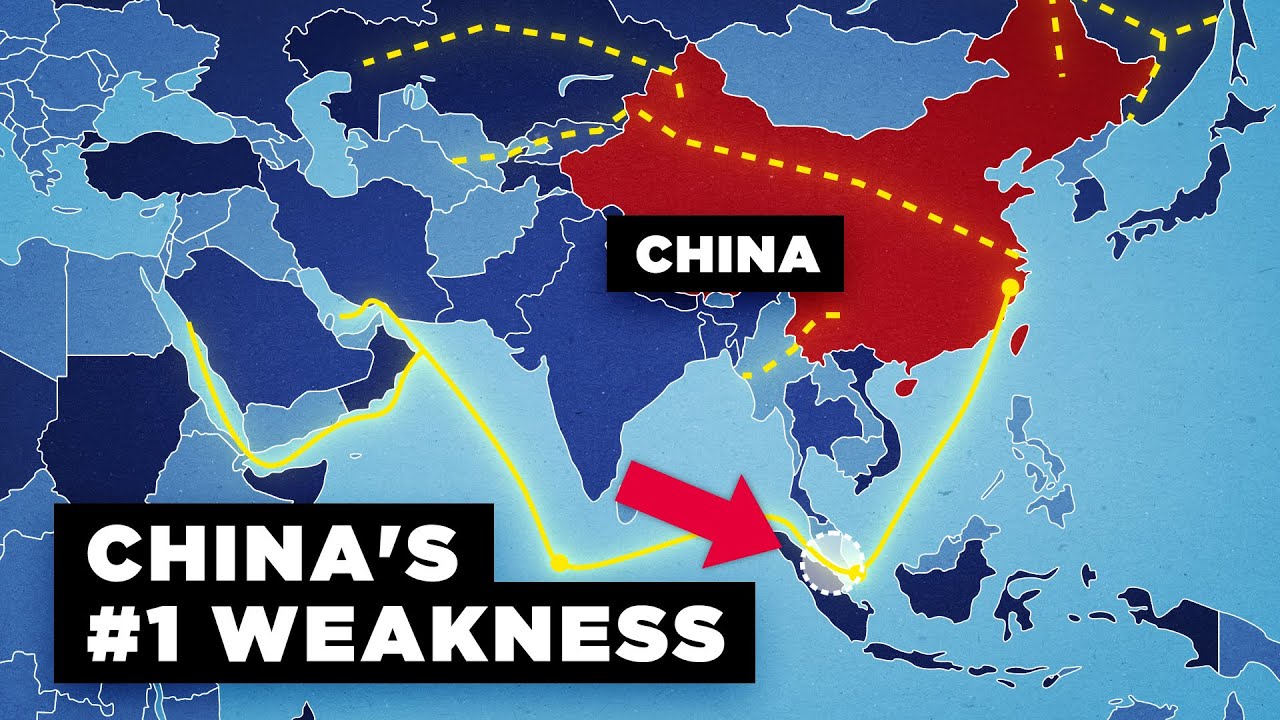
Nearly a fifth of the Chinese population lives in the three provinces closest to Taiwan. And 90% of the world’s largest ships transit through the Taiwan Strait. Even if they could take the longer route through Indonesia, it would increase shipping costs by an estimated half a billion dollars each month.
Collectively, a one-year war would reduce America’s GDP by 5-10% and China’s by 25-35%, according to one study from 2016. Now, let’s be clear: these are wild guesses. No one can realistically predict the outcome of a war between two nuclear powers with any accuracy.
The only thing we can say with certainty is that such a conflict would fall somewhere between absolutely catastrophic and existential. Xi Jinping’s 2049 milestone for “China’s national rejuvenation” includes economic prosperity – something incompatible with any invasion of Taiwan – whether successful or not. So, yes, China does prefer peaceful unification.
Of course it would rather achieve all of its goals without suffering any of the costs. Similarly, projecting a willingness to fight offers many of the benefits of actually fighting but few of the costs. ‘Toughness’ plays well to a domestic audience.
It appeases a powerful political faction – the military. It helps build Xi’s personal image. It’s an insurance policy against embarrassment in case of a confrontation.
…And it deters independence! 2049 could be a genuine deadline. It could also be, as the 100th anniversary of the PRC, a symbolic placeholder that feels far away, yet signals conviction, yet is also vague and non-binding – the perfect political ‘promise’.
Some observers claim Xi has urged the PLA to, quote, “date to fight”. But other Chinese speakers argue the phrase could just as easily mean “dare to struggle”. At the very least, his choice of words is deliberately ambiguous.
By definition, deterrence only works when indistinguishable from actual mobilization. In other words, it’s impossible to prove whether China is simply deterring independence or genuinely preparing for an attack. Having a larger, stronger military is useful whether or not it fights.
When taken as a whole, all the evidence proves definitively is that we simply don’t know when or if China will invade. The trouble with this indeterminate, conflicting “evidence” is that it’s ripe for cherry-picking. Sometimes this ambiguity is cynically exploited.
The more urgent the threat facing America, the more resources are directed to the military. But there are legitimate, or at least, understandable, reasons, too. The military’s fundamental, and in fact, singular mission is to prepare for every contingency, no matter how unlikely.
The real scandal would be if Admiralty Mike Gilday did rule out a Chinese attack in 2023. Or if General Mike Minihan wasn’t anticipating the worst possible outcome. Anyone who reads General Minihan’s memo in full will see that it clearly wasn’t written for a civilian audience – it uses Air Force jargon and adopts the tone of a stern, confident superior.
No one has to be doing their job poorly for the threat to be exaggerated. The issue may be that someone is doing their job. The problem arises when this mindset escapes the walls of the Pentagon.
In the media, not only do these warnings lose their institutional context – the organizational paranoia that we, the public, demand from the armed forces – but they carry undue credibility. At the end of the day, these are just guesses! That fact is confirmed by the sheer diversity of predictions.
Despite this, they carry significant authority. As one political correspondent wrote, “I don’t know if or when China will invade Taiwan… But I figure that when someone like four-star Air Force general Mike Minihan… writes…we should probably sit up and take notice. ” The United States should prepare for an invasion.
The consequences of a potential conflict would be so devastating that we simply can’t afford not to take the threat seriously. After all, Putin’s war in Ukraine demonstrates that no one’s sober, rational judgment can be taken for granted. The challenge is to prepare for war as if it were inevitable, without succumbing to a self-fulfilling prophecy.
To train for a sprint, while not losing sight of the fact that we may be running a marathon. If conflict is a chronic, not acute challenge, for example, America would be better off investing in, not diversifying away, from the Taiwanese economy, which only makes it more dependent on China. U.
S. -China tensions are unlikely to dramatically improve in any lasting way in the foreseeable future. Which makes careful management of that relationship more important than ever.
But it’s precisely because an invasion of Taiwan may not be guaranteed that we should take it seriously – our actions may influence the outcome. If an invasion isn’t guaranteed, exaggerating the threat could do more harm than good. As experts Ryan Hass, Bonnie Glaser, and Richard Bush point out, while an actual war is hypothetical, China is already engaged in a psychological war of attrition.
Contrary to what many Americans assume, no individual Chinese missile, fighter jet, or speech provokes much fear in Taiwan. But cumulatively, China’s objective is to slowly wear down Taiwan’s will to resist – to propagate a general sense of uncertainty and insecurity. In a 2017 survey, just 41% of the Taiwanese public believed China would attack if Taiwan declared independence.
Three years later, that number rose to 61%. If America’s pessimism is more fatalist than motivational, it risks doing China’s work for it. And finally, if or when we do detect signs of an imminent attack, one of America’s first actions will be to notify its allies.
Crying ‘wolf’ today would undermine its credibility tomorrow. In the early 2000s, for example, a Chinese general made headlines for claiming “hundreds” of U. S.
cities would be targeted with nuclear weapons if America defended Taiwan in a war. This comment, and others like it, led to panicked speculation about the true size of China’s nuclear stockpile. But this theory is likely wrong.
And this kind of exaggeration does no good for Taiwan. I explain why in this episode of “China, Actually”, which is available only on Nebula. In that same series, we also explore four other questions about China – like why most of the rare earth metals necessary to build electronics come from one rural town in Inner Mongolia, and why Chinese censorship is both more and less strict than we often imagine.
Nebula, the streaming platform built by and for independent creators, is the only place you can watch those videos. There are no ads or sponsors and many videos are available early. This one you’re watching now, for instance, has been available on Nebula since early July.
Nebula is home to dozens of other great Originals too – like Wendover Productions’ “The Logistics of X”, and RealLifeLore’s modern conflicts, explaining the wars we hear about in the news but rarely have time to truly understand. Normally Nebula costs $5 a month. But you can get it 50% off, for just $2.
50 a month, by signing up for a year with the link on screen or in the description now.