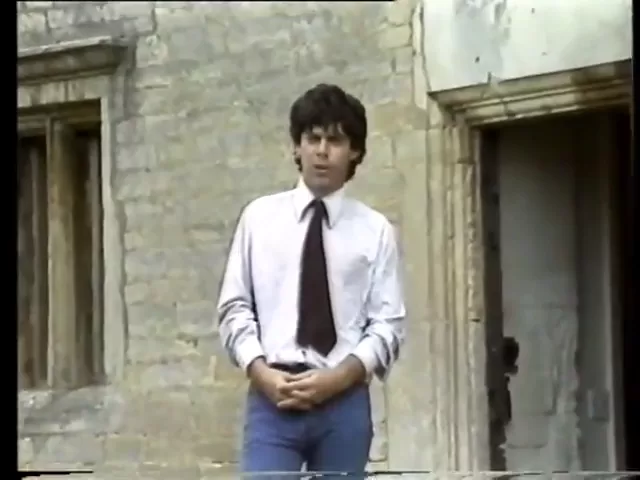
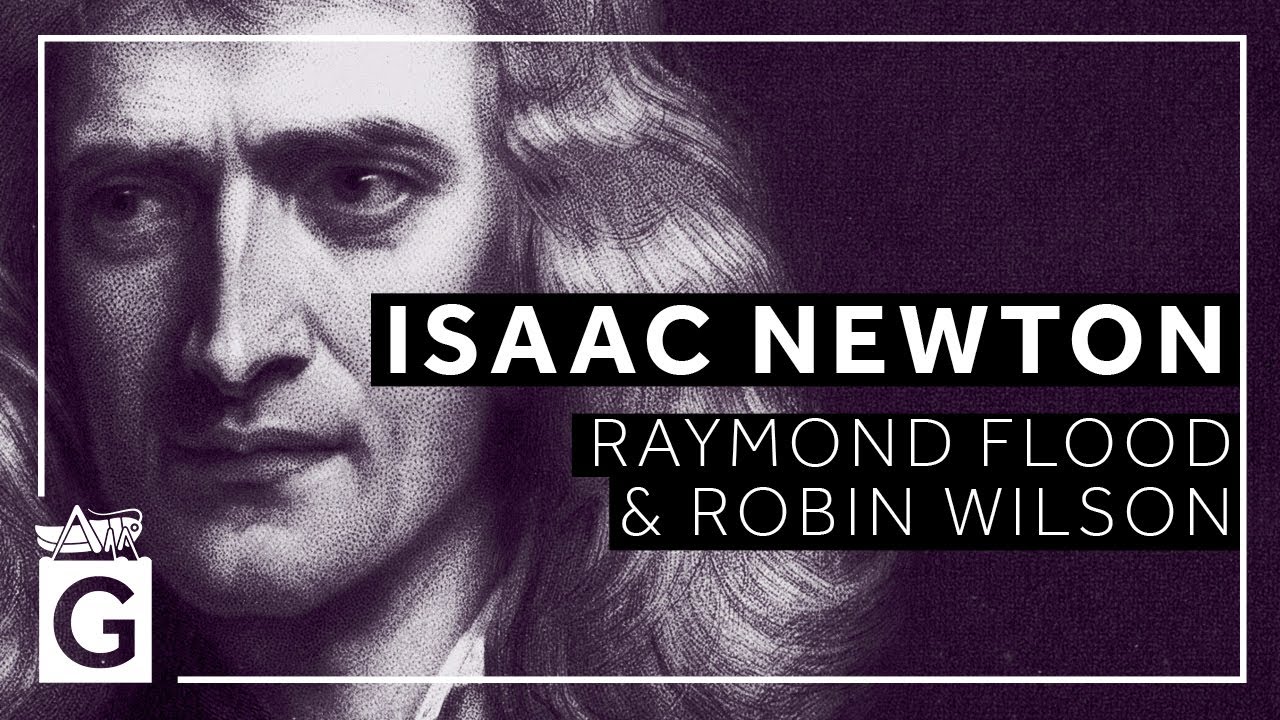
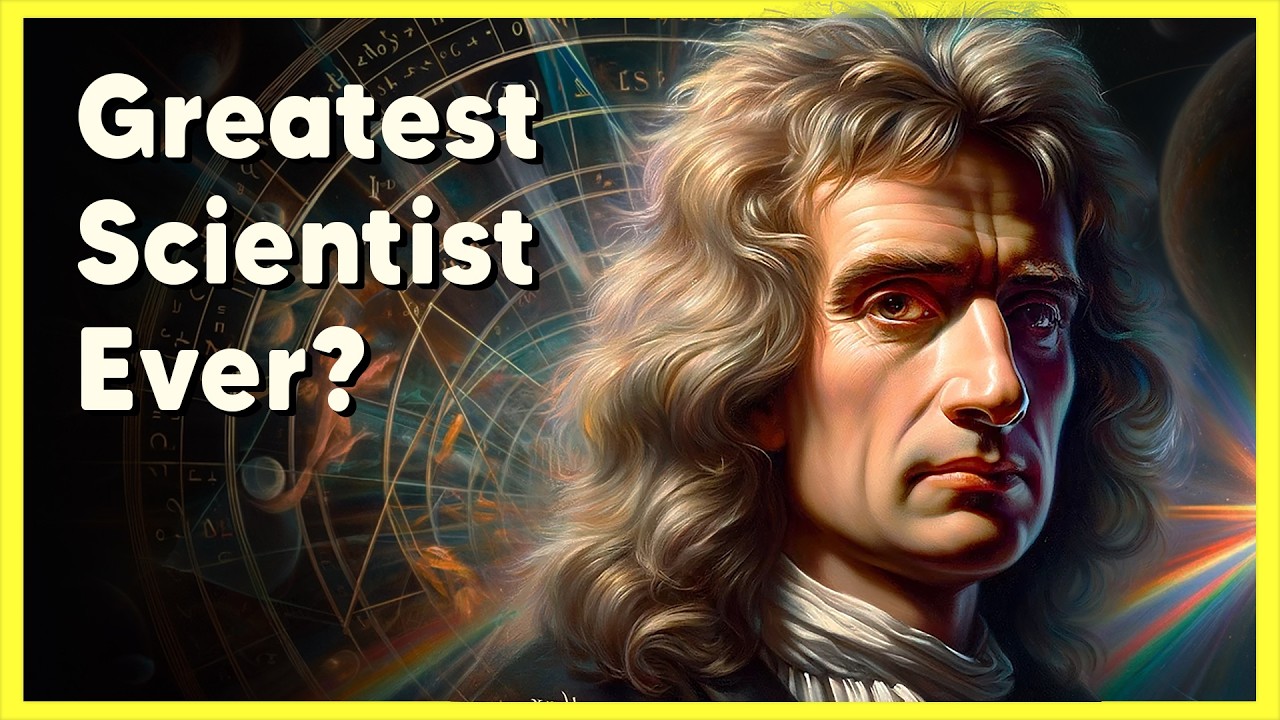
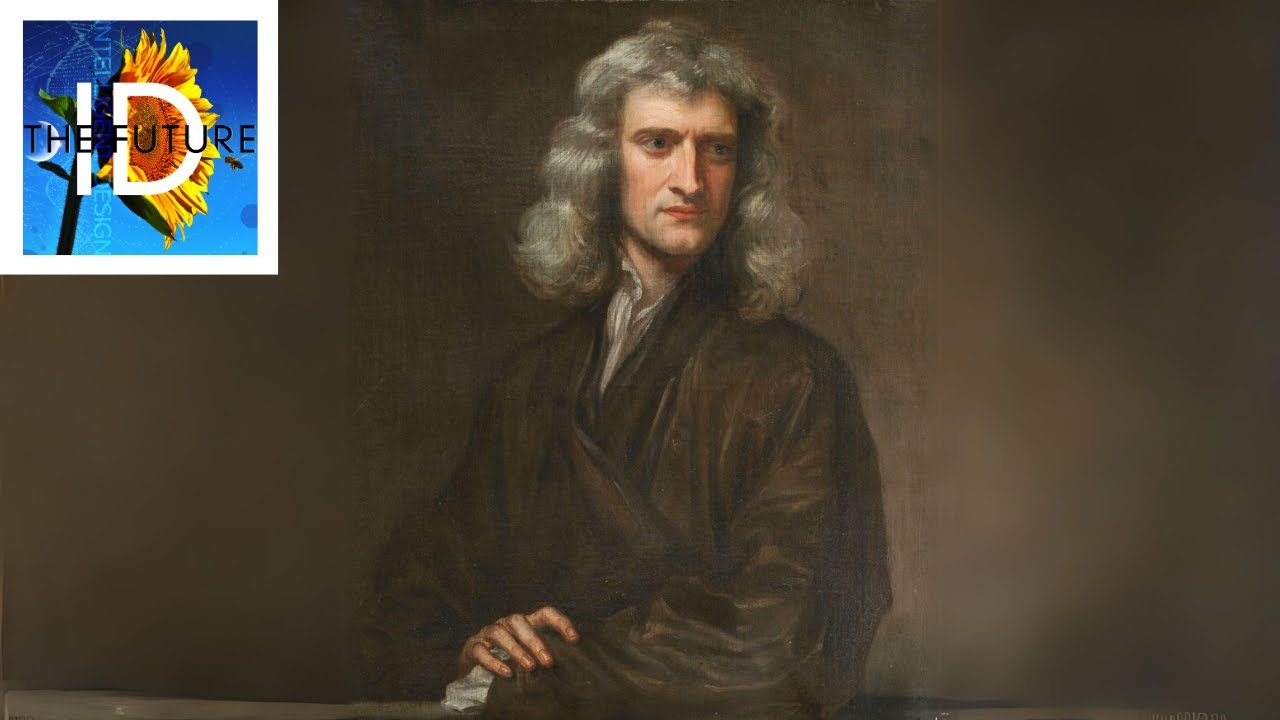
[Music] this is wool's thought manner in southern Lincolnshire Isaac Newton was born here on Christmas day in 1642 he was a weak and sickly child he later said that when he was born he could have fitted into a court pot and in fact he wasn't christened for a whole week until the 1st of January 1643 his father Isaac senior had died before his birth and his mother Hannah acoff now a widow soon married the local landowner Barnabas Smith the family's wealth increased steadily during the 1650s until at the end of the 1950s they had risen
to obtain an annual income of more than £700 a year making them one of the Thousand wealthiest landowning families in England they were wealthy enough in fact to send the young Isaac to the local school King's School Grandam where Isaac Newton was a distinguished but rather lonely and solitary pupil there are stories about his Technical and mechanical ability about his constructing a model Windmill and and so on but these are clearly myths which serve to illustrate the young genius's skill in science and technology in the event he studied at at at Grantham in the classics
notably Latin and Greek and by the end of the 1650s he was ready like many of his class to go to the university at Cambridge where he went in the summer of 1661 clearly therefore Newton was the product of a very typical mid- 17th century environment his family's income and his own income derived from land and from the rents from that land and it wasn't until he left Lincolnshire to go to Cambridge in 1661 that he was ready to begin a properly Scholastic career this is Trinity College Cambridge Isaac Newton arrived here at the age
of 18 in July 1661 and he was to spend more than 35 years of his life within its walls the function of Trinity College and the other colleges of the University of Cambridge was to train young men for government service and for the church and to this end their students were instructed in the conventional Scholastic curriculum which had pertained here for more than 400 years Newton himself lived a rather secluded life whilst an undergraduate he was a sub cizar that is to say a poor scholar paying his way by doing services for wealthier students students
and for the fellows but it was also during those very early years in Trinity that Newton first came into contact with the latest developments of the new philosophy which was being produced in England France and Holland at this time he would buy books of dayart and of the geometers from Holland at the local book fair and he studied them in private in his room when the University was closed for almost 18 months during the Great Plague which began in the summer of 1665 Newton returned to his family home in wols Thorp and it was there
that many of the most important developments of his intellectual career began when he returned he was elected a fellow and ultimately in 1669 became the second Lucasian professor of mathematics in the University of Cambridge when the Great plague broke out in 1665 Cambridge University closed and Isaac Newton returned here to his family home in westhorp it was during the two years he spent here from 1665 until the spring of 1667 that most of the important research projects of his scientific career began those on Optics on mathematics and on the mechanics of moving bodies these years
are described as Newton's anos mirabilis and he later said said that it was then that he was in the prime of his invention it was also at this stage that the story about the Apple falling and inspiring Newton with the idea of gravity is supposed to have taken place in fact it's now clear that that story was a myth it was told by Newton when he was 80 years old to a friend to explain his original creative burst but in fact the work of those years particularly the the research he performed on the Spectrum and
the papers he wrote on the calculus became important resources in the scientific research he conducted through the second half of the 1660s and on into the 1670s when he was working in Trinity College Cambridge Newton's career in Trinity College was dominated by problems of power and patronage he achieved his position as mathematics professor because of the patronage of one man Isaac Barrow his predecessor Barrow was impressed by the young Trinity fellow's mathematical skill in commenting on a recent mathematics book and when Isaac Barrow wished to move down to London to continue his work as a
priest he directly appointed Newton his successor similarly a few years later when it became clear that in order to continue as a fellow of Trinity College Newton himself would have to become a priest Newton traveled down to London to petition the king's ministers for a special Act which would release him from the UN from his obligation to take holy orders these kinds of political negotiation came to dominate Newton's life during the 1670s and 1680s towards the end of the 1680s while he was becoming extremely famous in other fields Newton went with a delegation from the
University to see King James and judge Jeff to resist the imposition of Catholics as members of the University and finally in 1689 Isaac Newton was elected Member of Parliament for the University of Cambridge in the first Parliament that met in London after the Glorious Revolution so we can see that for Isaac Newton Cambridge was as much a political and practical problem as it was a Haven for his own private work most of Isaac Newton's career at Trinity College was spent in private contemplation even though he was professor of mathem adcs he often as the saying
was lectured to the bare walls often too his lectures were written and deposited in the University library but never actually delivered at all most of the time therefore he was locked inside his own study doing research on areas of natural philosophy Alchemy and chemistry and his own crucially important work on the history of religion and on chronology it was these areas of Investigation which dominated Newton's life he was insensitive of criticism he was often unwilling to communicate his own results when he did intervene for the first time publicly in a scientific debate it it was
under extreme pressure from the secretary of the Royal Society Henry aldenberg Newton had sent down to London a copy of a reflecting telescope which he had invented at the end of the 1660s the Royal Society was extremely impressed by this budding optician and demanded more Newton sent a paper on the theory with which he designed that telescope and was then drawn into an extremely extended controversy which lasted for more than four years the controversy involved men of the caliber of Christian hyans and Robert Hook and Newton was unwilling to continue that controversy once it he
had terminated it in 1675 he'd learned his lesson and for the rest of his life he tried to live in solitude pursuing his own experimental and theoretical researches first of all in the privacy of his rooms here at Trinity and later when he left the college forever in 1696 in London in the summer of 1684 the young Secretary of the Royal Society Edmund Halley paid Newton a visit in Cambridge hi wished to discuss with Newton the famous problem of planetary motion this was a problem which had haunted astronomers throughout history Newton was able to tell
hiy when H reached Cambridge that he had been working on the problem for a number of years and that he had reached a completely satisfactory solution to the crucial problem of the relationship between the shape of the planetary orbit and the force which would attract the planet towards the sun hie was astonished by this news and encouraged Newton to publish his results immediately Newton was unwilling to do this because as we've seen he was unwilling to re-enter any further controversy which the with the scientists in London however he Incorporated his solution into a series of
lectures which he delivered in Cambridge during 1684 and under Hal's further encouragement and at Hal's own personal expense Newton was able to publish the three volumes of his great book the mathematical principles of natural Philosophy by 1687 under the aaces of the Royal Society and with the name of the president of the Royal Society Samuel peeps rather conspicuously placed on the cover with the publication of the prinkipia Newton's reputation as a European scientist was of course secure but the event of the publication coincided with an with a crucial political event within England itself the Glorious
Revolution during the late 1680s the King James II had attempted to impose Catholicism on the nation and in particular on Cambridge University Isaac Newton had led the resistance to this move and after the overthrow of King James in November 1688 Newton as we've seen became a member of parliament he was thus drawn increasingly into the sphere of public affairs during the early 1690s his influence on public Affairs grew the new King William III looked for a system of legitimation for the new orange regime and newtonianism provided this new legitimation on the death of Robert Bole
in 1691 a series of lectures were established in London to be given each year against quote notorious heathens atheists infidels and Jews the first boil lecturer Richard Bentley chaplain to the bishop of Worcester gave these lectures by attacking atheists and radicals on the basis of the new Newtonian Anglican religion and through the boil lectures the religion of Newtonian science was effectively propagated throughout the English ruling class in 1696 New Newton himself left Cambridge he had been searching for a job in London for over 5 years and his new Patron Charles montigue the chancellor of the
exer and leading wig Lord found him a job in charge of the Royal Mint thus in 1696 Newton left Cambridge forever and moved down to the Tower of London where the Royal Mint was situated and from where Newton ran the affairs of the currency of the country with his with his usual rigor and efficiency he prosecuted coiners and forgers and Clippers and he was instrumental in helping the Reconstruction of the English currency after the great recoinage of the 1690s Newton was therefore by the end of the 17th century a crucial figure in the wig establishment
he held a a government office he had published the prinkipia he was one of Europe's most famous scientists during the first two decades of the 18th century Newton effectively cashed in all of these advantages he was knighted by Queen Anne in a ceremony held in great Court in Trinity College as an election stunt during the election of 1705 he became president of the Royal Society from where as autocrat of science he grew to dominate the whole Corpus of English natural philosophy through the work of his laboratory assistant at the Royal Society Francis hawksby Newton introduced
the new experimental philosophy to A Wider Circle finally in his last years Newton was heavily involved in a fierce priority dispute with the German mathematician and philosopher lib nits over the priority of the invention of the calculus these disputes continued all almost to the very day of Newton's death but after his death his burial was a matter of national celebration and ceremony he was buried in Westminster Abbey as Vol later said like a prince who has conveyed benefit upon his subjects Newton the national hero the figure who would come to dominate 18th century science represented
in his tomb in Westminster Abbey the apotheosis of British Science this is Newton's study in woles thought Manner and it was here in the Years 1665 to 67 that Newton came while the University was closed because of the plague it was in this room many historians believe that Newton conducted his experiments on the transmission of light through a prism to produce what he called the celebrated phenomenon of colors these experiments with the prism were Newton's first public intervention in the scientific community of England in the 17th century Newton's earliest work to gain wide attention in
London was his work in building a reflecting telescope which he had assembled by the end of 1669 this was a radical new design which enabled a massive increase in telescopic power while making it unnecessary to construct the gigantic so-called aerial telescopes which had dominated astronomy up till then Newton sent a version of his reflecting telescope to the Secretary of the of the Royal Society Henry oldenberg in London and the Royal Society was so ecstatic about this new machine that it demanded further information from Isaac Newton about the work he was doing on Optics and so
in 1672 he sent the Royal Society his first paper on the celebrated phenomenon of colors this first scientific paper of Newton was also effectively the first scientific paper ever and the violent response which which it drew in London was to contribute to Newton's later fear of scientific controversy the arguments that he put forward in this paper Drew on the experiments that were that were performed here at westhorp and also in his rooms in in Cambridge what those experiments showed primarily were two crucial errors in the then existing theory of light and colors first Newton showed
that light reduced colors not by a series of modifications but that light was inherently made up of differently colored particles secondly he investigated the way in which those particles nevertheless made light a periodic phenomenon so-call Newton's Rings Newton finally published the results of his experimental work of the 1660s and 1670s in his famous book The Optics which first appeared in 174 after the death of his great rival Robert Hook in the Optics Newton constructed a model of a new science of colors and therefore a new kind of experimental natural philosophy his achievement in this book
was twofold first of all he'd shown how a specific kind of matter Theory and a specific kind of experimental analysis could penetrate to the heart of one of the most difficult of all experimental Sciences secondly he'd shown how this sophisticated mathematical analysis could actually be applied to the real world of nature for example in his famous crucial experiment which was redescribed here in the Optics in 1704 Newton provided a model of what a crucial experimental trial should try to do and how it could discriminate between rival hypotheses for the next 100 years in fact the
Optics was to be a model of how experimental science should be conducted and although experimenters were often rather Wayward in their interpretation of what Newton had achieved in this book nevertheless the Optics became as one historian has observed an Augustine Monument a monument of 18th century method now in Newton's Optical science he had used a particular model of mechanics in his prinkipia too he was to make that model of mechanics the most powerful model of God's action in the universe for most 17th century natural philosophers for example the great French scientist Renee deart natural philosophy
was a question question of analyzing the world in terms of two factors alone matter and motion all other factors in the natural world had to be excluded as occult ancient Scholastic and therefore all that scientists could do was to explain the change in nature in terms of these two qualities in terms of particles moving now what Newton did during the 1670s and 1680s was to analyze and introduce into the world of mechanics A New Concept the concept of force now it's a matter of some historical debate as to where Newton's concept of force came from
if we consider for a moment the work of dayart and his greatest follower the Dutch scientist Christian Hy we can see the contrast with what Newton was doing in dayart for example the planets move in whirlpools called vortices pushed around the Sun by impact mechanisms in Christian hans's Great Book of the 1670s the horologium oscillator hyans worked out the laws of centrifugal force and the motion of bodies in their orbits but what Newton did in this rapid burst of creative activity in the 1680s was to see how the forces that linked planets with the sun
could be understood not mechanically but mathematically The crucial intervention here was to combine a force between the planet and the sun with the correct inertial law for the motion of the of the planet tangential to the line joining the planet to the Sun it was this that Newton used in his first attempted solution of the ballistic problem in 1684 and this that he placed at the center of his analysis of planetary motion in the prinkipia of 1687 so evidently the key to Newtonian cosmology is the concept of force an active principle impressed into matter by
God one important source for Newton's concept of force and Power in matter was evidently his long drawn out project on Alchemy for Newton Alchemy was a secret knowledge which could penetrate to the heart of matter its secrets were lost buried inside the occult treatises of older writers what Newton felt that he should do was to extract the kernel of this alchemical work and to use it to understand how the relationship between force and matter was built up his work on Alchemy began in the late 1660s when a circle of workers in Cambridge communicated to Newton
some crucial medieval and early Renaissance alchemical texts Newton immediately began his work on EXP experimental Alchemy he constructed a laboratory in his garden in Trinity College and began to perform long drawn out experiments some historians have speculated that it was because of these experiments that Newton um became poisoned by Mercury and Arsenic and had a nervous breakdown in 1693 but this seems a rather far-fetched idea nevertheless what we do know is that Alchemy was one of the few activities which Newton stuck to for most of his active natural philosophical career what he leared from this
work was that God could impress active powers in matter and that the cause of gravity could be such a power it was dangerous for religious reasons to suppose that gravity could survive in matter in other words that matter was inherently active it was necessary to show that the activity of matter came from from God and the work on Alchemy was an excellent resource to make this clear obviously none of this alchemical or chemical work appeared in the prinkipia but in the final sections of the Optics entitled The queries Newton in a speculative manner inserted an
increasingly long number of comments on the way in which active principles could live inside apparently passive inert matter and he saw here the causes of electricity of gravity of chemical fer fermentation of volcanic activity and so on and here we see the crucial link between Newton's work on chemistry and his work elsewhere on Optics and on mechanics but for his contemporaries for whom this work on Alchemy was unknown Newton's greatest achievement was indubitably his work in rational mean mechanics and astronomy the apotheosis of the prinkipia what was Newton's achievement well I think we can sum
it up in three headings first of all what Newton had done was to show that a single guiding force ruled the universe that single guiding force was gravity in the prinkipia he'd shown that the motion of the Comets of the Moon of the tides the procession of the equinoxes and the fall of bodies on Earth were all due to the same fundamental action Universal gravity secondly he'd shown that this Force could be analyzed mathematically an excellent example of this strategy of Newton's is his argument within the body of the prinkipia about the importance of Kepler's
laws Kepler was the greatest astronomer of the early 17th century in his book the new astronomy he' shown that the planet Mars orbits the Sun in an ellipse and that the radius Vector connecting the planet to the Sun sweeps out equal areas in equal times this was a fundamental achievement of crucial importance but it was only with the appearance of the prinkipia that the full import of Kepler's analysis became clear what Newton showed was that if there was an inverse Square law linking each planet to the Sun then Kepler's laws would follow and similarly if
Kepler's laws were true then there must be an inverse Square law Force linking each planet to the Sun a mutually necessary relationship but what Newton did was far more sophisticated even than that because by showing that the force that linked each planet to the Sun was the same Force he was able to account not merely for the regularities that Kepler had analyzed but for many of the deviations from those regularities the prinkipia therefore appeared as a masterpiece of the command of mathematics over the natural world and finally and most importantly the prinkipia revealed the work
of God gravity as we've seen with its connection with other active principles was a Divine principle when Richard Bentley gave his boil lectures he presented Newtonian gravity as just such a Divine principle proof that God was as it were in the driving seat and so Newtonian physics represents the Triumph of a certain kind of natural philosophy and also the Triumph of a certain kind of religion Isaac Newton has always been the image of the heroic scientist the isolated genius working late and alone in his study discovering the truths of the cosmos by a process of
inspiration and hard work or by thinking upon it as he himself put it and the image we have of Isaac Newton determines in a sense the image we have of experimental science what I've tried to show in this film is that Newton's work was related in an extremely intimate way with the context in which he lived the concerns of his life his work in astronomy mechanics the motion of bodies on Optics were all crucially linked to the principal interests of natural philosophers politicians and theologians of the second half of the 17th century in England so
in order to understand the Newtonian achievement with its revelation of the great creative and guiding hand of God with its revelation of the supreme power of mathematical analysis with its evidence of the first scientific paper of the rules of scientific method imposed on three successive Generations all these aspects of Newton's work can only be understood as an integral part of Barack English society Newton was a man of his time his interests in showing how God ruled the cosmos were interests in showing how Society should be ruled his interests in navigation or in astronomy revolutionized man's
technical control over nature and so to see Newton as an isolated genius is to do Newton a profound Injustice as a product of his time he both over became and exemplified perfectly the the concerns of 17th century English society and of 17th century English science [Music]