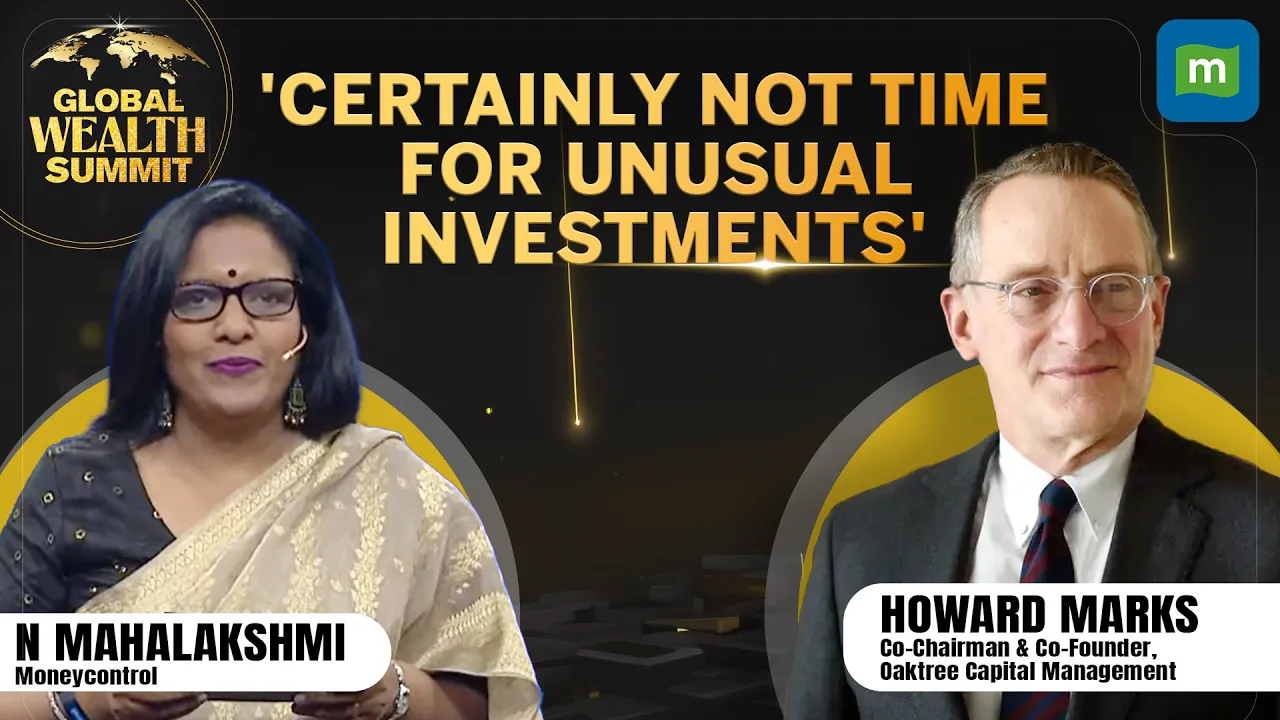
it is now our privilege to introduce Howard Marx co-chairman and co-founder of Oak3 Capital Management a legendary investor known for his contrarian thinking deep insights in market cycles and expertise in value investing His famous memos are widely read by top investors including Warren Buffett Please welcome Howard Mars and Mahalakshmi Aran Swami of Money Control for this conversation [Music] Thank you so much uh Sonel and thanks so much Howard for this incredible opportunity to talk to us I won't waste even 10 seconds uh talking about anything else straight diving into the questions and I just picked
up something you said in your latest memo and I read this out There were only four times in the history of S&P 500 when it returned 20% or more for two years in a row In three of those four instances the index declined in the subsequent 2-year period The exception was 1995 to98 when the powerful TMT bubble caused the decline to be delayed until 2000 But then the index lost almost 40% in the 3 years later In the last two years it's happened for the fifth time The S&P 500 was 26% up in 2023 and
25% in 2024 marking the two best year stretch since 9798 What is different this time in your view I know that you hate to do predictions but probabilistically speaking it looks like stocks will underperform bonds inflation and cash over the rest of the decade What's your view Well uh I'm I think if you accept the past numbers and it's dangerous not to then you have to accept the fact that today's valuations imply modest returns over the coming decade Um uh you know one investment bank said uh 3% a year uh in no early November Another
said five and a half Uh certainly we're uh you know the historic average return on the S&P has been 10 but we're at an above average valuation We guessed we'll have below average prospective returns What's different this time if anything is the uh constitution of the S&P 500 We have the Magnificent 7 It appears that some of them or if not all are some of the greatest companies we've ever seen better than the companies that led the S&P in the in the past You know when I started work reported for duty at First National City
Bank in September of 1969 we were investing in the nifty50 and those were the magnificent companies of their day uh selling at much higher P than today uh some of them didn't last very long and if you held those stocks for 5 years you lost more than 90% of your money These look like better companies to me although I'm no expert I'm not an equity person I'm not a tech person selling at lower PE ratios So you know there's always an argument this time is different Usually it's not different but sometimes it is This could
be one of the times when it's different but I think that it it's hard to argue that the S SNP is positioned for uh above average returns and maybe not today even for average returns Fair enough I was just about to come to that Uh do you think the craze around AI today is reminiscent of the Nifty50 era Well it's reminiscent in the sense that uh the nifty50 era was based on uh the new new thing It was dry copying for Xerox was computing power for IBM Um uh super drugs for uh Merc and Lily
Um uh instant photography for Polaroid and so forth And u most excesses in the markets I hesitate to use the word bubble but I will Most bubbles are by necessity built around something new something where there's no precedent permitting them the the imagination uh to to fire uh and uh and confidence to escape reach escape velocity Um in in 1999 we had the internet and people said the internet will change the world Guess what The internet did change the world They were right But they were wrong to value the companies as they did They were
wrong to assume the persistence of the companies that they did And most of the companies that went public in the in the uh TMT bubble of 989 are uh worthless today So now we have another new new thing The AI AI is expected to change the world I'm no expert I assume it will Uh nobody knows how Certainly no Nobody has knows when or to what extent I think it's going to have a profound impact Uh but again assumptions are being made about persistence and leadership Uh I can't dispel them I can't endorse them I
only say that require attention Fair enough But is it um is it a some kind of a warning signal you would say for investors because the magnificent seven have contributed to more than 40% of returns for 2023 as well as 2024 again numbers that on their face are are are a yellow light at minimum On the other hand you know it it I think that the the experts uh and certainly the optimistic experts would say wonderful companies at at at reasonable PE ratios So the mere fact that they're up is in troublesome if in fact
they're they are indeed great companies at at reasonable prices Somebody else will will have to tell me whether that's true today and of course we'll get the judgment of the market in the coming years Right Uh moving on to interest rates Something you've said recently interest rates will not return to ultra low levels nor will they continue to decline Why do you say that high interest rates in the huge I also want to you know just just say that high interest rates in the US have historically been correlated with low stock returns What's your take
First of all I want to clarify today's interest rates are not high H everybody says to me "Oh you mean you're saying that rates will be uh higher for longer?" Higher than they have been in recent years right But not not high in the absolute Um now I referred to it guard of the Fed funds rate for the last 70 years most of which I've seen and it averages just under 5% Today's interest rate is below average on that basis and I imagine will be brought down uh a bit in the coming years Um but
you know we went through a period from the beginning of '09 when the Fed took the Fed funds rate to zero to fight the global financial crisis until the end of 2021 when the Fed gave up on inflation being transitory and concluded that it had to raise rates to fight inflation Over that 13-year period I even I was surprised to learn when I studied it that the Fed funds rate was zero most of the time and averaged about a half% So that's the abnormality right That was abnormal I merely think we're not going back to
that abnormality Today's rates are quite normal and I see no reason why we shouldn't stay here It it seems like the markets are very um stuck up on you know decline in interest rates as a trigger for stock rates to go up Um is that expectation sort of misplaced You think this is a new normal whether there are pulls and pressures on monetary front or fiscal front these interest rate these interest rates are okay for the US economy to continue to fair the way they are Um I I think that today's rates are within the
band of normaly I think they can stay there Our our economy in the US is functioning well It's not booming and thus it does not necessitate a bust It's not sluggish it's performing well and I think that it today's rates or rates a little bit lower uh will be uh perfectly uh appropriate uh for that uh our economy does not need stimulus by taking rates way down it does not have to be restrained from overheating by taking rates way up I think rates can stay here and and I I think they're quite reasonable Sure History
doesn't repeat itself but it often rhymes said Mark Twain What is history teaching us now Well of course today isn't history yet and we'll when today becomes history several years from now we'll we'll learn its lessons The important message from that quote from Mark Twain which I think is one of the most important uh quotations in my world is that the details of history change the events change the reasons for them change the results of them change but certain things do persist and rhyme if you will from year to year and uh generation to generation
And most of those things or I should say many of those things are are behavioral And you know uh people will always get over excited when things go well and take asset prices too high and then when things uh come off uh they'll get too depressed and they'll take prices too low These are the things that rhyme from cycle to cycle and we have to be alert to them When things are going well people will lever up their enterprises in order to magnify the gains and they'll do that because they underrate the probability of losses
and they forget about the potential of leverage to magnify losses instead of gains But it works both ways This is another lesson that that repeats from from generation to generation and usually has to be relearned from generation to generation because uh it's a lesson that's forgotten in good times So um I believe we'll always have cycles Optimism will be taken to excess Bad deals will be done when spirits are too positive and those will be exposed in slower times through losses Um now you ask what what will we learn from today Today I think uh
as I say the economy is performing well The prices are generous let's say high In my uh memo of two months ago on on on bubble watch I said lofty but not nutty and I stick with that I don't see massive psychological excesses today and of course the events of the last uh uh days and weeks uh have even reduced uh the enthusiasm further Uh but I think that you know we know that the PE ratio on the S&P 500 is at an above average level maybe warranted based on the excellence of of the companies
in it or maybe not but certainly not underpriced uh and certainly not in my opinion time for uh unusual aggressors Sure Uh this question may sound um like it's a bit of an exaggeration but probably it's not Is value investing extinct Buffett says that all investing is value investing but if the essence of value investing is buying assets for less than what it is worth We haven't seen anything close to that in Indian equities for the past two years not in US perhaps in China Uh what would you say It it's a very complex subject
I I can't do it justice and if if I try you'll run out of patience with me But uh I wrote a memo in January 21 and all the memos are available on the Oak Tree Capital website under the heading insights It was called something of value It ensued from discussions I had with my son Andrew when he and his family moved in with my wife and me during the pandemic He's an investor I'm an investor We we we actively debated the question of value investing Now value investing to me means uh not thinking of
investing as pieces of paper that you trade daily uh for profit but thinking of an enterprise that you want to be an owner of and are willing to hold for the long term And you know you if you're if you're looking at a business and thinking about whether you want to buy a share of that business and hold it for the long term you're probably going to want make sure that the price is reasonable And I think all of that makes sense Now all semantics eventually get taken to an extreme and and and we we
it morphed into value investing with a capital fee And what value investing with a capital V was taken to mean was disregard for the future concentration on the present insisting on discount valuation parameters Andrew insists I came to the I accepted his contention that that that that doesn't have to be the definition of value That's too extreme It's too dichomous separated from growth And people like to dichotomize and codify things very formalistically But I I think you know um the way you're using it let's say where you're using it in a sense kind of in
the middle and uh you know the world tends to think that that growth stocks are companies with high rates of growth projected into the future and value stocks are are companies with modest growth rates with an emphasis on the present I think if you think about it that way the lesson is that since quote growth investing is future oriented it is accepted more readily in optimistic times And when people turn less optimistic and are less willing to credit the future uh with great events then they uh become a little more cautious and they want value
in the here and now So they look at what are called value stocks So I think if you look the most part not precisely but I think that that that this that growth investing value described that way rises when people are optimistic and value uh does better when people are are defensive or pessimistic Well the answer is that people haven't been fensive or pessimistic in a long time You know we the last serious prolonged negative incident we had was the global financial crisis which uh started in '08 So it's almost 17 years old We had
something called the pandemic in 2020 It was a very serious event A lot of people lost their lives but the markets and the economies kind of shrugged it off in short in short order So it didn't really last and it didn't have a profound effect So I think that if you look you would you would conclude that for the most part optimism has prevailed for 17 years or at least 16 or maybe 15 and and that's a big part of why what you call growth what most people call growth has done so well There will
be a time for value A time when people say well those stocks are being valued very highly because people say they have a bright future but I'm worried about the future and people I think people will return It's not growth or value It's that these sorts of companies have dominated the calculation of the S&P 500 for years and um and are the the the trend towards passive and index investing has amplified their the the uh the uh power of the S&P companies relative to the non-S&P and I think that's been an important contributor to the
success of you know there's there's a uh there's an overlap if you have a ven diagram an overlap between uh growth and S&P they're not the same things definitionally but there's a coinc coincidence and uh I think that indexation and passive investing have directed a lot of money towards uh it happens the growth aspects of the S&P I I it's it's hard to know when it's going to stop But you would think that if the S&P companies appreciate a a lot longer and the other companies appreciate much less you would think that eventually the S&P
companies will become so rich that that they can't keep outperforming Uh but my answer to that is same as my answer to many things We'll see Right So there is also a contrary logic uh that some people argue One argument in favor of high price multiples uh and strong equity valuations especially in the US is that industries are consolidating and we're not talking about just new uh uh new tech or AI uh but even traditional industries which is making companies significantly more efficient and profitable Corporate profitability in America is at a historic high at you
know 11 and a half% Of course real wages are at a historic low that's a different matter altogether Do you think this is good enough reason for equity valuations to sustain at elevated levels despite higher interest rates You know I don't have an answer to your question but what I'd like to do I'd like to discuss the form of your question for the benefit of the audience Um first of all it's dangerous when you assess the appropriateness of the market pricing based on one factor at a time because there are so many factors that matter
Uh um but um uh you know the re people tend to say well you know there's there's more concentration there's more profitability Uh companies are better today uh it merits a higher ratio That's the line of argumentation Well I would say maybe Um the question is how much better are the companies How much better do people assume they are Are their assumptions correct How much superiority is priced in to the prices today Is that degree of superiority uh appropriate So you know better companies higher multiples easy to say but hard to be sure that the
increase in superiority and the increase valuations are uh appropriate for each other Sure Um Howard how do you think Trump's policies are likely to reshape business and financial markets globally For us particularly do you think tariff induced inflation the cut in government jobs poses a real threat to US demand and therefore economic growth Uh we've been talking about a recession for the past 3 years It's never it never happened Growth has been fairly buoyant Um what is your view on that And secondly what should global investors be watchful of Well the overarching thing that everybody
should keep in mind is that Donald Trump is a pro business president And you know there's a old saying from from my youth that what's good for General Motors is good for America And you know I would say in general this is a vast overgeneralization the Republicans would agree and the Democrats would disagree And certainly today there's a whole uh element in the Democratic party which thinks that business and free enterprise aren't such a great thing Uh Donald Trump thinks they are and he will try very hard to uh to make business do well and
American business do especially well Um but some of the uh actions can have uh short-term negative effects uh for example the tariffs which he thinks will uh you know uh discourage uh imports and encourage exports and produce revenues for the government to balance the budget Uh all of that seems like great things but they should have an inflationary uh impact Uh that's just one example um the uh his I think it I think his policies taken to their logical extreme and we don't know how far they'll be taken u would end up in a lower
level of globalization than we otherwise would have seen Globalization in my opinion is is a wonderful force Uh it it rises it raises boats all around the world It lets everybody and every nation do the things they do best and everybody in the world benefits from that degree of specialization and division of labor If we if if we globalize less I think the whole pie shrinks Of course I I I think it's fair to say that Donald Trump is less concerned with the size of the whole pie than the size of America's slice of the
pie uh but you know when you introduce inflationary forces which of course could necessitate higher interest rates to cool off the inflation which would be uh bad for the economy when you uh reduce the level of globalization uh when you introduce high levels of uncertainty I think those things together are tough on business collectively and tough on investors So uh you know uh how where where Trump is going to go with his ideas uh how he will implement them and how good a job of the implementing uh he does uh all those things remain to
be seen Uh but it ironically you have a highly pro business president who has introduced uh a lot of questions along the lines I just enumerate Sure China has been waiting for a recovery for nearly 3 years now It's not happened uh to you Oak Tree uh what is your view on China and qualitatively speaking um how do you compare India visa v China well let me say upfront that I'm not an expert on ETH I travel I visit India and by the way let me say uh I I think it's uh uh coincidentally ironic
here I am in India even today but not with you in person I'm in Hyderrobad for the opening of Oak Tre's uh Hyderrobad office that we're all very excited about Unfortunately I can't be with you uh in Mumbai today U but I'm no expert on China I'm no expert on India I I travel I go on impressions Uh I read you probably know more uh than I do U I I only know what I read Um look I think that China has great potential It's it it has great human resources educational resources It's it's very
purposeful and it is highly motivated uh to become the biggest economy in the world It has problems of declining population low birth rate Um and um the uh the high functioning public uh private sector uh operates uh alongside the stateowned enterprises which uh generally I think don't do as well for the economy as the private sector there's there's kind of a uh an unusual what might you say uh a strange beds uh there Um but you know China has done very well for the last 30 plus years Uh if they settle on the right policies
it can continue to do well uh but it has to make up its mind about whether it's going to be uh uh truly socialist or uh encourage the private sector Uh India on the other hand has a growing population and uh coming off a low base It has incredible uh opportunities and of course you have a very constructive government right now which which is trying to uh to uh move this country ahead Uh my last visit here was exactly eight years ago Uh I feel a different energy today uh and and uh India seems very
positive but of course you have uh a large sector of this large and growing population that you have to move into the middle class You have to educate with skills you have to get jobs for um u and you you have to uh increase your capital base Uh different challenges uh but uh hard for me to say better or worse right now uh especially because of the geopolitical overtones Many people have described China as uninvestable People want I think people inherently want you know the the term the bricks uh was was coined 30 or 35
years ago and I think everybody who's optimistic wants to have some money in subset set of some subset of the bricks uh I think Indi India seems to be a great candidate for that right now and in fact of course India it has benefited from the uh the fact that so many people uh see China in a less positive light today um I'm optimistic on on India very glad to be here uh both physically myself and with our office and with our lending activities and uh I'd feel a lot worse if we were not participating
in India as we are today Sure For the benefit of our audience what advice do you have for invest for people out here to become second order thinkers second level thinkers Well the the the first advice I have is that to be a a superior investor you have to achieve what I call second level thinking which is thinking different from the herd and better Not easy By the way not everybody can be different from the herd and better Most people will be in the in the herd and know better some people will be uh worse
So it's not easy to be uh different from the herd and better Um and if you can't then you shouldn't try any fancy shots You should you you should just settle for participating in the growing Indian miracle And my own guess is that particip being being an average participant in India in the coming decade will be a pretty good thing to to be an above average participant to have higher returns than the averages You have to have a knowledge advantage and it takes a lot of hard work and and and and uh understanding of of
uh companies and markets to achieve that Um if if if that's people's goal if they want to be above average participants in these markets they have to achieve that they have to do the work they have to achieve the understanding insight uh I can't tell them how to do that I can only tell them about the importance of doing it and and uh you know be a second level thinker to be an above average investor you have to achieve a a rare higher level of insight and sophistic And uh it you you have to understand
that if you if you have the same data you see things the same have the same thought process engage in the same actions you'll be an average participant Nothing wrong with that But if you want to be above average you have to excel in one or more of those elements And it's hard And um you know I I my my most fervent advice to our audience today is that if you aspire to be above average go for it Put in the work Try to achieve that level of insight But the more important thing is participate
in this economy and in this market I don't mean buy today I mean you you don't want to in my opinion you don't want to miss out on India of the next 10 years And uh if you engage in market timing in out buy sell you just might miss it you know And and some of the most important lessons uh are are based in in humility and an understanding uh of the limitations on what we can achieve And you an example of that is one of my sayings is if you if you wait long enough
at a bus stop you'll catch a bus If you run from bus stop to bus stop to bus stop you may never catch a bus So you know mere hyperactivity merely trying harder is not necessarily the route to success A lower level activity combined with a higher level of thought might be the way to go Sure One last question uh Harvard Buffett talks about ovarian lottery You know a big part of his success was because he was born a white male in America uh at that time Today if you were to pick a country US
China India or any other country what would you think will qualify as oarian lottery number one Well I don't know who's going to win the race among those three countries The greatest luck is to be born at this time rather than uh 200 years ago and to have access to education and you know you can get a great education in all three countries and um I'm fortunate uh that as I travel in all three countries I uh meet the students at the leading educational institutions and they're the ones who are having winning the lottery today
Uh the the great news is you know uh you know I was born almost 80 years ago Buffett was born 90 almost 95 years ago Uh uh our lottery victory was to be born a white male in America in the mid 20th century Today you don't have to have been born a white male in America Just participate just living in any of our three countries If you can access the educational system and work hard you can have success It's not as it's not nearly as dependent on your uh gender race or location Thank you so
much On that note uh Howard that's all we have time for but thank you so much for this opportunity It's been a real privilege and honor Thank you Well thank you for your good questions [Music]