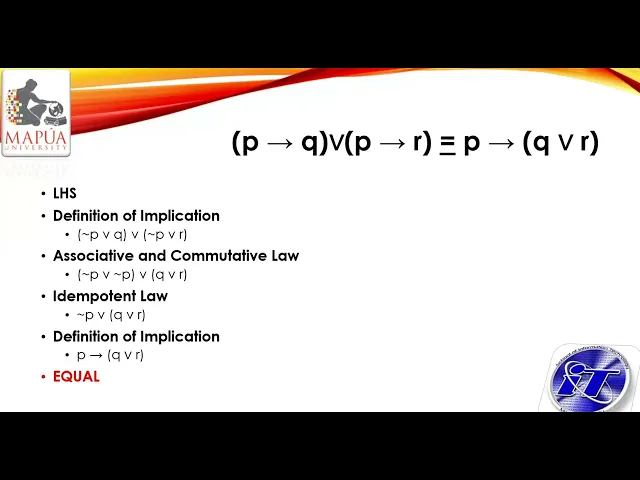
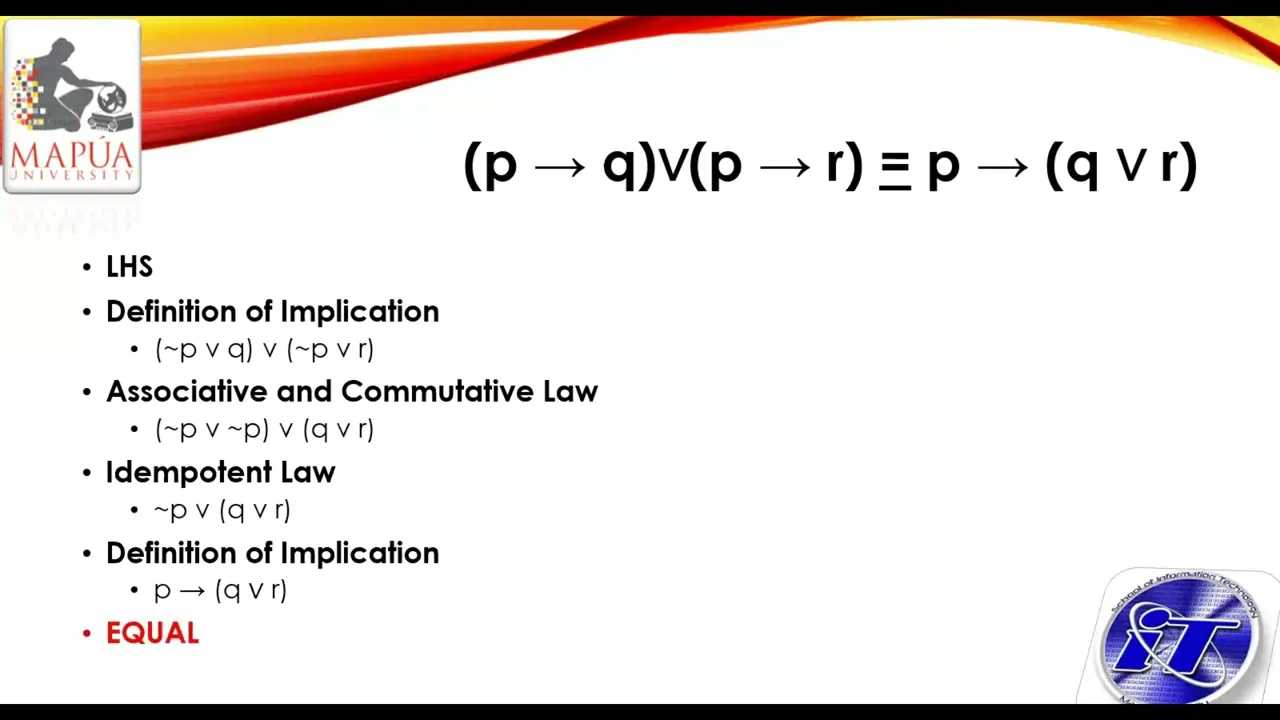
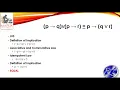
[Music] let's continue our discussion about logic and propositions specifically proposition equivalents solving problems using logic rules so let's answer this equation they're going we're going to determine if they are equivalent so we have p implies q and the 2p implies r is equal to p implies q and r so i'm going to evaluate the left hand side of our equation so we all know that implication should be removed from our equation it should be transformed to its second form which is not of antecedent or to consequence so using definition of implication we could rewrite our
left hand side of the equation as not p or q and the 2 not p or r and based on this equation we could say that we have two terms and they are connected using and and inside each term the main function is or so therefore we could implement distributive law okay and also we have a common term which is not b so not p will be the first term and the other variable which are not um not present on both terms will be undead for the second term so this will be the result not
p or q and r and if we're going to evaluate this form this is the second form of our implication so if we want to convert it into first form we could do that using definition of implication where in that p will be the antecedent q and r will be our consequence so therefore the equation will be p implies q and r which is the same equation on our right side so therefore they are equal equal therefore this logical equivalence is valid okay next example so p implies r and the toku implies r equivalent to
p or q implies r same as with the previous slide i'm going to evaluate the left side and i'm going to implement definition of implications so that i could remove the implication function so we have not p or r and not q or r same as with the previous slide we have two terms and they are connected through and operation and each term the main function is or and we have a common variable which is r so therefore we could use distributed law so the the uncommon variables will be entered which are np and not
q and the command will be another term so we have not p and not q or r and then instead of separate negation between p and q i'm i want to have a shared negation so that i could i saw that we could have an implicit uh a a premise for our implication later okay so using this using the morgan's law not b and not q could be rewritten as not of p or q then or are since we have this form not of a proposition or r this is the second form of the implication
therefore um by getting the first form p or q will be r and to see that r will be our consequence so this will be our new equation p or q implies r and if you're going to compare it on the right side of our equation they are equivalent therefore they are equal another example p implies q or p implies r is scalable into p implies q or r same as for the previous slide i'm going to evaluate the left side and remove all implication function by implementing definition the implication so the new form will
be not p or q or not p or r and based on this equation our main function is or so therefore we could implement associative and commutative law i'm going to associate not p with not p q with r so this is our new equation and we all know that anything or to itself is equivalent to itself based on independent law so we have not p okay so we have not p or q or r and we all know that this form is the second form of an implication statement so therefore we could implement definition
of implication where in p will be our antecedent q or r will be our consequence so the equation will be p implies q or r which is the same uh equation on the right side okay so therefore they are equivalent they are equal next not p implies q implies r is equivalent to q implies p or r same as with the previous slide i'm going to evaluate the left side remove all implication so then your equation will be not not p or not q or r and based on the first term we have a double
location so we could remove the double location so we have p or not q or r going back to our original equation so let's evaluate the right side our right side equation they um it simplify its antecedent is q so therefore in this equation in the left side we need to isolate that q okay so we're going to they associate that q with r and associate p with r so now we have that q or p or r so in this equation we have the second form of implication where n q will be our antecedent
p or r will be our consequence so by implementing definition the implication the equation now will be q implies p or r which this which is the same with the right hand side of our equation so therefore they are equal max we're going to prove that we imply a p by conditional q is the same as not p by by conditional not q so left hand side okay so from by conditional i'm going to implement the definition by condition wherein i'm going to break down by conditional to condition statement or in the implication statement which
is p implies q and then doki implies p then afterwards i'm going to implement contrapositive on both terms first term and second term implement contrapositive so we have not q implies not p not p implies not q for the second term and as you can see that q will be the antecedent here that q will be the consequence here not p will be the consequence for the first term and at the student for not p so therefore we could implement okay by conditional statement again so we have not p by conditional not q so therefore
they are equivalent so you could have a lengthier um solution for these but this is the shorter short version of the equation of the solution okay so that's it for this video lecture more example on the next video lecture see you guys thank you for listening [Music] you