All right, this is the very fast-paced version of the A3 A4 unit. This is just for review. You should have already gone through this at a normal pace.
So, A3. 1 diversity of organisms. No two individuals are identical.
monozygotic twins where we had one fertilized egg, a zygote, that split. That creates identical twins, which are identical for their genes, but immediately mutations occur. Um, different environmental factors occur and so there are going to be differences um immediately.
Okay, we've always as humans tried to make sense of our world and we've tried to classify and make sense of that. The father of classification is Carl Lanaeus and many of his uh classifications we still use to this day but they are based on morphology or physical features. Now we can look at DNA and we realize that even though sometimes things look alike they may not have been evolutionarily in the same uh lineage.
We use a binomial system. We mentioned this last time. Okay.
It's made up of a genus and a species. The genus is always capitalized. The species is lowercased.
And once we've used that the first time, we can shorten the genus to just the capital letter and a period. Okay. The biological species concept is how we define a species.
Okay. You should memorize that a species is defined as a group of organisms that can breed and produce fertile offspring. Now, these two horses, okay, if they were to breed, they could produce a fertile horse.
Therefore, these horses are of the same species. Now, if you breed a horse and a donkey, they can produce a mule. But a mule is infertile.
So, therefore, a horse and a donkey are not the same species. The only way to get more mules is to breed another horse with another donkey. Okay?
Now, of course, there are going to be exceptions. In captivity, lions and tigers have sometimes hybridized, okay? Um, and produce fertile offspring.
So there's some issues with the biological species concept there, but they're still not considered the same species. Okay. And then the other issue with the um concept of biological species is that sometimes there may be um a species that's in the middle of doing speciation where one species splits into two and it's kind of hard to define at what point is it at.
Is it two species yet or is it still one? Are they able to still produce fertile offspring? And it may not be clear especially uh in species like in plants, trees, conifers, it can be really unclear whether speciation has occurred.
Okay. When speciation does occur, okay, there has to be some sort of reproductive isolation. This is most often due to a geographic barrier, say a river that changes course and then splits those two populations.
Um, and eventually due to different selective pressures acting upon each of those groups, speciation occurs and we end up with two species. Okay, you should know that humans have 46 chromosomes. Just think of the company 23 and me.
Okay, that's referring to the 23 pairs of chromosomes that humans have. Um then chimpanzees have 48. Now you might be thinking that's weird.
Why do chimpanzees have more than humans? Okay. Uh note that there is a general increase in number of chromosomes with complexity but not um it's not like a straight correlation.
Um, you should know the difference between diploloyid or diploid cells that are all your body cells that have two sets of every chromosome, one from each parent versus the hloid cells, which are the sex cells like eggs and sperm, the gametes. They are only going to have one set of chromosomes so that they can combine um with another hloid cell uh from a different individual to create a new diploid organism. Okay, this is a karaog.
which shows the carotype of an individual. Okay, these are the 23 pairs of chromosomes in a human. The chromosomes are numbered in decreasing size.
So, chromosome 1 is just the longest one. Okay, chromosome 22 is the shortest and then we always have the 23rd pair being the sex chromosomes. You should be able to determine the sex of an individual by looking at the length of the chromosome.
X is longer than Y. And so here, if you see a long chromosome and a short chromosome, you know it's an XY and therefore a male. If the last chromosome are two long chromosomes, then you know it's an XX and that it's a female.
You can also identify chromosomal abnormalities like if there is an extra chromosome uh for example in chromosome 21, which would be indicative of down syndrome. Okay. Chromosomes can be identified by their specific banding patterns, their size and the position of the centromeir where they are joined together.
Okay, this is a specific example that I'd be like you to be familiar with. This is human chromosome 2. This is a chimpanzeee chromosomes 12 and 13.
Looking at these, you can see that the short arm of human chromosome 2, okay? And the long arm of chimp chromosome 12 have identical banding patterns. Similarly, we see identical banding patterns down here.
We also see the position of the centromeir being the same for chromosome 2 and chromosome 12. So this is strong evidence that the some point in evolutionary history. Chromosome 12 and chromosome 13 of some pre-anestor of the uh human and the chimp um those chromosomes fuse together to form what we now have as chromosome 2 in humans.
Okay, these are all just sort of questions relating to that summary. Okay, genes are just lengths of DNA within that chromosome. They code for a specific protein.
And within a species, we have the same genes at the same chromosomes. And so in every human chromosome 7 at this location, we're going to have the protein or the DNA that codes for the protein epidermal growth factor receptor. Okay.
Now while all humans and every species have the same number of chromosomes with the same genes at the same locations there are going to be differences in those genes that we are calling here single nucleotide polymorphisms. These form different alals so they may show up as different phenotypes, different physical characteristics depending on how the protein is made um based on this DNA code. Now, this particular location, because there's an A here and a C here on the paternal versus maternal AL, that's what we call a single nucleotide polymorphism, um pronounced a snip when we um abbreviate it.
Now, what's kind of mind-blowing is just to realize that we are so similar to each other. We have over 3 billion bases and in humans there's only four to 5,000 snips only four to 5,000 um places where um our DNA even varies between humans and so we are almost identical to each other. Okay.
Uh genomes vary in size. Um again there's not a direct correlation with complexity. More or less we're going to see smaller genomes with simpler organisms.
But we're going to note that in plants they tend to have very very large genome sizes. Um but note that large genomes can contain a large amount of non-functional DNA. In fact in humans almost half of our human genome consists of transposons most of which have no known function.
Okay. Hey, we can also compare um the evolutionary similarities uh between organisms by looking at their amino acid sequences because those are coded for by DNA base sequences. And here we can see um we often compare cytochrome C.
This is a protein that is used in cell respiration. And so every organism that does cell respiration has cytochrome C. And so it's a really useful protein to compare.
And here you can see that everywhere we see green that amino acid in cytochrome C is the same as humans. Red is different. And so you can see here that chimps actually have an identical cytochrome C protein to humans.
Or as we can see some other ones like a tuna fish has quite a few differences. Okay. Uh we spent some time going through a database taking a look at DNA size and we did see that consistently those plant DNA sizes are considerably larger than in animals.
Okay. Um whole genome sequencing is something that originally back in the 90s took um over a decade and um a hundred million dollars to just do a single human genome. Now we can do the ent that entire process for less than $1,000.
Why is this useful? Well, if we can sequence an entire genome that helps us understand evolutionary relationships and it also can lead to personalized medicine. I believe this is the future.
I wouldn't doubt if within a decade it's standard that everyone has their DNA sequenced and u medical professionals can then use your DNA to understand what different medicines, treatments, dosages work the best for you based on your genes. Okay, at this time if you are an SL student you are going to need to skip ahead. HL students stay tuned.
All right. So, a couple other issues with the biological species concept. If a species doesn't reproduce sexually, like a dandelion or blackberry, then we can't use the biological species concept to define them as a species.
And a second um issue is species with horizontal gene transfer. So these bacteria that are passing genetic information um between different bacteria is also going to be a challenge in being able to define a species. Okay.
Um I think we've already covered everything on this slide. So we're going to keep moving. All right.
You are um expected to know how to do a dichomous key and use it to be able to identify uh organisms uh based on their physical characteristics. Okay, DNA barcodes is where we have a short section of DNA from an individual organism that identifies its species. And this allows uh scientists to quickly identify the species that are present.
Um it can we can take um a soil sample, a water sample, and be able to look for DNA barcodes and identify which organisms are present very quickly. This allows for biodiversity of habitats to be investigated extremely rapidly. All right, that is the end of A3.
1. Let's move on to A3. 2.
This again is HL only. So SL students, you do not need to know this uh slideshow. First up, classification.
We have at the highest level of classification three domains bacteria, archa and ukaria. Ukaria is going to be anything with a nucleus in their cells, the ukareotes. Okay?
Bacteria are our proarotes and archa are our extreophiles. Now, we used to lump these together, but scientists discovered that there's actually way more differences between bacteria and archa that there needed to be um a separate domain system. You can see here that they even believe that archa have more in common with ukaria and have a more recent common ancestor than archa do with bacteria.
Okay, you should be familiar with the taxonomic system. Um you should be able to know the order um in decreasing u more specific uh groupings. These are each called um a taxon plural taxa.
Okay. And so this study of this classification is called taxonomy and it goes domain, kingdom, film, class, order, family, genus, species. The pneumonic to help you remember that order is dear king Phillip came over for good soup.
Okay. And here you can see those classification levels for humans. Okay.
But this is a pretty arbitrary system, right? How do we decide like which what should we, you know, include in this specific group? and um you know how should we uh decide that like these plants are similar enough to be put into a group but this plant is a little different so we're going to put it in that group and so this traditional method can have some issues.
Now ideally instead we would look at evolutionary relationships. we'd be able to classify based on evolutionary origins and looking at basically a branching sort of species level family tree to determine what common ancestors exist and be able to classify groups that way. Now, why is this even useful?
Well, if we know some characteristics of a particular species, then we can look for uh species that are in that same uh group and determine if they also have those same characteristics. And so we can make predictions. An example of where that might be useful, okay, is some types of daffodil produce a substance that can be used in treatment of Alzheimer's disease.
And so if we look at other uh flowers and other plants within that narcissus genus, it's possible that we could have other medicinal uses from those flowers. So now we use a organization system a classification system based on clades. You should know the definition of a caid okay is um a group of organisms evolved from a common ancestor including the ancestral species.
And that's important if u this has been asked on a on previous IB exams where you're asked to just define a cate and you need to make sure you include that the ancestral species is part of the cate. So this is a cate. This little node right here represents the ancestral species.
Okay? And these are all of the species uh that came from it. Same thing here.
Okay? All of the species and the ancestor. This is not a caid.
While this is an ancestral species that um represents uh these you know modern species. This one is not included as a caid. Okay.
Here we have an ancestral species but this is not also included and so these are not clades. Okay. Now, we base this system on DNA or amino acid um sequences because amino acid sequences are just based on DNA.
But sometimes we do have to go back to morphological traits or physical traits because the organism has gone extinct and so we don't have access to DNA. Each of these are clades. Okay, for example, number seven, here's a common ancestor and all of its descendants here indicated in green.
Okay. Uh here's another one indicated in yellow. Five is a common ancestor and here you can see this um all of its descendants.
Okay. These are just some other examples of clades. Okay.
A question you might get asked uh is for example uh according to this cllayoggram are chimpanzees more closely related to humans or to gorillas? So the key is to look for the most recent common ancestor. If we trace back, we can see that chimpanzees and humans have a common ancestor here, while chimpanzees and gorilla's common ancestor is all the way back here.
So, we would state that chimpanzees and humans have a more recent common ancestor and therefore they are more closely related. Okay. The concept of the molecular clock is based on the fact that random mutations occur at a fairly regular rate.
And so we can count the number of mutations and count back in time and estimate uh the time period of species divergence. Now this is only an estimate because those mutation rates are affected by things like generation time, the size of a population, the intensity of selective pressure and other factors. Okay, we spent some time then to do a sequence alignment um to determine the percent similarity of the DNA between these two species of tarsier using these instructions.
Okay. Um so the principle here is the fewer the differences between their DNA, right, the more recently they diverged. And good practice is to look at multiple different DNA sequences in order to determine um the clatoggram relationships rather than just one.
And if multiple sequences give that same pattern of divergence, that just gives you stronger evidence that that clatoggram is correct. Okay. We then did another um clatoggram research for the big cats and we were able to compare it then to this claoggram.
Okay, so some words you should know. This is the root. Okay, these are internal branches.
Anywhere where there's a branch that occurs, we call that the node. Okay, and then the branches that are here at the end are the terminal branches. Okay, one thing that I likes to do is ask you questions like for example uh is this snake more closely related to the crocodile or the tuitara?
And they like to trick you because they think a lot of people who don't understand this would say oh well the snake and the crocodile are right next to each other so they must be more closely related. But remember we need to look for the most recent common ancestor. So if we trace back the snake and the touittara, their most recent common ancestor is here.
Whereas the snake and the crocodile, if we trace it back, their most recent common ancestor is right here. So therefore, the snake and the touittara are more closely related because they have a more recent common ancestor. So don't be thrown off by the fact that they're not right next to each other.
Okay. Um, one example of where we had to take uh, Lanaeus' morphological um, observations and groupings and reclassify is the fig wart family. Okay, this is a family of plants that have this um, cupshaped flower and they all looked very similar and so they were placed together as fig warts.
But once we were able to look at the DNA of these flowers, we had to majorly reclassify um this family into several different groups. And it turned out that these flowers all had the same shape due to a common pollinator. And so they each evolved based on that pollinator through a process called convergent evolution where they developed those similar features but completely independently of each other.
and in this case in response to that same pollinator. Okay. And then here's just those three domains again.
Here's our last universal common ancestor. Uh we've already kind of addressed that. So let's go on.
Okay. Next up, A4. 1 evolution and speciation.
All right. The wrong way to understand evolution is through Lamarcism. Lamar believed in the inheritance of acquired characteristics.
And so if you acquired a characteristic during your lifetime, for example, if this giraffe stretched and stretched its neck to reach those high branches, then it would have offspring with a longer neck. Now, this is not the case. Okay, this is Lamarcism.
We know that acquired characteristics are not inherited. instead. Okay, let's compare that to Darwin's idea of natural selection and evidence being the change inheritable characteristics of a population.
Darwin's natural selection theory, okay, is based on the fact that there are random mutations in a population which leads to variation. The variation um leads to individuals, some having a higher fitness than others. Okay, the individuals with a higher fitness are going to be more able to produce offspring and pass on the genes.
Okay, for that characteristic and therefore we see evolutionary change in a population over time, okay, uh where we see a increase in frequency for the genes with that characteristic. Evolution doesn't ever occur in an individual. It only occurs in a population.
Okay. And here are some examples of us being able to see evolution right in front of our eyes. Okay, this is the evolutionary history of the SARS COV2 virus which causes COVID 19.
Okay, and we know that we have seen lots of changes and mutations and evolution in this virus just in the past few years. Okay, artificial selection then is when humans, okay, select specific animals, crop plants for desirable characteristics. Okay, for example, here's this wild red jungle fowl of Southeast Asia.
Okay, humans chose the red jungle fowl that laid like the best eggs, the biggest eggs, the most regular eggs, and bred them together for generations and generations and generations. The um where we end up now with our modern egg laying chicken. Okay.
And we've done this for um the purposes of meat and milk production, transport, and even pets. Okay. Here's an example of um a cow that was clearly being bred for meat production that is like Arnold Schwarz.
Okay. Um, all of our dog breeds that we enjoy today all came from a grey wolf, but they were selected for over hundreds and hundreds and thousands of years for desirable characteristics. Um maybe we wanted them to be able to retrieve and so um we selected individuals that had the best instinct for retrieving or um hurting um right or just friendly personalities or small size for being a little lap dog.
Um so that's artificial selection and it's done by humans. And what a lot of people don't realize is a lot of what shows up in our supermarkets uh is based on artificial selection. So this is natural selection but done specifically and chosen by humans.
All of these different crop plants that we eat, okay, were selected for from this single ancestral plant for various characteristics and that's how you end up with broccoli. Okay, here is pug evolution as another example. Uh you can see in the 1880s pugs were much larger and they were just selected for smaller and smaller size uh shorter noses until we end up with the pugs of today.
Okay. Um evidence for evolution homologous structures. This is our classic example of the homologous structure, the pentadactyl limb with those five digits.
Okay. And sometimes we see that over evolutionary time some of those digits have fused together. Now with a homologous structure that structure exists because a common ancestor had that structure.
Okay. So for this was our common ancestor had those five digits pentadactyl. But over time okay they we might have different functions for those five digits like a wing of where for a bat to fly or dolphin to swim or a mole to dig.
Okay. And so this though is evidence of a common ancestor that had that characteristic. It's a homologous structure.
Now, vestigial structures are structures that are left over from ancestors that it used to be useful. For example, a hipbone in a whale, but now is no longer useful. Whales don't have legs.
They don't need hipbones, but they're not hurting the whale um or being selected against. And so, they're just sticking around, okay? hanging out this digial structures.
The same goes for the appendix. Okay. And then here's just a comparison of those pendodactyl limbs.
Now let's compare this homologous structure that came from a common ancestor with the structure with analogous structures. Now analogous structures were not shared by a common ancestor. So the common ancestor of a bird and a butterfly, okay, did not have wings.
The wings have the same function but through convergent evolution they independently evolved. Okay. So for the same selective pressures in this case the ability to fly being such an advantage.
Okay. The wings evolved. Okay.
Whereas and you can see they're very different structures right? Birds we know have that penodactyl limb. Whereas butterflies just have these kind of thin membranes.
And so these evolved independently of each other. The common ancestor did not have wings. Okay, speciation by splitting of pre-existing species.
So here we have a group of trees. This river has changed course. It's now split the group of trees into two.
And if there are different selective pressures on either side of the river, it could be different temperatures, different amounts of rainfall, different predators, um then we could see eventually speciation occur um as each of those groups adapt to that specific uh pressure. and then eventually we could end up with different species that no longer can interbreed and produce fertile offspring. Okay, so these are the two things that are required for speciation that reproductive isolation which again is usually geographical as well as the differential selection.
So there's different selective pressures in each of those groups. It could be like different climates, different levels of predation, different levels of competition. Okay.
And an example of this is the chimps and the bonobos. Okay. In central Africa, the blue is the chimpanzeee habitat.
Okay. And there's a Congo river that goes and splits these two habitats. Now, neither chimps or bonobos can swim.
So, it's believed that at some point there was a drought and the water level of the river decreased enough that chimps could cross over into this southern territory. Then the drought ended, the river level came back up and we experienced geographical isolation between those two populations of chimpanzees. Now, because of different selective pressures acting upon each of those groups, eventually this population, okay, became the bonobos.
They're slightly smaller. They have different behaviors. And if the river level was ever to go down again, chimpanzees and bonobos would no longer be able to produce fertile offspring, and they're therefore different species.
Okay, this represents the N vessel content for this particular uh subtopic. Let's keep going with the HL content. All right, now that geographical separation that I mentioned a minute ago, okay, is a type of alopatric speciation because it's geographic.
But more rarely sometimes we can have sympatric speciation which is where in the same location we see splitting of uh one species into two and two different uh reasons that sympatric speciation could occur are because of behavioral differences or temporal differences. Now don't be thrown off temporal kind of sounds like the word temperature but it actually refers to time or timing. So, first let's look at behavioral difference example.
Okay, there's two different um forms of fish in this lake in Tanzania that are experiencing behavioral differences. One group likes to live by the shore. One group likes to live in the center.
Okay. And we're starting to see selection within those groups and speciation occurring due to um some of their different uh preferences where they like to live. Okay.
An example of timing difference are the winter pine processionary mods which are so cute. Okay. Um they live around the Mediterranean and um they have this little procession of their larae just like head to tail.
So cute. Um but the timing um of this you don't need to memorize the details but just know that they adults emerge in summer. Uh they live for a few days.
Um their larae feed during the autumn and winter. But what we're seeing now is another group of this same species that are using a different timing system. Okay, the adults are emerging in May or June.
The larae feed and grow through the summer where there's much more plentiful nutrition. They grow faster. Okay, and their timing is completely different.
They're ready to pupate by the end of September. And so this group is having a very different time of year that they are fertile and looking to have that sexual reproduction. And so this group is going to become um isolated from the other groups because of the different timing.
So, it's a temporal difference and an example then of sympatric speciation where we might see then in the future that these two groups if um they were to meet up temporally would no longer be able to interbreed uh and produce fertile offspring. Okay, adaptive radiation. Think of radiating out and adapting to different locations.
Okay. Um a classic example of this that you need to be familiar with are Darwin's finches. there was apparent population of finches that it is hypothesized that during a storm or s some other event they were blown all the way out to the Gapagos Islands which are very very far off the coast of Ecuador.
Okay, each of these islands have different uh environmental characteristics. Some are dry, some are lush, right? Some are higher elevation, some are lower.
And in each of those environments, there's different food sources for each of these different types of birds, right? There might be uh insects or seeds or cacti or buds or fruits and that parent species that radiated out to these different locations. Then those populations in each of those locations adapted to those specific uh selective pressures and example of different nutrition available.
Okay. And eventually their beaks changed to adapt to those uh food sources. the the individuals in that population that were most successful at eating that particular food source were the ones that were able to survive and pass on their genes and therefore we saw the alil frequency shift over time and therefore evolution occur.
So this is radiation where we have then adaptation to these varied environments. Okay, many species from one single common ancestor. Okay.
So, usually if we have hybridization, okay, we're not going to have fertile offspring like the mule example I said earlier, they have an odd number of chromosomes because if you crossbreed a horse, they have 64. A donkey is 62. So, mule is going to have 63.
And if you have an odd number, we can't divide the chromosomes in half to make sex cells with exactly half the mule's genetic information. Okay? And therefore, they are sterile.
Now, plantreeders can actually specifically aim for um hybridization to have sterile um uh products. For example, a seedless watermelon. Okay, we love to be able to eat watermelon without spitting out all of the watermelon seeds.
And so, this can be actually something that uh we do uh with that specific goal. Okay. But generally, evolutionarily speaking, having offspring that are infertile is a waste of resources.
Um really the goal evolutionarily speaking is to produce as many offspring as possible that can then continue to pass on your genes from generation to generation. And so species have evolved courtship behaviors to um ensure that the organis the other uh individual that they are going to breed with are members of the same species and therefore you have the highest chance of being able to produce fertile offspring. Uh and so there's all sorts of different dances and and uh amazing behaviors that uh these individuals do.
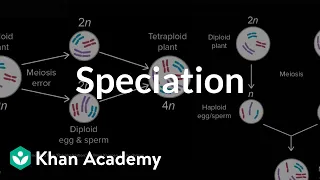
Okay. Uh lastly, a polyloid organism is an organism that has more than two sets of homologous chromosomes. Okay, it's most often occurs in plants.
This is when chromosomes in a cell are duplicated without subsequent cell division. So for example, if we have a diploid cell and it duplicates all of its chromosomes, okay, it's now going to be an auto tetroploid. The resulting organisms are not able to produce offspring with original diploid organisms.
And if they tried to, a triploid organism would result, which would be sterile again like a mule with that odd number. However, if individuals from different species crossbreed, the resulting cell duplicates but doesn't divide, the cell is going to have those four sets of chromosomes. Okay?
And so it's an even number. Each division would be successful. Okay?
And then this overcomes that fertility issue. Okay? This allows new species to be formed quickly.
And many species have been produced by this process, especially in the plant kingdom. All right, last up, A4. 2, conservation of biodiversity.
Okay, biodiversity just stands for biological diversity. Okay, um and it's measured in two ways, richness and evenness. Richness is just the number of species present.
Evenness is having a similar abundance of each species present. Okay. Um, today we have the most species existing on Earth.
Um, from all of the speciation that we've been talking about as individuals become geographically isolated, have differential selection pressures, speciation occurs. Um, however, uh, there have been five mass extinctions. Uh, the most recent one you're probably familiar with was when a huge asteroid collected uh collided with the Earth, caused um the dinosaurs to dry out to die out.
Sorry, not dry out. Um, and before that, the previous four mass extinctions are attributed to volcanic activity, changes in climate. Okay, but it's actually believed that human activity is causing what is predicted to be the sixth mass extinction.
So, why is that happening? Well, we call this first of all anthropogenic species extinction. Anthropo means human.
So, it's humancaused species extinction. for these reasons. Okay, humans doing overh harvesting, destroying habitats, okay, introducing invasive species, creating pollution, and fueling global climate change.
Okay, here are some examples of species that have gone extinct due to anthropogenic reasons. Okay, one example is the North Island giant moas from the North Island of New Zealand. Okay, within something like one or two hundred years of humans arriving on the North Island, okay, we completely caused this um giant 9- foot high bird to go extinct.
Okay. Um ecosystem loss is also occurring for several of the same reasons amongst others. Okay, take a minute and just look through these.
You should be able to produce these. Okay, a specific example is um the destruction of the mixed deraarp forest in Southeast Asia. We're cutting it down for timber.
We're clearing it for land for agriculture and all of that ecosystem is then being lost. Okay. Um there is an organization that keeps track and produces reports about biodiversity.
It's called the Intergovernmental Science Policy Platform on Biodiversity and Ecosystem Services, IPBES. Okay? And it produces reports like these about biodiversity uh that can help governments make good decisions about conservation efforts.
Okay? We can also gather evidence about um the ecosystem and biodiversity by monitoring. Okay.
We can be counting any of these things and just tracking them over time to be able to see what is happening with uh the environment. Okay. Now, a important principle is that those surveys need to be repeated.
This is an example off the Oregon coast. Every year they ask for volunteer citizen scientists to help spot whales. Okay?
So, there'll be a professional who is keeping track of the number of whales that swim by. Okay? but they one person might miss uh the whale.
And so if we have a lot of eyes, that increases the chance that we're going to see every single whale that swims by. And so these volunteers are helping keep a count. Okay?
And if we come back every year on the same day and count how many whales go by, then we can track year to year what's happening with the whale population. Okay? You should know the equation for the Simpsons reciprocal index.
This is how we can calculate biodiversity. Okay? We just count the total organisms of all species in the location.
Multiply it by that number minus one. And then this sigma symbol means the sum of. So we take the sum of each of the individual number of organisms of a single species times that number minus one and then add all those together for each of the species present.
Okay. And then here's just an example of that. Okay.
So we can calculate the Simpsons reciprocal index. And the higher the value that represents a higher biodiversity. Okay.
Why is a biodiversity crisis occurring? Well, the overarching cause is human population growth. Okay.
In the hundred years between 1920 and 2020, the human population more than quadrupled. Okay. Okay.
And this overpopulation causes all of these additional uh threats and all of these other problems. Okay. So, how can we try to conserve the environment and these um wild populations?
Okay. One approach, okay, is in situ conservation. Okay.
This just means in the organism's natural situation, in its natural habitat. So in situ, okay, is ideal because those organisms are able to live in their natural habitat. Okay, their behavior patterns remain normal.
They can still interact with other wild species and this tends to be a lowerc cost option if the environment is still in a good condition. So this is the ideal approach to conservation, but it's not always possible. Okay.
Um, and it could be because the natural habitat has been destroyed or humans have built cities there or any of those other issues. Okay. We also try to manage nature reserves.
Okay. These are some ways that we do that. Um, I always recommend to students if uh a great summer job when you're in college is working for a summer at a national park.
Okay. And helping with conservation efforts, trail building, removal of the alien species, etc. Okay, reing is where we take degraded ecosystems and we just try to leave them alone and let them go back to their wild state.
Now the opposite of insitu conservation where they're in their natural situation is ex situ which means okay outside of their natural habitat for example in zoos or if you're playing in a botanic garden. Okay. Um some benefits to exitu conservation is we can have captive breeding programs followed by release of those individuals back into their natural habitats.
Um if those natural habitats are still existing and are safe for them to live in. Okay. Another approach to conservation is storage of germ plasm.
Okay. This could be seeds, tissue, eggs or sperm. And we tend to try to store these in cold locations.
Um, of course the problem with that is with climate change, those cold locations aren't always as cold as possible, okay? But we want to preserve them there as long as possible so that if a species was to go extinct, right, we might still have some derm plasm stored, some seeds stored that we can then use to try to bring that species back. Okay, so the question is, we don't have enough resources to save every species.
So how do we prioritize our conservation efforts? Okay. And one way that we make that decision is looking at this edge of existence um acronym and this is a project where they look for and this stands for evolutionarily distinct and globally endangered.
So we look for two things. Is it evolutionarily distinct? Does it have very few or no close relatives?
In that case we will probably prioritize that uh species because there's no close relatives. Okay. Also, how endangered is it uh in every location?
So, is it in danger of extinction because all of its remaining populations are threatened? If so, that's also going to prioritize that species. So, we would target those um for more intense conservation and that's how we can make those decisions.
All right, that's the end of this one. Uh hope it was helpful.