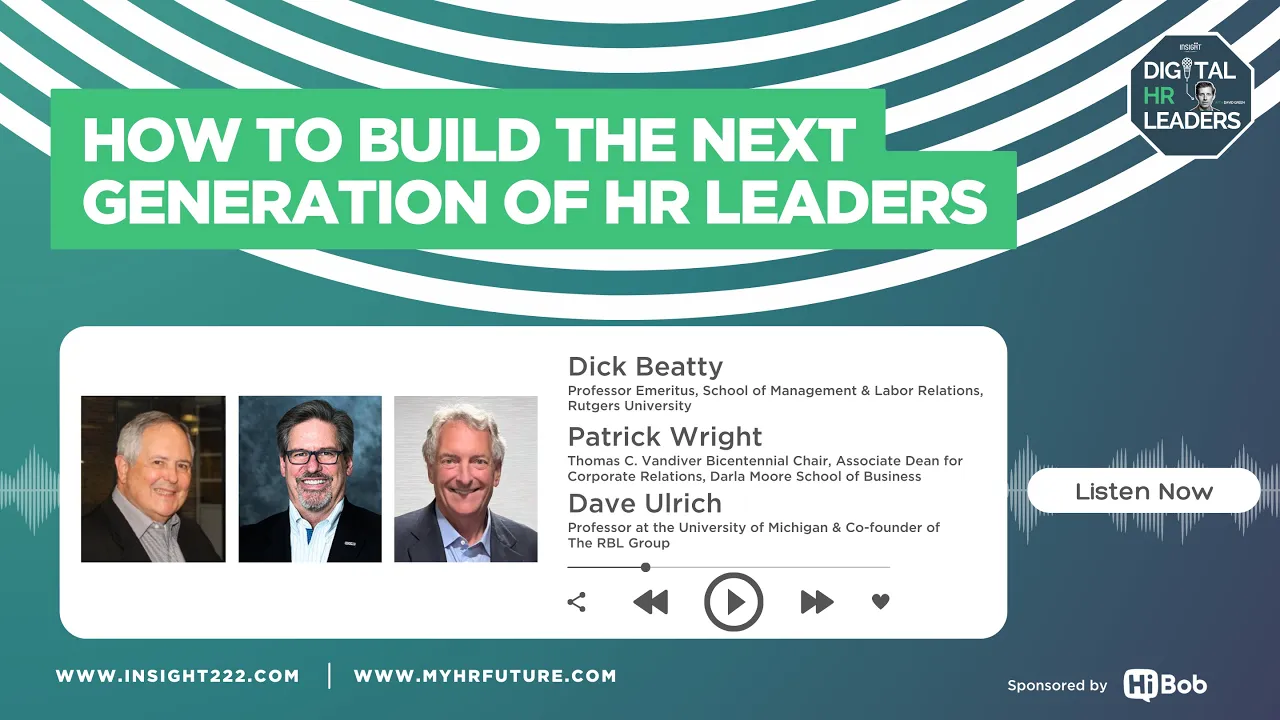
[Music] [Music] Today I'm absolutely delighted to welcome Pat Wright, Dick Bey, and Dave Oric to the Digital HR Leaders Podcast. Pat, Dick, Dave, it's a real pleasure to have you on the show, especially all three of you together. Um going to start Dave, you've been on the show a number of times, so hopefully our audience knows you well, but Pat and Dick, I'd Like to come to you first and just say they give us please give an introduction to yourselves and your backgrounds for for our listeners. Pat, I'll come to you first. >> All right.
Well, first, uh, David, thanks for having us on the show today. We appreciate it. Um, second, a little bit about me. I'm currently the associate dean for corporate relations in the Darlamar School of Business at the University of South Carolina. Uh, Been here for about 13 years. Uh while I was here I founded the center for executive succession that focuses on seauite succession. Uh prior to that I spent 16 years on the faculty at Cornell uh in the industrial labor relations school and u you know been kind of the typical academic researcher but also an
academic researcher who has a interest in practice as well. >> Thanks Pat. Great to have you on the show. Dick I'll come to you. >> Well I uh started teaching at the University of Colorado for a number of years. Then I was asked to come do some executive ed stuff at the University of Michigan where I ran into Dave and um which changed my career in various ways. uh all positive and then I went to Ruters school of management labor relations to run a global program that began in Brazil went to China went to India
and back to US over a 12 months period of time an executive masters Program that I did with a guy named Charlie Tharp that some of you guys know and uh spent a lot of time still with Dave at Michigan running the or working with the executive uh advanced executive HR program. >> Thanks, Dick. Great. Welcome to the show. And Dave, I'll come to you. You know, the three of you I know have been working together um a number of times over over the years, but what kind of Brought brought you together and um what's
your current um exciting project that you're working on? >> Well, it's interesting to I'll give a personal story and some of you may know some of this. When I went to Michigan a long time ago, um I got put in charge of an executive program as a very junior faculty and I made some of the stupidest decisions ever made. I fired all of the senior faculty uh except Dick Batty and uh by the way that's a way not to get Tenure at a university. Uh so for over 40 years Dick and I have been at
Michigan collaborating and and then our son with some lunatic idea decided to get a PhD in this field and he said dad where should I study and the answer was wherever Pat Wright is. Pat is the best scholar in the field. has been for decades. And so our son Mike went to Pat and uh Pat was gracious enough to teach him. And after Mike finished his PhD, he said, "Dad, you're right." Um so uh it Was better to work with Pat than you. And so the three of us have collaborated on a number of things.
We're committed to the future. We're committed to the HR profession. Uh we're committed to helping people and organizations be successful. That is a shared commitment that with you David and others that you talk to all the time, we share that in a very real way. >> Yeah. And and certainly for you know on behalf of our listeners, we're grateful For everything the three of you have contributed to the field over the years and you've really helped you know shape some of the pivotal shifts in HR and hopefully the stakeholders that HR serves as well. Um
but in your recent joint article um Dave what what's next for HR and how to respond you pointed to this particular time in history as being a real inflection point uh for for for the prof HR profession. So from your perspective, what feels different about Now? What's shifting? And why does it matter so much for the future of HR? >> You know, when we when we think about inflection point, it comes from some great work at Intel by um the Intel leaders long time ago, Bob and uh others. Inflection point is when the outside world
is changing, you've got to either respond or die. And and the changes in our world, everybody knows them. AI driving and fueling many of those changes. Information is Everywhere. Uh on this podcast, if we don't say AI 20 times, we ought to just get we ought to be thrown out. Uh good news and bad news. We see political toxicity. Uh we see wars and rumors of wars. We see economic uncertainty. We see so many changes postco especially that HR is at the center stage. It's material. Governments are saying you must report your human capital. It's
part of regulation. Business leaders are saying people, AI, technology, that's The key to our success. Boards are looking at it. Frankly, human resources are at the business table. That's an old issue that's irrelevant. The question is, can HR people join them because the human resource issues are central to what a business does. We see it, we live it, and so we call that an inflection point. Pat's done some amazing research about CHRO's. And one of the scary things is if they don't rise to this opportunity, they're going to get moved. And to be really honest,
and this is a scary thing I just saw this week, there's a lot of turnover among CHRO's right now, especially in North America. Pat's seen it, we've seen it. I think the demand and expectations for next generation HR, not just CHRO's, we think it's higher than it's ever been. It's time to build a whole pool of HR professionals who can respond to those opportunities. >> And and Pat D either of you might want To talk to this and Pat particularly you and Dave talked about the research you've done around CHRO's. Is it harder to be
a CHRO now than it's than it's ever been? And maybe what are some of the findings that that that you had Pat from from the research? >> Well, see, yeah, without a doubt it's harder today than it's ever been before. And I like to track through kind of the history of CHRO's and particularly the visibility of the board. So if you go Back, you know, 2530 years, nobody on the board cared about the CHRO for the most part. Um, and then we had the scandals and kind of the executive pay scandals that came out of
the dotcom bust. Suddenly the board was looking at well who's in charge of pay and that's HR. So now the board is looking to CHRO. Then you had uh you know the HP series of CEOs and the um the pointing to them not doing CEO succession well and so all of a sudden boards became focused on CEO Success. It's like well who does selection? Well that's HR. Uh then you get into the you know Wells Fargo and Uber scandals and it's a cultural issue board looks at who's who's kind of knowledgeable about culture and that's
HR. Then we had COVID and that was really the question of where work gets done. Then as Dave mentioned, now you've got AI and that is what work gets done by people. Um, and these are all the concerns that the board is trying to Deal with in terms of how they govern the the corporation. And all of it points to the CHRO, the role that the CHRO and HR plays in the organization. And so that's why I think it's it's a a broader role than it's ever been. It's a higher visibility role than it's ever
been. And it has the potential to have greater impact either positive or negative than it's ever been. >> Yeah. And certainly that's something that that that we see with the CHRO's That we work with at Insight 222. And and obviously there are some extraordinary CHRO's out there. I'm sure the four of us could all create a list, but we're not going to do that on the on the on the in the episode now. Um and and there's definitely more interest from CHRO's, but also outside pressure coming in on on transforming the way that the HR
function operates. But there's still a tendency I feel not in every in every organizations but in many Organizations that that HR still focuses too much inwardly uh on what HR is doing uh rather than on the outcomes that they delivered. And Dave you you've talked to this a number of times on on the podcast about that. Um I know Jake maybe come to you on this one. You why do you think it's so hard for HR to move from activity to impact? Well, I think it's very hard. I mean, when I think of HR, I
think of the old Sherm and the Society of Human Resource, You know, or pardon me, ASPA, the American Society for Personnel Administration. They we were defined as the administrators and I think still we look at it that way. Um, and I think now the whole issue is about the workforce. organizations are sort of forced to change more than ever in my lifetime. Uh I talk about the external ecosystem in terms of what's changing in that ecosystem for all firms. And if you look at the elephant graveyard of firms, you Know, whether it's fortune 500 or
any index of market value or whatever, sustainability is really challenged and organizations don't change themselves, people change organizations. So what work do we need? And I look at work in terms of three kinds. Strategic support and surplus. And knowing the difference about that and aligning strategic work and investing in that is what's going to enable the survival of organizations. Support work may outsource a much much Of that. AI will enable you to do much more of that. And surplus just like what we're doing with our federal government trying to get rid of a lot of
surplus work. things that we no longer need to do that cost us more. Plus, I think we're going to have to communicate that if people don't grow, they're going to have to go and increases are going to be dictated by what people contribute more so every year than getting an annual increase just because they're still Sitting in the same role. So, all those changes have profound impacts upon the human resource function and who leads that function. >> And and Dave, maybe maybe Dave coming to you now again. Is there anything you'd you'd add to that?
Obviously, you're working with organizations and and senior HR leaders every day pretty much. You know, what are some of the things that you see that that prevents them from from just doing stuff to actually Having an impact? >> I'll tell two quick stories that capture this. Um, and like you, David, and Pat and Dick, we all do talks. And in one of the talks, I was scared to death. I'm not sure, David, you've ever been scared, but I was intimidated. It was one of the large um technology companies, 100 people, 70 PhDs in physics and
science and math. And I thought who what am I going to say? And so I started by saying what do these Companies have in common? And I started listing some digital old computer company, compact, Eastman, Kodak, Toys R Us. And one of them yelled out, they all went broke. And I yelled back, I consulted for every one of them. And there was just a half a moment of silence. And they said, "So what's the point?" And I said, "I worked with digital from 120,000 people to 20 before they sold and then Compact and then Kodak."
Every one of those companies Were phenomenal. People Express Airline, they were the case studies, but they were internally focused. They all missed the marketplace. They didn't understand what was going on outside. And that's the challenge. It's not what we do inside. It's how what we do inside creates value outside. HR is not about HR. It's about creating value for stakeholders in that ecosystem. Dick talked about our customer, our investor. If they don't get value from what we do, We're not going to be doing it very long. Without success in the marketplace, there is no workplace.
The second story, and people go, "Yeah, that's obvious." I love in a workshop to say very quickly, write down the biggest challenge in your job. And you can't name a person. I mean, because that's always worrisome. Uh don't point at the biggest challenge. right down. And here's what they say is some of what Pat talked about. We have a challenge of Succession. Who's going to lead? We have a challenge of of compensation. How do we pay? We have a challenge of development. We have a challenge of workforce engagement. And my comment is that's not the
biggest challenge in your job. The biggest challenge in your job is to create an organization that succeeds in the marketplace. And so behind every one of those items, succession, compensation, employee engagement, so that so that a customer Buys our product, an investor invests in our product, a community has a better reputation. And again, that's a pitch that I think we've been on. And that's an evolution. I was reading something even today. They're saying, "Oh, HR is so good. It's going to reduce turnover. It's going to get higher employee engagement." And I'm going, "True, true, incomplete.
Because turnover, retention, employee engagement should lead to value in the Outside marketplace. That's the metaphor for us that I think is is an inflection point. HR is not about HR. Well, that's not true. HR is less about HR. We still care about HR, but it's more about success in a changing marketplace. >> And actually, Dave, that's so that that that you mentioned then you kindly spoke to our Insight 222 group of people analytics leaders in Colorado. It was a couple of years ago now. Beautiful summer's day, beautiful location. And I Think, you know, you were
doing a workshop with them and and you I think a number of them thought differently when you said add the so that to it because they're all, as you said, they're all extremely smart people, all delivering value within their organizations. But when they it's just about connecting some of the activities they're doing to to an outcome, isn't it? So that so that we drive you know so that we increase sales so that we execute on our strategy And um increase our um you know and and deliver more value for our shareholders etc etc etc it's
just that one extra step to take isn't it from in a thinking perspective >> it is and I'll say one more thing and then turn this to Pat and Dick my mentors we've said HR should drive business results HR should drive business results and so we've done a lot of work and us all of us on the call have done work around business results As have other colleagues and I hate to start mentioning them. Well, here's an insight. Financial results are a lag indicator. I can't report my profits for next year. I'm reporting my profits
for last month, last quarter, last year. So, in HR, our assumption has been, let's do HR work that drives last year's results. Well, that doesn't make any sense because the world's changing. And what it's going to take to get next year's results are different. HR is not about Last year's results. It's about next year's results. And the only place you're going to get next year's results is a customer is going to buy a product. An investor is going to pay money for my invest in my product. A community is going to have a better reputation.
And so our taking HR outside in Dick and I did a piece on this is changing the metaphor of HR. We believe in business results next year which is customer investor and that will be the lead Indicator or the lead driver of business results. That for us is an example of an inflection point. Um, quick quick story and then I promise I will shut up. Said to a head of HR in a Fortune50, "What do you say to your investors?" And her comment was, "What are you talking about? I don't meet with the investors. That's
investment relations." Holy smokes. I felt like sell short. By the way, I'm not going to. It's a great company. Sell short. Because if you're Not meeting with investors, giving them confidence at your succession that Pat talks about, your executive comp that Pat and Dick talk about, your training, your employee engagement, if it's not giving investors more confidence in your intangible future, then you're not doing your job. Anyway, that's that for us, and I hope you feel from the three of us, David, and those listening, an excitement, and to be really fair, people say, "Okay, smart
guy, how do you Do that?" >> That was going to be my next question, actually. So, maybe >> uh we don't know. Uh, well, that's why Pat and Dick are going to speak up. Um, by the way, if we knew how to do it, that wouldn't be very helpful. I mean, if we, you know, I I sent an article off to a leading journal once and they said, "Give us five companies who've done this." And I said, "When I have old news, I'll send it to you." Um, we want To go create what's next. That's
what inflection points do. >> And Dave, maybe you Dave Dave mentioned that you co-authored something on this about forwardlooking. um you know without giving the exact way on how to do it. What are some of the what's some of the maybe the different mindset maybe that that HR leaders HR professionals need to have? >> Well, I think we have to change the mindset. We have to bring the outside In. I mean, David mentioned some of the things even bringing in the lead investor for a particular industry or your industry in to talk to HR about
it so they have an idea and an early window to where we're going with this. Uh David and I wrote an article a long time ago and I doubt if Dave even remembers this really talking about sort of the history of HR and I'm old enough to remember when HR were nice people. They were polite and they were so nice we put them In HR, you know, and then we got the police so we were the enforcement people. We had all these laws and regs and everything else. And then David wrote this brilliant article about
being a partner. Well, we want HR to be a player on the field and with the ability to score on the only scorecard that really matters and that's the scorecard of the business, customers, consumers, investors and so forth. And that's not the focus. Part of the focus is how do We create cultures where organizations and the workforce and the or really understands why we're here, where we're going, how we're doing, what markets are we in, how are we doing in those markets, what's really happening, what's really changing. and the best organizations are able to do
that and onboard their workforce with the challenges of the marketplace and but not many organizations do that well. That's why this sustainability issue is A huge kind of issue for firms. >> So again Pat maybe I'll come to you on this one just listening to to Dave and Dick there you know and Dave talked earlier on about AI obviously being a huge disruptor and potentially an opportunity for HR to lead on. you know, he's one of the ways that that HR can really support the organization and deliver value for for for its stakeholders to take
the lead on the organizational transformation that that That will probably be relevant for pretty much every organization because of AI. Um, so not just focus on making HR programs better, but actually focus on how we going to transform the organization, who's going to do the work, whether that's humans or or or or technology. Um and also maybe how work's going to be different as well. Are the I mean are these just are these some of the things that you're you're seeing from from from you know some of the Companies that you're working with? >> Oh
yeah, absolutely. I mean certainly AI is the the biggest kind of known unknown right now. Um and that is that we know it's coming. We know what people say it can do. We have no idea or at least we're not admitting what it's going to do to our workforces. Um but I I I'll go back to thinking you know this whole AI um emphasis got to be around what's the value that it's creating for the customer. So it could be creating value For the customer in that cost can be lower. Uh it could be value
for the customer because uh our products are are more uniquely made for that particular customer. It could be that AI allows us to innovate and come out with new products uh that now make our customers willing to buy more from us as a result of that. Um, but I think that's where the starting with the customer is where I think there's a unique need in HR right now. And and Dave and I were at a Meeting of a number of CHRO's a few weeks ago. And you know, over the course of two days, I don't
think we heard the word customer more than a couple of times. um and and and the emphasis is on what's going on in our workforce and what is that doing for our shareholder, but our shareholder only cares about financials that come from, as Dave said, the customer, if we're delivering value to the customer. Um and and so that's where I think you know this everything We do in HR has to be focused on not just what's it doing to our employees or yes we're expanding our lens um over the last 15 or 20 years to
say and we also have to drive the financials but if we don't understand how what we're doing in HR is driving the financials through creating value for customers then then we're going to miss the boat. we're going to miss everything that's going on in the external environment and we're going to miss everything that we need to Do internally to transform the organization to create that value for our customers. And actually on stakeholders I think because I know that you've all done a lot of work around this you know traditionally HR views its stakeholders and employees
and and the leaders of the organization and to a greater or lesser degree most HR functions serve those two stakeholders well I looking at a lot of the the work that the three of you have done you you Identify three other stakeholders and correct me if if it's more than three please tell me one is obviously investors, two is customers, um which is I think you know as listening to you the most important stakeholder and then the third one is communities. Um so if we if we look at those if we assume that most HR
functions are serving their leaders and their employees well although you would argue if they're not serving their customers well maybe they're not. Um if You think of those other three stakeholders, you know, how can HR be better at service serving those three um stakeholder groups and maybe where have you seen, you know, examples of organizations that that are doing one or more of those three groups? Well, well, let me let me address part of that and and that is that um you again we keep coming back to the AI transformation and it it'd be ignorant
to um say that this is not going to impact our workforce. I Mean, we know that what AI is going to do is going to replace what a lot of people are doing. And so if that happens, are we doing something to help those employees transform their skills so that they're still employable with the within the organization? Because if we don't, we're going to be like when we outsourced all of our manufacturing overseas and we'll have these dying cities where people have been laid off and there's nothing for them to do Anymore. And I think
AI has that same potential. And so we need to be thinking about if we want to serve our communities, then that means we have to think about how AI is going to allow us to better serve our customers and our investors, but to to the transformational effect it's going to have on our workforce and how do we help them transform themselves to be employable in the future. And I think it's not just worrying about employees. It's not just worrying about customers, just worrying about investors. It's understanding that the things that we're doing particularly in HR
are going to have an impact on all four of those. And so we've got to be able to play almost a balancing act of understanding the impact of all of these decisions on each one of those stakeholder groups and and yeah it short term it may have a negative impact on somebody but are things we can do today to minimize that Negative impact tomorrow. And actually Pat just just building on that a little bit. I mean if we go back in history every previous industrial revolution has been a net creator rather than a net destroyer
of jobs. But obviously it's extremely disruptive and that reskilling upskilling piece is so important and that typically sits in HR in the learning and and development function. Uh and then you can connect that as you said to communities. you can connect That to customers as as as well. I guess if you if you think about it and and do it effectively. >> I think that's a huge challenge and we really have to look at external stakeholders including school systems and everything else. How do we better prepare people for transitions in life because career employers are
not going to be around. I mean not many people are going to stay with the same organization over a period of time. In fact, I just Read something about Amazon. Amazon's soon soon going to have more bots than it has employees, you know, and there all kinds of those kinds of things that are going to be very real challenges for us as dealing with these. So, how do we help people understand that and better prepare themselves to recognize that uh we're going to have to maybe go somewhere else to have a different kind of job
and that we're going to have to keep learning our entire career Lifetime. And Dave, I know um we've spoken before about the customer um and what what advice would you give to to HR leaders, H aspiring HR leaders listening about how to interact better with customers? >> You know, it's so so amazing. It's so simple. Invite them in. Invite them in. We're going to do a compensation system, setting standards, allocating money. Invite in some customers as a focus group. Are our standards the things that Will cause you to buy our product. We did that in
an HR group once and they had a day on compensation and standards and what's expected, behaviors, outcomes, long-term, short-term, individual, collective, all the standard setting stuff. And then we went to three or four customers and said, "Wow, look at what we set. Would that cause you to buy our product?" And they said, "No." Well, then why are you doing it? If our standards don't cause you to buy our Product, what are you doing? And you could do the same thing with training. You could do the same thing with leadership. Every company I know has a
competence model. One of the coolest things we did at Michigan, and Dick remembers this. Um, we had companies send in their competence model for leadership. We put them on the wall without a name and we said, "Can you name that company?" Nobody could, but they could name the Consulting firm that created it because one had a circle and one had these and uh well that's stupid. Our leadership competency should be the things that customers buy. Our culture should not be our internal values. It should be how they create value for a customer. And so it's
it's really simple. If you're in HR, are you spending time with customers? Very quick example, I I love this case study. Go out with your best salesperson and say, "I want To visit a customer." And they'll say, "Why?" And say, "Trust me, I'm from HR, by the way. Don't say that. But go out with your salesperson." And they sell a product. The customer looks at you, the HR person, and says, "Why are you here?" And here's what you say. Our salesperson just sold you a product or a service. I in HR have information and access
and II. I know how to hire people, train people, pay people, develop people, communicate, build engagement. I'm going To go look at every one of those processes against what you just did to buy a product. I'm going to take your buying criteria and weave them into everything we do. And here's why. Today, you buy 40% of product from us and 60% from someone else. In a year, we want it to be 6040 us. And in two years, we want it to be 8020 us. And the salesperson gets all the commission. They sold you a product.
We're selling You a relationship. Join us. By the way, if you're in HR, go try it. I almost we almost guarantee you'll mess up the first time. That's good. Do it again and do it again because that's a mindset that I'm not here to do staffing, training, development. I'm here to do it so that a customer has a better experience. That's the mindset. That's the inflection point. You know, if we could build that in the next generation of HR People, wouldn't that be cool? Wouldn't that be cool? Wouldn't that be cool? That's what we're trying
to do. >> It's it's interesting. We um at one of our recent Insight 222 customer meetings, get a group of customers together and they they'll talk about some of their work. You know, the one company there, it's a retail company. um and their people analytics team had been trying to understand what are the people factors that drive retail sales Performance. They quickly start they quickly understood that what drove in Asia Pacific was going to be driven what drove it in Europe, what drove it in the US, you know, and again it would be broken down
further than that. So what they did is the one of the the people from the people under 16 that was leading that p particular piece of work went to all those regions work with the employees in each of those retail businesses and actually went to the Stores and observed um and they were able to obviously create understand what was driving retail performance generally speaking across each of those three regions and come up with something that was a little bit different for each of those three regions as well which then the the businesses in those regions
are able to implement and and actually use those insights to try and drive up retail sales. And I guess that's what it takes. It's thinking a little bit outside the box and not just trying to do it from your office in the head office in in certain wherever whatever part of the world that's in. As you said, Dave, it's getting out there. It's meeting customers and and and it's learning, I guess. >> Well, and you said retail and Pat could tell the story. I'll tell it quickly. Large retail chain, head of HR. She does her
research with analytics and David, Your analytics work is so powerful. She finds out in stores with higher employee engagement, it's $48 a basket. In stores with average engagement, it's 40. So she goes to the executive and said, "We're a hundred billion firm and there's a 20% increase in basket size in in stores with better engagement. That's $20 billion I want to give you." People were saying, "Would you create a leadership training program?" And everybody said, "Oh, you got to ask for $500,000 or euros or pounds." She said, "No, I'm trying to make $20 billion in
revenue." And they said, "That's too much." She said, "Good. Cut it in half." And they said, "What do you want?" She said, "I want a billion." And she got it. She got it because she showed with analytics, I can increase the basket size with an employee engagement agenda. Now, what's fascinating and what we need to do is say, "So, where do you spend the Billion?" Pat and I saw this uh colleague and I think she'd be embarrassed if we mentioned her name. We saw her in November and said, "How'd it go?" And she said, "It's
great. This year I got two billion." By the way, that is the mindset. If can you imagine, David, if we could instill that within every analytics person, you're not here to measure HR. You're here to measure revenue and market value, intangible value. that just that Is so exciting. Um is a way that just transforms the field of HR. We're not about HR. We're about results and and and inflection point. Okay. I said too much. Pat, that's a story that you know well. >> Yeah. Well, let me build on that as well because uh in one
of the executive programs that I lead um I take them through business models and really understanding the basic financials um and in particularly looking at um you Know kind of revenue and and variable cost fixed costs and with regard to revenue I'll you know kind of go through like what drives revenue right this is ultimately your customer's willingness to pay and so why do companies want to innovate why does Apple come out with a new iPhone every year well it's not because somebody needs it it's because well we're going to offer for new types of
uh uh you know capabilities with that phone that makes you want to buy another One and lose money on your previous one, right? So, it's about that customer's willingness to pay that'll drive revenue. And so, at the end of the day, I'll say, "Okay, let's sit down as HR folks, what do we do that actually drives revenue?" And it's blank looks. I mean, they just they have they've never thought of it that way of well, is it innovation that makes that customer willing to pay more? Is it, you know, uh, quality that makes that customer
Willing to pay more? Is it the brand that we've created that makes that customer willing to pay more? But they're not thinking in those terms. And I mean, Dave is exactly right. We should be thinking the metrics for us in HR should be the same metrics as in the business. What are our revenues? Are they increasing? Are they decreasing? What's our customer share? What what is our our profitability look like in terms of fixed cost and variable costs? Those Should be our metrics that we're focused on primarily. and the HR metrics only so much as
we can see that those actually drive those financial metrics. >> And it it's hard, isn't it? It it's hard to quantify things into dollars and cents or pounds and pounds and pence or or euros and cents and I'll I'll stop talking about different currencies now, but um it's hard, but it's worth it. I mean the example that you gave there Dave you know um the supermarket you Know big supermarket business the head of HR is able to quantify engagement down to basket value and then and then multiply that to the number of stores to to
to give a very big number and that gets executives interested in investing in the HR processes and programs that can help deliver that extra value. And Dick, turning to you because I know this is a an area of a particular area of expertise for you. Maybe building a little bit on what what Pat just said Then when we think about metrics and we think about the metrics that we typically measure in HR, you know, what are the new metrics that that we really need to be thinking about in HR if we're going to get really
serious about delivering stakeholder value? >> Well, I don't know if they're entirely new, but uh my biggest enemy in metrics is means. As David knows, I feel like the mean is a mean thing. Uh because we use averages for all this stuff, you Know, and I don't think averages tell us very much, you know, like even engagement, you know, we move the average. I want to know who's engaged, you know, and our best performers engage and our worst performers disengage and anonymize the data and you can cut the data that way. You can also take
the same sort of concept to customers because a customer is not a customer is not a customer. So I ask firms to divide customers into three groups. Who are Your stretch customers? Who's going to be in business in the future? What kind of information do they have? Where are they going? Where are they investing? Who are their new customers and consumers? Because I believe you get more information from consumers than you necessarily might get from customers. Who are our steady edi customers? those that we know we're going to be in business with, we want to
invest, we want to stay, and who are our problem Customers. And if they're problem customers, you're probably better off getting rid of them rather than carrying them on just because they may contribute something to your revenues, but not much. And helping your workforce even to understand some of those things to me is a pretty important kind of thing as you begin to think about bringing the transition. I think in metrics we focus way too much on the how things to measure how we do things rather than What we deliver. And I believe anytime we start
any kind of metrics things, what are the destination metrics? What are we going to measure? What difference is it going to make? And how do we back away from that and talk about how we're going to get there? This thing in fact does make a difference in terms of what we're trying to do. And if we do that right, then we can do things like build strategic talent inventories and other kind of stuff that really helps us make Better decisions because we have better data that really is more indicative and more predictive about what we're
trying to achieve as an organization both on the house side and the what side. >> Can I can I give an example of that David? I gave an example of this retail company. She got a lot of money whatever the number was. So then the question is where do you invest? And for those of your colleagues David and you're the thought leader with your Colleague Jonathan and others at Insight222 on analytics that's an analytics question. Look at all the HR initiatives we could invest in. Compensation, communication, diversity, training, staffing. There are dozens employ culture change,
innovation. Analytics colleagues, how do you decide given that we've got commitment to invest that will build value and revenue in the marketplace? Where do we invest? And that's where I think the analytics Of the future will be so helpful. Can you give me guidance? And it's going to probably be it's not going to be flawless, but it's going to be some form of regression, some form of uh variance uh decomposition. Uh I learned that word recently. Uh that that you want to say what will cause more revenue. Is it A, B or C? For example,
in that in that retail example, she decided to invest disproportionately in first-line supervisor training Because she said employee employee engagement will drive customer basket size and firstline supervisor, not the store manager, not the executives. That's where the c that's where the employee engagement comes. So that's where our analytic folks need to begin to see some cause effect and to begin to see the impact of that which I think gets very very exciting and AI becomes an enabler for that. AI allows us to look at that longitudinal data in a Great way >> and actually building
on on the AI point as well. We've talked about AI, you know, a reasonable amount through the conversation so far. Hey, it's 2025. We're going to be talking about AI. Um, but what roles do you see AI playing in helping HR deliver greater value and where do you think it potentially hinders HR's progress? I I'll I'll throw that out and let one of you answer that. >> Sounds like a Dave question to me. So, >> it does to me, too. Why don't Why don't we pick on Dave? >> Yeah, I love it when when my
friends are stumped. And so, I'm going to give you uh Pat, I'm going to give you our grandchildren. You have to train them now. Uh uh um I think AI gets complicated and I think among the four of us, David, I'm going to include you, we like simplicity. AI is simple. It's about information that improves decision-m. That's what AI does. It improves decision-m. And so, how do we get better information? We do it through Gen AI. We source information better. We do it through aic AI. We get algorithms that predict stuff. And so information is
better. Our daughter when Pat did not train was a professor and she said students no longer do papers. They do AI papers. So she's a professor and all you get is AI papers. So she said that's an easy solution. Turn in two papers. Turn In your AI paper and now write your paper. And if your paper doesn't build on the information that's available, you're going to fail my course. I think that's what we've got to do in HR. AI can make you lazy. I I post on LinkedIn quite a bit. People have said, "Do you
use AI?" And I say, "No, because I'm scared to death. If I start using AI, I'll quit thinking." That's a real fear. I believe the future of AI is AI time AI. AI, artificial intelligence, times Authentic intimacy. The authentic intimacy is where you've got to have personal relationships, personal intimacy for the future. If you have AI information without the auto the um the authentic intimacy you're not going to get the future you're going to recreate the past and I'm really scared one final story for me company said what are the skills of a plant manager
in manufacturing around the world they had 40 plants they did AI they got their 10 Skills we're going to go hire pay and train against it and I said don't you dare because every competitor's done the same thing every competitor's done the same thing AI I sets a common benchmark. If we can't now have authentic intimacy and in insight beyond what's common, you're going to just be me too and you'll be out of business. AI is a table stake. It's not a differentiator. >> Yeah. Yeah. It's interesting because I Was having a conversation this morning
um with a chief peep officer. It's uh in another episode. It's going to be on the podcast and and we were we were talking about how you know AI guides but humans decide. um which which I which we're quite we're both quite proud of that I think we came out of that. Um but it's interesting isn't it because I you know I'm I was talking to a a head of people analytics um the other day and they are using they were writing a a a paper That's is going to be published and they really knew
the case. So they could have gone and written it themselves but it would have taken several hours to do it. But because they really knew the case, they were working with um co-pilots and and and and AI to help shape the story, and because they were able to ask the right questions, give the right prompts, ask for the tweaking. What they ended they told me they ended up with after a couple of hours was a fantastic piece of Work and and much better than um this person said that she would have been able to do
if she'd done it herself. But I think that's what you said then. That's that AI plus AI rather than just AI. And you know maybe again who knows it's just my idea really you know my synopsis is that if we learn to work with AI it's going to make us even more you know is going to make someone who knows what they're doing even more successful even more impactful perhaps. But if you just rely on AI as you said Dave that the danger is that you um you get lazy perhaps one and and you lose
the ability to think. There was there was just some MIT just did a study and it came out I read it this weekend of cognitive ability of those who use AI and it drops significantly. >> Interesting. >> That by the way scares the heck out of me. Pat, you may have seen some of that. It scares me to death. >> Yeah, I did see that. Yeah. Yeah. I would and I would add that um in thinking about it to to Dave's point is that um to leverage AI effectively you have to first understand what are
the questions that you want to ask um because you know whatever prompts you put in it's going to give you an output and so you have to be skilled at understanding how that output could be wrong given the way you've set up the question so there's a skill in that and Then on the back side as as Dave's saying this this kind of intimacy uh you you have to look at the answer and does it pass the smell test. Um, do you have to do you know the field and the the content well enough to
look at something that's an output of an AI and say that's just not right. So I had a colleague who was uh playing with his data set and he said he kept putting it in and it was given the wrong answers that the the AI program he was using was given the wrong Answers and he kept playing with it and playing with it and finally realized that instead of reading the data as columns it was reading the data as rows. Now, the only way he caught it was because he knew what the answer was and
was seeing that the AI was giving him the wrong answer. And so, you have to be smart enough to know this is just not right. What whatever AI is telling me right now is just not right. It doesn't fit with my experience. It doesn't fit With what I know. And so, let me go back and figure out what's what's wrong with what it's giving me. And then when I get it right or when the AI gets it right, I'll have a better answer and better able to extrapolate what are some of the implications of that.
So again, it's skilled on the front end of knowing how to ask a question and skilled on the back end of knowing how to interpret the the the output. >> And I think I mean basically listening To to both of you there is you know what does that mean for HR? HR needs to be involved in governance and use of AI across the organization. um HR, you know, needs to be heavily involved in thinking around ethics and and and and bias. HR needs to be heavily involved in reskilling and upskilling. So there there's lots of
roles for HR to play when it comes to the organization itself using some of these technologies. Um which leads us nicely. So let's bring This all together now. Um you've recently um the three of you and some some other colleagues have launched the global HR leadership experience. Um can you share more about that for our listeners about the global HR leadership experience? What it entails? What's the core philosophy behind its design and and specifically let me let me start. Okay, >> let me start. Imagine everything we've just done for 45 minutes. And if you're Listening
to this going, wow, you know, 60% of that I knew 20% is stupid. 20% that's kind of useful. How do you do the 20% useful? Dick and I started and said, "Let's take a clean sheet of paper. Let's not rebuild an existing development experience. We got to get HR people up to speed." If we had an absolute clean sheet of paper, what would we do? And Dick and my first thought is, we don't know. Let's go get smart people to tell us. So, we put Together an advisory board of the best and the brightest. and
and the four of us and and 12 other 10 other people who are just incredible from around the world from India from China from Malaysia every organization in the world and we said to them given what we've just said what should HR people know and do and we have spent the three of us six months massaging that and I'll stop with that we've put together a program and I'll Let Dick and Pat talk about it I just did some fascinating stuff if By the way, I don't think we're going to train the current CHRO's. There's
folks out there who do that. They're really good. They're doing a good job. We'd love to build a trove, and I like that word, a big bench. When there's a CHRO succession, there's four to five people who can do the things we've said. We want to build a broad and deep pool of candidates. So, we put together a Program at South Carolina. Pat can talk about that. I was so excited to see that we've got a program together. We've got CHRO's presenting. The CHRO's who present come from 30 different companies. Think about that. 30 of
the major companies in the world. We've got the heads of the six major HR associations in the world. Each presenting what's facing HR in the future. So, the six major HR associations. And then we've got some Bozo faculty. And I don't say bozo because that's some of us. But I add it up. The faculty in that program have written over a hundred books. This is not a shabby program. We've got the six heads of the six largest associations globally, China, India, Malaysia, Europe, North America. We've got CHRO's from 30 of the biggest companies in the
world. And we've got authors who've done over a hundred books. I think we've got a set of ideas, tools that will change The HR field. That's our pivot. Um, that's exciting to us. We guarantee we won't get it right the first round. Uh, and I'm not upset about that, but this is a long-term agenda with Pat and Dick um to move that forward. Okay, that's the context and what we've done. >> Yeah. And let me let me say that what I think are because left hands will get asked this question about how's this program different?
Um and and I tend to focus on three things that differentiate This program from most of the other programs. One is what I'll say is kind of the cast of all stars, which was what Dave was just talking about. I mean, these are the the thought leaders in HR or in their respective fields. A Ron Chiron um in in boards and governance, a uh Rita McGrath in strategy. Um so I mean it's a it's a cast of all stars. So you're getting in one program getting to hear from just amazing amazing folks. Second piece is
it's global global both In content and as we hope global in participation. Um so again the presenters are going to be from around the globe. Uh we hope hopefully have participants from around the globe and and the content and is going to be just you know fit for not just what's going on in the US but what's going on around the globe. And then the third thing is I'd say it's going to be an intensive, right? Is it's going to be um eight days on campus uh one morning off Sunday Morning off for people that
want to worship, but the rest of the time it'll be an intensive experience um with their colleagues, with the faculty um as as a great opportunity to get away from work and to just totally think about what do they need to do to retool themselves to make them have a greater impact on on all the stakeholders within stakeholders to the organization. Um, and so those three things I think are are incredible. And the intensive I mean that's one of The things where we get a lot of push back of you know well HR people can
they spend 8 days in something like this and you know how many times do we send senior leaders to an 8 day or twoe program and we don't think about that right it's oh well it's because they they need that development and they need they need the intensive two weeks to do that. Why should it be any different for HR leaders? um that it is one of the things that that um you have to be Willing to invest in your HR team to give them the time away to have that intensive experience to grow their
skill base. >> And Pat, this this this sorry J I was just going to say maybe it's part of this this episode's going out um second week of September. You know, when's when's this happening? How can people find out more about it? Um you know, it sounds like this is the first of of of many programs. I think It's it's taking place late October, early November, I think, the 8th day in person. But you're looking at doing this again as well, I think, as well. >> Yeah. Yeah. The 8 days in person is going to
be October 28th, November 4th. Um, and it'll be on the South Carolina campus in our uh business school building and the executive ed component or facility within there. And again, I talk about the global um you know, South Carolina and the Moore School of Business is known. Uh it's the number one master's program in international international MBA for something like 25 years, the number one undergraduate international business program for 25 or 30 years. I mean that's what we do is international. Um and so it'll be those eight days but with about a month before we'll
have them be doing an an organizational kind of diagnostic and a 360. they'll bring that in and get coaching during the program around their Organization, a project they're going to be working on for the business um and their own kind of uh 360 assessment and then we'll be following up with the coaching for about 60 days after the program as well. Um so again, an intensive leadership experience >> and thank thanks Pat and Dick, sorry I I interrupted you. You were gonna you were going to say something. >> No, I think Pat said it. I
mean, it isn't just these eight days, you know, They have to do work before they get there. They have to have a project before they get there. And they're going to work on that. So, there is some real deliverable when they return. And we would like to follow up with them after that at the same time. Plus, we're asking them to come in pairs. So, they're not there alone. So, when they go back, there's at least more than one voice that knows what took place and why we're doing this and why it's important. And they've
got somebody else to commiserate with when they run up against some obstacles and some folks that don't think some of these ideas are the greatest thing because it's going to maybe diminish some of their own activities within the organization. So the program is really designed to bring about change in organizations and better prepare the HR function to tackle the kind of strategic changes that organizations are faced with. As David Talks about the human capability, how do we build that capability to meet the challenges of the future? And how do we invest? Where do we invest?
Where do we disinvest to make that happen? So, how are we going to grow the workforce? Where we how are we going to acquire it? You know, how do we make it do and deliver? What is going to enable sustainability? To me, that's the exciting part of this whole deal. >> Very good. And I think um if people want To find out more about it, I mean I would definitely if you're listening and think I'd really want to do that or I'm a CHRO and want to send you know some of my our you know
people we've identified as my potential successor to it. First of all check Dave um human capability impact um newsletter on his LinkedIn because there's there's a number of articles about it. And then if you go to the moreexeced.com site, I think you can find out about the The ghle program there as well. And we'll put the links in the show notes. >> David, David, you knew I was going to do this. I can't let a show go by without asking you a question. >> Oh, no. >> Uh and you knew I've been struggling to question.
And David, you have one of the most unique perches in the world because you talk to so many people and and you have a gift of curation that your Monthly curations are just literally world class. Uh we used to do books like that. Now you do a book every month of of incredible material. >> You're very kind. >> Um I I'm not kind. I'm I'm I'm overwhelmed with what you do and I know you're working your incredibly difficult to do it. 0 to 10. How confident are you about HR's capacity to drive results in the
future? >> 0 to 10. How confident are you around HR's capacity to deliver? And when I mean results, it's not just financial results. It's stakeholder value. The things we've talked How confident are you? >> I'd say it's still a five. It's probably five or a six still, unfortunately. >> Yeah. Do you >> I'm optimistic though. I think it could be higher. >> Okay. Well, that's where I'm going to say. Are you optimistic That there are skills that can be acquired and mind, you know, think, behave, and act? Are there skills, are there mindsets, think behaviors,
and actions that would move that from a five to an eight? We're not going to get to 10, but but could we do it? >> Yes. Yes. I Yes. Because I see it in in different organizations around the world and and you mentioned, you know, some of the CHRO's that you've got participating in this program. There are at least Three or four of those CHRO's that that I know well enough and know the organizations well enough to know that they are at least an eight out of 10. So yes, it can be done. >> Well,
you know what? This is Pat. Who's who are the CHRO's joining us? You have that in your head. >> Uh Donna Morris, Nicolamo, I think Christy Pian. Yeah, Christy Pombiani of Caterpillar. Um Pam Kenneth just retired of Manual Life. Tim Richmond just retired at ABV. >> I I mean, brilliant. And And David, I'm where you are. You know, why do we continue to push this Cisphus rock up a hill because we think we can get there. And David, you've been helpful for us with the analytics piece and other pieces. And I'm kind of where you
are. I'd probably give it a five, six today. And I think we can get to an eight. And uh, by the way, that's Exciting if we can make that happen. And when people see this in September, get a hold of us. If you can't get in October, we'll get you next next March. We're going to get we're going to change the HR field. Um we are very confident about our ability to do that. And David, thank you for your your support that happen. And when people see this in September, get a hold of us. If
you can't get in October, we'll get you next next March. We're going to get we're going to change The HR field. Um, we are very confident about our ability to do that. And David, thank you for your your support. >> Well, I've got one more question because you've you've you've put a question on me. So, this one's going to be I don't know either any of you can answer this or maybe you can all give a line on it. So, this is the question of the series. Um, and I think it's perfect for the conversation
that we've just had actually. What's the single biggest Shift in the future of work that you foresee by 2030 and how will HR lead it? Well, I think I already addressed the AI and and that is it is it is going to transform the way work gets done. It will as much as companies want to say that it's not going to result in layoffs, it will result in jobs going away. And the question is will organizations have the foresight to reskill people prior to their job going away um so that they can maintain Employment with
the organization. >> That's great. Dave, Dick, anything you'd like to add? >> I think the big question about work is why is this job here? What value does it add? What difference does it make? Because we've had all these old job descriptions if we just push them forward, keep people in those positions. I don't think there's going to be room or we can be able to afford that in a much more competitive kind of Organization. startups are not burdened with the work of the past and I think that that firms are going to have to
uh change far more rapidly and I think it will change the social dynamics of the boardroom where we're going to confront people over real issues about the workforce what workforce we retain what workforce we get what workforce are you developing and your responsibility as a leader is to lead and grow people that contribute value to the organization and If you're not doing that you may need to go, you know, just because the workforce is going to be even more valuable, but it's not everybody. It's the workforce that really makes a difference in driving those strategic
outcomes that enable the sustainability of the firm. >> And Dave, bring us home. >> Um, I think it's not new and it is new. There's a timeless principle, values defined by the receiver more than the giver. For 50 years of marriage, I've given my wife gifts and every year she defines the value of the gift. Um that's a timeless principle. What's timely is the receivers of HR are new. The human in human resource for me is the stakeholder. And it's not just the employee or the executive or the board. It's also the customer, the investor
in the community. So when people say I'm in human resources, I go absolutely. Are you creating value for a customer, an Investor, a community? Those are all human beings. and the timeless value defined by the receiver is always there, but the human in human resources has been has been has been moved to stakeholders. That's exciting. >> As ever, it's always it's been a fascinating um privilege to talk to the three of you, Dave, Pat, Dick. Thank you very very much indeed. Um for those of you listening, if you don't already follow U Dave, Pat, and
and Dick on LinkedIn, then please do so. If you want to find out more about the the the global HR leadership experience, go to moreexec.comghr program. Um, and don't worry, that's a bit of a mouthful. I will put it in the in the show notes as well. Um, Dave, Dick, Pat, thank you very much for for joining the HR uh the the digital HR leaders podcast again. >> Thanks so much. >> Thank you for the opportunity. In this Series, we will be speaking to a range of senior leaders who are pushing a datadriven and digital
HR agenda. Make sure that you subscribe by your podcast app of choice and also via our YouTube channel for free and regular interviews with the digital HR leaders of the future.