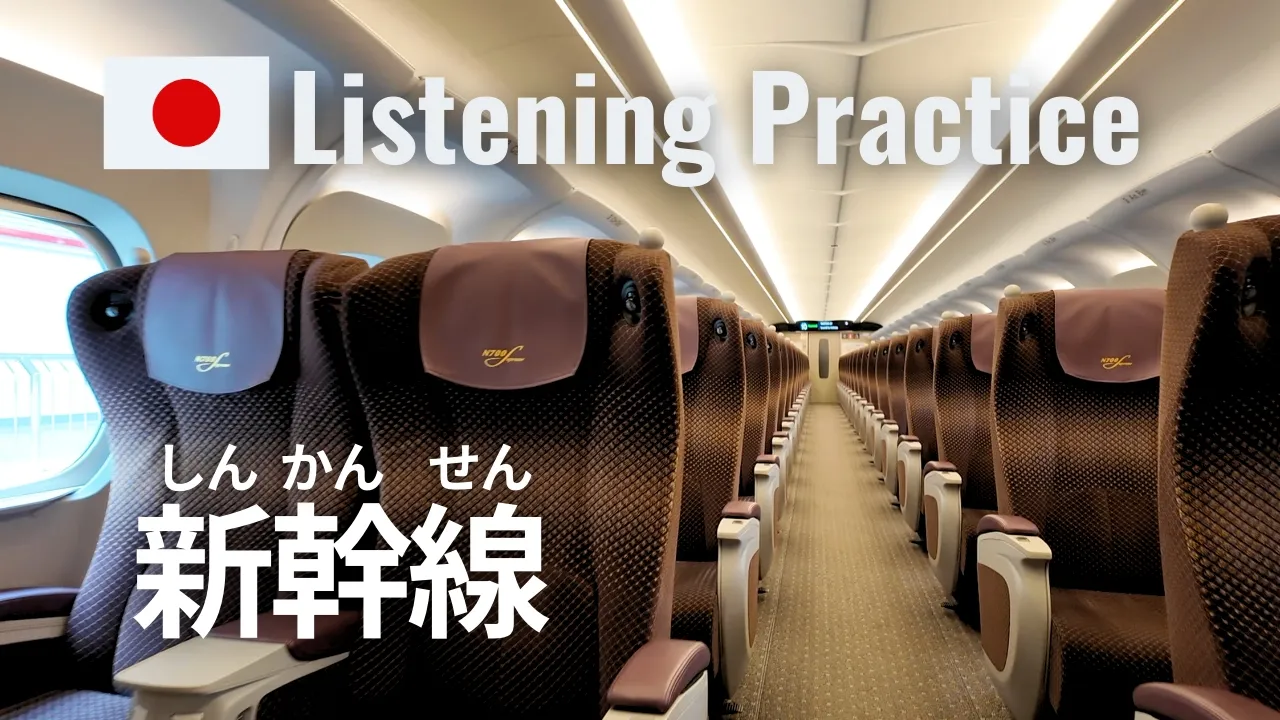
Hi everyone. In today’s video, we’re taking the Shinkansen from Tokyo Station to Shin-Osaka. There will be lots of train announcements too.
Please watch this as if you’re about to get on the Shinkansen yourself. This is Tokyo Station. Before getting on the Shinkansen, we’ll buy "ekiben.
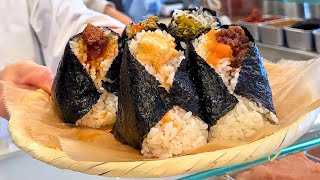
" “Ekiben” is a boxed meal sold at stations. They sell bento you can’t buy at places like convenience stores. I thought they were (made of) balloons, but they weren't.
It felt hard. They are cute, aren't they? This is a Japanese omiyage shop.
These places with lots of people are sweets shops. Where are the ekiben shops? We found the ekiben shops.
They are "kaisen. " “Kaisen” means seafood, like fish and shellfish caught in the sea. These are hamburger steaks.
They have two layers, and rice is in the bottom. There were so many shops that we couldn’t decide. These are tonkatsu (Japanese breaded and deep-fried pork cutlet).
They come with two big pieces of tonkatsu. There were so many shops and so many people. It was hard to choose, but my son picked this, and I decided on an unagi bento.
My son: “This one please. Thank you. ” Me: “Yes.
” Me: “These, please. ” Clerk: “Thank you very much. ” Clerk: “Plastic bags are charged.
Would you like one? ” Me: “Yes, please. ” Clerk: “That will be 3,685 yen.
” Clerk: “Do you have a JRE point card? ” Me: “I don’t. ” Clerk: “All right.
How would you like to pay? ” Me: “Um, by credit card…” Clerk: “Credit card, okay. ” Clerk: “Please insert your card from below.
Thank you. And please wait just as you are. ” Clerk: “Would you like the receipt?
” Me: “Yes, please. ” Clerk: “Okay. ” Clerk: “Thank you very much.
Have a nice trip. ” At the end, the clerk said, “Itterasshaimase. ” People who buy ekiben are usually getting on the Shinkansen or a limited express train.
That’s because on regular trains, people usually don’t eat. And people who take the Shinkansen or limited express are traveling far. So that’s why the clerk said, “Itterasshaimase(Have a nice trip).
” We can see the Shinkansen transfer gate now. We’re taking the Toukaidou Shinkansen. Me: “It says Toukaidou is this way.
” The mark for the Toukaidou Shinkansen is the blue one. Past these stairs is the transfer gate. This is the ticket machine area This time, I bought the Shinkansen tickets on an app.
So we’re heading to the ticket gate. People are stuck here. It looks like there’s some kind of problem and they can’t get through.
It’s taking a while to pass. We finally got through. A seat information ticket comes out, so we take it.
The train we’re taking is the 11:12 a. m. departure, Nozomi 27, bound for Hakata.
Which platform should we go to? Platform 16. Okay, let’s head to Platform 16.
Platform 16 is just ahead. The Shinkansen that leaves before ours are waiting. It says “Kodama” here.
There are three types of Shinkansen going from Tokyo toward Osaka: Kodama, Hikari, and Nozomi. Kodama and Hikari are names that have existed since the Shinkansen first began operating. Because light travels fast, the faster one was named Hikari.
And the Shinkansen that stops at every station, in other words, moves slowly while stopping at all stations, was named Kodama. “Kodama” means the sound that comes back to you when you shout loudly in the mountains and your voice hits another mountain and echoes back. So Hikari represents the speed of light, and Kodama represents the speed of sound.
They were perfect names for the Shinkansen. But later, a train even faster than Hikari was introduced. But nothing is faster than light, right?
So I wondered what they would name it, and it was called Nozomi(Hope). The Shinkansen we’re taking has arrived at the platform. The platform doors opened, and the Shinkansen doors opened too.
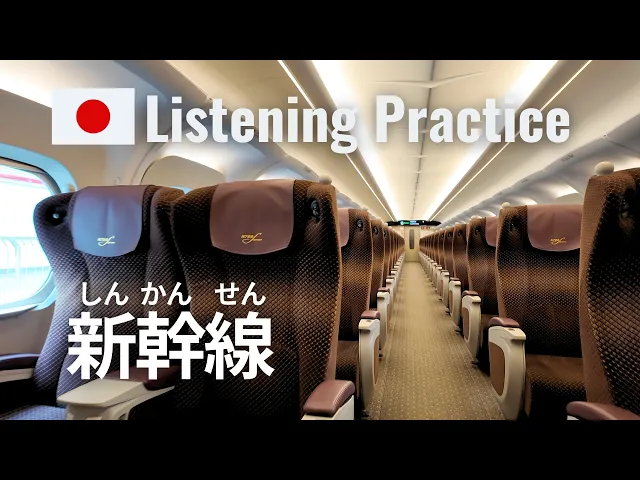
Okay, let’s get on. The Green Car seats are a different color from the regular seats. Announcement: “When leaving your seat, please take care of your valuables.
” They said, “When leaving your seat, please take care of your valuables. ” “Kichouhin” means valuable and important items. Your wallet, an expensive laptop, and nowadays, I think smartphones are also considered kichouhin.
Japan is a safe country. There are hardly any pickpockets. But still, when you go to the restroom, it’s safer to take your wallet and smartphone with you.
Announcement: “Shortly after departure, the train will sway slightly from side to side. Passengers who are standing, please be careful. ” They said, “Shortly after departure, the train will sway slightly from side to side.
” “Passengers who are standing, please be careful. ” It means, “After the train departs and some time passes, it will sway from side to side, so if you are standing, please be careful. ” The Shinkansen has departed.
We arrived at Shinagawa very quickly. Announcement: “This is Nozomi 27 bound for Hakata. Non-reserved seats are in Cars 1 and 2 at the front.
We will depart shortly. ” They said, “Non-reserved seats are in Cars 1 and 2 at the front. ” “Jiyuuseki” means seats without reservation.
In other words, they are not reserved seats, so you can sit anywhere. However, if there are no empty seats, you cannot sit down. “Shiteiseki” means reserved seats.
They cost more than non-reserved seats, but you are guaranteed a seat. “Maeyori no” means “toward the front. ” When the Shinkansen runs in the opposite direction, Cars 1 and 2 become “ushiroyori,” meaning toward the back.
In the Green Car, you can use mobile ordering. I’m going to try ordering coffee. First, scan the QR code.
Then go to the website and select the mobile order service. Enter the number of the Shinkansen you’re on. I had forgotten it, so I checked the seat information ticket.
Then enter which car and which seat you’re sitting in. After that, select the station where you will get off. On the next screen, choose what you want to order.
Surprisingly, beer was cheaper than coffee, so I was really surprised. I selected coffee and pressed “Confirm,” then pressed “View Cart,” and finally “Place Order. ” It says they’ll bring it in about five minutes.
That’s so convenient. Staff: “Please be careful, the coffee is hot. ” Me: “Yes, thank you.
” Staff: “That will be 430 yen. ” Staff: “How would you like to pay? ” Me: “Um… with PayPay.
” Staff: “PayPay. Certainly. ” Staff: “Excuse me while I scan your screen.
” Staff: “Thank you very much. ” Staff: “Here is your receipt and a paper napkin. ” Me: “Thank you.
” We had a lot of luggage and couldn’t get on while holding coffee, so I’m glad I could order it on the Shinkansen. We’re about to pass another Shinkansen. We passed each other in about three seconds.
The Shinkansen is really fast. A Green Attendant handed out oshibori(a disposable wet towel). Me: “Oh, I can see Mount Fuji.
” At first, we could see Mount Fuji on and off. But from around here, we could see it clearly. Can you see that slightly bulging part on the lower right side?
That bulging area is from an eruption 300 years ago. At that time, 49 days before Mount Fuji erupted, a massive earthquake occurred. That earthquake is called the Nankai(South Sea) Trough earthquake.
Some seismologists say that another major earthquake could occur along the Nankai Trough in the 2030s. And if a Nankai Trough earthquake happens, it could possibly lead to another eruption of Mount Fuji. During the eruption 300 years ago, volcanic ash from Mount Fuji piled up to 4 centimeters even in Tokyo.
The Tokyo Metropolitan Government has created a website about preparing for Mount Fuji’s volcanic ash. It explains what to do. I’ll put the link below, so please check it out if you’re interested.
Now, while we continue looking at Mount Fuji, let me introduce a program in July where you can enjoy a Japanese festival. Do you know the Gion Matsuri in Kyoto? It is said that the Gion Matsuri originally began at Susanoo Shrine in Fukuyama City, Hiroshima Prefecture.
This program lets you enjoy the festival at that Susanoo Shrine. You can experience carrying an omikoshi, and practice playing wadaiko, traditional Japanese drums. This festival is famous for “kenka mikoshi,” where portable shrines are crashed into each other.
Of course, you’ll go see that too. This time, it’s a hotel-stay program, with a six-day course and a ten-day course. You’ll stay at a hotel, but there will also be time to meet local people and take part in cooking activities.
There’s so much you can do, and you can enjoy the festival 100 percent. Only four people can apply. Please check the link in the description box.
Before looking at Mount Fuji, we ate our ekiben. I had unagi, and my son had salmon. It was very delicious.
We came to a place that looks like the sea. This is a lake called Hamana-ko. Hamana-ko is famous for unagi.
My elementary school friend’s mother was from this area. When my friend visited her grandmother here, she would always bring back unagi pie for us. This “unagi pie” is delicious, so I recommend it.
It doesn’t taste like unagi. I’m throwing away the bento trash. But in the Green Car, the Green Attendant sometimes comes around and collects trash for you.
So you don’t have to go throw it away yourself. Announcement: “We will soon arrive at Nagoya. The doors will open on the left.
” Announcement: “After departing Nagoya, the next stop will be Kyoto. ” Announcement: “Please make sure you haven’t left anything behind or lost any items. ” Announcement: “There is a gap between the train and the platform.
Please watch your step when getting off. ” Announcement: “Thank you for riding with us. This is Nagoya.
” In the part that didn’t have an English translation, they said, “Please make sure you haven’t left anything behind or lost any items. ” “Owasuremono” and “otoshimono” have similar meanings. If you get off the train leaving something on your seat, that’s an owasuremono, and if you drop something while walking, that’s an otoshimono.
Announcement: “This is Nagoya. Passengers getting off, please watch your step. ” You hear “Passengers getting off, please watch your step” a lot in train announcements.
It means, “Please be careful when getting off. ” That green train is a train carrying oil. Announcement: “There is a gap between the train and the platform.
Please watch your step when getting off. ” Announcement: “Thank you for riding with us. This is Kyoto.
” After Kyoto, we arrived at the next station, Shin-Osaka, in less than 15 minutes. It was really close. We arrived at Shin-Osaka.
While walking through Shin-Osaka Station, I’ll explain my pronunciation course. I run a subscription-based pronunciation course. We do a monthly Pronunciation Challenge, and the pronunciation of people who join regularly has improved a lot.
If you want to speak Japanese with clear pronunciation, please check it out. I also offer channel memberships. If you become a member, for example, you can download a PDF for this video.
At the next higher level, you can watch special videos. If you’d like, please consider joining. Now I’m going to read the names of the people who are members.
Please let me know if I pronounce your name wrong. Charlton Rowe-san, Dimas Oshiro-san,Deb-san, Albireo-san, William Downey-san, Fragrantocean-san, Jorge Ascensión-san, Huang Yinghui-san,Thomas Ralskov-san, Melanie Sander-san, Ed Easton-san, AMYA-san, David Spillane-san, SoundVisionNW-san, Dade Drams-san, Yorque Ubaghs-san, Nick Wondergem-san, Irene chng-san, Kizuna suki-san, ZhiyuanQi-san, Anna Lyon-san, Raphael Kruczkowski-san, Ryan Moorhouse-san, Olenka-san, George Yang-san, Maren-san, Jonalyn Abe-san, Park Se-yeom-san, coo-san, George Yohng-san, Guo Sixian-san, Joerg Diederich-san, nick espo-san, Blox-san, k-san, yaguapiru42-san, CoderXYL-san, Jean Michel Vadel-san, Changmo Koo-san, Gerd Thys-san, Patrick Canfield-san, Cameron Russell-san, Sakai Rukawa-san, Shreyash Singh-san, dervalaquino-san, BG-san, KomahaStudio-sam, aa ta-san, Huang Qiuling-san, Fu Kaijun-san, Corey Hodge-san, Calliope-san, Kaela Brazee-san, Christian G-san Lena Delaunay-san, sandaygirl-san, Hiangrae Lee-san, Bob Celery-san, Kasia, Jo Deok-yeon-san, Ke Xuming-san, Ada-san, KesArts-san, Bubbyhole-san, ferchi-san, Lee Seul-a-san, SexySnob-san, Chen Buyan-san, Mutsugi Misugi-san, Bartłomiej Potrawa-san, Richard Davis-san, Sheepdevil Nema-san, CyberSecurity From Scratch-san,D///-san, xzomofox-san, Shahira Banu-san, Przemyslaw Niezbecki-san, JuiceHolic-san, new channel-san, Remi De Vos-san, Kwon Seung-haeng-san, Mole of Asia-san, Walter Eerdekens-san, Jesse-san, Tribute-san, Cécile-san, David D. P.
-san, Rakroi-san, In Sik Baik-san, Natalia Hernes-san, Ness Tanner-san, Lucius Schoenbaum-san, Hwang Sang-min-san, Norma Carey-san, Ni Ni-san, Jason Wang-san, John M-san, SG Oh-san, Matthew Edwards-san, Roy Wang-san, Banana Kids TV-san, ByungHo Kim-san, shizuokaBLUES-san, Ralf Poetsch-san, Elaris-san, Yukigitsune-san, Maxence Vahié-san, Ramon-san, Dina Rahmawati -san, Ada-san, Harro Kremer-san, Lee HK-san, panda lorian-san, Joshua Farrar-san, Lee Gil-jin-san, Cedric-san, Richard Nicholas-san, Kauderry Moon-san, Sabella Johnson-san, Yazhen Lin-san, Kim Jae-gwang-san, VOLLTEXT-san, Ernie-san, Oakkar Myat-san, Mu Huiyi-san, Danny Roth-san, Emlyn Lofthouse-san, Thank you so much for joining the membership! It truly encourages me. And Ernie-san, thank you very much for the Super Thanks as well!
I really appreciate it. For everyone who wants to improve your Japanese pronunciation, I have a subscription course where you can learn Japanese pronunciation, rhythm, pitch accent, and intonation from zero. Japanese pronunciation, including rhythm, pitch accent, and intonation are very different from English.
But if you have the knowledge, I'm sure you can improve your pronunciation. I also run a Pronunciation Challenge every month. And I give feedback to everyone who joins, so you can fix your weak points.
If you want to feel more confident when speaking with Japanese people, please check out my subscription course. The link is in the description box. Thank you for watching until the end.
If you enjoyed this video, please give it a thumbs up, share it with your friends, and subscribe to the channel. Everyone, thank you again for watching until the very end today. If you liked this video, I’d be happy if you could give it a thumbs up, subscribe, and share it with your friends.
I’ll see you in the next video. Bye for now.