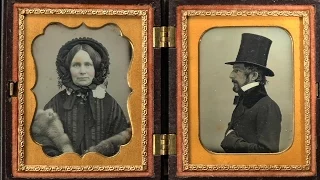
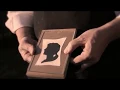
[Music] the invention of photography was not one discovery that led to what we understand is photography today there are winners and losers in the evolution of photography it's so fascinating at every different point in its history the way that we familiarize ourselves with the world around us just fundamentally changed with photography [Music] the silhouette really is the essence that's the essence of a person's soul and and people knew that the term photography in Greek is light drawing so when you're drawing with light you can do it with chemicals but before photography you would look at
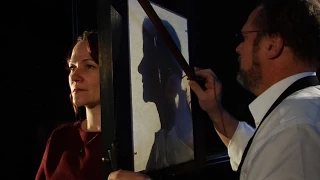
the shadow you would trace the shadow the problem drawing a shadow with someone is that if you put a person in a room and you put a candle on one side of that person and it cast a shadow it's a very big shadow so the biggest problem is how do you take a very big shadow and make it into a little tiny shadow so there are tools that they used the pantograph use a pantograph machine that has these intersecting bars with a pencil and you could trace the large object and it would make it into
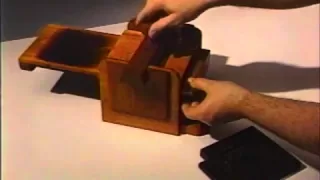
a very small object there was an inventor by the name of Christian who invented a device that would trace the shadow of a person through a series of levers it would then reduce the picture at the same time and this instrument is called a physio no trace the thing about the silhouette and the physio no trace that made them different from a painted portrait was that they were mechanical they were much more objective portraits of individuals unlike paintings which were very subjective camera obscura means darkroom that's all it is it's a room with no light
you know and if you have a room with no light and you poke a little hole in the side of that room and you let light in from the outside by miracle you'll have an image projected upside down turned around but in color and moving on the other side of the wall it's a phenomenon that people have been aware of for thousands and thousands of years it's easy to do it's very often a the first project that is taught in photography classes just as a way to get people to understand the simplicity of what the
camera is later improvements of the camera obscura included putting a lens in the hole so that the light could be focused so that you would have a brighter and more focused image that would be projected on the wall but for photography the camera is essentially a box the early experimenters with photography all knew that they wanted to make images in that box the story of the invention of photography builds on experiments after experiment Johann Heinrich Schultz is a German professor and in the case of Schultz's experiment what you have is a glass jar and it's
filled with chalk there's some nitric acid and there's some silver it's sparingly sensitive to light so you have this jar with a barrier around the outside and when light goes through the stencil it then darkens the chalk that is facing the glass on the inside of the jar this is where Schultz uh contributes to the evolution of photography is that he's proving that this is done by light and not by heat Thomas Wedgwood was the son of the famous Potter Josiah Wedgwood [Music] the signature of the Wedgwood line was the decoration that was made of
silhouettes it's no surprise that one of the wedge woods would think that the light which makes a silhouette could also make an image by the action of light wedgewood is experimenting with silver nitrate and he's brushing silver nitrate on two sheets of paper and on two pieces of stretched white leather he was making images by doing contact prints or photographs he was putting an object on top of the sensitive paper or leather and when you put these in the Sun it's very easy to see the effect of light you can see the paper darkening so
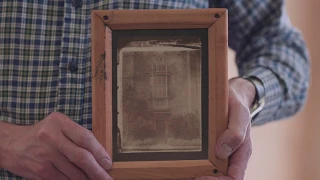
it makes sense that he would want to make pictures in a camera obscura after all camera Obscura's had been used for years to make an image on a ground glass so that you could do drawing so you could see the effect of light coming into a camera obscura and producing an image and yet he had no real success with his process he wasn't able to make those images last he wasn't able to fix the image those images were fleeting they disappeared after a certain amount of time Talbot de Guerre nee Epps all knew about the
work of of Wedgwood because Humphrey Davy his friend had written an account of his worker that was published in 1802 it was a springboard from which other people could then do their own experiments [Music] you [Music] you