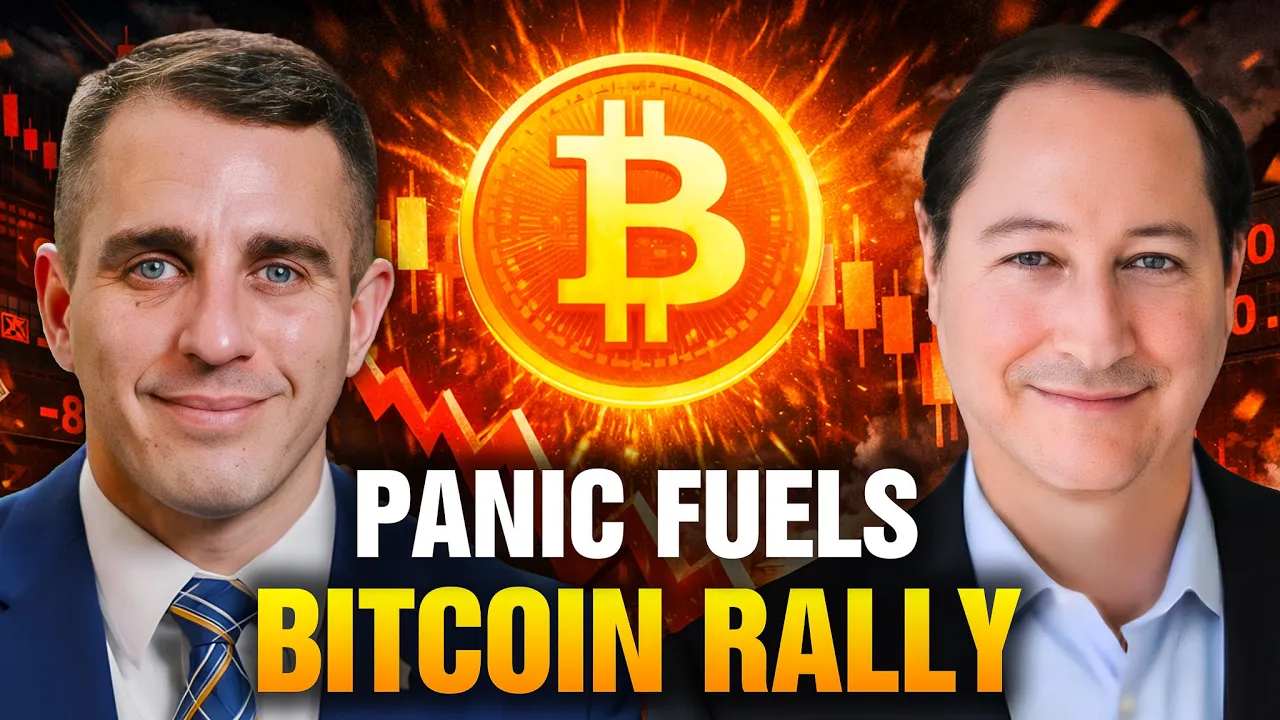
If I'm right about private credit, I'm right about 98 or 2008. There obviously was no Bitcoin in '98, but in 2008, it was created for a reason. And the biggest rallies we have ever seen in Bitcoin right after financial problems, and we always have financial problems, and this year is another financial problem. What's going on, guys? In today's conversation with Jordy Visser, we get right into the heart of exactly What's going on in the financial system. We talk about conflict. We talk about oil. We talk about Bitcoin, software stocks, private credit. if you should be
worried, if you should not be worried, where we think that there's problems and where we think that there's opportunity. We also talk about what's going on in artificial intelligence and how it's related to Bitcoin, but also how Bitcoin tends to do really well after financial shocks and what the financial shock that We're in right now means for your portfolio. Here's my latest conversation with Jordy Visser. All right, Jordy, I thought a great place to start the conversation is private credit is seeing tons of cracks. uh people are very worried but private credited is only about
three to maybe$4 trillion dollars in the market. So it's not massive. What's your take on whether this could be the start of some big recessionary event or is this more so people in Finance are worried and and everyone else should just calm down? >> Uh it's it's surprising to hear when someone says something that's 10 to 12% of the economy is is small. Um private credit is an issue. Bitcoin, by the way, is 1.5 trillion. So, you know, it's only double the size. >> Well, let's put it this. So, commercial real estate's been in trouble
since Silicon Valley back. Okay. Well, that's a big market. The housing market's not In great shape. That's a big market. Um, I could go through credit card delinquencies. I mean, when you're in a K-shaped economy, that means there's a significant portion of the economy that's not well. So, private credit may be viewed as this small thing. But if you combine all of the private markets, if you combine the leverage that we've seen since the great financial crisis in I would say offbalance sheet stuff, the numbers are enormous. So if if people Want to disagree, we
restricted the banks, DoddFrank. >> Yeah. And we're only now lifting the restrictions. But somehow or another, the debt to GDP of the country has grown rapidly since then. The money supply has grown rapidly and the size of GDP like the debt in the country has continued to grow due to the fractional reserve banking system. So someone's lending to someone. The problem is there has been a Bubble in two things. One is marktomarket, meaning there's a lot of investors, insurance companies, pension funds, and retail that have moved into private equity, private credit, VC. Like all of
these things, they've got cracks in them. They've had horrible returns relative to the public market. So, I learned a long time ago um with credit that if you pick something like subprime and go, it's just a tiny little problem. You're making a big mistake because Behind lending is other issues. And as we learned with Silicon Valley Bank, which was a hundred billion dollars of deposits, it can be a seismic shift that forces the central banks to do something. So I don't want people to minimize this. And the way that I look at it is this
way. Financial stocks, the equity, which is above like that's the part of the cap structure that if it's getting hit, it's because people are having trouble with inside some portion Of credit. Whether it's Blue L, whether it's Blackstone, a lot of these things are down 30 to 50% this year. Goldman Sachs yesterday closed below the 200 day moving average. Goldman Sachs, it's 20% off the highs. So, um, when financial stocks, which I've said on on my podcast, I've said it here, when financial stocks are negative, when they're below the 200 day moving average and the
200 day moving average is pointed down, that is when really bad Things have happened. Um, and credit spreads have widened and VA has gone higher. Now, I've been talking about the VIX going higher for quite some time and it's gone higher. I don't think this is going to end just by going away. I wrote a Substack this week where I talked about Bitcoin connected to private credit. So I I I want people watching this to just realize that although private credit to me is not a systemic event once you start getting Into a situation where
all of these problems are shaking and then you throw on top of it oil going up by 25 to $30 by gas at the pump going up 60. This reminds me a lot 2008 and 1998. Not that this is going to end up with the great financial crisis, but those were events that both had issues that were going on where you had kind of a a K-shaped economy when you see um all of these cracks happening, how big can the Contagion be? Can this affect everything? You know, people think of the global financial crisis and
they feel like everything was falling apart, everything was affected. it really um there was the layoffs, there was you know financial pressure some people, there was stocks going down, credit had a problem, etc. Can private credit be the kind of domino that tops over and creates this massive contagion? Well, the the answer is anything can be In a fractional reserve banking system. So again, so so people understand what that means. For every dollar you put in the bank or whatever it gets put into when it gets levered out 10 times, the total assets of the
world are about 800 trillion dollars. The total GDP is 120 trillion. The total monetary base is about 120 trillion. So that would mean the assets are worth about seven times. This is the issue and the reason why in my opinion when when the Bitcoin white Paper came out and watching banks go down, we still need to have the economy grow and the only way we could have the economy grow was through this magic of QE and just increasing the debt. So the government debt has become this big thing. So the good thing about government debt
being so large is that the private sector debt has gone down. But again, we have leverage in the system. It's in the insurance companies. It's clearly in uh the the private Equity firms and in areas of that meant where they don't have to take marktomarket. So the issue comes in is whenever you have deflationary pressures of assets, it eventually starts to feed through other vehicles. We had a deflationary fall in software stocks and I remember when you had your event and I came up after someone spoke and said this is like co and I went
this is not like co. I jumped on the stage and said this is a bad situation. Software stocks Are falling for a very valid reason which is the disruption from artificial intelligence. The problem is a lot of debt in the private market and a lot of VC dollars went into that SAS market back in 2021. So the problem for everyone to realize and when I say 1998 and 2008 what I want to make sure people realize on this K-shaped economy a K-shaped economy means some people are doing well and a lot of people are not.
Well, in 1998 when I was in Brazil, Emerging markets were falling apart and the US was doing great. In 2008, for people who don't remember, emerging markets were doing great and the US was doing horrible. This one's a little bit different. This K-shaped thing is really about anything related to AI and exponential innovation and assets on the on the top end, but a lot of that was created by QE, and we're not having that. And right now this week, all rates around the world are moving higher Because in 2008, people forget before Lehman fell apart,
crude went up to $155. Crude is like monetary policy. And especially when inflation expectations go higher and one-year tips break evens have now gone from 3% for 1 year to 4.7%. And inflation in the next print is going to be a blowout high number. And then we'll see what happens to gas at the pump. >> Today's episode is brought to you by Fountain Life. Are you ready to seize the day that will change your life guaranteed? You invest in wealth creation every single day. But what's the point of it without an optimal health span? Award-winning
Fountain Life is the world's most advanced longevity destination. And in just one day, they can map an exact and complete picture of your health profile. No guesswork and no blind spots. From there, they create a personalized plan that prevents disease And may even reverse aging using precision medicine and restorative therapeutics. It's available nowhere else. In other words, your energy supercharged, your memory sharper, your life extended, and so you can live without limits. It's the best investment you'll ever make. Receive $1,000 off the cost of a life-changing membership with Fountain Life when you schedule a call
at fountainlife.com/p. That's fountainlife.com/p. Truflation went from8.9 to within 4 days, 5 days to 1.47. And true inflation is uh you know real time pretty sensitive to these movements uh both up and down. And so if that is jumping 50% in a short period of time and probably going higher uh I definitely think that the CPI is going to see you know a pretty substantial move as well. Um that then brings the question of how high can oil's price go and what does the Fed have to do to to Kind of combat some of this stuff.
>> Well this is the dilemma of having deflation happening on one part of the economy and inflation happening on the other. I like talking to you. See, I was, you know, I'm leading you to water right here. Of course, that's what I want to talk about. Um, so, you know, one of the, I think, problems for the market right now is that people are now associating that the only reason the stock market is weak is Because of oil. And the problem is the issues with financial stocks. Financial stocks were already below the 200 day moving
average when oil was still around $65. This is not about oil only. Oil just adds another layer into it. Um the good thing about oil is it has a natural mechanism for taking things lower, GDP. So if demand starts to come down, which it will. The longer oil stays up here, you're going to start to see the GDP side go down. You're going to see Businesses pull back on things. When you have this oil price, it's because there's disruptions. And it's not just oil, it's gas, it's helium. Helium is necessary for semiconductors. It means it's
necessary for data centers. it's necessary for a lot of things. So the longer this goes on, the higher the risk of the economy falling over uh to a much lower level in the short term. And I think people are starting to forecast that for Q2 Uh if oil stays up above $80 for some time. And I think people like Jeff Curry have spoken and a lot of people that I pay attention in the Middle East, even if this were to kind of get resolved, it's going to take a while for everything to come back to
the market. that's how much of a disruption this has been by the by hormones being shut down that it could take another you know 6 weeks to 12 weeks before you can normalize things. Well, if that's the Case that means Q2 GDP is very likely to be negative if for no other reason just because inflation is going to be high. So I think it puts the the Fed in a in a difficult position. What I'm watching and we've taken out basically the rate cuts that we're in for this year. They're almost completely gone. We're not
we don't have one built into the curve anymore. We have about three 75% chance of one cut before the end of the year and those are reducing. In the case Of Europe, we've seen a massive change in the front end in Europe where they're starting to build hikes in and the rest of the globe everybody rates are up through the roof. So I think this is a dynamic where the equity market is repricing the reality of slower GDP and every day that passes where uh Hermuse is still shut down. I think people are starting to
build in a much worse scenario. So, I do think the Fed is going to be in a very difficult Position. And remember, we're going to have the switch over during this whole scenario and we're going to get war. Uh, and I I I think they're going to have to air at some point on saving the private credit side, but not until oil comes back down. >> And we've seen now a number of countries say, "Hey, we'll release 400 million barrels, you know, into the global supply." Um, we've seen the United States, obviously, they have got
uh some Influence over what happens in Venezuela. The US is a net exporter. It does not feel like even though we have all these things working in our favor, it's having the impact on the oil price that maybe people want it to have and oil is still going higher. And maybe one of the aspects of the oil price in particular to me is how volatile it's been. You know, 77, 120, back to 77, 90. Like it's not just a straight line up. It's actually this like constant Girration that almost makes it feel like there's more
uncertainty. there's more chaos than if it was just going, you know, a straight line up and people just said, "Hey, you know, it's going to go higher." And and I can understand that. >> Yeah. I I think you're you're mentioning intraday and I think on Sunday night when the markets were closed and they're up big. If you look at a chart, you know, at daily close, it's pretty much straight up. There's there's there Gas at the pump has not been down one day. So, when you look at the futures market, they may go back and
forth. They might be down for the day and then finish unchanged and then the next day they're back up. >> So, you don't worry about you just kind of ignore all that. >> So for me again I I either something has to change the economy meaning earnings andor the economy for the market to actually respond in a big way. So when Tariffs were happening last year >> this was a shock meaning I don't think anyone expected him to intentionally hit the stock market. So when he put the tariffs on everyone was caught off guard. Iran
the the situation with Iran had been building to this point. So I think the market had a sense of this kind of happening. Oil was going higher. >> You mean when he moved all the warships close by? >> It's not like this one I mean very smart People for beginning in January said this is going to come to a head but I think two things surprised. One was because of June of last year and how quickly things were done they figured okay it'll be the same thing and her most will not be an issue. Well,
it is an issue and I think now the tale of that is when you look and you read some of the news items and again I'm more focused on artificial intelligence and the way wars are being fought today. >> Mhm. >> It's very scary to me um to watch how much a country can use very cheap equipment to stop one of the most important if not the important waterways in the world for the global economy. But they've been able to do that with drones and with mines. These little floating things that just go around at
very slow speeds. >> Did you see my uh my announcement this week? No. >> I made a new investment. >> What's that? >> Andis, do you know about this and DAS? >> Yeah. Where did I hear this? Oh, this is with Palunteer, right? >> Well, they did just do a uh a deal with Palunteer. But um basically what I find very fascinating is I think that over the last 6 weeks or so it has become very apparent to everyone drones and autonomy on the battlefield is going to be very big. So AI basically and drones
>> and um this company in particular I think has taken the view whether they're right or wrong that there's a lot of money that gets sunk into the R&D components of creating this technology, testing this technology and trying to go and and get it to a point where then it can be scaled. So instead, what they're doing is they basically have a big war chest and they got like a billion and a half dollars worth of cash and they built a team that's really good at M&A And really good at business development. So they say,
"Look, all of these drone companies, etc., uh, that have gone and done all the R&D and spent all this time and effort, those teams are usually not that good at scaling the business. And so what we'll do is we'll go and we'll buy them and then we will be really good at the M&A part of it and then the business development part." And so they've started to win a lot of contracts. But um in a conversation with The CEO, he was explaining to me that when I think of drones and probably when you think of
drones, it's very offensive. >> Mhm. >> He's like, "Look, there's just as big of a market on the defensive, the counter drone component." And and he was explaining to me things that, you know, we now have drones that can go and hunt down a drone and throw a net at it. We can take over the like communication Wave and actually like safely land it and do like a soft kill. And that's just in the air. And then you start talking about mines and like like I I don't know if we have put a a boot
on the ground yet in Iran. At least not we haven't acknowledged it. >> Mhm. >> It's been going on for what two weeks bombing the hell out of it. And I think we actually sent people in before we bombed in Iraq. >> Mhm. >> It's just a different world, right? >> It's definitely a different world. And again, I I this is why I think as as people are sitting at home and they're managing their money and maybe they haven't gotten worried yet because maybe they're only long semiconductor stocks and some of the things we've talked
about here, I think people should be worried about private credit. They should be worried about the war Extending longer because of the things you just talked about, which is this is a new world like artificial intelligence getting to this point. um the difference between like how long Ukraine and Russia have been going at this like this has been a long time and I think if you go back to the beginning which was in 2022 and oil had jumped up to 120 and it stayed above 100 for like 4 months. >> Mhm. >> I think on
the second night everyone Said this will be over real quickly that Russia will just and it's still going on. So, I think part of the thing that I've heard from people is this expectation that either taco will take over and we'll just okay, we did what we wanted to do. Um, >> Taco is such a good meme. >> Yeah. And it continues to go. I think people should be more concerned with what is really happening here, which is we are definitely in the next phase of Deflation relative to the disruption from AI. The jobs market,
we have not created a single job over the last 12 months. And if you strip out healthcare, you're negative. The economy has been weaker. And I still think people are very naive about the disruption that AI is going to have to jobs. And even though maybe it won't create massive job losses, it definitely displaces people and forces them to take jobs they don't want, which makes them more miserable. And it's one of the reasons why consumer confidence just can't get out of lower levels. The war situation adds to gas at the pump. We know inflation
has been a huge, huge issue from a political basis. when you move gas at the pump up to the levels that it is at 363 this morning, it's a big problem. So, I think people in their portfolios should remain hunkered down. I think this is going to take longer. I'm going to keep watching and seeing, but when the financial Stocks are as bad as they've been, I think people have to realize that we're probably closer to the end in terms of the central bank sitting on their heels. I think there is going to have to
be a liquidity facility eventually put in place to stop the credit unwinds because every day that I wake up there's a new redemption story, new gates. JP Morgan's going to mark things down. People are these situations just don't end on their own. They just don't. They end with some Help from the government. And I think that's going to be necessary at some point this year >> when we look at things, let's say, in the housing market. Um Lance Lampard at Resi Club put out this great chart that shows um the amount of money you needed
to buy an average home in America has gone up like 90% or something in the last call five or six years. So that takes into account like real wages, takes into account home prices, etc. Right? But the amount of money you need to buy an average home in America has gone up, let's say 80 or 90% in the last uh five years, but it is down almost 6% in the last 12 months. So it's basically this huge chart that runs up and then you get this small little y decline. What I hear a lot when
I talk about the economic data with people and I say well you know there's deflation happening in the home market and trueflation saying it this metric is saying it etc. The First thing people say is like, "Dude, are you crazy? It's unaffordable. It's too expensive." And so, I think that that's also part of this of like the government has a choice. And I remember Besson got interviewed on the All-In podcast uh right when he first got into office and they asked him, "Do you believe the economic data?" And he said, "No." But he said one
of the things that he had learned throughout COVID was the data can tell you one thing, but the People are screaming something else. Should you trust the data or the people? and he seemed to be much more sympathetic to what people were saying than just the economic data. And so I think housing is a great example where like yeah sure it's coming down but it's still up you know it's almost doubled or whatever it has in the last five or six years. People are like I don't care that it came down 5%. It's still unaffordable.
And I think that's really Where the government almost feels like these folks are a little bit more sympathetic and in tune with the plight of the American consumer more so than just like show me the spreadsheet, show me the numbers and I'm going to make decisions exclusively off of that. Yeah, anyone who argues that the the level the markup we had in the cost and again if you really go through everything involved in a house, mortgage rates are up and again now mortgage Rates are going back up because we've got long-term yields. 10year yields are
up 30 basis points in the last two weeks since the war started. Um you also have insurance costs which have gone through the roof and those are not coming down anytime soon. Uh car insurance has gone up. When you add everything together, and I always say this, when you put an enormous amount of money into the system, which is what we did during COVID, and you hand it out to people, And yolo is a theme, you only live once, that is meant to replace the wages that you lose during a time that you're not working.
You don't have to pay your mortgage at that point, but really theoretically, you should be saving that money so that when everything comes back in, you're able to pay things. But if you go spend it, which is what happened, eventually you've spent your savings. So if cash comes into your bank and you spend it, then eventually you're living Paycheck to paycheck again. And I just think this country has been in a paycheck to paycheck mode for a long time. When you're in paycheck to paycheck and then you move the cost up dramatically. But then you
also get the fear factor that comes with AI. And there was a survey in um NBC about AI. And I'm sure you saw the list of where it fits. I mean, it's near the bottom. People do not like artificial intelligence and I think the reason they Don't like it is partly for fear. Um, social media and these viral things going around, especially with AI and AI agents are only going to get worse. Silicon Valley Bank was a run on a bank. It was a run on a bank that happened because of digital reasons. The ability
to do it, but also the fear that grows and it's you see this tweet come out and you're like, "Oh my gosh, I got to pull my money out." Private credit's not that easy, but the redemption numbers are Through where these guys, they've got gates on. So, this is a new asset class. So, if people go, "Well, this is not systemic." I look and go, "Hey, the one thing I learned about credit a long time ago is when it's a new thing, we don't know who else has lent to this, how much leverage is in
there, how much fraud is in there." A lot of the things that happened with First Brands and Tricolor, there was fraud involved. So when you get into a credit event, and that's why I wrote the paper, when the tide of liquidity goes out, you get to see who's swimming naked and when credit is a big issue, you start to go through. So I think when you add all those up and you put in the the problem, >> there's a reason why credit's bad, why student delinquencies are bad. And the reality is people are living paycheck
to paycheck. And if you move inflation up to a very high level, which we did, even if it goes down by 1% for a year, it's Still elevated and it still makes it difficult. Let's talk about the granddaddy of them all. Bitcoin. It's hanging in there real strong. I I I think that if you had said to me four weeks ago, all of the things that are going to happen happen. I don't know. Bitcoin's down another 15%. Maybe would have been my thought process. You know, hopefully not more than 20, but but I would have
said it's going to sell off and uh uh it's going to have a tough Time. The fact that it's flat to sightly up feels like maybe that's a victory for Bitcoin. >> Okay. Good news, bad news story. Uh oh. >> Which one do we gonna do first? >> Let's do the bad news first. >> All right. >> Um software let us down. Bitcoin went with it. Now, Bitcoin, as I wrote in the Substack and I showed the chart for the last year, it's pretty much a direct overlay with two things. Software and Private credit. So,
as the private equity guys have fallen over, so is Bitcoin as this. So, Bitcoin is doing and the whole point of it was I thought Bitcoin would be up a lot last year. I didn't expect the AI progress to be as fast as it is. And then as we got closer to the end of the year, I still in the back of my mind when I was buying it at 100 and 102 and then 95 and all, my belief was that we'd still go higher because the Agentic side was coming in And we'd see the
network effects kick in. Well, we've seen the network effects kick in and this is part of the good news when I get to it with the Middle East which is stable coin volumes have they're growing exponentially and the agents Stripe ramp credit cards this week for agents like the agent world is going to grow which means volumes are going to explode and the digital economy the crypto side is going to happen. If you get a chance read Stripe's annual Letter it's always a good read but they talk about agentto agent commerce and where this is.
So the bad news is that we've had a momentum unwind meaning all the stuff that was leading us down like software has gone up. Well, Bitcoin was part of that camp. On the flip side, semis and a lot of things that were doing great on AI, they've come down. So you've had a hedge fund unwind trade, which Bitcoin benefits from because Bitcoin is a proxy for the software and For the code world. That's the bad news. The good news is to me uh what's happening in the Middle East there's a lot of talk about people
moving into stable coins instantaneously. So whenever there's problems in the world there's a move to dollars. Well this is happening in the Middle East in a big way Iran Dubai any of the places over there there's been volumes and talk of all these growing volumes. Now, I think Bitcoin benefits from that because I Think we're running into another issue that falls falls into Bitcoin. If I'm right about private credit, I'm right about 98 or 2008. There obviously was no Bitcoin in '98, but in 2008, it was created for a reason. I think the private credit
world and the transparency and all the issues that are going when Goldman Sachs is down 20% off its highs when it's underperformed the S&P by as much as it has. That historically is a time when Bitcoin is About to rev up and go because that means the central banks and the Treasury are going to have to come in because the one thing that I still want to say to everyone, this is a financialized world. The equity market is over 200% of GDP. if they allow equities to fall and we're starting to get where private credit
in the financials are dragging down the S&P and I highlighted in my subscriber webinar that has not happened in the last 25 years That financials went below the 200 day moving average and the S&P didn't eventually follow. We're just getting into the danger right now. VIX is going higher. Credit spreads are widening. We're getting into that contagion mode. And once you get into a contagion mode, if we're a month from now and we haven't solved things in hormuz and and and you have oil still sitting around the same levels, the S&P is going to be
lower in my opinion and credit spreads are going To be wider. The private credit world is going to continue to worsen and that means we're going to get closer and closer and every single time the central banks have come in to defend some kind of a unwind of equities or an unwind of anything. And it doesn't just have to be the central banks doing something. It could also coincide with a China US grand deal. It could also coincide with the Iran war coming off and oil going down at the same time that the central Bank
is forced to come in. That is usually when Bitcoin doesn't just go higher, but it goes higher at a beta that makes people realize. And the great news is for everyone. So I gave you good news, bad news. Now the great news, I think software is a dead asset. So everyone who wants to try and pick the bottom of software, go for it. This is not what you want to be doing in your life because AI is going to disrupt most of these companies, not all of them, but Most of them. You need a new
growth asset. The crypto guardrails, the financial guardrails are quickly becoming the network effects. And I always believe that when we came out of this, it would be Bitcoin that would be the growth asset. And eventually all of the traditional finance world, including pension funds and endowments. What do they need right now? Transparency and liquidity. What does Bitcoin offer every single day? Transparency and liquidity. That's what the blockchain offers you. You don't get that in private credit. You don't get that in private equity. You don't get that in VC. You don't get that in commercial real
estate. I think between tokenization, all these movements, the end of this year, there's going to be a cry for more liquid things and more transparent things. Today's episode is brought to you by Bitket. Bit is the world's first universal exchange serving over 125 million users with Access to over 2 million crypto tokens and trady markets such as 100 plus tokenized stocks, ETFs, commodities, FX, and precious metals like gold and silver. They officially opened its Trady trading suite on January 5th, 2026 and has already hit the milestone of $4 billion of daily volume just days later.
Users can now trade 79 instruments across global macro assets such as forex, precious metals, indices, and commodities directly with USDT all Within their existing BTG account. This experience is designed to feel familiar to crypto native traders while opening the door to macrodriven strategies without the need to switch platforms. Users can also enjoy high liquidity and low slippage while trading these assets with up to 500x leverage. The Bit ecosystem is committed to helping users trade smarter with its AI agent to execute trade orders. As a co-pilot, BitGet is driving crypto adoption Through strategic partnerships with La
Liga and Moto GP. Aligned with its global impact strategy, Bit has joined hands with UNICEF to support blockchain education for 1.1 million people by 2027. Bit currently leads in tokenized tread by market, providing the industry's lowest fees and highest liquidity across 150 regions worldwide. Check them out at bittget.com today. That's bit t.com today. Today's episode is brought to you by Arch Public. I absolutely love these guys. Arch public is an agentic trading platform that automates the buying and selling of your preferred crypto strategies using sophisticated algorithms like the intelligence arbitrage and oracle protocols. Arch public
executes advanced automated crypto strategies fully customized to your goals. Is your aim to accumulate Bitcoin during market dips, generate Profits from Ethereum volatility, or sell Salana or XRP in layers as it reclaims all-time highs? If so, Arch Public is built for you. Are you worried about doing it alone? No problem. Arch Public provides everyone, yes, everyone with hands-on dedicated support from their concierge team to help implement the strategy that you choose. As a preferred trading partner of Coinbase, Kraken, Robin Hood, and Gemini, Arch Public offers a proven track record of Security and performance so that
you can trade with confidence. Sign up today at archpub.com and start your automated trading strategy for free. No catch, no hidden fees, just smarter trading. Your crypto, your exchange, your profits. Archub. Go to archpubic.com and tell them I sent you. I've always had this uh theory for the last couple of years that um a lot of the asymmetric returns in venture capital have started to be arbed away because there's so much capital Chasing still uh about the same number of great companies every year. And so the data is kind of all over the place, but
let's just say that you take the average venture uh return. Um it's somewhere in like 17.5% range. the NASDAQ, depending on when you pick, is somewhere around 13 and a half percent compounded uh over that period. And so you got about 400 basis points of outperformance by being in the venture funds. And so people are willing to lock Themselves up for 10 years or so. As more capital pushes into the private market, you just arb that. And so let's say now venture capitalists, now again, it's paper marks, but let's just say they claim, you know,
150 basis points of outperformance. I don't know how many investors are willing to lock up for 10 years for only 150 basis points of supposed outperformance. And so therefore, I have a thought that there's gonna be this push back into the public Markets. People would want those liquid type things. It sounds like you're taking it a step further and saying it's not just venture, it's also private credit and kind of anything that's illquid will then lead to more and more people wanting these kind of asymmetric liquid assets like Bitcoin. >> So there's two things about
those markets. If you break down VC, you break down private equity, you break down private credit. Let's just go through This. You've got companies that are either going to grow like VC and then eventually monetize. And if you get two out of 10, but those two are 10 baggers, then you're making money. Well, if companies don't grow to the size they used to grow, and then they actually peak and they start to decline. And I've mentioned like a company like Curser. Now cursor's revenues are still growing, but when I hear people on X, most of
the stuff is about how expensive it's Getting now. >> Mhm. >> The we have never seen companies grow this fast, but also reach a point where there's competition in their world so quickly. So that's the other part is how long are you going to keep doing that business if there's another competitor? And I believe what has happened and this whole thing we all know the lifespan of a company in the S&P 500 has been declining for a long time now that is Because of exponential innovation. And I think exponential innovation is what's crushing all of
these things because long duration assets are about time. >> Do you have time to generate this? Do you have time for this to work out and I'll say it again and again that is the number one thing that has changed. When you hear that in the singularity in this world, what is equivalent now to a year of innovation is what used to be 10 years by definition that means every Year a company that has a business is 10 years of competition built in today and because of claude code because of open like the advancements we've
seen just in the last three months then when you add openclaw nano claw and auto research which and andre karpathy put in GitHub this week which I'm going to start uploading along with open call because I have an idea on how I can use that with my agents. I just think people don't realize that the ability of building Stuff instantaneously. Having a business right away is just faster than ever. And this extreme this extreme time difference is what people need to be in your head. If you're investing in something based on the long term, the
longer it is, the more likely you're going to be out of business. And I just think that the markets are discounting that on long duration assets. So I've been thinking a lot about these modes in AI and how durable they are and um I'm Coming at it from the perspective of we have a business that is in the AI space you use it for personal finance and one of the things that we have seen over the last couple of weeks is the conclusion if it is software it is not going to be a moat and
we have seen a rapid proliferation of people picking off features products etc. And so then it begs the question of well what is the moat? And I've come to the conclusion that there's basically three things. There are analog world things. So that could be um you know uh uh what's his name? Um Ory Emanuel is now famous for going and doing live events and trying to buy up a bunch of these live event things, right? And talking about hey I can't disrupt live in person type stuff. Um, you also have network effect, like true network
effect that is going to be very hard to unseat regardless of who builds what software. Um, I think that there is probably a distribution mode That you can have for some period of time. Now, there's a question if it's like B2B sales, can the agents eventually replace that and out compete you is unclear, but but at least for a while there'll be distribution mode. And I still do think that there is something about uh I call it the innovation mode and it's basically this idea that if you create something new and you are an innovator,
you are going to get copied very quickly. But if you are constantly Improving and you're just like a true innovator who can stay ahead of the curve, there will probably be some sort of moat there because you just are always the pioneer and everyone else is, you know, kind of watching you or chasing you. And so the odds that they're able to be just as good and get the next idea before you do is probably lower. But this completely changes the way people think about building companies Now. I mean this is this is pretty crazy.
And so the other maybe example is have you seen Pulsia? P O L S A. All right. So first of all the name of the company is AI slop backwards which you know you should appreciate. Um it's a guy uh named Ben online >> who basically said I want to create a business with no employees and all AI agents. So he created it. Now in a little bit of a meta, he created a company that helps you run a business With all AI agents and no employees. 0 to three million in uh ARR couple weeks,
three weeks, four weeks, right? At one point, I don't know what the latest numbers are, but he was adding a million dollars of ARR like every 3 days. And so you look at this and he's posting that online. He's like building in public. He he was maxing out many of the different vendors or models, etc. because so many people were using it. You see that story every young kid in the world. It's like, how do I learn how to use this technology to go so I can go build a company that's $3 billion in AR
and not have to deal with people and raise money and do all this stuff? >> I don't know how we go back. Like you there's no putting the genie back in the bottle, right? >> No. And I I can just I I mean again I can say this from my own experience but for everyone watching if you're paying For one of the if you're paying for the expensive side of Claude or even Perplexity. So if you're paying for Opus 4.5 and you're at the pro level just go into it when this podcast is done. I
know you hate it when I say do it now. >> Yeah. Don't do it now. >> Don't do it now. Go in after. >> Hey don't go anywhere. Stay right there. into a chatbot and say >> go into GitHub and whatever thing you Want like for me if I wanted to this is how I built my turbulence model just say I want you to go into GitHub and find me a model for a port building a risk portfolio of my shares of what I own in my portfolio and how if I wanted to optimize it
from a risk basis I could do that something along those lines or do something simpler it doesn't really matter just ask GitHub for just go out there and go there. GitHub is a library. It's a repository where all of these Open-source people that build stuff, they just put it. So, it's like a library of code. If you ask it to do that for you, it will build it for you and then you will have it on your own. That means that any idea that's out there, so the Andre Karpath, it's it's open source. Open Claw,
it's open source. You can just go bring it into your computer and it takes you maybe an hour, a few hours if you have no idea how to use the terminal and Go through this, but you can do this stuff very quickly. I could never do this. So now all I need to do is just go out and if I come up with an idea, what I end up doing is saying, "Hey, I want you to go to GitHub and see if this idea exists. And if it does exist, come back and give me the
top five ones that are rated there and then go build it for me." And by verbally saying that, you can build something that can be an HTML that you use. I did that in Perplexity Computer this week. I'll be showing it in my weekend video about what I built. So again, anyone can do this stuff if they're paying for the models. I just think people have to realize that this competitiveness of hey, someone's built something and go. So if you want to know how someone can grow a business and make money, I think the way
you have to think about it and and you know if if this is what you meant. So if I create if I go to GitHub and I Create something and let's assume it makes it's on pace for a million dollars this year. Okay, but it stops at a million dollars. Okay, but I still want to grow. I just come up with another idea. Okay, this one's 40,000. Okay, let me come up with another idea. And these things are just running on their own. This is what's happening is that the ability of creating 20, 40, 60,
100 because you have no people. It is literally just the Code. It goes to an HML HTML site. You have to get it somewhere where it gets distributed. But the reality is with social media and everything else, you can do these things. I just don't think people realize that the growth is now going to come horizontally. It's not going to come with one company and one product just continuing to grow. It's literally how many great ideas can I come up with to arbitrage other people that haven't done this yet and do it From around the
globe. And I think this is going to be the way business is done >> 100%. Um, we we have I'll tell you two quick stories. We have a guy who used to work for us, doesn't work for us anymore. uh he was in sales and um he all of a sudden I got an email from somebody I know and they said uh hey who is this person emailing me and I looked and I didn't know who the person was. It was from like an ad agency that was trying to sell ads on our behalf. I
was Like I don't it must be a scam or something like don't don't respond and uh so okay fine. Then the guy who used to work for us comes to me and he goes hey by the way I got some leads for you. And I was like wait what? And so he had built an AI agent and he just plugged us in because he knew that, you know, we we're we're good friends, whatever. And he just wanted to see if it worked. And all of a sudden people started responding to them, right? And he's Like,
"What do I do with these leads?" And I was like, "Well, first of all, next time, you know, like let us know, right? Don't just because I'm telling people it's a scam or whatever." Um, but I was like, "This guy not technical at all. He could be the salesperson for like 10 companies if all his job is to go and drive leads and he's going to do it all automated, you know, and you're just like, "Oh, this is going to rapidly Change not just how the businesses themselves are constructed, but the distribution, all this stuff."
And the other story is um remember the woman I told you who's online who uh does uh um uh homeschooling and she keeps talking about this stuff. So, she now I think that she built like a YouTube uh clone, but it's only with videos that she has pre-approved and puts on. >> And so, she's able to not just say like YouTube Kids has certain videos, but They're not like the most entertain like the kids want to watch some of the other stuff. >> Y >> So, she basically was able to clone like a version of
it, put the videos on there, and now her kids can sit and watch, and she knows that they're only watching educational videos that are entertaining, blah blah blah, whatever. There's no ads. There's again smart woman, homeschooled teacher, Very interested in her kids. But come on, you're telling me that uh more and more people aren't going to start to do this stuff. Okay. So, the way you ended that, I want to make sure people hear this. I've said it repeatedly, but I've used an analogy now with business leaders, and maybe it's because they're business leaders and
they understand this analogy. Well, >> leaders. >> Yeah. Um, so what I've started to say to People when they go, "Well, how how do I start doing this?" And I go, "Okay, let me reverse the question to you. What's your handicap in golf?" And whether they play golf or not, they've tried it. Every business leader has business-wise. I got to play golf. It's like Japanese back in the 80s. Got to learn Japanese. All right. So, let's assume 20 handicap. And I go, "Okay, so instead of saying, "How do I get started with AI?" What would
you need to do to take your Handicap from 20 to 10? And everyone immediately gets the right answer. Well, I got to play more. Okay. If you want to be part of the AI entrepreneurship, you have to start using AI not as an answerbot, but you have to start building things. You have to be a builder. So, I finally finished my my AI series and for parents and things for their kids. I I literally I took a lot of time with this. My son has used it. He's built things for me. It is Literally in
five videos taking people from how to use Cloud Skills. I'm giving them the prompts, too. And the only reason I'm giving people the prompts is because I don't want them to get caught that they don't know how to do prompts. I explain how you can build your own prompts as well. But more importantly, I want them to see the output that comes as opposed to, hey, I'm taking the train today and I'm thinking of taking a bike. Which one's faster? That is an Answerbot. That is not a good way to use it. You need to
build stuff and you need to be in this place. >> Walk. >> Yeah. Exactly. So, if if things are really getting hard for you and it's like, okay, use golf. If you want to get better, the first thing you have to do is put in your reps. You have to use it every day. And you have to start using it in a way that you're building stuff. Two things happen when you build stuff. I don't care who it is. Whenever I've met someone who's never cooked and they make something, they are so proud when it
comes out good, of course, but that's the whole thing is you have to take pride in what you can build with this assistant. It is the most powerful, unbelievable tool. And as someone who is constantly coming up with too many ideas, there aren't enough ideas. I don't have enough time in the day to use AI the way I want. So when we joke last Week, I write a lot. I need AI to help me with the brainstorming part, to help me with putting the things together. The substack I wrote this week, it didn't take me
that long to do because I literally said, "This reminds me of08. This reminds me of 1998. Let's go through Bitcoin's history. What happened? When did it bottom after Silicon Valley Bank? When did it do this?" I can do that in Bloomberg, but I wasn't in front of a Bloomberg. I was Out on I was on a train to Philly. So I want to see how all this stuff happened. I want to know when it rallied, what went on. That is the beauty of using it. And trust me, this week or in the last two weeks,
we got chatbt 5.4. It is fantastic. And again, I say this every week. It was like it happened with Claude 4.5, 4.6. Chat GPT 5.4 off the charts. So you people have to start using it every day. Do not fade this. And at a minimum, get your kids to do It. Pay attention. Go watch my videos. Everything's good. And again, my website is up. It's good. >> What's the website? >> It's at 22V research. If you just go to 22vresearch.com and you go look at the AI Nexus, which is me, and you click on that,
you will see the website. It's got a beautiful photo of me about looks like 20 years ago. I look a lot younger. Every lazy, >> how could it be 20 years ago if you're 21? >> All right. So, 22V AI Nexus. have people go there and then you're dropping the video uh this week on uh on YouTube as well. >> Yes, the video will go out and again for people who are concerned about their portfolios um every week for about the last six weeks I've been highlighting how we're just in a period where I think
the risk is higher and people need to be ready because at some point this year is Going to be a phenomenal time just like it was after liberation day last year to go put money into certain things. >> Yes. And those certain things will remain commodities. It will remain semiconductors. It'll remain all of these things that we've talked about. And most importantly, Bitcoin, which I think will be getting the next phase. And the biggest rallies we have ever seen in Bitcoin occur right after financial problems. And we always have Financial problems. And this year is
another financial problem. >> Let's go. See you guys next week. >> See you.