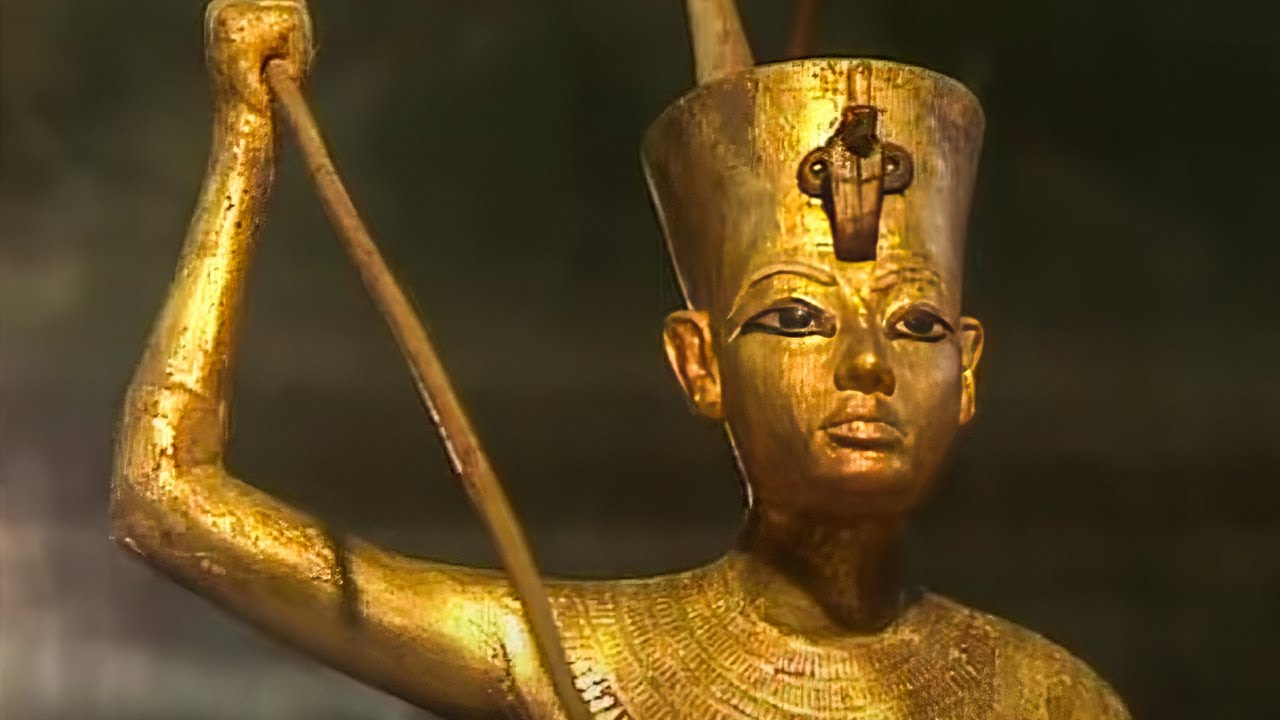
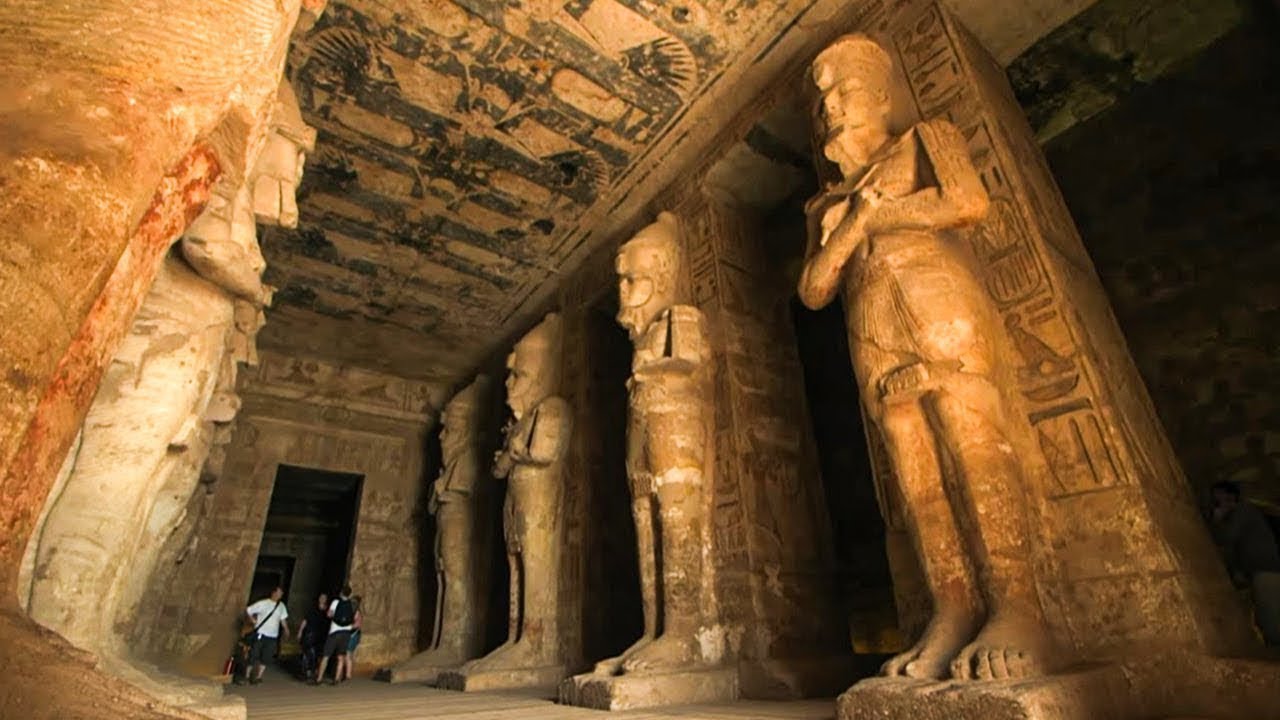
Egypt, land of the pharaohs. They are the ones who created the first unified state in history and for nearly 3,000 years, they ruled like demigods. Then, the country fell into the hands of different foreign occupiers, until the Egyptian royal dynasty was founded by Mohamed Ali Pasha, Ottoman commander of the Albanian army, at the beginning of the 19th century.
It is he who will lay the economic and military foundations of modern Egypt. For nearly 150 years, the dynasty prospered, but major modernization projects plunged the country into debt and poverty. The kings of Egypt, placed under the protectorate of Great Britain, will succeed in saving their throne, but at what cost?
They will be nothing more than puppet kings. During the last years of King Farouk's reign, corruption reached an unprecedented scale. The humiliating defeat in the 1948 war in Palestine shows that the monarchy is running out of steam.
In 1952, General Mohamed Naguib, a former commander of the war in Palestine, joined the "Free Officers". This clandestine movement brings together officers of the Egyptian army who decided to liberate their homeland from British colonialism. Gamal Abdel Nasser, at the origin of this organization, is a charismatic 33-year-old colonel who wants to restore the people's dignity and free them from oppression and injustice.
Tired of corruption and poverty, Egyptians are taking to the streets to demand bread, freedom and social justice. They receive unexpected support from the military. Will yesterday's liberators become today's oppressors?
Between 1952 and now we have replaced one colonial power with another. Today, the colonizers are Egyptian, they are Egyptian pharaohs. It's harder to resist them.
A new chapter in Egyptian history opens: an incident, which could have remained isolated, will trigger a revolution throughout the country. On January 25, 1952, the Fedayeen, the Egyptian resistance movement, intensified their attacks against British troops stationed near the Suez Canal. And that day, General Erskine, the British commander, decided to teach the Egyptians a lesson.
Seeing that the police were supporting the Fedayines, the British army surrounded the Ismailia police station and demanded that the Egyptian soldiers surrender. But the commander who was there refused. The police station is under siege, but the police officers, although fewer in number and less equipped, do not want to give up their weapons and resist.
By evening, 50 of them were killed. The news reaches Cairo. Riots break out.
Soon the capital is ravaged by flames, under the helpless gaze of the officers who wait in vain for King Farouk to give them the order to intervene. For years, the “Free Officers” have been conspiring to end the corrupt regime of King Farouk, who allowed the British occupation to continue. In great secrecy they collaborate with the main popular and religious movement, the Muslim Brotherhood.
What do you want ? We want to cut off the British supply, but the state protects it. There is also an unofficial position.
Our request is simple. Stop protecting him. We knew that the Muslim Brotherhood had sent men to fight the British in the canal region to liberate our country.
We gave them weapons and ammunition. Abdel Nasser was in constant contact with them and our men sympathized. Experienced army officers trained our volunteers.
They were capable of turning anyone into a real fighter. Gamal Abdel Nasser was one of our instructors. I didn't imagine that one day he would lead the revolution and that we would stay in touch.
Since its formation in 1928, the Muslim Brotherhood movement, Ikhwan, has built an impressive popular network. He considers Islam to be the cornerstone of the future independent Egypt. Nasser has a radically different point of view, but for now, they need each other.
Gamal called and said: “We have common interests and we trust each other , the country needs reforms, we can decide on reforms together to launch and cooperate. » The fire in Cairo pushes the Free Officers to act more quickly than expected. Nasser tells us: "The Palace has discovered the plot and the commanders will meet at headquarters.
If we do not hurry to stop them before they gather, it will be the end of the Free Officers and the revolution. " It didn't take much for the revolution to fail. Free officers take control of the Army.
General Naguib officially announces the success of the coup d'état without the slightest bloodshed. King Farouk, descendant of the Albanian dynasty of Mohamed Ali Pasha, is forced into exile. It's the end of an era.
For the first time since the days of the pharaohs, Egyptians hold the future of their country in their hands. The British presence is limited, but 80,000 soldiers of the colonial troops nevertheless remain stationed to protect their “property”, the Suez Canal. The Free Officers' first concern is that the British withdraw their troops and that the Egyptians finally obtain what they have been demanding for a long time: "Bread, freedom and social justice.
" We did not have a precise strategy. I naively believed that once the king was gone, the country would be better. I was convinced that it was enough to depose the king, then expel the British from Egypt.
The leaders of the revolution promise to establish a truly democratic republic. A 19-member military committee is founded to oversee the transition. The CCR, the Command Council of the Revolution, is chaired by General Naguib.
His second in command is Gamal Abdel Nasser. This Council must govern the country until the adoption of a new constitution consistent with the ideals of the Revolution, which will then allow elections to be held. But governing quickly turns out to be much more difficult than expected.
Two or three days after the revolution, textile workers in Kafr el-Daouar went on strike. The army intervened to stop them. The strikers refused.
An officer drew a white line on the ground with chalk and said, “The first person to cross the line is shot. ” They didn't believe him. Moustafa Khamis has crossed the line.
They took it and started shooting people. It started off badly! We reacted by executing their two leaders, Khamis and el-Bakari.
Communist members of the Revolutionary Command Council are horrified by the brutality with which the workers' movement is being repressed. Their protests reveal the first dissensions among the leaders. For a regime that promised to defend the poor, this is a bad start.
But the CCR soon took action. On September 11, 1952, Law 178 confiscated land monopolized by the old elite. There were almost 18 million inhabitants.
And 90% of the land belonged to only 500 owners. The least wealthy of them had 5,000 to 10,000 acres, and all the peasants were his slaves. For an owner owned the land and everyone on it.
- 10, 11, 12. . .
- Put the parasol over my head! - 56, 57, 58. .
. Land reform restricts the power of landowners. But it is the decision to provide free education to all that will profoundly transform Egyptian society and overcome the old hierarchy.
The reforms won immediate popular support. Mohamed Naguib was president. He was very popular.
We took the train with a hundred photos of him, a hundred 10-piaster bills and a stapler. And we threw the tickets stapled to the photos out the window . At the time, 10 piastres was a lot.
That way the peasants were happy and they saw Naguib’s face! We made it very popular. The RCC agreed, and Nasser did not disapprove .
peasant would be happy and then he would see Mohamed Naguib's face. We made him very popular. The Revolutionary Command Council approved this, and Nasser were the ones doing that and Nasser did not object.
Nasser was a master at gathering information. From the very first day, he had put Naguib wiretapped. Personally, I really liked the president until we learned that he was meeting secretly with the Muslim Brotherhood.
This is where the conflict began. Naguib's popularity generates tensions. Nasser, the strong man of the revolution, feels sidelined.
He suspects Naguib of getting closer to figures from the old regime and leaders of the Muslim Brotherhood under the pretext of not excluding anyone. The crisis began when Nasser felt that Naguib had fulfilled his mission and that it was time to get rid of him, because if he stayed, his popularity would become monstrous. They began to confront each other, each in their own domain.
Gamal Abdel Nasser focused on his power within the army and Mohamed Naguib, on his popular support. We have called this crisis “the crisis of democracy”. There were two points of view.
Some wanted to establish democracy and send the soldiers back to their barracks. Others insisted that the revolution must achieve certain goals before there could be any question of democracy. - Democracy is the path we must follow.
- The country is not ready. - Democracy is democracy. Reform requires discipline.
The revolution leaves no room for moderation. Is it revolution or democracy - I believe it is you who are responsible for the instability. And you better return to your barracks.
The problem was simple. Who governs? It wasn't more complicated than that.
Who rules Egypt? The RCC wanted to make Naguib a puppet, and he wanted to be president. That's all.
The battle, crucial for the future of the country, broke out on the night of February 25, 1954. Democracy or military regime? The debate already existed within the army.
The artillerymen support the democracy desired by Naguib. The Nasserists believe that if the army returns to its barracks, there will be chaos. The confrontation between the two currents divides the army and threatens to plunge the country into civil war.
There was a meeting. Nasser arrived at 6:00 p. m.
, followed by everyone else except Mohamed Naguib. At 7:00 p. m.
, his personal secretary brought a letter containing eight requests. He wanted democracy, a parliament, a non-military government, and so on. We said no.
At our level, we had no idea of the power struggle between Naguib and Nasser. We thought that if Naguib was misbehaving, we should have been informed. In Naguib's absence, the CCR decided to dismiss him from office.
The president's loyalists call for an emergency meeting at artillery headquarters to see how to prevent Nasser's supporters from hijacking the revolution. The guys were beside themselves because Naguib had been sacked. Where have we seen a military regime succeed?
Hitler destroyed Germany. Mussolini compromised Italy… I said : “Those who are for the continuation of the military regime go here”. These are the ones we were debating.
“And those who are for the return of democracy go there. » I assure you that everyone went on the side of democracy. But they were looking over my shoulder.
I turned around and saw Gamal Abdel Nasser. He had quite a presence, you know. I asked him, “Have you been here long?
” » “Since the start of your vote. » This is a difficult time for Nasser. He is convinced that at this stage of the revolution, only the army can implement the profound changes he plans.
But not at the cost of civil war. His supporters give him no choice. We locked Nasser and Amer in the latter's office.
We took charge of the situation and took action. Let the Artillery even try to start a tank, and it would be destroyed immediately. We have regained control of the country.
The gunners are arrested. But the headlines provoke massive demonstrations. Egyptians march in the streets: they want the return of President Naguib.
The General returns to power but his democratic demands will be ignored. A few days later, demonstrations against democracy broke out. We are the ones who organized these demonstrations.
That’s politics! This is politics! We printed the leaflets ourselves in the security services offices and then distributed them.
We had men everywhere. The leaflets said: “Long live the revolution”, “This is not the time for democracy. » “Down with democracy, down with freedom!
Long live the revolution! ” Freedom is one thing, revolution is another. Nasser said: "The people want neither freedom, nor democracy, nor the constitution.
The artillery wants me to impose them on the people, but that would make me a dictator. " And There you go ! The crisis of democracy allowed Nasser to purge the Army and the Revolutionary Council.
He then took care of the Muslim Brotherhood. Their support for President Naguib during the crisis was the straw that broke the camel's back. Hassan El-Hodeibi, the supreme leader of the Muslim Brotherhood, contests many of the revolutionary measures.
The confrontation is inevitable. We plotted against each other. Nasser and Hassan El-Hodeibi met and Nasser said: “You go against every decision I make, I can't work like that.
» “…I am leading a revolution, I must have room to maneuver to move forward. » El-Hodeibi replied: "We are just discussing to make the best decision. " I remember very well Nasser's response : "I don't need a guard.
" The Muslim Brotherhood wanted power. The conflict was not over religion or the application of Sharia law. It was a political struggle.
The Muslim Brotherhood was preparing a putsch within the army. I had men infiltrating their home. They kept me informed daily.
That day, we had just explained the situation to Nasser, I even showed him their operation order. He just shook his head. Then he looked at me: “Farid, are you unhappy?
” "Yes, I am unhappy. Every morning at 10 a. m.
I make my report. Why are we delaying taking care of the Muslim Brotherhood? " He replied: "Now is not the right time.
» Nasser very quickly had the opportunity to organize reprisals. The divisions within the Muslim Brotherhood were no secret . El-Hodeibi, as supreme guide, officially dissolved the armed wing of the movement, the "section special".
But rebel elements reject this decision. It is true that there was a group of young people of which Hendaoui Douir was a member. He led a cell which wanted to assassinate Gamal Abdel Nasser.
When I discovered it, I I spoke about it to Hassan El-Hodeibi. He said: “No, you who are a member of the Executive Bureau, go tell these Brothers that I do not admit that, that I do not agree. ” The “section special" carried out his assassination plan.
Not a single one of the eight bullets touched Nasser. This assassination attempt remains controversial. .
. Rumors suggest manipulation by the secret services or, conversely, a plot within even from Ikhwan against the leadership of the movement. In any case, the episode gives Nasser sufficient reason to crush his last remaining ally.
If Gamal Abdel el-Nasser had crushed the Muslim Brotherhood when I told him, the entire population would have stood with Ikhwan. But after the assassination attempt on Mancheya, everyone supported Nasser. He was a strategist.
This is what he had planned. Seven Ikhwan leaders were executed and the rest were imprisoned. The Muslim Brotherhood is officially banned.
It is reduced to silence, but the humiliation and torture that will befall their detainees will soon ripen the seeds of a much worse radicalism, which will end up threatening the all-powerful military regime. I was with the officer in charge of the Muslim Brotherhood file. He asked me if we could go through the prison.
I entered a 1 meter square room containing a desk with two whips on it. The officer gathered the prisoners of Ikhwan, made them sing patriotic songs. They had to squat down, a dog sniffed El-Hodeibi's clothes.
He sniffed here and there, then attacked him. I didn't like what I saw. I swore to myself not to go to the military prison again.
President Naguib had lost all power since his return after the crisis of democracy. However, he is accused of collusion with the Muslim Brotherhood in the assassination attempt against Nasser. He was unceremoniously sacked, placed under house arrest for decades, and his name erased from official history.
Now the entire opposition is behind bars. Nasser will be able to carry out his great project. He wants to build a modern and secular Egypt , which will lead the African continent and the Arab world.
To support local and regional development, it intends to play off rivalries between superpowers. For Nasser, independence was a priority. We told ourselves that since the United States was not a colonial power.
. . .
. . we could count on them to neutralize the British.
“Help us, and Egypt will not become communist. » This was what the United States feared. The Americans did not give us the weapons we needed to defend Egypt's borders.
We were a young military revolution and we had to build a strong army. Our first mission was to protect our borders. Our failure would have been that of the entire revolution.
We had the idea of signing an arms contract with Czechoslovakia. It was a turning point, known as "the end of the arms monopoly. " No one in the Middle East would have imagined obtaining weapons anywhere other than the West.
We were in the Western zone of influence. At a time when struggles for independence are erupting across Africa, weapons play a decisive role. Nasser, as the founding father of the Pan-African and Pan-Arab movements, pledged to help these revolutions.
The birth of the non-aligned movement offers an alternative to the hegemony of the two superpowers. But the Egyptian leader nevertheless hopes that the United States will finance the project of his dreams: the Aswan dam. The Aswan Dam was the dream of all Egyptians.
He united us in the fight to build our future. It would make the land cultivable, produce electricity, and help prevent flooding. Suddenly, the United States announced that the economic situation in Egypt made it impossible to carry out such a large project.
It was a fatal blow for Nasser, and a humiliation for Egypt. It was a real slap in the face. Nasser responded by nationalizing the Suez Canal.
“In the name of the country and the President of the Republic, the Universal Suez Canal Company is nationalized and becomes an Egyptian company. » It was the American refusal that pushed Nasser to take this enormous risk since the British troops were still in the Canal zone. But the nationalization of the Suez Canal is a strong symbol of the independence to which so many Egyptians aspire.
The entire continent suddenly regains its dignity. Nasser immediately became the hero of the Third World. The man who defies the superpowers is now hailed as Zaïm, the leader.
Before being a symbol, the Suez Canal is an essential trade route for the global economy. The response is therefore immediate. Israel, Britain and France jointly attack Egypt.
OCTOBER 29, 1956 Nasser wins his bet. The tripartite aggression is stopped and the British must evacuate the country, ending 74 years of colonial presence. After the American refusal to support his central development project, Nasser knew that to realize his vision, he must turn to the Soviets.
When they came to Moscow, of course, it was mainly to ask for more weapons. They came to go shopping! On May 2, the event of the day was a sports gala, and Khrushchev invited Nasser to attend.
But it was a Friday and Nasser told him that since it was Friday, he had to go to the great mosque in Moscow. Nasser is a staunch defender of secularism and he wants a version of socialism tailor- made to meet the needs of his country. He knows that by allying himself with the communists, known for their atheism, he risks getting into problems in Egypt with practicing Muslims.
He therefore made it clear to his Soviet allies that he would set his own rules of the game. Nasser wanted to make the country an industrial power. He keeps repeating: “Egypt will make everything from a needle to a rocket.
” The army will have the right to use desert territories for all its development projects. Officers began to take civilian jobs, especially in the public sector. It was no coincidence.
When the skills didn't exist among civilians , they found an officer to do the job. Mahmoud Younis headed the Suez Canal Company. Almost all oil companies were run by military officers.
The members of the Revolutionary Command Council prosper. They now form the new Egyptian elite. A happy army, covered with privileges, is, for Nasser, a real insurance contract.
Our army is a real monster that must be controlled. Nasser was an officer who took power by force. He became obsessed with safety.
He feared what the army could do. He was afraid and he was suspicious. Merit or loyalty?
He chose loyalty and surrounded himself with people whose livelihood he provided, knowing that in return, they would not try to overthrow him. So loyalty trumped merit. Nasser chaired the ruling Arab Socialist Union party.
Decisions were made and then sent to ministers. They were approved without discussion. The ministers accepted this, starting with Anwar el-Sadat.
When I needed his signature, if I tried to explain , he would say: "Meguid, don't bother me, show me the leader's signature instead. " That is to say Nasser's signature. There was no opposition of any kind and the State dominated all life, political, cultural, artistic.
In short, all aspects of life. The ruling party even co-opted Al Azhar, the high authority of Islam which gave Islamic approval to Nasser's secular reforms. For the young generation of the Muslim Brotherhood, this is too much: many go underground.
Nasser had more and more power, he became tyrannical, harsh, frightening. So much so that we were no longer afraid of him, but we took care to maintain the greatest secrecy. Since the revolution, Nasser wanted to change society and move it from Islam to secularism.
His regime was determined to transform people, moving them away from Islam and the Koran and towards secularism. The debate on the transformation of society is central among Ikhwan leaders in prison. Moderates, led by Hassan El-Hodeibi, believe that the use of violence is counterproductive.
But for Sayyed Qotb, one of the main intellectuals of the Muslim Brotherhood, we must on the contrary resurrect the ancient concept of Jihad and make it the basis of all change. Qotb, hardened by years of torture in Nasser's jails, sets out in detail the radical path of Islamic Jihad in his work “Milestones on the Road”. Qotb smuggled the manuscript of “Jalons sur la route” out of prison.
He had written it by hand, in elegant handwriting. I spent several nights copying it with carbon paper. The main topic of “Milestones on the Road” was that many Muslim leaders claim to be Islamic.
But in fact, they are pursuing a policy that is not. And if their politics are not Islamic, they can be considered apostates, and therefore be assassinated. His argument was that the regimes are too strong, that they have the army at their disposal, and that they will not change voluntarily.
So this justifies violent military means being used. “Milestones on the Road” by Sayyed Qotb finds an enthusiastic response among the young Muslim Brotherhood and exacerbates the divisions within the movement. When Qotb came out of detention in 1964, his disciples had already formed clandestine cells.
I went to Sayed Qotb's house and told him: "We know that some young activists want to assassinate Gamal. I also told him 'We will not let blood flow, we will not allow assassinations or violence. '" Afterwards ten years of imprisonment, the main leaders are released and they have no desire to confront the regime.
However, despite their warnings, some activists are preparing an assassination attempt. We met in the greatest secrecy , even our families did not know anything. We were known for our good behavior.
No one could imagine that we belonged to a secret society. A military police patrol entered a cul-de-sac in Shubra by mistake . It was found that it was precisely on this street that the armed wing of Ikhwan had its weapons depot.
They believed that the police were coming to arrest them and they opened fire. The police were taken by surprise because they did not suspect the existence of such an armed network. We were organized in a network, they pulled a thread and the whole ball came !
They arrested everyone who had even the slightest connection to the Muslim Brotherhood, whether or not they had anything to do with the armed wing. They arrested everyone. Sayyed Qotb and his co-defendants are on trial for attempted coup d'état.
Qotb is personally accused of having wanted to assassinate the President. The trial is seen as a charade. The death sentence on six Muslim Brothers and Sayyed Qotb made the latter a martyr.
His book “Jalons sur la route” is banned, which will have the effect of strengthening his success on the black market. The disproportionate harassment of Ikhwan will be a recurring process in Egyptian political life. “Milestones on the Road” would later inspire Osama Bin Laden and Al Qaeda, and radicalize Islamists around the world.
My mission was to escort him from the military prison to his place of execution. He remained silent in the car, he only said a few words: “I only have my convictions. Take them and leave me.
» We arrived when the muezzin was calling for dawn prayer. I handed it in and they executed it. With Egypt under his strict control and the socialist development project bearing fruit, Nasser was at the height of his power and glory.
“Zaïm” finances African liberation movements, lays the foundations of Arab unity and travels around the world to promote its vision of the Third World. But tension is rising along the border with Israel. Inexplicably, Nasser decides to provoke a confrontation.
The Gulf of Aqaba is in Egyptian territory. We will not let the Israeli flag pass through Aqaba. The Jews threaten war.
Let's go, we're ready. On June 5, 1967, in less than an hour, Israeli aircraft destroyed the Egyptian air forces. This phenomenal defeat changed the situation in the Middle East and brought Nasser's socialist project to a brutal halt .
Suddenly, Zakaria Mohieddine, the vice-president called me: “I am at headquarters with Nasser, we are going to announce an immediate ceasefire . ” I was furious: "A ceasefire? I only announced victories on the radio.
Give me time to say that we have problems. " It was a shock for everyone. Hopes had been kept alive and now a ceasefire was announced.
The radio announced the number of planes that had been shot down. I thought our army was at the gates of Tel Aviv! And then they said that our troops were retreating to the second line of defense.
I thought it was a military ploy. But that day the radio started broadcasting poignant patriotic songs, and I had the feeling that disaster was imminent. I didn't know the president was going to resign.
I was surprised when, in the morning, he called me to say: "You must give instructions that after my speech, my name will never be mentioned again. This is an order. " And he hung up.
I have decided to completely withdraw from any official position. . .
. . .
from any political role, and to become an ordinary citizen. I delegated my functions as President of the Republic to my colleague Zakaria Mohieddine . Millions of people shouted: “Don’t resign!
” The security organs did not know what to do. Should the demonstrations be prevented? Security was confused, completely lost.
A huge crowd gathered in front of Nasser's house. They took me for Zakaria Mohieddine, the vice-president, because they saw a big car arriving. We saw Zakaria Mohieddine.
We caught him and the crowd shouted: "Zakaria refuses, refuses ! Nasser is our leader! " I went out into the crowd.
They shouted: "It's Zakaria! Beat him! Kill him!
" They grabbed my throat and it started bleeding. I thought I wouldn't make it. If I had fallen, they would have trampled me.
Nasser responded to the people's demand. Even if we were happy that he stayed, the link with Nasser and his regime was broken. We were angry.
Our dream had been shattered. Even if we continued to hold on to his father figure. It is the only country in modern history where a massive defeat, a military defeat, did not destroy the position of the army which was phenomenal.
After the president, who was a military officer, offered to resign, millions of people demonstrated to demand that he stay in office! We've never seen anything like this! Barely 7 months later, the Egyptians lost patience and turned against Nasser, when the regime organized a mock trial.
A few Air Force pilots will bear all the responsibility for this bitter failure. People understood that the Air Force was not the only one responsible. It was an entire system that was responsible, and which suffered defeat.
It was among the students that we saw the popular reaction to the pilot trials manifest, as they were the only politically active group left. Apart from the ruling party, all parties were banned. The leftists were in prison, the Muslim Brotherhood was in prison, the liberals too.
It wasn't planned, it was a spontaneous movement. We started with a silent demonstration inside the university and then there were more and more people, it snowballed . .
. It was the first time we saw demonstrations against the revolution and against Gamal Abdel Nasser. Our security forces were not equipped to deal with protesters.
I saw the Central Security forces for the first time. It was created at that time and to this day it plays a major role in suppressing popular movements. - Get up !
Get up ! - Who is it ? - Are you Ismail el-Sheikh?
- Yes. There is a problem ? - Follow us.
- Who are you ? - State Security. - What's the matter ?
- We want Zeinab to come. We started hearing about disappearances in the middle of the night. Phrases like "people sent behind the sun" or "visitors of the dawn" evoked the new security forces who were tyrannical and hunted down opponents in the dead of night, while people slept.
They took them to unknown places, it was said that they had disappeared "behind the sun". - For what ? What did I do ?
We've been called "dawn visitors" and it sticks with us. But this is normal police procedure. It was a wake-up call that revealed the nature of the regime: culture of secrecy and power of security organs, corruption and authoritarianism.
We didn't realize it because our basic needs were met: there were good health services, education, we had work, housing. But it turned out that we were living in the most complete illusion. Salah Nasr, the director of intelligence, was discovered to be governing Egypt.
He sowed fear by shouting that the security of the country was threatened and he ruled with an iron fist. Nasser's charisma overshadowed what was really happening. In fact, there was no freedom.
Freedom is far from being Nasser's priority. With the occupation of Egyptian territories and 90% of military equipment destroyed. Above all, he must recover the lands conquered by Israel.
Nasser wants to recover Sinai without delay. Although he is in a weak position, he orders his troops to open a war of attrition. - We received orders to carry out retaliatory raids , to infiltrate enemy lines, in Sinai.
This type of operation is called "war of attrition". For two years, daily clashes with the Jewish State were contained along the Suez Canal. Then Israel suddenly changes strategy and sends its brand new American F-4 Phantoms to strike in the heart of the Egyptian capital.
Nasser appointed Anwar Sadat as vice president when he went to a summit in Casablanca. During this period, in Nasser's absence, Sadat ruled the country. It was December 25, 1969.
That day, all Egyptian missile bases were bombed. Nasser came and reported to the Politburo. He declared that he could no longer bear such a situation.
It's war, they're bombing, and I can't fight back. Either you send your combat troops to protect our skies, or I resign. Nasser undertakes a secret trip to Moscow, with a humiliating request.
It's not just weapons he wants. He asked, in the middle of the Cold War, that Soviet troops fight with him, on Egyptian soil! In Alexandria, we were welcomed by senior officers of the Egyptian army.
Overnight, we were provided with Egyptian uniforms, and all our equipment was repainted sand color. Our mission was simple: teach the Israelis a lesson. Give them a good.
. . a good beating.
. . as they say, so that they understand that it was high time to stop waging war.
The Israeli attacks stopped, but Nasser's self-esteem did not escape unscathed. The hero of anti-colonial struggles had to beg for the intervention of foreign troops on his soil. The failure of 1967 continued to weigh on him and, despite health problems, Nasser persisted in his role as pan-Arab Zaïm.
We spoke with my brother about Nasser and the repression. We told ourselves that we could only wait, at best around twenty years because Nasser was young, he was only 51 years old. We criticized the Nasser regime, the party, corruption, and State Security, and then I went home .
My brother called me with a funny voice. I said, “Aren’t you okay? ” “The president is dead.
” His voice was full of sadness. I dropped the receiver, I was desperate. It was horrible, horrible, horrible.
I have never cried for anyone, including my father and mother, as much as I cried for Nasser. It felt like the country was going to fall apart. There were all of Nasser's achievements, because there were still real achievements.
It felt like it was his fault. He had taken control of the country, monopolized power, banned any expression of opposition. .
. And now we found ourselves in this situation. No one has the right to make an entire country orphan !
Zaïm is no more. He died in his sleep. Millions of people gather, forming the largest funeral procession in human history.
Nasser, the hero of anti-colonialism, the rebellious revolutionary wanted to make Egypt a powerful, modern state and secular. To achieve this, he had to mercilessly crush his opponents, he buried democracy, laid the foundations of a police state, and cemented a political system itself anchored in military power. Even today, these choices determine the very infrastructure of the Egyptian political system.
By wanting to restore the past greatness of his country, Nasser rose to the level of a modern-day pharaoh.