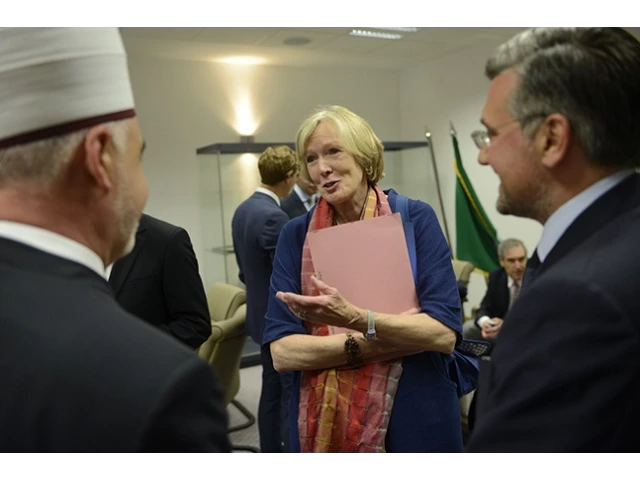
thank you very much indeed and my thanks to the K Council the American University the biblioteca to the Grand mafy and to the president of the Ki Council for their very thoughtful remarks which I think have set a very high standard for our deliberations today it is something quite extraordinary and all inspiring to be standing here in Saro in a building that has been rebuilt which symbolizes the Persistence of humanistic values and in a city which has played such a part in the troubled history of the 20th century and quite overwhelming really to reflect that
tomorrow will it will be 100 years ago to that the event took place just a few yards from here that helped to set in train the series of events which created so much damage so much misery and which shaped the worlds of the 20th and 21st centuries we still are trying to understand how it happened we're still still trying to understand what that war meant and I think this is very important it is a very complex event but it is an event which has Echoes into the present I think we've all been thinking recently about
parallels between that world and our own world as troubles start in the Crimea and now of course as Iraq looks in danger of Falling to Pieces we're wondering if some of the same pressures which led to war some of the same structural factors some of the same bad decisions that led to war in 1914 will come to afflict us again and the parallels are enough at least to make us uncomfortable I think it is important to try and understand that war partly because without understanding how Wars come we don't understand how peace can be maintained
and I think one of the very important things to look at at the outbreak of the first world war is not to start by assuming that it was inevitable the danger is that as we look back we see the pressures building up for war we see the things that were tending towards war in Europe and I think we make then the very dangerous logical illogical assumption in my view that the war was bound to come because there were so many reasons it happened to happen it was bound to happen and I think this is wrong
I will try and persuade you that it's wrong and I think it's also a very dangerous way to think about human Affairs if we throw up our hands and say something is inevitable then we don't try and prevent it and I think what we also need to do is look at Europe in another way remember that the Europe of 1914 had enjoyed at least in European terms a a relative Century of Peace quite an extraordinary Century in Europe's long and troubled history it is true that there had been Wars in Europe in the 19th century
but they had tended to be short they had for the most part only been between two powers and they had settled something whether or not people liked what had been settled was another matter but to take one example the Franco Prussian war between the German Confederation and France led to the creation of Germany and the relative isolation of France in the International System but it was decisive and it was short and so when Europeans looked at their Century the 19th century they could with some confidence look at a century which was on the whole peaceful
and it was a century of enormous prosperity and progress for all of Europe not shared equally in all parts but you could see a general Trend in European history as Europeans became more prosperous more Europeans were sharing in the benefits brought by the industrial and technological and scientific revolutions Europeans were traveling more their societies were more integrated and they were also more aware of each other and so for Europeans it was a century in which they could take considerable pride and what I think is very striking in the period before 1914 is how many Europeans
assumed that this would go on that there would in fact continue to be peace and prosperity and progress not that many people in 1914 expected a major war there were certainly some who feared and some who worked against it but I think the general feeling in the summer of 1914 was that Europe had come through some rather rough periods there had as you would all know better than me been two wars in the Balkans in 1912 and 1913 which had led many people to talk of the possibility of a general War but it hadn't happened
and so at the beginning of 1914 the British foreign secretary sir Edward gray said that the international Horizon looked calmer than it has been for many years and and we had every reason to think that we were now entering a period of continued calm and again continued progress and prosperity the pressures in Europe towards both War and Peace are things that we need to look at and I think what we have to remember that just as there were pressures towards War there were also very very strong pressures towards peace before I do that I'd like
to talk just about some of the ways in which changes in European Society were affecting the relationships of people both to their own societies to other societies and towards war and towards peace we have to remember that this was a period in Which Europeans moved from being members of relatively isolated and detached communities to being parts of Greater units whether they were Nations or Empires and this is partly a result of modern Communications the tremendous spread of literacy spread of things like the mass media and people people simply because they were more prosperous had more
time to notice what was going on in their own societies there had also been and this affected pretty much the whole of Europe a very significant shift in the relationship between peoples and their own societies which I think certainly goes back to the French Revolution and that is that people increasingly no longer saw themselves or were seen by their rulers as subjects in other words increasingly they saw themselves as Citizens as members of a poity as members of an organization to which they had obligations they had obligations to support that society and that could mean
supporting it in peace but it could also mean supporting it in war they also had an expectation there was an expectation on the part of those in charge that citizens would see themselves as part of this greater unit greater society and so you have a sense that citizens both have a stake in their society increasingly they're able to vote for their own rulers there's a very significant spread of the franchise again throughout Europe in the course of the 19th century more and more people are voting even in countries such as Russia which were generally regarded
as being slightly behind the development of the rest of Europe by 1914 there were well-rooted local assemblies as zempo but also a Duma for which again the franchise was extending and so you see in the course of the 19th century a new relationship between people and their rulers this a sense of Mutual responsibility and mutual obligation now that could lead to a greater involvement of the public in war and did in some countries increasingly people took an interest in what their countries were doing felt an obligation to come to its defense and in 1890 General
von malka the Elder the man who had done so much to bring Germany together in the wars of German unification gave a warning to the Reich stag he said we have moved Beyond what he called cabinet Wars we have moved Beyond Wars which governments decide upon for limited purposes which they do their best to control in which they will stop when they have achieved their purpose in other words Wars made for very specific purposes and limited in very specific ways we have moved Beyond cabinet Wars to people's Wars and he said once a people's war
starts it will be very difficult to stop he said it may last for as long as seven years and he said his concluding words were woe be to him who sets the first Spark that sets Europe a light very very preent words I think now that was a danger I think that the greater the involvement of citizens in their own Society the greater the possibility of expanding the nature of war and we see in the course of the 19th century a move towards Total War a war not just of military versus military but increasingly peoples
against peoples and you get the passions of peoples becoming involved what that means is not just that you have tremendous support on one side for war but you also get an increased hostility to the other side in other words you're not just fighting the army of the other side you're now fighting the people who produce the soldiers you're fighting the women you're fighting the old people you're fighting the children because they might be soldiers one day you're fighting the industry of another Society because they Supply the increasingly the means for the arms the armies to
remain in and the Navies in the field and the Navies to remain at Sea that you are fighting often a whole set of different moral and and and ethical values in other words war is something now is seen as a massive struggle between two very different sorts of people and that's a danger I mean we see what that meant in the 20th century and we're still seeing it today on the other hand that change in the relationship between citizens and their rulers or between peoples and their rulers could have another outcome and was having another
outcome that as Citizens became increasingly involved they also felt an obligation to prevent their countes from doing things that were stupid or dangerous and so citizens felt increasingly they had a right to criticize what their governments were up to and often that criticism was that the government was behaving recklessly that the government was risking war that the government was threatening to damage both its own society and other societies and so obligations to your larger Community didn't necessarily me lead to supporting it in war it could also lead to supporting it in peace and there was
very interesting development in the course of the 19th century which was that this sense of being a citizen of having an obligation to whatever structure you were part of was increasingly extended Beyond National boundaries and so increasingly in the 19th century you got people saying we have an obligation not just to our own particular set of rules we have an obligation to humanity and you begin to get a sense that we are all somehow part of a much wider organism and that we have a responsibility to that and that fed into what was a very
Ive peace movement and I think what we have to remember always about the 19th century and about the period just before 1914 that there were many forces at play in Europe and in the world and again I think we have to warn ourselves against looking at War as something that was inevitable that it was bound to happen that it was just waiting to happen Europe was very much a continent in play in 1914 and I think it could have gone in any number of of directions so let me look at some of the forces for
peace before I look at the forces which alas turned out to be stronger the forces for war ideas are very important here Europeans looked back at their Century of progress and they thought we have progressed not just in material terms and that of course was very evident to people and people were living longer they were eating better they were living in much better housing they had access to a range of consumer goods which they would not have had most of them in 1815 but by 1914 did they looked back at that Century of progress and
they said to themselves we have not only progressed in material things we have progressed in terms of civilization and part of being civilized is that you don't fight you don't need to resort to force that we have moved beyond the need to have force that we have got we've also got too much to risk I mean a number of people argued that European economies were no now so tightly linked Britain and Germany for example reach other's greatest trading partners and Britain was the place where you came to for investment and Europeans from all over Europe
came to places like London came to places like Paris came to places like Berlin for funds for investment increasingly European markets were being linked both through trade and investment and so arguments were made most famously perhaps by Norman Angel a British journalist who wrote a book called The the great illusion in which he said governments are literally crazy if they think they can make war and get any benefit out of it they won't they will spend down their own resources and they will find that if they do conquer another piece of territory they will conquer
a piece of territory that has been so exhausted and so damaged by war that it won't pay Germany for example he said would be much better off not trying to conquer Belgium or the Netherlands two very prosperous countries much better off if it simply trades with them and gets the benefit of all the the hard work of belgians and and the Dutch it would be foolish and surely governments and business people must see that it's foolish to think of war war in the modern age is too expensive too costly damages everyone that none of us
are going to win and so you do get a sense in Europe that the progress of Europe Which Europeans were so proud of was something that was making War Impossible I think it's fair to say that for many Europeans in the summer of 1914 war was either impossible or improbable it was just not something that they did anymore there wasn't any purpose in doing it I think you also got a sense um which came partly from darwinian ideas that H human species was evolving now Darwin's ideas as applied to human societies were mixed blessing because
they could Trend either towards war or towards peace let me just look at how they could Trend towards peace and then I'll come to the other darker side the ways in which darwinian ideas could Trend towards peace was in this notion of evolution that species Chang to adapt to their environment and so as the environment of the world was changing and of course the Industrial Revolution was not just a F in Europe it was affecting a much wider world as the world as the material circumstances of the world were changing so too was the human
species now there was an assumption in this view that the human species was one species not a whole separate set of species I mean there was an alternative view in Social darwinist thought but there was at least in the more Progressive thought an assumption that human beings are all one species some are further advanced than others some in the empires perhaps aren't yet ready to rule themselves people like British imperialists found this very comforting they could both feel they were rightfully ruling over other people but doing something good that one day India would become ready
for self-government in fact the the British government used to put a report before Parliament every year called the moral and material progress of India in which it talked about how one day Indians would be ready for self-government but then it comforted itself and and imperialists comforted themselves by saying this will of course take centuries because the Indians have a long way to come but you did have at least one view which took over darwinian ideas which were very very powerful and argued that there was one human species that it was moving at slightly different rates
perhaps towards full capacity to govern itself and that therefore since we were one species it was Unthinkable to think that we should fight with each other and so you did again get this idea of feeding in to support for peace that somehow um even science showed that war was something that the human species shouldn't do and and as Joel renel mentioned this was something that affected the thinking of people like Andrew carnegi as a result I think of a sense that somehow this evolutionary process was going on as a as a partly out of a
sense of wonderment at what they'd already achieved there was considerable support for peace not just in in a general undifferentiated way not just assuming that peace is somehow a good thing but very active support for peace you see very much in the period before 1914 the beginnings of a truly International Society the beginning of international organizations um International NOS such as the Red Cross which tried to work impartially across borders dealing with those who had been damaged or wounded um by War International Crusades for example the international Crusade against the Belgian abusers in the Congo
um which was in fact a very successful Crusade International organizations of jurists lawyers increasingly got to together to talk about ways of trying to settle disputes peacefully International organizations of liberal parliamentarians who started to meet in this period and of course who still meet today International organizations of churches which met in international congresses to try and talk about ways in which peace could be promoted among the many ideas that were floating around in this period was international support for arbitration arbitration between nations was seen as a more Progressive a more advanced way of settling disputes
than going to war much less costly and would benefit everyone who agreed to take part in arbitration if you agreed as a nation to take part in arbitration and agreed to be bound by the rules then this was a way of avoiding conflicts there were some 300 arbitrations held between 1794 and 1914 more than half of those were held after 1890 and so you can see a very real Trend developing in increasingly as well governments began to put their support behind arbitrations the secretary of state in the United State States before 1914 William Jennings Brian
signed over two over 20 arbitration treaties with different countries agreeing that the United States any particular country would agree to arbitration um the one country interestingly which refused to sign such a treaty was Germany um we can make make of that I think what we will in addition to the middle class peace movement there was also very very large workingclass movement which found expression in the second International which was set up in the 1880s to bring together all the left-wing parties of the world and this was not just a powerful organization it was becoming more
powerful because as the working classes were growing as they were becoming organized as socialist parties were being established there were more and more members represented by the second International in Germany just to give one example the Socialist party was the biggest single party in the reichstag by 1912 in France the Socialists were very powerful indeed in Britain a labor party had been founded and Union membership membership of unions was going up and so the second International potentially represented a very powerful force and at its International congresses representatives from the different countries would talk about what
they would do if a general European war broke out because there were fears that such a war might break out and they talked about ways in which they might stop such a war and of course what they had in their hands was a very powerful weapon to stop war and that was that they could go on strike and they could call on all their members to go on strike this was brought up time and time again at meetings of the second International that they should pledge themselves to go on strike to have a general strike
if a general European War should break out the argument was that such a general European War would not benefit the workers they would be quite literally the cannon fodder their men would have to go the men would have to go and fight many of them and they would be the people who would have to work in the factories to produce the equipment that was needed to keep any war going and what would they get out of it and so there was a lot of talk of a general strike no firm commitment was ever made but
I think there was a widespread hope and understanding that should a War break out workers would go on strike now had they gone on strike what it would have meant is that the massive European armies which were conscript armies which depend Ed on their reserves to come back would not have been able to fill up their ranks and this was such a real fear that the French military calculated that in 1914 20% of the soldiers they called back wouldn't come because they would refuse to come the very deep fear among the European ruling Elites that
that in fact they could not rely on the workers not only could the working class soldiers have refused to come back to the colors if the factories had gone on strike it would have been impossible to sustain the the first world war because the first world war was as people have mentioned an industrial war and it was a war that relied on continual resupply it it mobilized the economies of countries in a way that no economies had ever really been mobilized before moreover if the workers had gone on strike the trains wouldn't have run and
in those days European armies relied on the trains to move these massive armies to supply these massive armies to keep them in position once they're at the front Dock Workers could have got on strike and sh could not have been loaded and unloaded Mine Workers on strike there wouldn't have been the fuel that was needed the coal that was needed to make all this happen and so you had I think tremendous potential for peace tremendous forces for peace before 1914 unfortunately and this is true of any society there were other sorts of forces and other
sorts of constraints social changes had made a lot of the ruling Elites in Europe very uneasy and they were worried about the reliability of their lower class they were worried about the reliability of their middle classes and would people who were used to living in cities who were increasingly used to comfort in life be good soldiers there was a lot of fear around about the degeneracy of the human race I mean there was hope that the human race was evolving but the other side of that coin was that perhaps it wasn't that perhaps the human
race was getting soft that perhaps too many of the wrong sort of people were being born and too many of the wrong sort of people were being survived were surviving it's not by coincidence I think that in this period you get the first International Eugenics movement the idea that you can breed and manage human populations much as you would manage animals or vegetables um beasts any and things in the natural world the first International Eugenics Congress was held in London in 1912 at the Royal Albert Hall which is a very large Hall in the center
of London and among its patrons were the president of Harvard University Winston Churchill who was the first Lord of the admiralty in Britain and Alexander grah Bell the inventor who among other things invented the telephone and so there was another side to the belief in Social Darwinism that in fact perhaps the human race wasn't progressing all that much that it might in fact be degenerating the other very dangerous side of social Darwinism was the side that did not see the human species as one species but saw it as divided into a separate separate sets of
species which it called um Nations and it used nations in the way that we might use races today but there was a lot of talk before 1914 about how you could actually identify a separate English Nation a separate French Nation a separate German Nation a separate Italian Nation none of it of course scientifically based none of it taking into account the ways in which peoples had moved around the worlds and which it was very you couldn't isolate a particular human species but this was something that people believed in very strongly and what fed into this
I think was a fear that Nations as identified like this were condemned to fight that they were condemned to struggle for survival it was a very pessimistic view of international relations which went alongside that view that we're all getting more interlocked and we're all depending more on each other the other side was that we are somehow condemned to a struggle which goes on and on and that those that don't struggle in a way and it becomes almost it becomes certainly a moral thing those who don't struggle deserve to disappear they're not just condemned to disappear
they deserve to disapp appear because they're not prepared to make the necessary struggle in order to survive and so that feeds in I think not to an idea that peace is the normal course of or or should be the normal and desired situation for human beings it feeds much more into a sense that war is in fact the natural situation for human the human species and that in fact War could be a very good thing um it G again this whole sense of degeneration this this worry that somehow the human species is degenerating helps to
feed the arguments of those who think that war is in fact desirable and you get men and I must say to be unkind often men who are themselves Beyond military age saying that what we need is young people to go off and be prepared to sacrifice themselves that in fact it is good and healthy to have a society in which every so often there is a war because it somehow tones up that Society it makes that Society more healthy it brings out Superior sorts of Virtues it makes people ready to sacrifice for a greater good
it encourages nobility it encourages bravery it encourages discipline and so you get a lot of writing at the time including in fact by a very eminent professor at Oxford my own University of which I feel rather ashamed talking about how in fact it would be desirable and good to have a war every so often because of what it does for society because it enhances um the superior qualities and the nobler virtues in society and so social Daris could lead as it did with Andrew carnegi to thinking that war is no longer something that the human
species should do and that the human species is one species or it could lead in the other way to saying that in fact war is a natural part of human Affairs that it's something we do and that the human species can be clearly subdivided and that they are condemned to struggle with each other and such ideas of course fuel nationalism the period before 1914 is a period of heightened nationalism an intense nationalism which is fed by the new mass media by the Press which plays on the virtues of its own people and plays on The
Vices of people which it chooses to dislike it's fed by I'm afraid people like me it's fed by fed by historians who teach a very slanted history almost all the history is been taught in European schools before 1914 a highly nationalistic histories histories which show the superiorities the virtues the great strengths the triumphs of the German people or of the French people or of the English people or of the Serbian people or of the czechoslovak people or of the Hungarian people histories which also show the failings and the weaknesses and the vices of other peoples
and so you get historians in Germany the famous Von trka who gives lectures which are widely popular attended by the German general staff by the royal family I mean these These are massively popular in Berlin in which he argues that the Germans have always been a superior people he said you go back to the Roman times and clearly they were the only people who could really successfully take on the Romans they were always a nobler people and this feeds in to a sort of sense of exceptionalism but what Von trka and others also did is
portray other nations as being base motivated by the worst possible Mo motives Von trka tried to avoid ever visiting Britain because he disliked it so much and when he finally went he was able to find more fuel for his dislike of course as you will he picked out he said I was appalled by the look of the English by their pubs by the ways which they seem to be enjoying themselves there it was a summer day and they were enjoying themselves too much you know this is very dangerous and what you also got are very
very bad um histories being written of the other I mean you got in France German sorry French historians ethnographers writing about the German people as though they were somehow um lacking all moral sense um one very famous book argued that that the prussians in particular who live in the north of Germany lack all moral sense because they live in a very flat landscape and so therefore you can see for yourself they don't see mountains and they don't see valleys and you got the Germans writing the same sorts of things a German um ethnographer wrote about
the French he said they are a viciously immoral and frivolous people and he said to his readers if you want to see examples of their frivolity and immorality I can tell you exactly where to go in Paris so these are dangerous because they help to inculcate a sense of us against the other and so again ideas social Darwinism can play out either way and this is a world as I say that's in play what also I think feeds in to the situation in Europe is is globalization itself and again like social Darwinism this can be
a force for peace or for war we've tended to assume and our age is an age of Glo great globalization ation that it's a good thing that the more it brings people together the better we will all be but I think what we're beginning to realize in our own period of globalization is that not everyone benefits that there are winners and there are losers and that globalization the very process can create real disparities in society disparities in income those who feel they've somehow been left behind I think very important part of the recent vote for
the European Parliament has been a protest vote from people who simply feel that that the ruling Elites are not paying enough attention to them don't understand their fears and don't understand how they're worried about getting jobs for themselves worried about the futures of their children and feeling competition from elsewhere I this is an incoherent and incoherent response to what is happening but it's a very real response I think which has to be taken seriously and you had very much the same thing happening before 1914 um globalization produced tremendous benefits but produce tremendous strains let me
just take the example of Germany and Britain who as I mentioned were each other's greatest trading partners before the first world war that did not in itself bring them closer together in fact what it did is in some ways helped to fuel a rivalry that was developing between them a rivalry that was certainly I think much enhanced by the in my view very wrong and foolish decision of the Germans to build a Navy to challenge the British Navy because what that did was shake the British out of their isolationism shake the British out of their
complacency and make them look for allies and it helped to divide Europe up into two camps the British most improbably when the Germans began building a big Navy turned towards two of their most vehement enemies France and Russia and settled disputes with them and and and began to work with them but what also fed the growing rivalry between Britain and Germany was a fear in Britain that the Germans were doing a bit too successfully out of the trade that they were cutting into British Markets around the world that they were overtaking Britain in all sorts
of types of production which was in fact the truth and a sense on the part of the Germans that the British were being selfish that they didn't want the Germans to compete with them they didn't want the Germans in their markets and so globalization did not in that case serve to bring two countries to close closer together in fact it helped to drive them further apart in 1893 an alarmist pamphlet which sold widely was published in Britain which said the British should be very careful of the coming threat from Germany and said to its readers
who had assumed were men look around your house your children are playing with dolls made in Germany and your son is playing with little Soldiers made in Germany your wife goes out in the evening and what does she do she goes and listens to German music sung by German singers there is a menace here and you got very similar pamphlets in Germany of how the British want to undermine Germany how the British want to somehow prevent Germany from having its place in the Sun and so in the summer of 194 this is the world I
think we have to remember that Europe was like a world in which there was both tendency towards war and a tendency towards peace one final component in the thinking about whether war or not was desirable of course was the assumption that so many of the military planners were making about the war itself and it is the business of the military to plan for War I don't think military plans in themselves created the first world war but what they did do was get in into Curr common currency a very very dangerous assumption and that was that
the war would be short it was assumed that any general War could not last too long partly because trade and investment would break down it be impossible to move money around governments wouldn't be able to pay for the war without international trade and investment uh that governments hadn't yet quite realized how much they could squeeze out of societies when they really set their minds to it and so what you have is an assumption that war will have to be short and the military plans are almost entirely by 1910 offensive plans and they all assume is
going to be a short and decisive Victory you all know the stories people went off in the summer of 1914 saying to their families we'll be home by Christmas and of course many of them were not home and so we come to the summer of 1914 and I won't rehearse the way in which the war broke out because I think you're all familiar with it but I think there are a number of things we should remember and one of them was that a lot of the European leaders and many of Europeans themselves were very very
complacent they had come through a number of crises the two most recent Vulcan crises of 1912 and 1913 had led to talk of war and they had not had war and so there was a very dangerous assumption which is very understandable that we can manage crisis we've done it before we can get through this one and so you get a very real sense when you look at those 5 weeks after June 28th 1914 that they don't many of them them leaders and citizens alike take seriously enough the crisis that is beginning to unfold they simply
assume that they somehow going to get through it and so a lot of people go off on their summer holidays as usual the one of the leading editors in in Berlin takes his family to our stand in Belgium on July 27th 1914 and before he goes he checks with the German foreign secretary and he said you know there's a bit of a crisis developing do you think it's safe to take my family to Belgium oh yes said the German foreign secretary don't worry it'll all be over by next next week so there is a dangerous
complacency tied up with that however is a sense in certain quarters that last time in the last crisis we didn't do very well and so complacency on the one hand and a sense that this time we're going to show ourselves and so in St Petersburg as the crisis begins to develop and Russia has to decide whether or not it will come to the defense of Serbia you get leading people in the government of the military saying this time we can't back down we won't have any credibility left as a great power if we back down
I think a very dangerous thing and a lesson we might want to take away is when Nations start talking of honor and credibility and Prestige then they will do things that are not rational they will be pushed by forces that are not rational and I think we have to be very careful not to let issues matters like honor and credibility get caught up in decision-making because then you're inclined to make very stupid decisions what also comes into play in the summer of 1914 is fear fear both of of their own peoples fear that their peoples
won't fight but a fear of what the other might do and this again I think is something we need to remember that you have to do your best to try and understand the other side you have to do your best to keep in communication with them you have to make sure that your assumptions are grounded so often in international relations we assume the other side is thinking in certain ways behaving in certain ways we don't do enough to find out the real fear in Germany among the military for example that if they didn't fight Russia
in 1914 they would not be able to fight it by 1917 that Russia was getting so strong it didn't I think make them deliberately bring about a war but it made them think that if we've got to have a war this is the time to do it another thing I think which we see very clearly and we'll be talking about I'm sure all of this later on today but we see very clearly in 1914 is the way in which honor gets up with defending small Alliance partners that great powers do not always have the freedom
to act that we think they might do that they get themselves caught because they have committed themselves to a smaller power that off of means that they have to support the smaller power but they don't have control over it and I think you see this very clearly with Russia and its relationship with Serbia in 1914 um the Russian government was concerned by some of what people in the Serbian government were doing not necessarily the whole Serbian government but they were concerned about the activities of the black hand but they didn't want to be seen to
be abandoning Serbia and so I think the serbs were emboldened particularly the more nationalistic elements to behave in ways which they might not have done if they had not been fairly confident that was Russia was behind them and I think we see the same thing with Israel for example and the United States today or North Korea and China today great Powers don't always have as much control as they would like over smaller powers in the end I think the war broke out because people made stupid assumptions they acted hastily they acted for reasons which were
not particularly rational and they acted in they acted without attempting I think to think of other Alternatives the key moments I think were when Austria Hungary decided this time it had the perfect opportunity to destroy Serbia or at least bring it under control and then Germany decided to back Austria Hungary but the situation the setting for the catastrophe was set much further I think peace was still possible until very late in July 1914 and if there's one final lesson I'd like to suggest we all all try and remember is that we don't give up um
it's not easy to work for peace it can be a very hard SLO but I think very important not to give up not to throw up our hands and say nothing we can do thank you very much [Music]