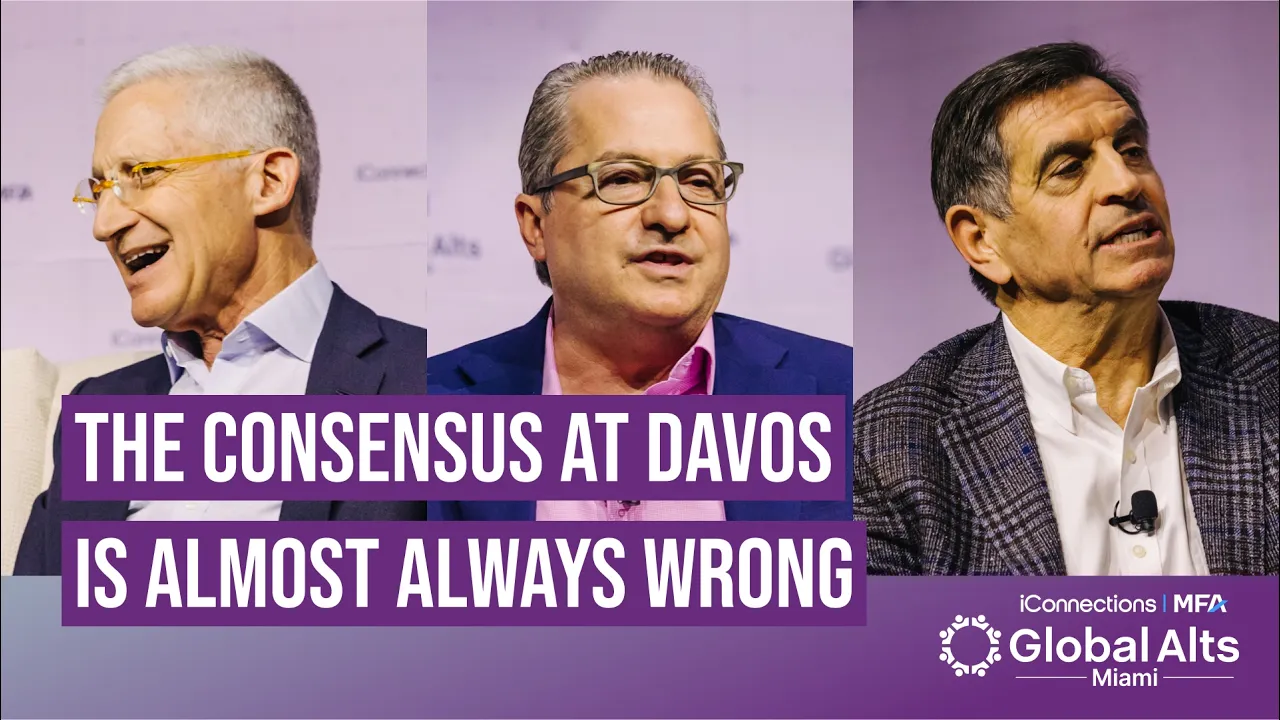
okay guys so um backstage Nick who might just told us to have fun um we've only got 30 minutes so we don't have time to sing Happy Birthday but it's Josh's birthday today so wo Happy Birthday Josh thank you okay guys so um I'm Jeff Asaf with icg advisers Josh Freedman with Canyon I'm sure you all know who you're here to listen to Tony yoff with Davidson cner our firm's been invested with these guys forever and I've known them for a very long time so this is it is fun for me to get to have
a conversation like this with people I've known as long as I've known um I put some questions together uh and I'll tell you where I want to start just last week I think was Davos right okay so our firm does an asset allocation study every year where we try to look into the future and come up with what we think is a rational reasonable expectation for future returns in various asset classes globally and at Davos I heard you can I think you were there Josh yes that there was a lot of talk about basically unattractive
forward-looking returns for most of the non- US markets at least that was the talk and that's interesting because in the work we did uh which we do every year like I said um our work is suggesting that like the next five plus years of returns here won't be that great and so if if we're at all right and if whatever you heard in Davos which I'd like you to talk about is right then that really begs the question well where are people going to get returns which is probably why there's 19 ,000 meetings set up
at this conference because it's all going to come from something in alternative because it's not going to come from beta if beta's going to do what people seem to think so Josh you were there will you talk a little about expectations for returns this is a credit panel and it is credit focused and I think it's titled the future of credit investing I don't know who comes up with these titles but it is a it it's important because there is so much going on in the world of credit and availability of it and how it's
getting used to lubricate the financial system and these guys whose assets are 25 and 35 billion dollar and almost mostly in credit it's their life's blood so Josh can you talk about that so Davos first of all it was a little less crowded than it was in Prior years I think a lot of people were at the inauguration I think there's been a political swing back to the center from the sort of globalist eurocentric type of mentality that Davos tends to have and I also think maybe there's one too many conference these days between now
that fi has entered the scene as well so so it was a little less crowded but they do a Governor's panel where they have all the finance guys and definitely people are are maybe less positive on Europe in general than they are on the US and Trump of course had just given his um inaugural speech was like an infomercial on how we're open for business and by the way if you're you want to know which businesses here are the tech guys we're talking about energy you know we're going to deregulate Etc so there was a
lot of optimism but there's a difference between being optimistic I think about the state of the economy and the state of business and employment and growth and all that and valuation and I think there was a bit of um I think some of the more thoughtful people said look the US is now something like 70% of the msci if you count private assets it's probably closer to 90% of it really the high yeah crazy it's the highest it's ever been wow um okay it may be a little less after this week's uh you know developments
but but the V but that doesn't mean that it's not a great environment for business and a very positive one and one that's likely to be better not worse but valuation is a whole other a whole other issue and valuations have gotten pretty stretched and um that was kind of Howard Marx's point this morning in his comments yeah and well and the other part of it is it does relate to interest rates it was interesting I I I like to do these kinds of panels when I'm way out of consensus or you know out from
doing you know you know the TV stuff and I've been saying longer higher for longer for a very long time now because of um you know low unemployment High stock market fed foot on the gas pedal but also the treasury foot on the gas pedal so the FED can't do all the work of changing that nor would they necessarily want to As Long As everything's good why should they put the brakes on so um I why should they stimulate why should they lower rates if everything's great already so I've been in this higher for longer
category almost every single person I talk to it do was now in the higher for longer category all of a sudden so that's become the consensus which leads me to think maybe that's not necessarily going to be the case um because they're almost always incorrect um the consensus at davo so that that was the talk I think it was us is really strong valuations are really stretched interest rates are going to stay high so be careful so does that mean the US is really strong so business can be good but that doesn't necessarily mean that
stock prices will follow because that's already built into the price yes the valuation Gap has gotten larger by almost any measure on now we have to grow into that on equities clearly almost any valuation measure has gotten stretched and if you think on top of that you're going to be facing higher for longer interest rates then maybe that's a headwind as well again I'm not sure I agree with that consensus on valuation but that was the talk okay okay so Tony so you guys I Fally refer to you guys as DK but Davidson Kepner he
recently published a white paper and uh and it was really about opportunities and absolute return which is if any of what we're hearing is right then that's the place one's going to need to spend more of their time to make any money beyond what you could make by just buying a treasury talk about your paper and talk about the the the the general summary of how you guys are tackling this at Davidson C and where you see those opportunities and how to exploit them yeah for you and for us no thank you and I was
going to say speaking at I connections uh today I feel like I'm pushing on an open door in terms of talking about the value of absolute return strategies you go to some different forums and there's more skepticism about the strategy we actually think it's going to be much more important in the 2020s than it was quite frankly in the 2010s we'll come back to Europe later I agree with your um sentiment uh Jeff in terms of where opportunities are going to be the next five years versus where they were the prior uh 10 or 15
years but you know I had a simple um thesis which is something I spent a lot of time thinking about last year which is the fact that um in the 2000s allocators could rely upon absolute return strategies to get you home right so if you were looking for you know somewhere between seven to % net Returns on an endowment or on a pension fund over a long period of time you could check a box and you knew that your absolute return um strategies would get you there um in the 2010s as interest rates were zero
for a longer and longer period of time absolute return all of a sudden just became abolished right we would use absolute return as is the ballest in our portfolio we would expect a lower rate of return on it but hey we're going to earn our return in equity and we're going to return in private Equity or venture capital and and that would get us home an absolute return would be a volatility uh uh dampener um against that I think you can still rely upon absolute return uh as a dampener but I actually think the rates
of return um today will get you home um as an allocator and I think there's a couple reasons for that so the first of which we went back and looked at like 30 years of data and this is all available in this white paper that we published which is um absolute return the part's just getting started um and so not only are you benefiting today from um higher base rates than you were previously and you could access that through fixed income you don't need to Absolute return to access that benefit but there's much higher dispersion
and much higher idiosyncratic risk in higher interest rate environments than lower interest rate environments we looked again over a 30-year um history of this and in fact the outperformance compared to a base rate is over over 50% higher in um higher interest rate environments than is in lower interest rate environments so not only are you getting the benefit of the base rate you're also getting 50% additional excess return than you would get in a lower um interest rate environment it's because of dispersion in Securities right so rates shot up higher there's winners and losers of
that I mean you could see that on Monday right Monday was an absolute blood bath for a handful of the um highest um returning stocks in the D in the um S&P over the last few years the Dow Industrial Average was up on Monday it wasn't down my screen was full of green on Monday it wasn't all red if you owned Nvidia or you owned vistra or stocks like that good luck to you but if you didn't own the most over owned uh over storyed stocks you actually did okay um on Monday and so not
only do you have massive dispersion in performance in issuers in equity markets you also have massive dispersion of performance of issuers in credit markets as well and fundamentally you know absolute return strategies so for uh Josh firm and our firm we're doing a combination of opportunistic credit and event driven investing we also do some relative value investing as well those are fantastic opportunities when you've got high dispersion in markets and it's it's just there you can look over very longer periods of time and there's massive dispersion in Securities performance it's not just following everything up
or everything down and that's what's creating the great environment today for absolute return if you believe in um higher interest rates for longer which I do as well I mean it's a consensus view but I believe in it as well and by the way not just at the short end of the curve at the longer end of the curve you've actually seen a normalized uh yield curve in the last you know six to 12 months for the first time in two or three years that's going to create massive dispersion and massive opportunities for absor return
it doesn't look that normal to me well a 30-y year like for how about what's the 30 year at four and 3/4 485 490 yeah I mean you have a 7080 basis point gap maybe a more normalized would be 100 to 200 basis point gap it's not inverted right your 210 is not inverted the way um the way it was and and again I I think this is sort of consensus but you know my guess is the short end goes lower and the long end goes longer goes higher and you wind up having much more
normalized curve in the next year too okay so you've got obviously we all know this we have a higher base rate like call it 4% or maybe a little more today that's that's the free money and then you add pre risk premium on top of that and there's also IL liquidity premium so you can get credit in liquid Vehicles you guys both have them and you can say I don't need liquidity I'm willing to tie it up commit it for a few years and put it to work and harvest it over a few more years
but I want extra I want some extra for that and for the inability to change my mind how much is that ill liquidity premium today and where do you guys see that over the next few years like is this the time to lock it up or take advantage of it but do it in liquid Vehicles either one of you can tackle that well first of all you have to be careful when you say illiquidity uh public markets are sometimes just as illiquid as private markets private markets have exploded in size compared to private markets that's
true in the equity markets where the number of public companies has shrunk and it's certainly true in the credit markets um I I think there are places where you don't necessarily want to go that might lock your money up with duration in both the public and the private markets just because the spread's not compensating you the basic high yield spreads are tight they're very very tight right now but if you look at the at at the spreads across the whole spectrum of credits you see that the bottom 80% of credits in the high yield index
are trading at unusually tight spreads and then the then the next 20% the stuff that gets scratchy the things that were overleveraged that are having trouble refinancing in today's interest rate environment actually really wide and there's a lot of interesting absolute return um opportunities in that uglier part of the credit Spectrum where there are going to be liability extensions and all the kinds of um things that happen to balance sheets when they just can't really handle today's rate environment so you have to look a little bit at supply and demand um I think a lot
of traditional players uh have moved so aggressively into essentially large cap unitron lending that that's another world where rates and spreads have come down uh what used to be a great 675 unitron loan and it was a brilliant brilliant business plan because the banks weren't making loans you could stretch out that first lean a little bit charge a nice premium that 675 is now 425 or 450 the debt to IA has increased quite dramatically and the covenants have vanished and you can get eight term Sheets if you're a private Equity acquir so you just put
them in competition with each other that's that's pretty interesting because it tells you maybe that's not the optimal place to play and you look there's 400 billion of Virgin Capital waiting for deals to happen maybe they'll be a lot more deals now with less less antitrust uh scrutiny and so forth but for the moment at least leas that's looking looking looking tight and to lock up Capital there at that spread may not be where you want want to be and that is il liquid but if you go just one step down in size one step
higher in complexity it's a completely different picture and things are 650 to 850 over and much less competitive it almost sounds like you're saying while that's supposed to be riskier it may not be because of price you're yes you're very well compensated in one place you're not as well compensated and by the way that may change Capital May flow in different places it's also true in distressed a lot of the places people that used to compete in the distressed World there are new players there are smart people it's the rules are less predictable so it's
competitive but you certainly don't see a lot of the major distress players that you saw a few years ago because they've transformed their business models into they've become hyperscalers much much larger and it doesn't have the same impact on their own firms that maybe it had when they were 20% the size of what they are today and I I would add on to like some of my truisms of investing are the fact that um Capital chases returns and markets become uh efficient over time and so if you look at um let's say liquid credit strategies
compared to liquid uh credit strategies and you look at the sheer amount of money that's flown into what people call Private credit but they really mean by that is Direct Corporate lending um you know 10 years ago Direct Corporate lending was a differentiated strategy the folks in that strategy could cherry-pick their credits and earn real excess return now it's just a direct competitor to the bank indicated loan market and the issuers of that debt which tend to be private Equity firms are among the most sophisticated borrowers in the planet and so they just play One
Market off against uh each other to get the lowest spread in the worst terms imaginable so the terms that were differentiated in those markets certainly for any larger issuers five or 10 years ago it's the same it's the same stuff and in fact often Direct Corporate lenders if they if they lose out on a private Market deal we we'll buy the public market deal and put it into the same uh uh vehicles or related um Vehicles we're much more active in um opportunistic credit which distress would be a part of but not the only uh
part of and actually asset back lending um as well so asset back lending is more regular way lending but it's far less competitive it's much harder you can't build a you know a machine to do it you have to do each deal um individually and so as a result of that the deals are smaller the spreads are wider the covenants are tighter the velocity of capital is more quicker quickly quick as well and you typically get am ation along the way which you might not get any Direct Corporate lending Vehicles so you know to answer
your um original question like I I would expect probably a 500 basis point pickup for an a liquid longer duration opportunistic credit uh strategy compared to what I might expect for a um absolute return strategy it's probably somewhat Less in um an asset back strategy but still quite uh uh meaningful and pickup I don't know if I would expect a lot of pickup honestly in a Direct Corporate lending strategy versus a liquid strategy that could be different five years from now that what it is today fundamentally it's Supply uh demand driven and where markets have
gotten to and just where the scale of the business is but you know time will tell if that's correct okay so you mentioned Banks so you guys have built these great track records doing what you've been doing but you've had a competitive Advantage for a while which is the regulatory regime that has basically taken a lot of the opportunity to make loans away from the banking system which has given birth to what we're all talking about and now Trump is back in office and there's a view that there's going to be less regulation and a
more a more conducive environment to doing business which probably I don't know I want you guys to touch on this probably means some of the bank regulations will be lifted or eased and it'll become easier for the banking system to get back into doing some of the things they used to do that you guys got to clean up and is that going to create a headwind for you and maybe the expectation of what we can all get through the kind of credit work you do some of that might get pushed aside because you get squeezed
out by cheaper Capital because Banks lend for less than you do I I don't know I think um maybe not it it depends like like let's take real estate for example and then and then we'll go to the corporate world or the Structured Products world in in real estate lending the banks have been sort of shut out right now they have enormous Capital charges associated with construction loans with office loans with broad Cate ories of loans that they used to make lots and lots of where they did lots and lots of transactions yeah and and
the consequence when you have higher interest rates is that a lot of uh smaller financial institutions get their balance sheets upside down and so this was the way of The Regulators dealing with it um will they just eliminate that and let these Banks fa I I don't know that that's going to go away so quickly right now the quality of the real estate lending that we're doing is is higher the sizes are higher the amount of equity underneath the the the transaction where lend money is much larger and the source of the transactions is the
banks because they want to keep their clients so they'll give us a deal and then give us back leverage but it doesn't count with the same Capital charges as if they made a direct loan on the property so it's equivalently the same risk but it's just regulatory Arbitrage will that stay forever I don't know that nothing stays forever I suspect not but but you won't have competition I don't think from the large unitron lenders because it's just the bite sizes aren't big enough to make a difference it's it's very labor intensive in the corporate lending
World um I'm not sure it's really a regulatory phenomenon that that has kept the banks from making loans Banks still make plenty of loans but unitron loans are deeper there it's it's the bank it's really Bank debt plus plus the the depth of the loan is really more Bank debt plus bonds and the spreads are closely tracked by what it costs for Bank debt plus bonds you've just got one guy doing it and they've gotten pretty good at it but as Tony was saying you got a lot of money chasing those things it's not the
same Alpha potential that it had when it started 10 years ago so I I don't think that the regulatory framework is necessarily what's going to drive it I think you have to look at the supply and demand for Capital and right now so much capital is run one way there's a a hole here and when that gets filled in there will be a hole somewhere else you just have to have a broad enough mandate and you have to be at a size where things might make a difference to us or to Tony that may not
make the same difference to somebody who's toing around 500 billion of assets there's a reason why some of these firms are talking a lot about their business doing um Insurance related investment grade U types of credits because that's a gigantic market and that makes a scale difference for a firm that's got several hundred billion dollars in assets if you've got 25 or 35 or 45 billion dollar in assets you don't really necessarily need to go migrating all the way up to investment grade to put that Capital to work I'm going to make a point about
that because you're kind of teeing up my next question but do you want to say something about yeah I'll just I'll just add in I mean I think the lowest hanging fruit for the banks is to make more of an effort in Direct Corporate lending you've seen a number of JV relationships that have been set up with larger Banks and individual uh very large investing uh firms Goldman Sachs announced a big reorganization in the last couple weeks to try to better attack that market although they've been a bigger purveyor of that through through uh G
Sam and pre previous to that through SSG I think there's still a lot of muscle memory of what happened with real estate lending and Structured Products in 2006 to 200 uh nine that arguably led to the uh Global financial crisis certainly spearheaded by The subprime Lending that was done in that period of time but the bad lending went well well beyond subprime and so I do think the combination of regulators having big muscle memory globally of the um of those issues in the banking system um and not wanting to give up the very high Capital
charges with it coupled with um what Josh was talking about which is the more bespoke nature um of it is going to make it a much longer timeline for banks to get involved in that portion of the lending compared to corporate um uh lending I will say a lot of the things that we're doing in asset back lending would have been done by Banks um uh you know 15 years ago plus um it's not anymore sometimes they'll want to provide you um backdated leverage sometimes they'll they'll kind of te the deal up for you which
is what Josh was alluding to in exchange for deal fees and along those lines so it's not that they're not in the mix for it they definitely are it's just the capital charges are too uh punitive and again I I think that's like the LA that's the high hanging fruit if the low hanging fruit for banks is Direct Corporate lending the high- hanging fruit would be the Structured Products and if you want if you're an investor like we are looking to capture that excess return like when we do our diligence on managers one of the
things we always talk to them about is how much money are you running and how much can you run and keep doing what you're doing and and there's been consolidation in the credit space and you got guys like Black Rock buying up different firms and you've got there's all this Capital chasing this and some places are getting pretty darn big for you guys to do what you do we're going to all hold you to this as you how much is how much can you run before you you just can't you can't keep playing in the
same sandbox the the market you like far away from it or is it so deep that you've got plenty of I think we're pretty far away from it now I didn't think that five years ago or 10 years ago but the amount of money the size of these Capital markets Jeff has gotten just way way way larger and you almost need a certain amount of size to be relevant if you're involved in a distress situation you've got to make sure you own enough to have real influence on that creditors committee so you don't get um
treat mistreated by somebody else who's bigger than you and now that may be sort of yesterday's Trend and people may be just getting tired of that nonsense now so people are playing a little better than they were playing a while ago with some maybe a little bit of Tailwind from some Court decisions but I think you need some size to play in this the sheer size of the private Equity business has gone from you know a$3 trillion business to A10 trillion doll business that that creates gigantic debt issues it creates a lot of volume of
transactions you need more size and more scale to maintain your relevance today than you needed uh I think 20 years ago so I I don't I think it's hard to be a small firm you also need um more products and it used to be product proliferation was like the great sin you had to stay small never have product proliferation never hire from the outside never have an outside shareholder it helps have an outside shareholder now you got a balance sheet you can hire people it helps to have proliferation of products a little bit to feed
your core product because you need the size and because as not only has has have the private markets exploded but every client has an advisor who's telling them exactly what their pie chart should look like they want this much in this asset class and this much they want this much direct lending they want this much opportunistic credit they want this much real estate credit they want a little bit of global macro and some long short whatever it is somebody else is doing it so if you have your multi strategy single product you know you can
die on the vine if you don't have some of these other other more specialized things to feed it people don't always want to buy the club sandwich they just want to buy the bacon or they just want to buy the turkey or they just want to buy the tomatoes or the bread so I think it's I think the world's changed I think it helps to have a balance sheet you need more scale and you actually need other products I think to remain relevant in today's world I mean the things I would say is first of
all you need to decide who you are as a firm and institution like what are you good at and and where do you fit into the marketplace right and so for Davidson Kepner the things I think that we're very good at are opportunistic credit and event driven um investing and we try to make sure all the different things that we're doing in the investing landscape fit in one of those two areas that has led us to a number of different strategies um like Josh's firm has um as well but I want them to all be
tangental because another thing that we believe in is that we should seeare research across the organization and there are real synergies to doing these things in different um areas you know as an example my long short uh equities team which is not a credit strategy talks to our long short credit Team all the time because there's a lot of synergies between what they're doing and often it's the same industry sometimes it's the same individual names that's super helpful um the the Synergy that I think is super interesting that I sometimes refer to us as is
a crossover credit shop and that's a term I've sort of stolen from some of the crossover technology shops so in the technology world you have firms that do Public Market investing in um equities in Tech and they do venture capital and growth Equity um as well in the credit for world I think it's actually super important to both be in public markets and be in private markets at the same time you learn a lot from your public market um situations that you can actually apply to your private Market companies and I think it goes without
saying that you learn a lot about being in private markets that you can apply to different situations in public markets you know as Josh mentioned in the public markets today if you own two or three per of a instrument you have no rights and no say and you're going to get run over that's a very different environment than the credit world was in uh uh 10 years ago that could be next year's panel in terms of uh of um of what we talk about but you also there is a reality you need some scale um
as well you know 10 years ago the large firms maybe had a hundred billion dollars in assets and by that I mean the Apollos or the um Aries or blackstones in the world today the largest of those firms have a trillion dollars in assets and there just certain things you need to be able to afford as an institution like you might want a data science effort right that could be very helpful in doing individual uh uh situations you want a transactional legal team that you can sort of parachute in versus um just relying upon bespoke
uh um um outside uh attorney and so you need some scale to do that you need some scale to be relevant and so we think we found the right balance of that but it's never changing number and it's bigger I don't you find Tony that when you're doing a private credit transaction and you're trying not to do a standard unitron you know whatever it is and just compete with 10 other term sheets y the bite sizes on these deals might be a couple hundred million or 250 or $300 million and if you can't stand up
for that and if you can stand up for that you can do something really really interesting and get paid excess payment because you're dealing with complexity and customization and so forth but if you can only do 50 million bucks you know that's you're not you're not relevant they're going to some else you're not relevant then you're running around scrambling calling your friends that's not useful okay we're out of time but I'm going to just you each of you just like literally 30 second answer because we started with this the environment in Davos and Europe does
not look good and the US doesn't seem to have a lot of opportunity or it seems expensive domestic credit or International or both we we're probably roughly 5050 in terms of how we're spread and in our longer term Vehicles we're more recently a little bit over indexed to uh Europe we're very busy in liquid Credit in Asia and we're very busy in less liquid Credit in Europe Josh I I definitely both um I I'm not as much of a fan of Asia just because governance in general in a lot of those countries so freaking challenging
I mean we do some and we've done some with Tony but it's it's hard and challenging if be three times more selective but I think Western Europe for identical credits you get paid more you have less debt to IA and it and it can be pretty good in spite of slower growth so I like both um and and I think there's plenty to do in Western Europe you just those are to me Western Europe and the US are the most most important areas and they're both important but we're more like 7030 8020 not 5050 we're
done thank you thanks everyone thank you all [Applause]