talking about risk management in this video. Go over a couple things. First and foremost, how we kind of know what our risk is.
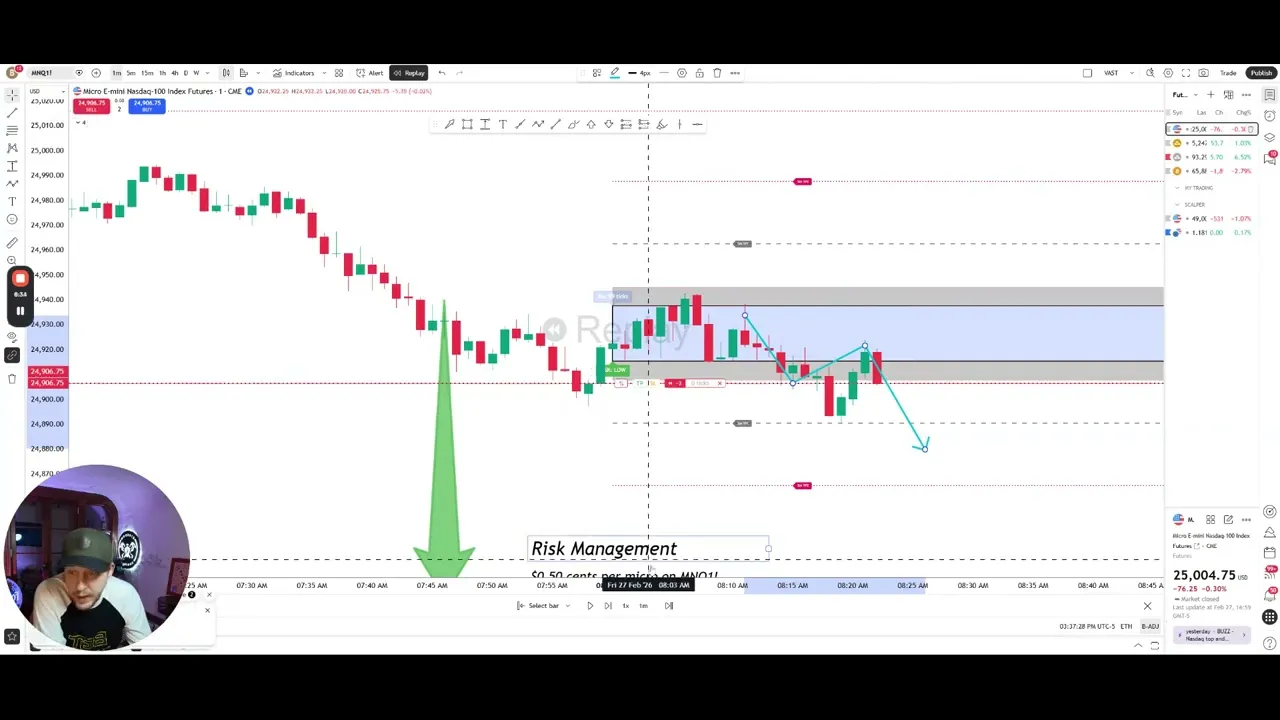
This guy right here, 89 ticks. Kind of hard to see, but 89 ticks. I just call it 90.
Let's just pretend it's 100. But right here where that that ticks, this is how we determine our our risk. Then our TP1 is always 100 ticks.
Take profit one is always 100 ticks from right here, the bottom of the blue or the top of the blue. From there to this TP1 is 100 ticks. So, in a scenario where you get in, let's just say right here at the bottom of this red candle.
I'll I'll zoom in. Let's say you get in right here, which is where this candle closed. Are we going to get 100 ticks for our TP?
Think about it. It's 100 ticks from here to here. We got in here.
Are we going to be at 100 ticks? No. maybe less than 100.
So, let's just measure. This is the price range tool from one of the earlier videos. You should have that pinned.
So, let's just measure. So, we're going to be It says 81, let's just call it 80. So, instead of 100 ticks, we're actually 80 ticks.
Okay. So, instead of uh let's do our math over here. It's 50 cents, guys.
on NASDAQ. It's 50 cents per micro on MNQ1 exclamation micro NASDAQ. So, one contract 100 tick take profit.
So, 100 times 0. 50 would be $50 in profit. And then on the stop-loss, if we have one contract, it's 100 ticks stop-loss, we're losing 50.
Now, you know, we have 80. Half of 80 is 40. So in this scenario, it'd be a $40 profit instead of a $50 profit.
So risk management. Couple things I want to tell you guys or show you guys. If you only use one contract and let's just say same scenario your where let's just say we get in here and let's just say you have your stop loss right here.
So, if we were to measure that from where you got in, which is the bottom of this red candle to here, 108. Or if you were to go to the top of these wicks, which is more realistic within the buffer zone, which is gray. Here's your buffer zone.
Let's just say you went to the top of these wicks, which is what I would have would have done. It's 128. 128 divided by two would be your risk.
We already looked at the profit. It's like 40 bucks. So if you only ever use one contract in this scenario, if we were just to repeat this scenario 100 times, you would lose money.
You would lose money. So in risk management, it's important to know, you know, obviously the math. 50 cents 50 cents per tick.
Okay. per tick 89 ticks 128. It's this number right here on the right.
128 all the way on the right is your ticks on the price range tool. So a lot of times what I see is people, it's normally not that they're getting in too big, although that can be part of greed, but a lot of times people are getting in really small. They're getting in really small and they don't have a runner.
So let's just replay this really quick. I want to show you guys a couple things just how my brain works a little bit. Let's start new.
Let's just go to down here at the bottom. I'm in replay mode. Highly recommend you guys do this.
I'm in replay mode. It says select date. I actually want to select the bar and I'm going to put the bar like let's just pretend there right here.
Okay. So, how I'm I'm I'm not in a trade yet. I know I've got $45 worth of risk per micro.
Half a 90 is 45, I believe. Suck at math. And I'm just going forward.
I'm on the one minute looking for a qualifying candle and I'm just walking you through the mindset here. You guys can do the math on your own end. Okay, we're going to go short.
Let's just go let's go start with two. Okay. So, I know that my risk is going to be if I go up here, I'm going to measure this again.
Well, actually, it'll do it for me in replay mode. 128 tick risk. And we know our TP1 is going to be down here.
And I only have an 82 tick 81 tick takerit. My risk toreward is not one one. I have more risk than reward.
So, I'm going to see if I get an opportunity to potentially add into this trade. All right. So, let's move forward.
If I was to scale into this trade, what I'd be looking for is from here come back into our box and then break out of this. I would want to be at least here. Need to go up first.
didn't get an opportunity. Let's pretend that we didn't. I'll show you guys if if we get another entry.
I'll show you. Okay, we're back up. Like I said, I'm going to be looking for it to come back down.
There we go. I would add this bad boy comes all the way down. Works out in our direction.
Okay. So, when you guys are looking at this, again, it's it's really basic math. Just divide everything by two.
Call this 90 $45. You know, I had a little bit more because I put my stop up here. You know, my TP1 because we got in here.
like the risk-to-reward wasn't great, you know, but I'm adding to it or maybe I have a runner. That's really how we look at risk management. The other thing I want you guys to look at is this.
As you get closer to your goal, go down in risk. So, let's say that your goal is to pass a prop and you're 75 80% of the way there. You don't want to increase your risk as you get closer to your goal.
You want to decrease. So, if you're just starting out, you know, and you're starting out at one micro contract and you're only using one, number one, it's going to take you forever to pass a prop unless you just have massive runners. But so, number one, that and then number two, as you get closer to your goal, you have nowhere to go.
You can't derisk if you're already at one. You can't go to zero. That doesn't work.
So, a lot of times, we have a rhyme for this. If it starts with a three, meaning 300 tick box. This one was 89.
Pretend this is 300 instead of 89. Starts with three. 300.
Above 300, we leave it be. Starts with a three, leave it be. Starts with a two, trade a few.
People forget this and like they don't actually do that. A few means like two to four. Then if it starts with a one, meaning 100 ticks or less than 100, have some fun, right?
Not a massive amount of risk on an 89 tick box, you know? So, don't be starting with one on something this low. So you can be a little bit more aggressive in the beginning, you know, two, three, four contracts, but as you get closer to passing a prop or let's say you're at the end of the week and you're up $900 for the week, drisk as you get closer to the end of the week, maybe Monday, Tuesday, Wednesday, you've got an opportunity to be a little bit more aggressive.
Thursday, Friday, you're up for the week. Drsk. Getting towards the end of the month, go lower.
You can always go lower, guys. I want to show you what I mean by that. So, I want to show you another scenario.
And I'm going to delete everything on here just so I have a clean slate. I'm going to go back. This is something that we've been teaching a little bit lately.
I'm going to start with one contract. So, here's the whole idea. If we start with one contract, we get stopped out.
We're getting stopped out at the the smallest possible position size there is. You can't go to zero. The smallest is one.
So, let's take a look and I'll show you how I add to this. And this is all risk management, by the way. I'm not off topic here.
So, let's go forward a bar. Here's our short. I'm going to go short with one.
So, if I lose 126 ticks, very small takeprofit. I'm actually going to pull this down a little bit cuz I know we got stopped at on the last one. So, if I lose right now, I'm losing the smallest possible position size.
That is good risk management. But you don't always have to stay there. And here's what I mean by that.
So, we're in one. Looking for a re-entry. So, we're going to hopefully come back up.
Okay, so 70 ticks. It's moving in the direction that we want it to move in. We are We're getting some confirmation that we're moving down.
That's great. But let's just say we don't hit our takerit. Market manipulates us a little bit.
Let's come back into our box. Okay. Now, I want to add, but you never want to add on the way up.
What you want to do is you want to add when we are confirming that we're moving down. So, you never ever ever want to add here. You want to add down.
Okay. So, let's get rid of this. I'm in one contract.
I'm the most risk adverse I can be on the planet. The trade is moving against me. I am looking for an opportunity to add and maybe even add risk, but I want confirmation that it's moving in the direction that I want it to move.
So, let's go forward a candle. Okay, now we're moving back in the direction that I want it to move. And in fact, we've even broken out of this gray buffer zone.
So, I'm going to add one more. I'm going to click on sell one more time. Now, guys, this is replay mode, so it automatically change this to two, and it automatically change that to two.
In real life or in a prop, how we do it, you would need to click on these and manually adjust some. Okay, now that I've gotten confirmation, I've added to my risk. not added to my risk when I don't have confirmation.
Only adding to my risk when I do have confirmation. A little bit like playing Texas Holde. You've got, let's say, pocket jacks and you get the card is flip.
You get another jack. You've gotten confirmation that you have a good hand. You started with two.
Now you got trip jacks. You should be betting more, right? Not you have a crappy hand.
And when as they're flipping the cards in the river, you get nothing to confirm that you have a good hand. You would not bet more in that scenario unless you were trying to fake them out. Okay, so we added two contracts now that we have confirmation.
See what happens here. Still confirmation. Still confirmation.
This right here would have hit your takerit. Just let's just give it a second. Let's see what happens.
Okay, that did hit our takerit. So, we only added when we had confirmation that this was going in our in our direction. Boom.
Look at that, guys. So, nowhere in here did we get close to being risky, but we actually did uh what did we get in here? This actually went to 400 ticks.
Pretty sweet. So, I hope that makes sense, guys. the math on it, all of that.
If you guys have any questions, don't hesitate. But hopefully this makes sense. All of this is meant to be practiced, okay?
You got to practice this. Replay mode is one of the best ways to do that. You guys can find replay mode.
It might depend on what variation or subscription to Trading View you have. I think replay mode is worth $1,000 a month. I've replayed 5,000 plus trades.
I've replayed multiple years every session. That's how I got good real quick. Highly recommend replay mode.
It's the best way to do it. All right, guys. That's it.