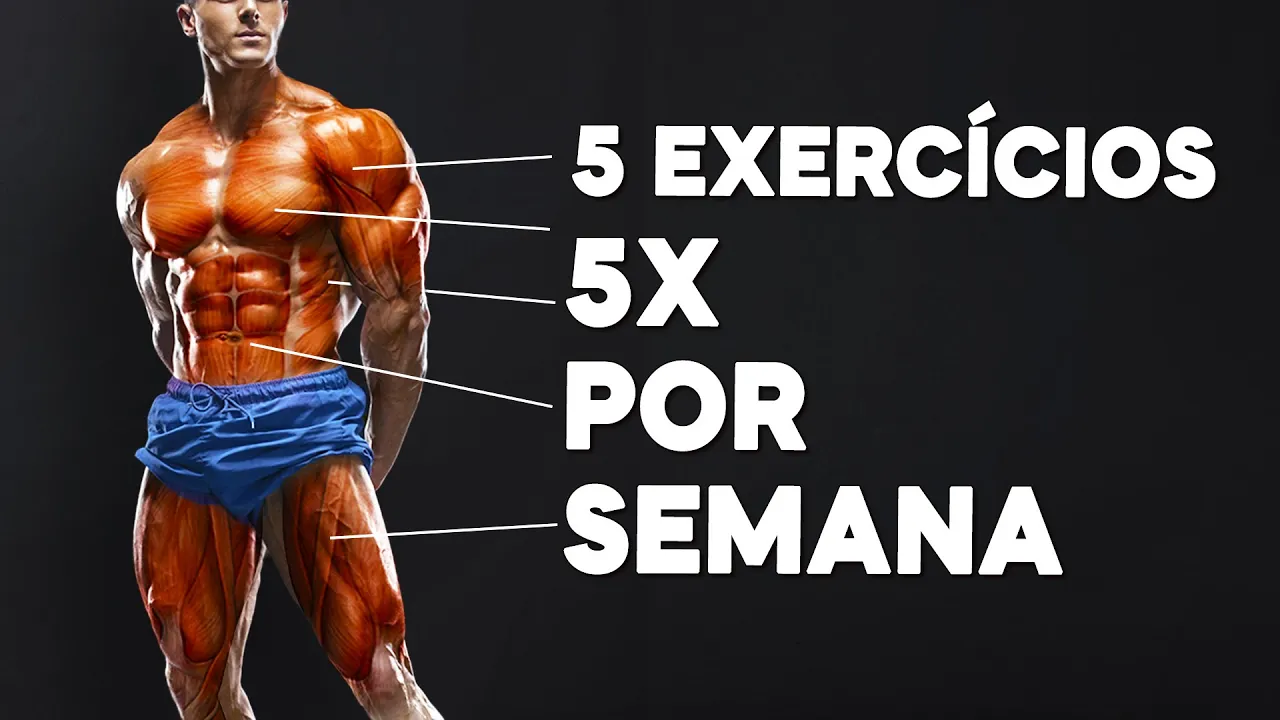
I arrived at the gym, looked at the clock, and I have 25 minutes to do a workout and I need to train my entire body. And now, is there time? Let's go, no!
At this point I'm already taking the X-ray at the gym and going straight to free squats. And there are some questions that I need to tell you about, why choose this exercise and choose it in the first place. First, it's an exercise that works my entire leg, it works the glutes, it works the erector spinae, and even the abs work in this exercise.
We have studies showing that the abdomen hypertrophied in people who did squats. The squat is excellent. I do a warm-up series, because I need to turn on the whole system there, and the second series I still warm up.
One cool thing: during warm-ups, I start stretching too. Stretch one leg, stretch the other, and you'll be ready. - You not me.
I'm the one training. - You see that our head is a weakness. When I'm warming up, I only rest for 30 seconds.
I don't exhaust my muscles, I don't need a lot of time to recover. Always remember this: the more you intensify your work, the longer your rest time. As he was low, I rested a little.
Even now in the squat, which involves the whole body, as I'm not tired, 30 seconds is enough. I go there with a charge of more or less 60%, and I get close to failure. I leave two or three repetitions in reserve.
I go to the second series, increase the load and get close to 70, 75%, close to failure again, and then the load will increase a little more. And then you go until you almost, almost fail. If you fail, you fall.
If you fall, you die. In my head, I'm making a checklist of my body, and I'm ticking the muscles that have already been worked. I've already worked on my quadriceps, glutes, because we like to have our butt in the moment.
. . I can't believe what I heard.
Abdomen have already had a bit of work, erector spinae, because the posture will be elegant, even the calves have had a bit of work. One muscle that got shameless work in this exercise but didn't work right away was the hamstring. Studies today show that the hamstring contracts, and that is good, but it does not do the work of shortening and lengthening the fiber, so the hypertrophic stimulus does not reach it.
I get out of the squat, take advantage of the fact that the blood is more here, and then I go to the flexor chair. Among all the exercises for the posterior thigh, the chair flexor is the one that studies show has a little more hypertrophy. The first series I will do with 50% of the load, I will not reach with both feet on the chest because remember, this muscle contracted in the squat, but it did not do the shortening-stretching.
If he didn't do the shortening-stretching, reaching with both feet on the chest is dangerous, I could get hurt. Open your eyes, man. I don't need to rest for a minute and a half, the hamstring is good .
I'm going to rest for about 40 seconds, a minute. Increase the load, 70% close to failure, another minute of rest, and then I go to 90% - of the load. I'm going to fail on that last one.
- What I can understand is that in the beginning the first series will have more repetitions so you can reach failure with less weight, and in the last series - will the repetitions decrease? - That's exactly it. The idea is not to focus on repetitions, it is to focus on the load.
I got there, I put in 50%, to get close to failure, I need to do a greater number of repetitions, but as I increase the load, because I'm focusing on the load, this is a consequence. Repetitions will naturally drop. How many repetitions?
It doesn't matter, think about the muscle you're working. Reinforcement: I'm not going to do calf raises in this workout because I'm out of time, and I've already had a little calf work in the squat, and I've had a little calf work in the flexor. Don't rely on that, you lazy bum who doesn't like doing calf raises.
Shameless cheater! I started to warm up, and remembered that I was wearing this Insider t-shirt. That's good, because I was on an appointment, well dressed, I went straight to the gym and it worked , because it works in both environments.
This is Insider's tech t-shirt, it makes you look good in more social environments, and it also works well for you to go train. Take a look at the link and it will be great. Now let's go to the top, I'm going straight to the muscle that catches my attention the most, that I want to develop more, especially because it helps me have a more elegant posture.
I'll work back. I'm going to the pulley to do a back exercise there. What goes through my mind is this, bro.
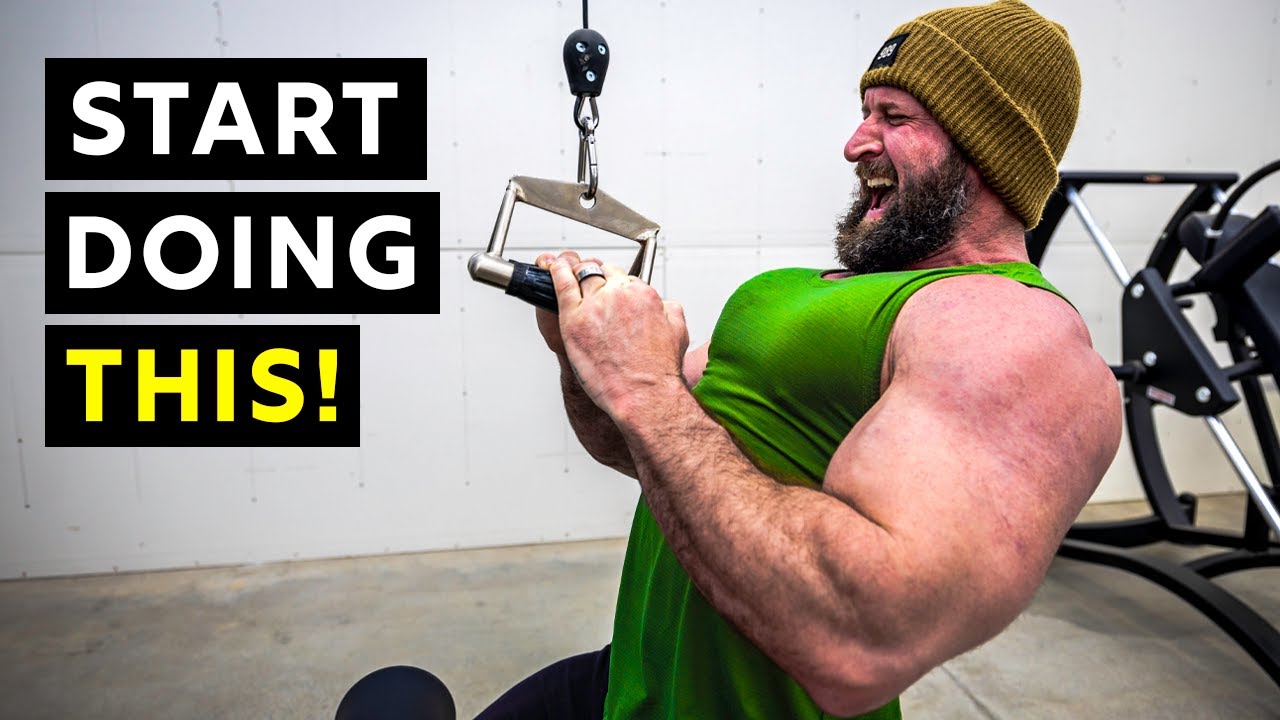
I have little time, so if I do an open pulley, I'll work my back well. If I do a closed pulley, I will have more work on my posterior shoulder, because this muscle extends the shoulder, and I will also add strength to my biceps. I'm going to send a pulley here, front and closed.
And of course, you need to do at least one set to warm up. Your whole body is warmer, but you didn't do anything to your back. Then you go to first grade and follow the same pattern.
Throw 50%, 60% of the load there, until close to failure. Increase it a little, get close to failure, 3 sets is what I want. 1 minute is enough to rest.
Could you rest - more? Yes, but I don't have time. - I don't have time for this, man.
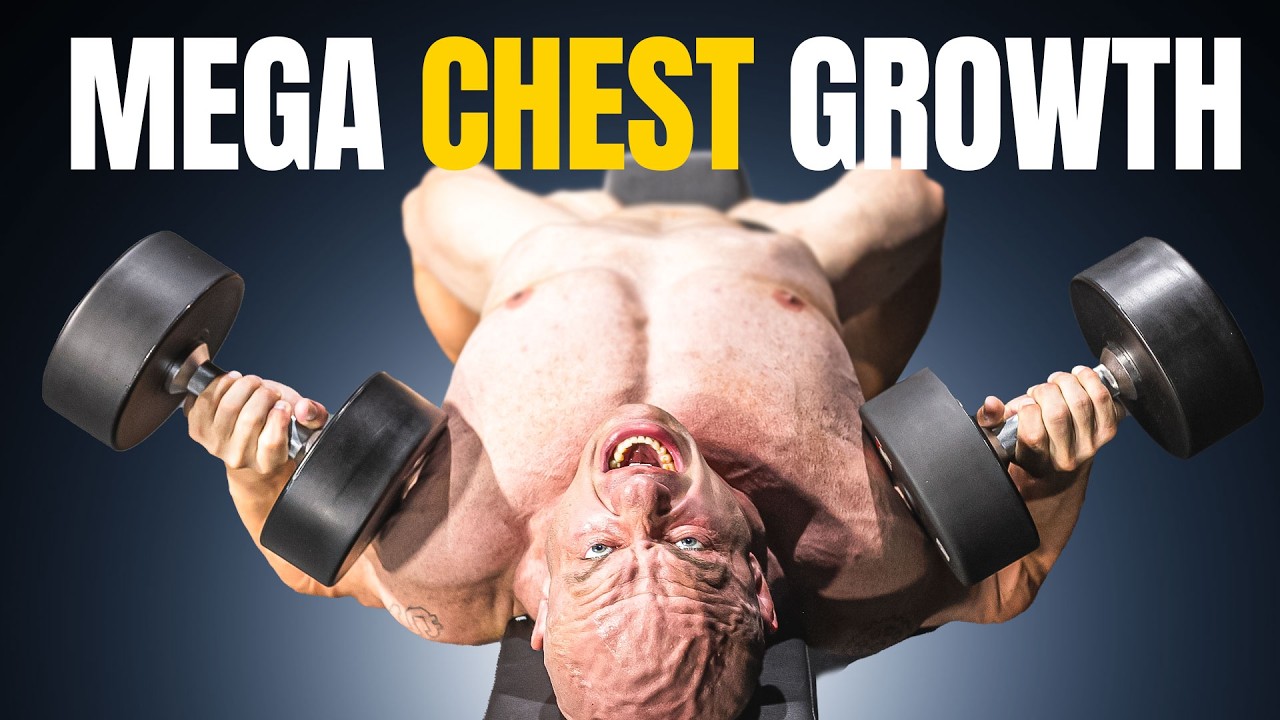
Since I did the work on the back, now I'm going to do the work on the front. I'm going for the tit, and I love the dumbbell press, a nice chest exercise , great, it works the anterior shoulder too. Detail here: if I do it with dumbbells, the fact that I don't have to work on a vector of friction with the bar means that I have less triceps work.
In other words, if I do bench presses with a barbell I have more work on my triceps. If I do it with dumbbells, my triceps work less. As I want to optimize my time, it seems to make more sense to go for the barbell bench press.
But are you tired of me saying here on the channel that barbell bench presses are. . .
We go bench presses on the machine. In the bench press on the machine, we have the same quality that I'm bringing, this same positive point of triceps work due to friction work, a vector of friction, on the machine bar, as the bench press but I don't have the negative points of the bench press. To do the technique cool and elegant so you don't get hurt is an ass.
I prefer to stay on the safe side of the bridge and avoid this shoulder-injuring exercise. And there's one more thing: I'm here at Ironberg, and here at Ironberg there are a lot of cool bench press machines , I find one that is convergent, and this convergent machine has a very high quality, above the barbell bench press, which is exactly the fact that it shortens my muscles more and lengthens my muscles more. It's much better than the barbell bench press.
As I haven't done anything to my chest yet, it's a good idea to do at least one warm-up series. The muscle will start to work, warm up and work. Go work another one, warm up and work.
Now, I'm going to the series, same thing. 50%, 60% of maximum load, until close to failure, increase the gear, and in the last series you go to failure. At this moment, I look at the clock and I'm approaching the 20th minute of training.
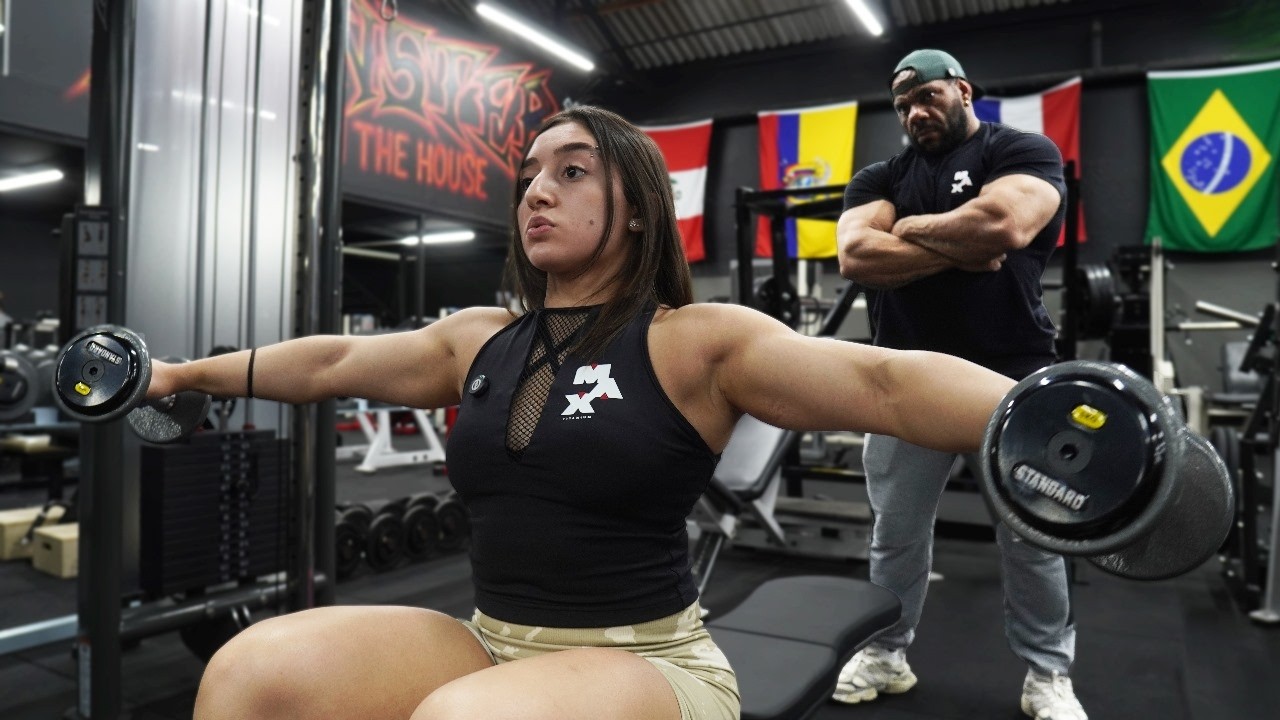
I run to the dumbbell rack, grab an 8kg weight, and start doing lateral raises like a bird, and then I'll do 3 sets of lateral raises. Same thing, I increase the load, naturally the number of repetitions decreases. But here, there's a great thing that I'm going to teach you the secret to.
Let's do the first series, warm up, second series, which is the first of the training, 60% of the load, 70%, 80% of the load and then I did 3 series. And as lateral elevation is an exercise that is less tiring, I will allow a little less rest. 40 seconds is fine, relaxed.
This will save me a little time to do another series. When I look at the clock, I have 23 minutes. I go back to the 8kg dumbbell, and there, I extract as many repetitions as I can.
At this point, I'm going to do about 30 repetitions, my shoulder will be throbbing, and even after that, I'm going to go to the 5kg weight, and I'm going to do at least 20 repetitions, and at that moment, my entire body will be trained, of course, in 25 minutes. But if you want a specific, quick back workout, it's here, and you'll have a back workout that Go to work right away, with the same grip as this one, - quickly, and how long does training last, Rani? - It's too little.
- Is fast. Click here. - Is fast.
. .