all right so for the next section I'm going to talk about living primates uh for this I'm mainly going to focus on the the major groups of uh of current living primates uh the thing that you should know or take away from this uh is being able to identify um major clayes so what is a caterine what is a platon what is a strep oron what is a Haine um Mak sense as I go through this um so obviously we can't talk about every species there's more than 220 species of primates around the world we
just can't talk about all them so we're going to talk about the major groupings and uh on the slide here I have some examples in the top left I have there's a ring to lemur moving right from that uh you've got tarer slow luses actually slender lorises excuse me um and west Lan gorilla that's in coce was a gorilla at the North Carolina Zoo when I was doing research with the chimpanzees there um bottom left is a given a mandril if you've ever seen Lion King and you thought Rafiki was a baboon you have lived
your life being wrong Rafiki is a mandril um they're not super duper close to related to baboons um they're more Clos related to another kind of monkey called a drill um baboons are Savannah monkeys mandrills are Forest monkeys and then around me is uh these are chimpanzees uh the one with the bean in her mouth is eie and the one who's being stood on is Nori the two chimpanzees North Carolina Zoo so this is the primate family tree um you can see on the left hand side are the strep serines strep serin are the wet
noosed FR Meats uh these are lemurs like your ringtail lemur um lorises like the uh the Slender L on the previous page um and also gagon which you might know as bush babies um those are the three major groups of strep serine primates and then you have the Hines and that's everybody else that's the Tarsiers all the monkeys both the Central and South American monkeys as well as the African and uh Asian monkeys uh and then apes and humans so we are a haon we fall into the haon group so strep serons uh Strep Surin
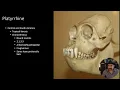
are the wet noosed primates uh they have a rhinarium that's is the wet nose um they have a postorbital bar so remember from the earlier slide when we talked about primate traits they have a postorbital bar so they have a bar behind their eyes here but um they don't have orbital closure and so to give you an example right so this is a human skull right notice that inside the eyes there's bone this is the postorbital bar but inside the eye where there's bone that is um not found in strep Orin so lemurs have open
eye orbit but they do have a post orbital bar so that I don't have a lemur skull let to give you an example this is a Havalina skull so they don't have a postorbital bar but see how their eye there's no bone in the back of their eye that's how lemurs are so they do they have a bar lemurs have a bar but they don't have orbital collusion um strep serines have a dental comb you can see that in the picture on the bottom left um this is what it sounds like it is a grooming
uh Implement uh on the lower in sizers um that the Lemur use to groom themselves they basically rake it through their hair to remove debris and then they have a grooming claw I don't think I have a picture of a oh I do haha um it's a lemur skull at the top but you can see in the bottom right right above right next to my head um this claw so lemurs have nails on all of their fingers except for one on that they have a claw and it's used for Grooving um so use it to
clean themselves both pick through their fur but also to clean their butts and stuff too so those those are kind of the major characteristics of the strep serons so if you want to identify strep seron go back really quickly let me it won't so to identify stre look for the postorbital bar without postorbital closure so if you see a post orbital bar with no postorbital closure it's a street if you're sure it's a primate look for those heterodon teeth for Tarsiers um Tarsiers or tarsa forms they they kind of some of their traits are similar
to strep serines uh and some of their traits are more similar to the Haines um Tarsiers are more Clos related to us than they are to lemur um but they're strange primate they have really large eyes they're nocturnal and uh they're the only fully carnivorous primat so all primates are mostly herbivorous U many primates are omnivorous um but uh Tarsiers are fully carnivors uh and then the other Big Branch within the Haines are anthropoids anthropoids have large complex brains they tend to be more sexually dimorphic although it's not always the case um they have enclosed
eye orbits so they have the bone in the backs of their eyes so do tars seers but they don't have full closure of their eye orbits so the postorbital bar and most of their uh eye orbits are enclosed with bone but it's not totally enclosed like ours is within the anthropoids they're two infraorders these are just two major classifications within the anthropoids the plates those are the new world monkeys so like your capin Hower monkeys spider monkeys and the catons these are going to be the African and Asian monkeys Apes the African Asian apes and
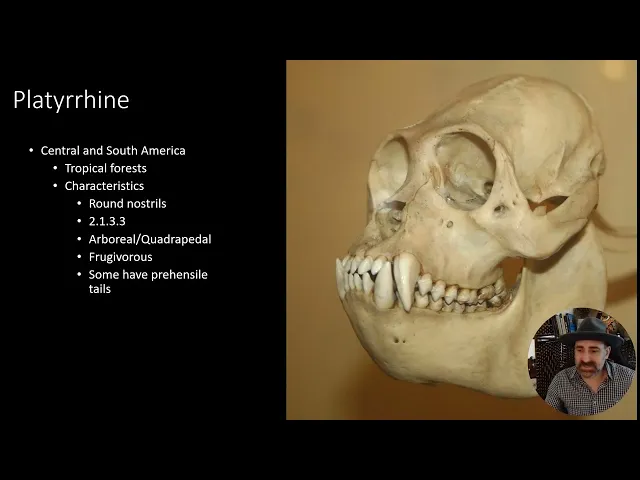
humans um so this could be cat could be baboons gorillas um maacs Etc so in the platons um I'm blocking part of the thing I'm sorry I can't move my camera here um so in terms of the plat Rines in the pictures here we've got in the top that's a um an emperor tamaron uh the black with the white mustache um a Hower monkey that's showing the prehensile tail so if you see a monkey with a prehensile tail a tail that can be used as a fifth limb to grab onto stuff it is a plat
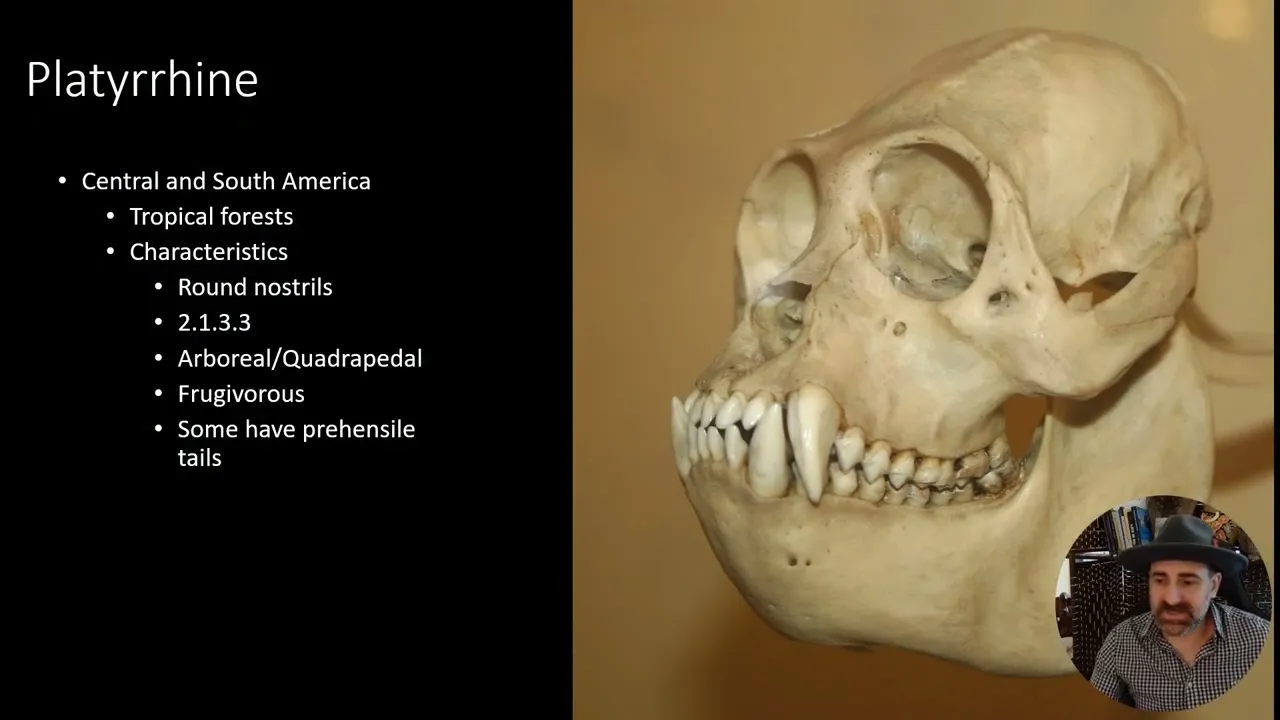
um all plat Rines Live in Central and South America um and then the bottom left is a squirrel monkey um all plat Rines live in tropical forest they all are are boreal they all live in trees they're mostly frug gous it means they primarily eat fruit however there are folivorous ones like Hower monkeys eat lots and lots of leaves leaves um they have rounded nostrils that face outward that's kind of a major characteristic of plines you can see it really clearly in the uh the emperor Tamarind here some have pre insil tails and then when
you're looking at teeth um if you remember back to one of the other videos from this lesson they have two in sizers one K9 three premolar and three molers so that's different from us so we are a catarine and catarin are 2 one two three so if you look here we've got one two incizors 1 K9 wrong way 1 K9 oops one two premolars and one two three molers so we are 2 one 2 three other direction three I'm backwards I'm mirrored in the video so we're 2123 plates are 2133 so if you are shown
a skull of a primate and you want to know if it's a platon or a caterine is Count teeth uh if they have three premolar then they're plat um you can see that really clearly here in this Hower monkey skull so if we count the teeth you can see let me get my drawer out you can see there's one two incizors one Kine one 2 three premolars and one 2 three moles so 2 1 3 3 catons um are African and Asian monkeys uh and African and Asian apes and humans and our ancestors the hominins
which we'll talk about later um whereas plates are all arboreal and they all live in tropical rainforest as catarin are much more VAR um in the top left that's Nori chimpanze in the middle that is Reese's macac and then the bottom that's a mandr um they have wide range of habitats they have wide range of diet um one of the things that is kind of characteristic of catarin is that they have narrow nostrils that either face straight forward or down so you can see in the MAA here they have narrow nostrils and they're pointing down
same with the chimpanzees although the chimpanzees prism makes it c um just like us unless you've had your wisdom teeth removed uh caterin are 2 one two three so two incizors one canine two premolar three M so instead of three premolars like you see with the plates they have two premolar and then many of them have isal coloi this is simply a pad on their butts that they sit on um so if you ever look at a chimpanze not when they're really swollen if you look at a like a primates rare end and it's really
swollen that's a female who's an estris so she's at a reproductive period and that is a social signal to say like hey I can get pregnant right now or it's more likely for me to get pregnant it right now um but when they don't have the big swelling you can kind of see the pads on their butts that is called an isal colos you don't see that in platons you do see that in many catons not all catarin humans don't have it um because we have butts so we have pattern back there to sit on
the issue kocity is basically to protect their rear ends while they're sitting down so this is a baboon I'm kind of in the way so I'll count the top teeth um um so you can see here one two enzers one K9 one two prolar 1 2 three moles 2 1 2 3 uh and then finally just to talk a little bit about different kinds of Locomotion um in terms of arboreal Locomotion you have brachiation this is a gibbon brachiating so it's like swinging from monkey bars um so Gibbons brachiate uh orangutans brachiate um they often
do free hanging brachiation like this although they are brachiators uh they also fist walk on the ground a vertical uh climb and leap so this is a Shaak lemur um you can see that uh she is holding on to the trunk of tree and turning and jumping to the trunk of another tree so this is how they move through the landscape tarer move in a similar way to this as well uh and then uh not all lemurs do so chaats move this way injuries move this way um but most lemurs walk on all fours in
the trees and then our Boral quadrupedal Locomotion this is walking just on hands and feet holding onto the branches as they're moving through the trees uh this is a longtail MAAC uh fit and then terrestrial Locomotion so arboreal means uh the in the trees terrestrial means on the ground um so this is a gelada baboom um who is demonstrating uh or by terrestrial quadrupedal Locomotion so walking on the flats of their hands and feet on the ground there's another kind of quadrupedal locomotion and that is knuckle walking so this is walking on these Knuckles here
on the ground gorillas chimpanzees and bonobos do that orangutans do not knuckle walk orangutans fist walk so orangutans don't come down to the ground very much in the wild and when they do they just kind of put their fists down and how however they hit the ground is good enough um whereas gorillas and chimpanzees have special adaptations in their wrists and their hands um to walk on their Knuckles and then finally uh bipedalism so humans are obligate bipeds obligate like obligated we have to walk on two legs um Gibbons like this uh white-handed Gibbon in
the video here is uh also showing that Gibbons are bipedal when they're on the ground so when Gibbons are in the trees they're brachiating but when they're on the ground they walk bipedally so they hold their arms up and they walk upright onto legs other um primates can walk bipedally so chimpanzees can walk on two legs but it's less common um only humans are obligate bipeds and then Gibbons do walk bipedally when they're on the ground but they're not often on the ground all right so that this is uh the end of just kind of
introducing the major groups next I'll talk a little bit about primate behavior and how to study