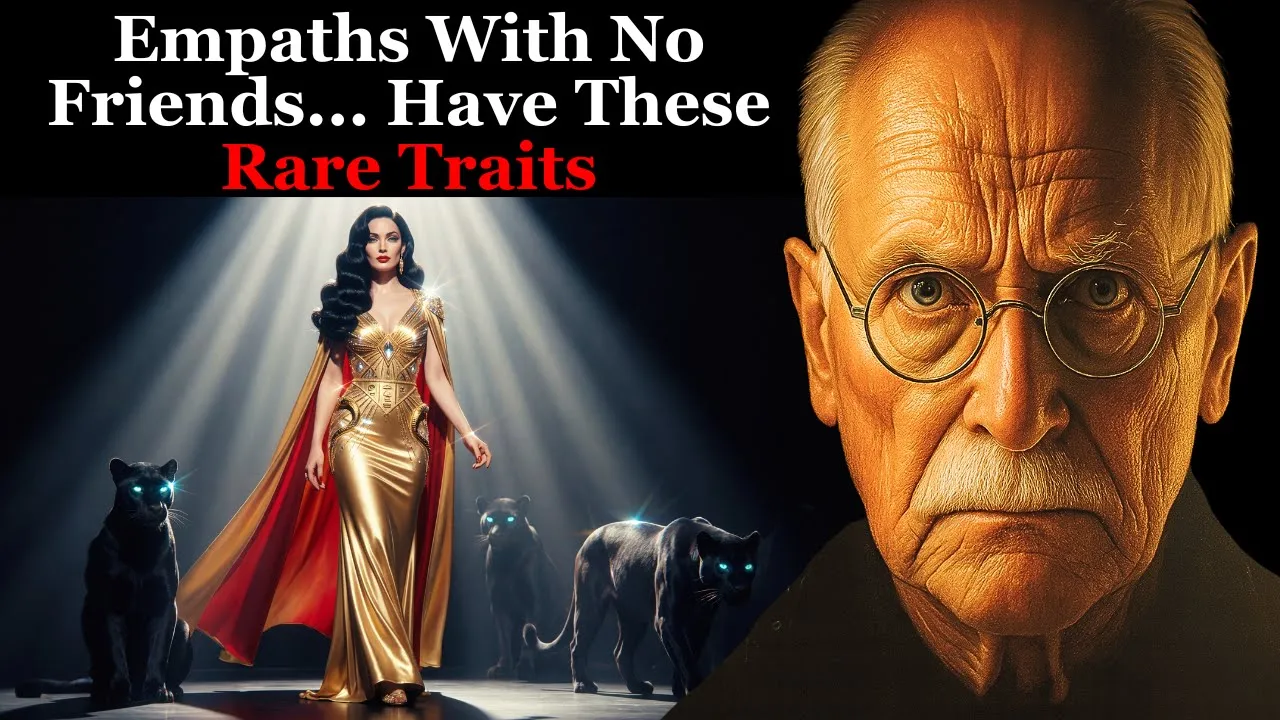
Have you ever wondered why some empaths walk through life with almost no friends? You might think they are broken, socially awkward, maybe even failures at connecting with people. But Carl Jung discovered something that turns this entire assumption upside down.
Empaths with few or no friends are not failing at socializing. They are succeeding at something far more rare and powerful. Jung called it psychological filtration.
And today I am going to reveal the specific traits these individuals possess. Traits that unconsciously repel fake people and terrify those hiding their true selves. If you have always felt like something is wrong with you because friendships never stick, everything you thought you knew is about to change.
Before we dive into the traits, we need to confront the dark side of being a friendless empath. Because let's be honest, it is not peaceful. It is lonely.
[music] It is confusing. And most of the time, you feel like something is wrong with you. Society has conditioned you to believe that having many friends equals success.
That being popular means you are doing life right. But here is the truth Yung uncovered through his clinical observations. The reason you have no friends is not because you are unlikable.
It is because your mere presence forces others to confront their own lies. That discomfort they feel around you. That is not your fault.
That is their shadow rising to the surface and they cannot handle it. So they leave. They ghost you.
They slowly fade away and you are left wondering what you did wrong. But you did nothing wrong. You simply exist at a frequency most people cannot tolerate.
Your energy operates like a truth serum. And most people are not ready for that level of honesty. Let me illustrate this with a narrative example that captures the psychological pattern Jung observed repeatedly.
Consider a composite case profile based on the patterns he documented. Picture an individual who could walk into any room and immediately sense the emotional temperature. She could feel who was pretending, who was hurting, [music] who was hiding something.
This was not a mystical ability. It was pattern recognition happening at a speed most people never develop. When colleagues would complain about their partners, she could see the whole dynamic playing out.
Not because she was judging them, but because the patterns were obvious to her. And when she would gently point out what she was observing, people would get defensive. They would accuse her of being negative or reading too much into things.
But 6 months later, everything she sensed would come to light. The affairs, the resentments, the lies people were telling themselves. And instead of thanking her for seeing clearly, people would avoid her because nobody wants to be around someone who can see through their carefully constructed illusions.
The first trait Yung identified in Friendless Empaths is what he called the shadow mirror effect. Let me explain this in simple terms. Everyone carries a shadow.
That dark bag of traits we drag behind us. The parts of ourselves we refuse to look at. Jealousy, greed, insecurity, rage, selfishness, cruelty.
Most people shove these things down and pretend they do not exist. They wear masks to hide them. They perform a version of themselves that feels safe and acceptable.
But empaths you see right through the mask. You do not even try to. It just happens automatically.
Your brain is wired to pick up on in congruence. When someone talks to you, they feel like you can see every lie they have ever told themselves. And you know what?
You probably can. You pick up on their micro expressions, the tension in their voice, the way their energy shifts when they talk about certain topics, the tiny pause before they answer a question, the forced enthusiasm when they talk about things they claim to love, you are not judging them. You are just observing, processing data.
But to them, it feels like judgment. Because when you look at someone and see their shadow, they see it too. They catch a glimpse of themselves in your eyes and it terrifies them.
And most people cannot handle that level of self-awareness. They would rather be around someone who lets them keep pretending. Someone who plays along with the illusion, someone who nods and smiles and never questions the performance.
That person is not you. And that is why they cannot be your friend. Being around you requires them to be real.
And most people have forgotten how to do that. The second trait is what Jung called the intimacy threshold. Most people bond over surface level things.
The weather, sports, gossip about people they barely know. Celebrity drama, small talk that goes absolutely nowhere. It is comfortable.
It is safe. It requires nothing from them emotionally or intellectually. But you, you cannot do that.
You physically cannot engage in shallow conversation without feeling like you are dying inside. When someone asks how you are, you want to tell them the truth. You want to talk about the existential dread you felt this morning or the deep realization you had about human nature or the patterns you are noticing in the world around you.
But they do not want that. They want you to say fine and move on. They want the script, the performance, the socially acceptable response that keeps everything light and easy.
So you try, you force yourself to be light and breezy. [music] You talk about the weather and pretend to care about things that bore you to tears. But it feels like wearing a costume that does not fit, like speaking a language you barely understand.
And people sense that. They sense that you are operating on a different level, a deeper level. And it scares them because depth requires vulnerability.
It requires them to take off their mask and show you who they really are. And 90% of people would rather keep the mask on. Empaths aren't broken.
They're alchemists in progress. The Alchemist's Path gives you drills, young-based boundaries, and three exclusive chapter videos to turn overwhelm into clarity by Surreal Mind. 236 page downloadable ebook in stock.
Begin now at the surrealmind. com. They would rather stay comfortable in the shallows where nothing is ever truly felt or examined.
So they stay there and you are left standing alone in the deep end wondering why no one will join you wondering why everyone seems content to float on the surface when there is so much richness waiting below. The third trait is the lie detector vibration. This one is brutal because you did not ask for it but you cannot turn it off.
You can feel inauthenticity like a physical sensation coursing through your nervous system. When someone is lying to themselves, you feel it in your body. It makes your skin crawl.
It makes your chest tighten. It makes you want to leave the room immediately. You are not trying to detect lies.
You are not playing detective or looking for reasons to judge people. But your nervous system picks up on the dissonance between what people say and what they truly feel, between their words and their energy, between the story they are telling and the truth they are living. And once you feel it, you cannot unfeill it.
You cannot unknow what you know. This eliminates most social circles because let's be real, most people lie to themselves constantly. They stay in jobs they hate and say they are building a career.
They stay in relationships that drain them and call it commitment. They abandon their dreams and call it being realistic. They betray themselves every single day and pretend it is fine.
And you you cannot be around that energy. It is too heavy, too suffocating, too dissonant. Your system rejects it the same way your body rejects spoiled food.
So you pull away. You create [music] distance. You stop accepting invitations.
And people think you are being difficult or judgmental or antisocial. But you are not. You are just protecting your energy from the weight of everyone else's selfdeception.
You are refusing to participate in the collective delusion that everything is fine when clearly it is not. The fourth trait Yung identified is psychological hermeticism. This is the concept of necessary withdrawal.
The intentional stepping back from the noise of the world. Society tells you that isolation is bad. That if you are alone, something must be wrong with you.
That healthy people are always surrounded by others. But Yung said the opposite. He said that for certain individuals, for empaths specifically, solitude is not a symptom of dysfunction.
It is a requirement for individuation. Individuation is just a fancy word for becoming who you really are beneath all the layers of conditioning. And you cannot do that in a crowd.
You cannot do that while constantly absorbing everyone else's emotions and expectations and projections. You need space. You need silence.
You need time alone to process the overwhelming amount of information your brain takes in every single day. This is not antisocial behavior. This is self-preservation.
This is you honoring your need to recharge and recalibrate. Jung called it an incubation period. A time when you withdraw from the noise of the world so you can hear your own voice.
So you can integrate all the parts of yourself that society told you to hide. So you can separate what is yours from what you have absorbed from others. And when you emerge from that incubation, you are not the same.
You are stronger, more whole, more aligned with your true self, more clear about who you are and what you will no longer tolerate. But society does not understand that. They pathize your solitude.
They call you depressed. They call you [music] weird. They tell you to get out more, make more friends, be more social, go to more parties.
But Jung understood. He knew that your isolation is not a prison. It is a fortress, a sacred space where you are building something powerful.
Where you are becoming someone who cannot be shaken by the opinions of others. Now let's talk about the controversy because society has very strong opinions about people like you. If you have few friends, they assume you are the problem.
They assume you are difficult, antisocial, maybe even mentally ill. There must be something wrong with you if you cannot maintain friendships like normal people. But Yung challenged that assumption completely.
He said that more friends does not equal a better life. In fact, for empaths, having too many friends can be a sign that you are betraying yourself, that you are dimming your light to make others comfortable, that you are playing small so you do not threaten anyone, that you are sacrificing your authenticity on the altar of social acceptance. And here is the uncomfortable truth that nobody wants to talk about.
Most friendships are not based on genuine connection. They are based on convenience, proximity, shared superficial interests. People call each other friends because they work together or live near each other or went to the same school.
But are they really friends? Do they actually know each other? Do they see each other?
Or are they just two people wearing masks, pretending to connect while staying safely on the surface, never risking the vulnerability that real friendship requires? You cannot do that. Your system rejects it.
You would rather be alone than fake a connection. And that is not a flaw. That is a feature.
That is your integrity showing up. That is your soul refusing to settle for less than what it truly needs. So here is where everything shifts.
The moment the empath realizes their solitude is not a prison but a fortress. You have not lost friends. You have simply stopped settling for energy vampires.
You have stopped forcing connections that do not feed your soul. You have stopped pretending to be someone you are not just to avoid being alone. And that is terrifying at first because loneliness is painful because humans are wired for connection.
Because being alone triggers every abandonment wound you have ever carried. But there is a difference between loneliness and solitude. Loneliness is when you abandon yourself to be with others.
When you betray your truth to fit in. When you silence your voice to keep the peace. Solitude is when you come home to yourself.
When you choose your own company over bad company. When you honor your need for depth, even if it means standing alone. And once you learn to be at peace in your own company, something incredible happens.
You stop needing people to validate your existence. You stop seeking approval from those who cannot even approve of themselves. You stop waiting for someone to save you from the discomfort of being human.
And in that space, you become sovereign. You become someone who can stand alone without falling apart. Someone who can be surrounded by people without losing themselves.
Someone who can offer love and connection without depleting their own reserves. This is the shift Yung was talking about. From lonely to sovereign, from desperate for the many to patiently waiting for the few.
And that brings us to the final resolution. How do you integrate this? How do you move from feeling broken because you have no friends to feeling empowered by your selectivity?
First, you have to stop seeing your friendlessness as a failure. It is not. It is a boundary, a very necessary boundary that your soul has put in place to protect you from people who would drain you, dim you, or destroy you.
Your lack of friends is not evidence that you are unlovable. It is evidence that you have standards, that you refuse to settle, that you value quality over quantity. Second, you have to understand that you are not looking for the many, you are looking for the few.
The rare ones who can match your depth. The ones who do not flinch when you remove your mask. The ones who see your intensity and say, "Yes, more of that.
Show me everything. " Those people exist. But they are rare.
And you will never find them if you are wasting your energy on shallow connections that go nowhere. If you are filling your life with people who keep you on the surface, you will never dive deep enough to find the ones who live where you live. Third, you have to practice being comfortable in your own energy.
Spend time alone. Get to know yourself. Learn what you actually think and feel when you are not absorbing everyone else's opinions.
Build a relationship with your own soul because the quality of your relationship with yourself determines the quality of every other relationship in your life. And finally, you have to trust the process. Trust that your isolation is temporary.
Trust that the right people will find you when you stop chasing the wrong ones. Trust that your sensitivity is not a curse. It is a gift that will eventually lead you to the connections you have been craving your whole life.
Let me be clear about something. You are not antisocial. You are selectively social.
You are not broken. You are awake. You are not failing at relationships.
You are refusing to participate in fake ones and that takes courage. It takes strength to stand alone when the whole world is telling you to blend in. It takes wisdom to walk away from connections that do not serve you, even when you are desperate for companionship.
And it takes faith to believe that better is coming, even when you have been waiting for a long time. But here is what Yung knew. Here is what he spent his entire life trying to tell people through his work on individuation and the development of the self.
The ones who walk alone are not lost. They are finding themselves. And once you find yourself, once you truly know who you are beneath all the conditioning and expectations, you become a magnet for the right people.
Not the convenient people, not the people who tolerate you, but the people who celebrate you, the people who see your depth and want to dive in with you, the people who match your energy instead of draining it. You are the keeper of the deep. You are the one who sees what others miss.
You are the one who feels what others avoid. You are the one who refuses to pretend when everyone else is performing. And that is not a burden.
That is a superpower. But like any superpower, it comes with responsibility. The responsibility to protect your energy.
The responsibility to honor your need for solitude. The responsibility to stop apologizing for being too much for people who are not enough for you. Jung believed that empaths like you are essential to the evolution of human consciousness.
You are the ones who can see through the lies. The ones who can feel the truth beneath the surface. The ones who can hold space for depth in a world that worships the shallow.
But you cannot do that if you are drowning in toxic friendships. You cannot do that if you are constantly trying to fit in with people who do not get you. You have to be willing to stand alone, to trust that your isolation is not permanent, to believe that the right connections are worth waiting for.
So if you are someone who has few or no friends, I want you to hear this. You are not alone in your aloneeness. There are others like you.
Others who crave depth. Others who cannot do small talk. Others who would rather have one real connection than a hundred fake ones.
And those people are looking for you too. But they will never find you if you are hiding behind a mask pretending to be someone you are not. So take the mask off.
Be yourself. Be unapologetically deep. Be selectively social.
Be okay with walking alone until you find your people because they are out there. And when you meet them, you will know. You will feel it in your bones.
That sense of finally being seen. finally being understood. Finally being home.
Your friendlessness is not a life sentence. It is a filtration system. And the people who make it through that filter, they are worth their weight in gold.
So stop chasing quantity. Start honoring quality. Stop feeling broken.
Start feeling powerful. Stop apologizing for your intensity. Start owning it because you are not too much.
You have just been around people who are not enough. And once you accept that, once you truly integrate that truth into your being, everything changes. You stop seeking validation from those who cannot give it.
You stop dimming your light to make others comfortable. You stop settling for crumbs when you deserve the whole feast. And in that space of self-acceptance, of self-love, of self- sovereignty, you become the most magnetic version of yourself.
The version that attracts the right people effortlessly. The version that no longer needs friends to feel whole. The version that can offer genuine connection because you are no longer desperate [music] for it.
This is what Yung meant when he talked about the journey of becoming whole. Becoming who you really are. Not who your parents wanted you to be.
Not who society expects you to be, but who your soul came here to be. And for empaths, that journey often requires walking alone for a while. It requires saying no to connections that do not serve you.
It requires trusting that solitude is sacred, not sad. It requires believing that the few are better than the many. And it requires patience because the right people are not always easy to find.
But when you do find them, when you finally connect with someone who sees you, really sees you, it makes every lonely moment worth it. It makes every rejected friendship make sense. It makes you grateful that you did not settle, that you waited, that you trusted the process even when it hurt.
So here is my message to you. [music] If you are ready to stop feeling guilty about your friendlessness, if you are ready to own your need for depth, if you are ready to accept that you are not broken but beautifully selective, then embrace it. Embrace your solitude.
Embrace your intensity. [music] Embrace your inability to tolerate fake connections because that is not a weakness. That is your strength.
That is your filter. That is your protection. And the people who make it through that filter will be the most important people in your life.
So do not rush the process. Do not force connections that do not fit. Do not apologize for needing what you need.
Just trust. Trust that your path is different. Trust that your journey is valid.
Trust that your friendlessness is temporary. And trust that the connections you are meant to have are already on their way to you. You just have to be patient enough to wait for them, strong enough to stand alone until they arrive, and wise enough to recognize them when they do.
You are the keeper of the deep. And if this message resonates with you, if you finally feel seen and understood, then like this video and subscribe because we are creating a community of people who refuse to settle. People who value depth over superficiality.
People who would rather walk alone than compromise their truth. And that community needs you. So join us.
Share your story in the comments. Let us know which of these traits you recognize in yourself because you are not alone. You are part of a rare and powerful group of people who are changing the world simply by refusing to play the game.
And that is something worth celebrating. In the Alchemist's Path, perception training for empaths, you'll turn overwhelm into wisdom with practical drills, yung inspired boundaries, and step-by-step perception training. This guide includes three exclusive chapter videos to deepen each lesson written by Surreal Mind.
236 pages beautifully designed 8 1/2 by 11 downloadable ebook in stock now. Start your training today. Feel deeply while thinking clearly.
Get the Alchemist's path at the surrealmind. com.