Welcome to my channel, Bookish English. Do you think education ends when school ends? What if I told you that real learning begins after school?
Today, we'll explore why education is not just for students or young people. It's for life. And I think you'll be surprised how much learning you're already doing without even knowing it.
Stay with me. I promise this will change how you see learning forever. Chapter one.
What is education? Really, when people hear the word education, they usually think about school. They imagine teachers, blackboards, exams, and certificates.
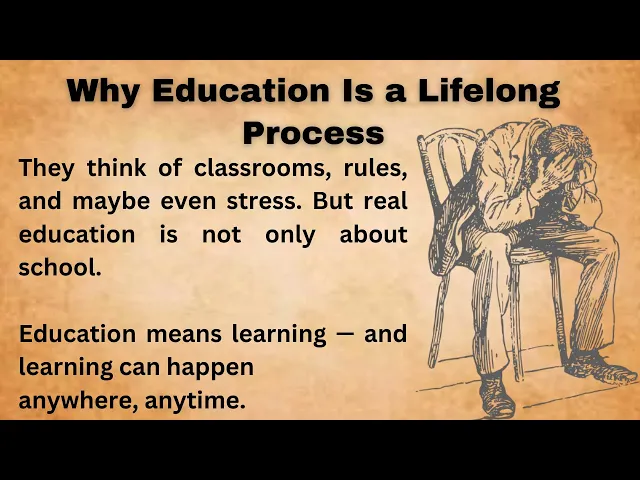
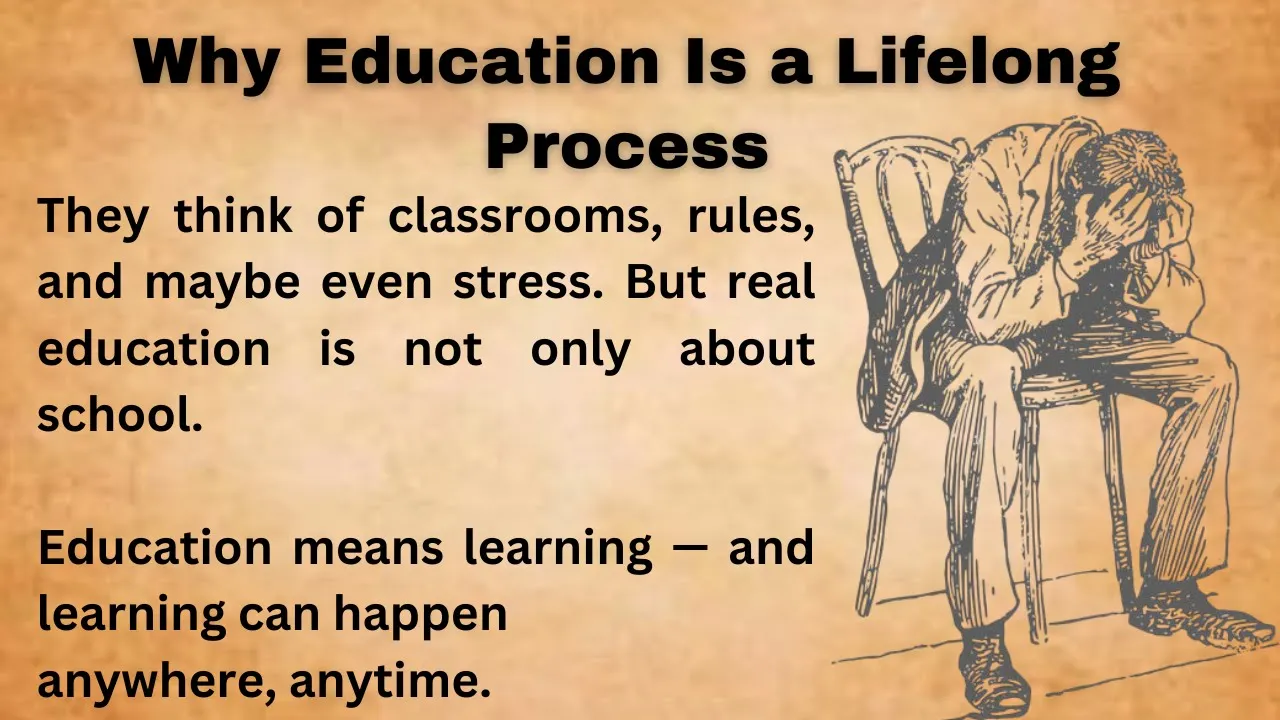
They think of classrooms, rules, and maybe even stress. But real education is not only about school. Education means learning.
And learning can happen anywhere, anytime. You are learning right now just by watching this video. You are learning when you try something new.
When you make a mistake and try again. When you ask a question, when you read a book, when you talk to someone who knows more than you. All of that is learning.
All of that is education. But many people don't believe that. They say, "I'm not in school anymore.
I'm not a student. " Or, "I didn't go to university, so I'm not educated. That's not true.
You don't need a classroom to be a learner. You don't need a certificate to be smart. You just need curiosity.
You need to be open to learning something new. Let me give you an example. I once had a student named Rosa.
She was 62 years old. She never finished high school and she worked in a small shop for many years. One day she decided to join my English class.
She told me, "I feel nervous. I'm too old to learn. " But week by week, she started to grow.
She learned to write short messages in English. She listened to podcasts. She watched simple English videos.
She asked questions. She made mistakes. And she kept going.
After one year, Rosa told me something I will never forget. She said, "I used to think school was only for young people. Now I know education is for everyone, even me.
" That's the idea I want to share with you today. Education is not only something we do when we are young. It's something we do all our lives.
When you help your child with homework, you are learning. When you follow a cooking video online, you are learning. When you read a story in English, you are learning.
Even when you listen to the news and think carefully about what you hear, that is learning, too. And here's something even more important. Learning doesn't have to be hard.
Many of us had a bad experience with school. Maybe the teacher shouted. Maybe the lessons were boring.
Maybe you didn't feel smart enough. I understand. But learning outside of school can be different.
It can be fun. It can be interesting. It can feel natural.
For example, I learned how to cook Indian food by watching YouTube videos. I didn't take a class. I didn't read a textbook.
I just watched, copied, made mistakes, and tried again. Now I can make a great chicken curry. That's education, too.
So, next time you learn a new word in English, remember that's education. When you fix something in your house and understand how it works, that's education. When you read this sentence and understand what it means, that's education.
You are not just watching a video. You are growing. In this video series, we will explore this big idea together.
That education is not just for school. It's for work, for home, for your mind, and for your happiness. You'll see that you are already learning more than you think.
And the best part, you don't have to do it perfectly. You just have to keep going. This is just the beginning.
In the next chapter, we'll talk about why learning doesn't stop when school ends and why for many people that's when the real learning starts. So stay with me. You're already on the path of lifelong learning.
Chapter 2. Why learning doesn't end with school. When we finish school, many of us feel two things.
A little proud and a little tired. We say, "Finally, no more homework, no more exams, no more school. " And that's true.
You may never have to sit in a classroom again, but that doesn't mean you stop learning. School gives us something important, the basics. We learn to read and write.
We learn to count and think. We learn how to listen and follow instructions. These are important skills, but they are just the beginning.
The world outside of school is big and it's changing all the time. Think about it. When you were a child, how many people had smartphones?
How many people used the internet every day? How many jobs needed computer skills? Maybe not many.
But now everything is different. Most jobs today ask for more than just reading and writing. They ask for new skills like using email, joining video calls, understanding apps, speaking English or solving new problems quickly.
So if the world keeps changing, we must keep learning. It's like this. School gave you the tools.
Now you have to build something with them. Let me tell you a story. I once taught a man named Ahmed.
He worked as a taxi driver for many years. He didn't need English before. But then one day he told me, "More tourists are coming.
They ask questions. They want to talk. I feel shy.
" So at the age of 45, he joined an English class. He was nervous at first, but every week he learned a few new words. He started to speak slowly.
One year later, he could have short conversations with tourists. He told me now I feel more confident and I get more tips. That's real life learning.
And it's not just young people who do it. I met a woman named Marita. She was 72.
She had never used a computer, but her grandchildren lived far away, and she wanted to learn how to use video calls. So, she took a free class at the library. She learned to open a laptop, send an email, and talk on Zoom.
Now, she speaks to her grandchildren every weekend. She says, "It's like magic. I never thought I could do this.
Learning doesn't end with school. For many people, it starts again later in life. And this time, it feels more exciting, more useful, and more personal.
Maybe you want to learn English or how to cook or how to fix your car. Maybe you want to learn how to start a small business or how to use a new app. These things aren't taught in school, but you can still learn them.
You can learn from books, videos, podcasts, or people around you. You can learn by trying, failing, and trying again. And the best part, you don't have to be young to learn.
You just have to be willing. Some people think, "I'm too old. My brain is slow.
I can't learn new things. But that's not true. Science tells us that the brain keeps learning if we keep using it.
It's like a muscle. The more you use it, the stronger it gets. So, if you're watching this and thinking, "I want to grow, but I'm not in school anymore.
" I have good news for you. You don't need a classroom to grow. You just need curiosity.
You just need to start. Think of education like walking. You don't stop walking when you leave the house.
You walk to new places. You discover new things. In the same way, you don't stop learning when you leave school.
You keep going. And every step teaches you something. In the next chapter, we'll look inside your brain, not with science words, but with simple ideas, and I'll show you why your brain is ready to learn at any age.
You don't need to be a genius. You just need to keep moving. So stay with me.
Your journey of learning is just beginning. Chapter 3. The brain likes to learn at any age.
Have you ever heard someone say, "I'm too old to learn. " Maybe you've said it yourself. Many people believe that only young people can learn fast.
They think the brain gets slow when we get older. But guess what? That's not true.
The brain is not a machine that breaks down with age. It's more like a muscle. And just like muscles in the body, if we use the brain, it stays strong.
If we don't use it, if we stop learning, it becomes weak. But here's the good news. The brain can learn at any age.
Yes, any age. Scientists have a word for this. They call it neuroplasticity.
But don't worry, you don't need to remember that word. You only need to remember this. Your brain can change and grow when you learn something new, no matter how old you are.
Let me show you what I mean with a story. Last year, I read about a man named Mr Watanab in Japan. He was 92 years old.
For his birthday, his grandson gave him a tablet, a small computer like an iPad. At first, Mr Watanabe didn't even know how to turn it on. He had never touched a computer in his life.
But his grandson showed him step by step, one button at a time, one tap at a time. And something amazing happened. Mr Watonab started watching cooking videos.
Then he started learning English words from a simple app. After two months, he was using video calls to talk to his family. At 92, he said, "I didn't know I could still learn.
I thought learning was finished for me, but now every day feels exciting again. That story makes me smile every time I tell it. " Why?
Because it shows the truth. Your brain doesn't care how old you are. It just wants to be used.
And it's not only about big things like learning a language or using the internet. Even small things can help your brain grow, learning a new recipe, trying a new game, listening to a podcast, taking a new way to work, talking to someone with a different opinion. These things may feel simple, but to your brain they are like exercise.
When you learn, your brain builds new connections. It becomes faster, sharper, and even healthier. Studies show that people who keep learning as they get older have better memories, and feel more confident.
Some even say they feel younger because their minds stay active and curious. You might be thinking, "But I forget things easily now. " That's okay.
Forgetting is part of learning. When we were children, we forgot a lot, too. But we didn't stop.
We just kept trying. Adults often expect to learn things fast, but slow learning is still learning. If you need to hear a word five times before you remember it, that's okay.
You're still moving forward. So, don't say, "I'm too old. " Instead, say, "I'm just getting started.
" In fact, older learners sometimes learn better than younger ones. They have more experience. They know how to focus.
They often have strong motivation. A young student may learn because they have to. An older learner learns because they want to.
That makes a big difference. And remember, you don't have to do this alone. You can ask for help.
You can find videos, books, podcasts. Many are made just for beginners like you. And the more you learn, the easier it becomes.
Just like walking gets easier the more you do it, learning also becomes more natural with practice. So here's my message to you. Your brain wants to learn.
Your brain likes to learn. And it doesn't matter if you're 9, 29, or 92. It's never too late to start.
In the next chapter, we'll talk about something very real. How mistakes are not bad. In fact, they are a good sign that you are learning.
I'll tell you why making mistakes is not failure. It's part of the process. And I'll share how to become a fearless learner.
Stay with me. The best is still coming. Chapter 4.
Education in the real world. When we hear the word education, most people think of classrooms. We think of students sitting in rows writing in notebooks.
We think of tests, grades, and certificates. But education is much bigger than school. Education is not just something that happens between four walls.
It happens everywhere. in your kitchen, in your car, on your phone, in the market, at work, at home. Real education is learning, and learning happens in real life.
Let me show you what I mean. Last year, I met a young mechanic named Fisizel. He didn't finish school, but he was very good with machines.
One day, a customer brought in a new type of car with a smart system. It had a problem, but Fisel didn't know how to fix it. So, he searched online.
He watched videos. He asked questions on a car repair forum. After a few days of learning and trying, he fixed the problem.
The customer was very happy. Fisizel said to me, "I felt proud. I didn't go to school for this, but I learned.
That's education, right? Yes, it is. Then there's Mina.
She's a mother of two. Her daughter was struggling in school, not with reading or writing, but with understanding how to focus. So, Mina started reading simple articles about children and learning.
She watched short videos by teachers. She learned how to ask her daughter better questions, how to make homework feel easier, and how to stay calm during stress. After a few weeks, her daughter started to enjoy learning again.
Mina didn't get a diploma, but she learned something valuable, and that made a difference in her daughter's life. That is education. or take my friend Arjun.
One day his best friend called him and said, "I feel really down. I don't know what's wrong. " Arjun didn't know what to say.
So after the call, he started reading about mental health. He watched short interviews with psychologists. He learned some simple things.
how to listen better, how to be patient, how to ask questions without judging. The next time they spoke, his friend felt heard. Arjun told me, "I didn't become a doctor, but I think I helped.
" That too is education. Education is not only books. It's not only degrees.
It's life. It's when you cook a new dish by watching a video. It's when you ask your child how school was and really listen.
It's when you teach your grandmother how to use a smartphone. It's when you read instructions, try something new, and learn from it, even if it goes wrong. In fact, most of the important things we learn in life don't come from school.
We learn how to be kind, how to work in a team, how to make decisions, how to handle problems. These are not written in textbooks, but we learn them every day by watching, doing, asking, failing, and trying again. Some people say, "But I never went to university.
" That's okay. You are still learning. Some of the smartest people I know never went to university, but they are always curious.
They always ask questions. They always want to grow. That's the real secret.
Education is not a place. It's a mindset. It's the decision to say, "I want to understand this.
" And then take the next step. So, if you're learning how to use a computer, if you're reading articles, if you're trying to understand your family better, if you're watching this video to improve your English, guess what? You are educating yourself.
And that's something to feel proud of. In the next chapter, we'll look at how learning gives you power. power to make better choices, power to grow in your job, and power to feel more confident in yourself.
So, keep going. Your education is happening right now. Chapter 5, how lifelong learning helps your job and career.
Let's talk about work today. No matter what job you do, driving a car, working in a shop, cooking in a kitchen, or using a computer, one thing is clear. Learning doesn't stop when you start working.
In fact, to do your job better, to earn more money, or to get a better job, you have to keep learning. But don't worry, I don't mean going back to school full-time. I mean, simple, small learning, reading a new rule at work, watching a video about safety, asking someone how to use a new machine, even learning a few new words in English can help a lot.
Let me show you how this works. I met a taxi driver in Delhi named Romesh. He didn't speak much English, but many tourists visit the city and they often used apps like Uber.
One day, Romesh picked up a couple from the UK. They asked him questions, but he couldn't answer. He felt embarrassed.
So, he made a decision. Every evening after work, he opened a simple English app, just 10 minutes a day. After 3 months, he could say basic things like, "Good morning, where would you like to go?
And do you need help? " The tourists smiled and they gave him better ratings. He started getting more trips.
That small bit of learning helped his work. That's what lifelong learning looks like. Then there's Asha.
She works in a factory. Her job is to pack products, but recently her company started using new machines. At first, she was scared.
The buttons were confusing. But instead of giving up, she stayed after her shift and asked a younger worker to show her how it works. She wrote down the steps in her notebook and practiced.
After a few days, she became confident. Her manager noticed. After a month, she was promoted to team leader.
Again, that's lifelong learning. And I have a student named Tar. He was good at using a phone, but didn't know how to use a computer.
He wanted to earn some money while studying, so he started watching videos about video editing. He practiced every day. He made short videos for his friends.
And soon people started asking, "Can you edit this for me? " Now he's doing small freelance projects online and earning extra money. All because he kept learning.
Whether you are 18 or 58, every skill you learn can help your work. It doesn't matter if it's big or small. Reading better can help you understand forms.
Writing better can help you apply for jobs. Speaking better can help you in interviews. Using technology can help you get more done.
And it's not just about making money. When you learn new skills, you feel stronger. You feel more confident.
You don't have to wait for someone else to help you. You can help yourself. Many people feel stuck in their jobs.
They say, "I do the same thing every day. Nothing changes. " But change is possible.
It starts with learning something new, one step at a time. Maybe you're thinking, "But my job is simple. I don't need to learn.
" But the truth is, every job today is changing. Even cleaning staff are now using new tools. Shop workers use machines and apps.
Drvers follow GPS. Office workers use email. If you want to grow in your job, you must grow your skills.
And here's the good news. The internet is full of free ways to learn. You can watch short videos, join online classes, listen to podcasts, read guides, or ask a friend.
You don't have to sit in a classroom. You can learn from your phone, from your home, from your own life. So, next time you feel bored or stuck at work, ask yourself, "What's one new thing I can learn that might help me tomorrow?
" That question can open doors. Because when you keep learning, you keep moving forward. And when you move forward, more opportunities will come to you.
In the next chapter, we'll talk about how learning new things doesn't just help your work. It helps your brain, your happiness, and your life. So, don't stop here.
Keep watching and let's keep learning together. Chapter 6. Learning new skills brings joy and confidence.
Sometimes life can feel boring. Every day looks the same. Wake up, go to work, come home, eat, sleep.
Some people feel like nothing will change. They say I'm too old or I don't have time or I'm not smart enough. But here's the truth.
When you learn something new, even something small, it can bring your life back to life. Learning gives us energy. It gives us confidence.
It brings joy. Let me tell you about Suman. She was 50 years old when I met her.
Her children were grown up, her job was simple, and her days felt empty. One day, her son bought a new phone and gave her the old one. It had a good camera.
She started taking photos of her plants, her street, the evening sky. Then she learned how to edit the pictures using free apps. Then she opened a small Instagram page to share them.
At first, it was just a fun hobby, but slowly people started liking her photos. Someone asked, "Can you take pictures for my birthday? " Another person said, "Your flower photos are so beautiful.
Can I buy a print? " Now, she takes photos part-time and earns a little money, but more than that, she's happy. She said to me, "At this age, I never thought I would feel excited about something again.
" That's what learning can do. It doesn't have to be something big. Even learning how to cook a new dish can make you feel proud or learning how to use a new phone or learning how to speak a few words in a new language.
Each time you learn something new, your brain says, "Wow, I can do this. " and you feel good, you feel strong. I had another student named Omar.
He worked in a small shop. His life was busy, but he always loved music. He never played an instrument before.
But during lockdown, he bought a used guitar and started watching videos. He practiced every evening. He said it helped him relax and feel happy.
After 6 months, he played a song for his family. They clapped and smiled. He said, "I didn't know I had this inside me.
" You see, learning is not only for work or school. Sometimes we learn just for fun. And that fun gives us new energy.
We start to feel like ourselves again, like we are growing, like we are not stuck. When we feel proud of what we've learned, our confidence grows. We stand taller.
We speak more clearly. We try new things without fear. That's why learning a new skill, big or small, can change your whole mood.
It's not just about knowledge. It's about how you feel inside. And you don't need to spend a lot of money.
You can learn from books, from free videos, from neighbors, from your children. Even watching this video is part of your learning. And every minute you spend learning is an investment in yourself.
So if you ever feel bored or tired or unimportant, try learning something, anything. Try a new recipe. Try writing a small poem.
Try fixing something in your home. Try learning five new English words. Each small step adds joy.
And when others see you learning, they feel inspired too. Your children, your friends, your family, they will think, "Maybe I can do that, too. " So here's my message to you today.
You are never too old to learn. You are never too busy to learn. And you are never too late to feel proud of yourself again.
In the next chapter, we'll look at how technology makes learning easier than ever before, even for people who never touched a computer before. So stay with me. The journey continues.
Chapter 7. Learning from mistakes is education too. Let me ask you something simple.
Have you ever made a mistake? Of course you have. We all have.
And here's something important. Mistakes are not bad. In fact, mistakes are a part of education.
Maybe they are the best teachers we have. Many people are afraid to make mistakes. They say, "What if I say the wrong word?
" Or, "What if people laugh at me? " So, they stay quiet. They stop trying.
But when we stop trying, we stop learning. Think about babies. When they learn to walk, they fall down.
Not once, not twice, maybe 100 times. But do they give up? Number.
They fall, they get up, they try again, and one day they walk. Learning a language, learning a skill, learning anything in life is just like that. Let me tell you a funny story.
I had a student named Laya. She was learning English and wanted to talk about food. She loved chicken, but she always said kitchen instead of chicken.
One day in class, I asked, "What do you eat for dinner? " she said with a big smile. I eat fried kitchen.
Everyone laughed, including Laya. She was embarrassed for a second, but then she started laughing, too. And you know what?
After that day, she never made that mistake again. She remembered it forever. Why?
Because she made a mistake and learned from it. That's how learning works. When we make a mistake, we usually feel something, surprise, laughter, even frustration.
And that feeling helps us remember better. If we only do things we already know, we don't grow. But when we try something new and fail a little, we grow more.
In my own life, I've made many mistakes while learning new languages. Once I mixed up the word for bread and arm in Spanish. I walked into a bakery and asked for two strong arms instead of two loaves of bread.
The man behind the counter looked confused. Then we both laughed. I never forgot that word again.
Making mistakes is not a sign of weakness. It is a sign of learning. Think about cooking.
The first time you try a new recipe, it might be too salty or too dry, but the next time it gets better. That's learning. Think about driving.
No one drives perfectly the first time. But after a few mistakes, you become confident. That's education.
And the best part, you don't need a classroom or a test. Life gives you the lessons. You just have to stay open.
So next time you try something and it doesn't go right, don't stop. Smile, learn from it, and try again. That's what smart learners do.
That's what lifelong learners do. And when someone else makes a mistake, be kind. Help them.
Laugh with them, not at them. We're all on the same journey. So, if you're afraid of saying something wrong in English, don't be.
Say it anyway. If you're scared to try something new, try it anyway. You might make a mistake.
That's okay. Mistakes are not the end. They are the beginning of learning.
In the next chapter, we'll explore how learning with others, your family, your friends, even online, makes the journey easier and more fun. So, don't go anywhere. Chapter 8.
reading, listening, watching, learning everywhere. Let me tell you something that surprises many of my students. You don't need a classroom to learn.
You don't need to sit in front of a teacher or buy expensive books or go to a school building. Of course, those things can help, but they're not the only way. In fact, learning is all around us every day, everywhere.
If you read a short story in English, you're learning. If you watch a YouTube video with English subtitles, you're learning. If you listen to a podcast while you clean your kitchen, you're learning.
If you talk to a friend and try to use a new word, that's learning, too. Some people think I'm not learning anything. I'm just watching videos.
But if your brain is trying to understand something new, even a little bit, that's learning. You're feeding your brain, just like food feeds your body. I'll tell you about Ronnie, a student of mine.
She never finished school. She felt shy in English class and said she was too slow, but she liked cooking videos. So, I gave her an idea.
Watch cooking shows in English. They're simple and you can see what they're doing. She started watching one video every evening.
She didn't understand every word, but she started picking up useful words. chop, mix, stir, heat. And soon she was not only cooking better, she was speaking better, too.
She didn't sit in a classroom, she sat in her kitchen, but she was learning every day. I also have a podcast called Englishspoken Stories. It's made for learners like you.
Every week I read a short story slowly with clear pronunciation. You can listen in your car, on your walk, or while making dinner. Many listeners say it feels like I'm learning without trying.
That's the best kind of learning when it feels easy and fun. Maybe you prefer reading. You don't need big hard books.
Start with short stories. Fairy tales are great. Simple language and fun to read.
You already know some of the stories so it's easier to follow. You can also find websites where you can read free easy English or download free books made for learners. Even simple conversations are education.
If you speak English with your child, your neighbor, or someone online, that's practice. That's learning. Learning is not only for exams.
It's for life. When you read a sign in English and understand it, that's success. When you watch a movie and understand three new words, that's progress.
It doesn't have to be perfect. It just has to continue. One of my favorite sayings is this.
Do a little, but do it every day. That's how real learning happens. Small steps every day.
5 minutes of reading, 10 minutes of listening, watching a video, talking to a friend. All of it adds up. Slowly, your English or any skill will grow.
Some people say, "But I'm too busy. " I understand we all have jobs, families, responsibilities, but we all have small moments. Waiting for a bus, cooking dinner, folding clothes.
You can learn in those moments, turn on a podcast, read one page, watch a short video. The classroom is not the only place to learn. The world is your classroom.
The internet is your library and your curiosity is the most powerful teacher of all. In the next chapter, I'll talk about how learning with others, your family, your friends, your community makes the process even easier and more fun. So stay with me.
We're almost there. Chapter nine. How to stay a learner all your life.
Let's talk about how to keep learning every single day. I know what you're thinking. I don't have time for big classes or long lessons.
But guess what? You don't need big time or big effort. All you need is small daily habits.
Just a little bit of learning every day can change your life. I want to teach you something called microlearning. It's exactly what it sounds like, small bite-sized pieces of learning.
Instead of spending hours trying to learn a whole language or a new skill, you focus on small, manageable steps. It's easy, it's fun, and best of all, it fits into any busy schedule. Here's how to start.
One, read for 10 minutes every day. Pick up a book, an article, or even a short story. Just read for 10 minutes.
Maybe it's a fun English story. Maybe it's a blog that interests you. The key is to make reading a daily habit.
You don't need to read for hours. Just 10 minutes a day adds up over time. Imagine how many books or articles you could read in a year.
That's a lot of new knowledge. Write a short diary entry. This one is simple, but it works.
Write about your day, your thoughts, or something you learned. You don't have to write much, just a sentence or two. This helps you practice your writing skills, but more importantly, it gets you thinking and reflecting.
And trust me, when you write about something new, you remember it better. Three, learn one new word every day. Pick one word to learn.
It could be a word you heard in a podcast, a word from a book, or just a word you think is cool. Write it down. Use it in a sentence.
Say it out loud. Learning one new word a day might seem small, but in a month, that's 30 new words. In a year, that's 365.
The magic is in the consistency. You don't need hours of time. You just need a little bit of time every day.
It's the same idea as exercise. A short walk every day is better than running a marathon once a month. Small actions every day lead to big results over time.
Let me give you a challenge. Try something new today. It doesn't have to be huge.
Try listening to a podcast in English, read a new article, or speak to someone in English for 5 minutes. Whatever it is, try something new and then share it in the comments below. Tell me what new thing you learned today.
I want to hear about it. If you do this challenge, you're not just learning today. You're building the habit of learning every day.
And once you start that habit, it becomes part of who you are. You're a lifelong learner. That's the key to staying sharp, curious, and open to new possibilities.
So remember this, learning isn't something that happens in a classroom or only when you're in school. Learning is a lifelong journey. Every day is an opportunity to learn something new.
Whether it's reading a page, learning a word, or writing a sentence, it all counts. In the next chapter, I'll talk about how to make learning a fun social activity. You don't have to do it alone, so stay tuned.
We've still got more to explore together. Chapter 10. You are already learning.
Keep going. I want you to take a moment and think about this. If you're watching this video right now, you're already learning.
You've taken the first step by being here, by being open to new ideas, and by believing in the power of education. That's huge. And it tells me something important.
You already care about growth and you already know that learning is a lifelong journey. So, what's next? Keep going.
Learning doesn't stop just because this video ends. In fact, this is just the beginning. Now that you've got the mindset, keep exploring what makes you happy, what sparks your curiosity, what makes you feel excited to learn more.
That's where you should focus your energy. Whether it's reading books, learning a new skill, or discovering something that lights you up, that's where the magic happens. I want you to remember this.
You don't have to be perfect. You don't have to know everything. You don't have to be the best at anything.
The key is just to keep growing. Every step you take, no matter how small, adds up. Every new word you learn, every book you read, every skill you pick up, they all make you better.
They all make you stronger. And don't forget to share this gift of learning with others. Whether it's teaching someone else what you've learned, helping a friend solve a problem, or just talking about something new you discovered, you become part of a community of lifelong learners.
You inspire others to keep going, too. So, as we wrap up, I'll leave you with this simple message. Learning isn't a destination.
It's a journey. There's no end to it. There's always something new to explore, something new to experience, and a new way to grow.
So, I challenge you. Keep learning, keep growing, keep going, and remember, the best is yet to come. Thank you for joining me on this journey.
I believe in you and I'm excited to see where your learning will take you next. If you enjoyed this video, I'd love it if you subscribe to the channel. It helps more learners like you find this kind of content and tell me in the comments what's one thing you've learned recently or one thing you want to learn next.