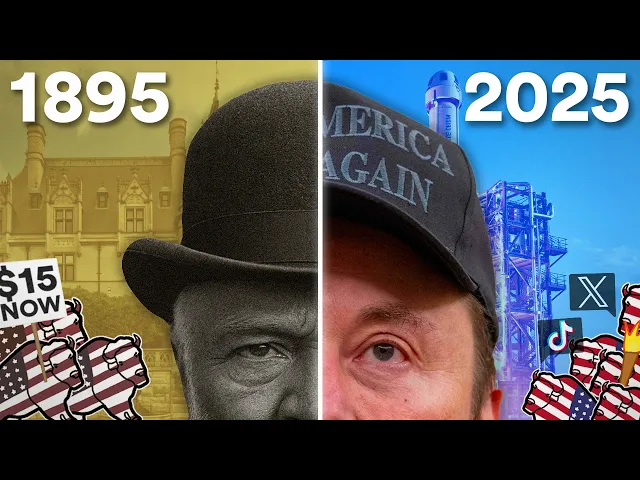
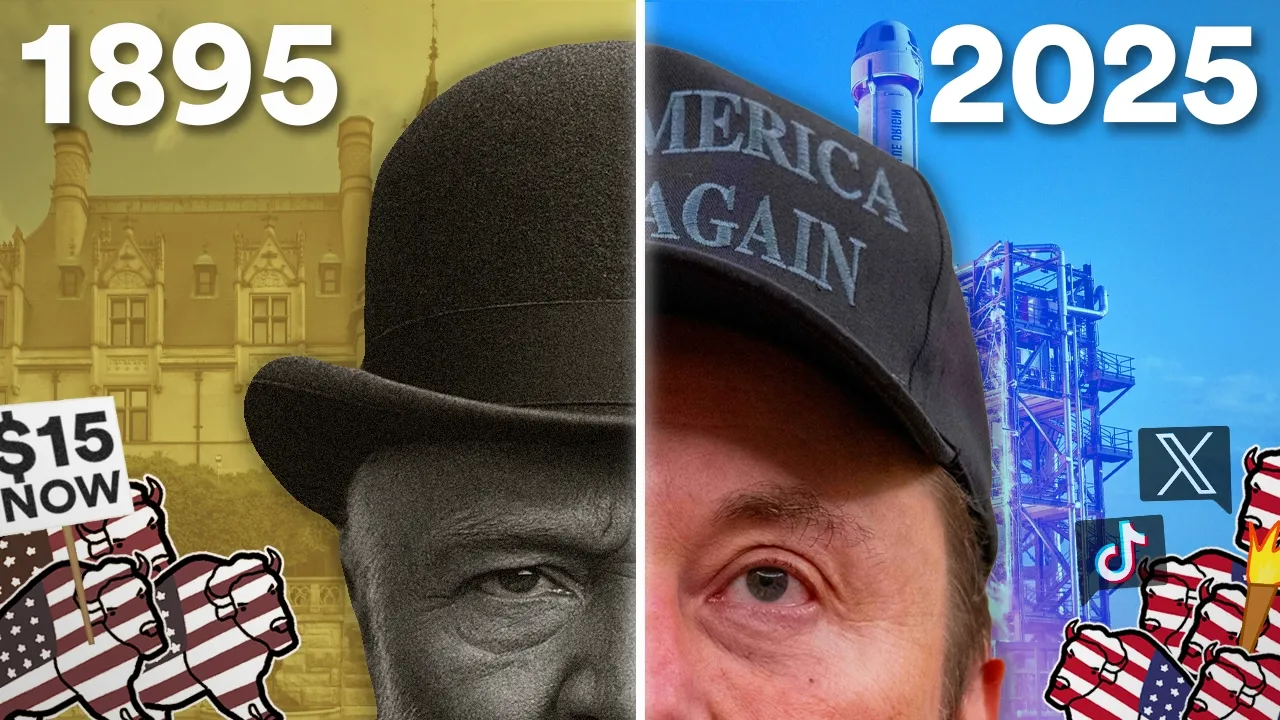
The people want to know, is America in a second gilded age? This term was used by Mark Twain in his novel, The Gilded Age, to make fun of the post civil war era in America. Get it?
Like a golden age, but it's only covered in a sheet of gold. On the surface, this period between the 1860s and 1900 looked great with rapid industrialization, urbanization, and the spread of new technologies. But it was also a time when inequality was reaching a breaking point where a new class of tycoons who got rich off of new technologies threatened ordinary people's livelihoods and American democracy itself.
And if you're a certified comparer, you may notice some similarities to modern-day America, a period of technological revolution, the breakdown of government, and the flaunting of wealth. I want to warn the country of some things that give me great concern. So, and that's a dangerous concentration of power in the hands of a very few ultra-wealthy people.
Today, an oligarchy is taking shape in America of extreme wealth, power, and influence that literally threatens our entire democracy, our basic rights, and freedoms, and a fair shot for everyone to get ahead. At Donald Trump's second inauguration, sitting behind him was Elon Musk, Jeff Bezos, Sundar Pachai, and Mark Zuckerberg. Each a representative from America's largest tech companies.
Also there were Tim Cook, Shai Chu, Bernard Arno, and a crowd worth a total of $1. 3 trillion. Elon Musk, the world's richest human, is attempting to fix what he sees as a corrupt and dysfunctional government using his Department of Government efficiency.
But others see it as an ideological purge for his own gain. Mark Zuckerberg announced he was getting rid of Facebook's fact-checking while wearing around a million dollars on his wrist. And Sam Altman, Open AI CEO has talked about the total rethinking of the social contract with the use of AI.
But I do think like the whole structure of society itself will, you know, be up for some degree of debate and reconfiguration. These guys have power. What's more, the Trump administration has announced half a trillion dollars for those large AI companies to build more data centers.
Billionaires are launching themselves into space. Elections are getting more and more expensive to become multibillion dollar bets. Crippling tariffs have been announced for American consumers and businesses, but not for Apple to pay.
And the number of billionaires in America has risen by more than a factor of 10 since 1990. It's all a little robber baron-esque, reminiscent of a time when incredibly wealthy industrialists would use their money to influence a government that would not stand up to them. And this graph shows that America may have possibly returned to that inequality.
The share of income the highest percent of Americans earned was roughly 20% of the total at the end of the Gilded Age. It dipped down to a low of around 10% in the 70s, but has risen back up to 20% at the start of our age. The top 10% of earners show a similar story, and while losing much of their share during World War II, have actually risen to a higher level than the early 20th century.
This trend is not isolated to America, but it is definitely more pronounced here than the rest of the world since America has been the hub of technological innovation for the last half century. Of course, though, a higher average income with the same level of inequality means the average person is better off. And it's true the average American was much worse off in the guilded age than in our time.
Back then, the average salary was around $380 a year, the equivalent of around 12,000 now, whereas the BLS estimates the median salary is around 58,000 in 2025. That's almost five times a gilded age salary. What they have in common though is a period of wage share decline where the amount of economic output going to someone earning a wage declined both in the 1870s and the 2010s.
Still, it can be hard to compare these periods because the guilded age could be seen as the start of modern American growth. As Brad Dong has put it, an American boy living in the 1850s would have more in common with a boy from the year 1 than from 1900. The same would surely not be true of a boy from the 1950s versus the 2000s, who both would have grown up with the modern school system, sports leagues, cars, and televisions.
During the Civil War, the northern states had to support an army of 2 million soldiers. that involved organizing the production of manufactured goods in a way to efficiently defeat the Confederates. The best way to do this was to get everyone together in factories.
This shift away from rural life was one of the biggest changes in the American character in the history of the country. People moved from the countryside to the city. New immigrants came and when they did landed in cities.
The population doubled between 1870 and 1900 and America became an industrial powerhouse with this new urban population. The hubs of American civilization, New York, Chicago, Pittsburgh and so on were built on new technologies, steel, oil, rail, and electricity. For context, in 1860 the US had produced 13,000 tons of steel.
But by 1900 that number was 11. 2 2 million tons. So in this effort to build up the country, the Union government had supported industrialists like with the 1862 Pacific Railroad Act where for every mile of rail laid, a company would receive 6,400 acres of federal land and between 16 and $48,000 in loans.
Of course, the best people suited to lay these rails were already rich magnets like Thomas A. Scott and Leland Stanford. government support had enriched them even further.
Yet none compared to the big four. John D. Rockefeller in the oil refining business, Andrew Carnegie in steel, Cornelius Vanderbilt in shipping and railing, and JP Morgan in finance.
All of these men came to dominate the respective industries, mainly through the strategic purchasing of their competitors, monopolizing their industries. Morgan was a little different by seeing where new monopolies could be made and financing them like he did when he merged 10 steel companies together to make US steel which included Carnegie Steel and Edison and Thompson Houston Electric together to make General Electric. And because the railroads were also monopolized, rail bosses could set different rates for different products and people.
Essentially, large industrialists who moved things in bulk. That's efficient. That's cheap.
And they got a discount. But small farmers had to pay the full price. The robber barons, as they were called, used these shady deals, profitering, and union busting with private and state militias to become the richest men in the country.
Some would then flaunt their wealth, throwing grand parties, hosting art collections, and living in these massive homes. The Builtmore estate, the Vanderbilt's family home, is still America's largest private house, looking more like a European aristocrats than a normal Americans. Remember, the average American lived on a wage we would classify as being in extreme poverty today.
The difference between the workers and the millionaires who revolutionized high-tech had never been larger up to this point. It's important to note that many industrialists believed what they were doing was morally right. That Americans would not reap the benefits of cheap steel or electricity unless someone were to monopolize the industry and provide it to them.
If they got fabulously rich along the way, that's a sign of success for the American economy. John D, a devout Baptist, summed up his stance directly, saying, "Competition is a sin. " Andrew Carnegie wrote out his thoughts in his gospel of wealth where he argued the rich had a moral obligation to donate their wealth and advocated for a strong inheritance tax.
But he also wrote that the rich deserve this wealth because they more than the poor and lazy know where it's best spent. Throughout his life, Carnegie would give away around 90% of his wealth, creating over 2500 libraries as well as hospitals, universities, and parks. According to Forbes, that number for Zuck is 5% of his wealth and for Elon Musk, it's 1%.
Many robber barons believed that private philanthropy, not government, would be the best way to help the poor. This is quite reminiscent of Sam Bankman Freed's effective altruism. He was a young billionaire getting rich off of a new technology who often talked about the need for himself to personally make billions so that he could give it away in the way he saw most fit.
Uh how that story ended is not important. What is is the reemergence of this robber baron type philosophy today. Peter Teal, who's made billions from PayPal and other tech investments, believes individuals should have more power than nations and that tech nation states should be created with a national CEO in charge.
And of course, probably the most watched human at any given time, Jimmy Donaldson has made a career through extravagant private philanthropy and the flaunting of wealth. Of his 10 most popular videos, four are explicitly about showcasing expensive objects and five others involve giving away some life-changing amount of money. And look at these views.
You can draw your own conclusions, but it's clear people like to watch these. For the average Joe, factories in the guilded age were certainly not what we glammed them up to be today. They were crammed, wages were low, and working conditions were awful.
Labor movements became a popular counterbalance to this new industrialist influence. Robberons used intimidation and violence to suppress many of these movements, though. This includes the Homestead Strike where an armed battle broke out killing nine workers and seven private militia guards, the Cole strike, the Great Railroad Strike broken up by the National Guard, and the Pullman strike where workers in Chicago shut down the rail hub of the country.
By 1894, with how many American workers grew to rely on rail, this strike was controversial to say the least, as it effectively shut down the entire nation's economy. President Cleveland, fearing the growth of more unrest, sent federal troops to the city and others where the strike had spread, leading to boycots of Pullman cars, the imposition of martial law, and the deaths of 70 people. Although companies like Amazon and Tesla have come under fire for their labor violations, the biggest strikes of our age have caused no deaths.
So, I don't think it's fair to say there's as much tension between the worker and the boss as there was in the guilded age, unless some company protesters strike suddenly turn bloody. Still, if you think writing software and managing products is lamer than building railroad networks and new cities, you're not alone. Instead of moving from farms to factories, the modern trend has been moving from factories and services to services and digital services.
America has de-industrialized. One of the biggest similarities between the two periods and likely how they both end has been the rise of populist movements. But because of these different environments, they grew to be fairly different.
For instance, populists now may want to install trade barriers, but in the guilded age, that was the stance of big business who supported Republicans like William McKinley because of his high tariff policies. Another was the issue of money. Because of America's new productive capacity in this time and the fixed money supply being tied to the amount of gold in the nation, the guilded age was a time of great deflation.
Prices fell an average of 2 to 3% per year in the 1870s. While this sounds great, the bulk of Americans were still farmers dependent on the price of crops to live. These farmers often had to take out debt to run their farms as well, and the devalued currency made it harder and harder to pay it off as time went on.
In fact, the most common time for guilded age America to have a financial panic was in fall, harvest season, when most farmers would default on their debt. Many farmers would support movements promising an expansion of the money supply by removing the gold standard or adding silver to the mix. The Grangers, greenbacks, populists or progressives.
America flip-fpped between these systems. In 1873, the silver standard was abandoned. But in 1890, Congress authorized dollars to be backed by it again, which was again reversed by President Cleveland.
The gold reserves of the nation had nearly hald in the 3 years since the Sherman silver purchase prompting many to take money out from the banks on mass. This panic of 1893 was the defining depression of the guilded age caused in large part because of these monetary swings. This led to more populism, economic pain, and tension than there already had been.
The 1896 election, the first after the depression, had been won on a gold standard platform with large support in the industrial northeast and from corporate powers, capturing the strains between the two halves of America. There are some today who want to see a return to the gold standard, though that's becoming more and more outlandish. Increasingly, it's cryptocurrency taking on this fixed money supply role.
Outside of America, there have even been some governments who have embraced cryptocurrencies in their national developments. This popularity, especially among a certain subsection of the population, is not a backlash against falling crop prices, but a backlash against this time's economic woe, inflation. Ever since the late60s, America has seen a quite dramatic rise in prices, at least compared to the relatively stable prices it saw before.
Although the Federal Reserve has done a quite good job at keeping inflation near the 2% target for most of the 21st century, that only includes consumer price inflation. The Federal Reserve has not targeted asset inflation. The average stock return is a little over 10%.
And though that's not much different than what it has been for the past century, it's much higher than prices have risen. Much of the pain though is in housing inflation, which has quite dramatically outpaced regular prices. Housing is a consumer good to be lived in and used, but is treated as if it were an asset.
Housing speculation, investment in already built properties, and the growth of the real estate industry has been one of the defining characteristics of this time in America's economic history. In fact, it's this inflation which caused the defining financial panic of modern America as special investment tools were abused so that the average American could more easily afford a mortgage. a sign of both how unaffordable houses have gotten and in the end the government support for wealthy financeers.
If asset inflation outpaces price and wage inflation, it's basic economic sense that inequality will grow. You could argue that the artificially low interest rates the Federal Reserve targeted after the Great Recession was the main policy to help the new robber barons. By buying US debt from investors, the Federal Reserve would lower the supply of US bonds on the market, making them more valuable.
A more valuable bond can be given a lower interest rate to pay back. And from 2008 to 2016, it was held around 0. 25%.
the lowest ever interest rate in American history. Entire industries were built off of this free money period, like those in Silicon Valley and shale production, which had incredibly high upfront costs, but were not profitable without cheap debt. And of course, this cheap money aided the fortunes of those whose companies thrived in this environment, like Harold Ham, Jeff Bezos, and Elon Musk.
Although the government did not explicitly support these men like they might have with land grants in the 1800s, when Fed Chair Ben Bernani even suggested dialing back their purchases, the bond market freaked out and the Fed backed down. Investors had bet too much on these new industries, and the Federal Reserve could not abandon their support of them, at least not without an excuse. Today's American populist movement seems more likely to embrace isolationism.
Canada's been very bad to us on trade. But now Canada is going to have to start paying up animosity towards people they don't like. We will root out the communists, Marxists, fascists, and the radical left thugs that live like vermin within the confines of our country and the culture of being anti- elite.
Ladies and gentlemen, the universities do not pursue knowledge and truth. They pursue deceit and lies. And it's time to be honest about that fact.
Then the old movement which built new institutions that addressed ordinary Americans' issues. The Federal Reserve which cooled panics and the need for wealthy financeers to bail out American banks. The Interstate Commerce Commission to get rid of railroad price discrimination.
The Federal Trade Commission to enforce antitrust law. and the professionalization of the American university. When a Gallup poll was taken in 2025, less than 1% of Americans said that corporate corruption was the biggest problem facing America, the defining feature of the guilded age.
And just 2% said it was the gap between rich and poor. But over 25% said that poor government was its largest problem, while around 10% said inflation and 15% said immigration. The problems of the first Guilded Age were solved with these government institutions.
But if a majority of Americans think these institutions are the problem, I'm not sure how government can be the solution to the second. instead, Americans have become more likely to fall into a sort of digital superstition or group think. And if we're being honest, have just gotten so pessimistic about the future of their country.
What was radicalizing, very shocking, and very disturbing for me was the city of Moscow, where I'd ever been, the biggest city in Europe, 13 million people. And it is so much nicer than any city in my country. I had no idea.
My father spent a lot of time there in the 80s when he worked for the US government. It barely had electricity. And now it is so much cleaner and safer and prettier aesthetically, its architecture, its food, its service than any country city in the United States that you have.
And this is not the US cannot even agree on its own values. There's definitely hope. America did eventually get out of the guilded age.
And some today are trying to create a broad movement based on shared values. But if Americans can't decide who deserves to be included in these values, it becomes a lot harder to end this new age. The story of today is far from over.
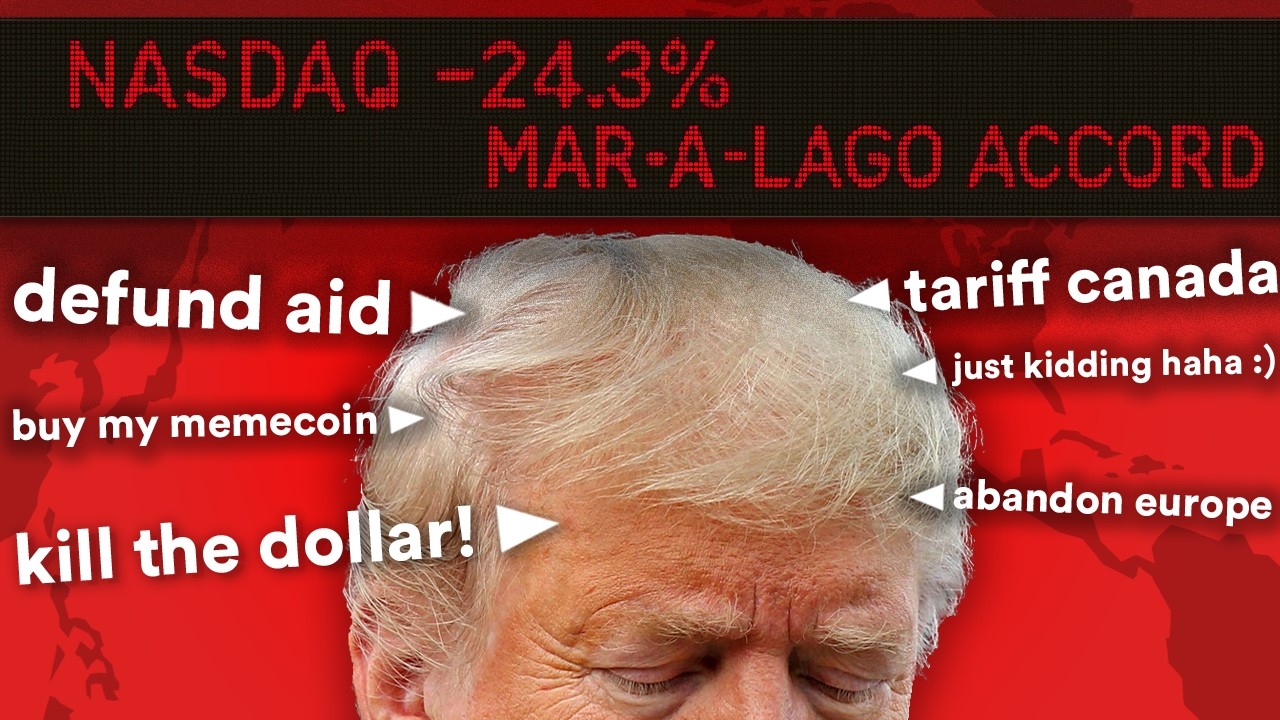
But if Americans cannot defend against this age of robber barons who have come to own technologies gambling with the truth, then I think they may end up losing a couple decades until they can figure out how to. I made this video along with another about Trump's radically different foreign policy. If you'd like to check that out, click the big image in the middle of the screen.
And if you'd like to subscribe, we're close to hitting the big 1 million on this channel. So, why is Trump crashing the dollar?