welcome back to mad medicine in this lecture we're gonna be discussing pyruvate kinase deficiency if you guys don't know on our youtube channel youtube.com forward slash mad medicine we have created and he Mont playlist where you can watch all of our lectures for us Emily step one specifically human ecology in oncology while you're there don't forget to Like comment and subscribe to our Channel your support really means a lot to us and we are posting brand new Stepan videos every single day so make sure you subscribe so you don't miss them with that being said
cycle a normal citic anemia is the most anemias are anemias with the red blood cell is normal therefore the MCV is going to be 80 to 100 that's what we have put an arrow to this normal sized red blood cell not macrocytic not sorry not micro said it not macrocytic you have a normal sized red blood cell and these can be subdivided based off of hemolysis especially normocytic anemias you can have non hemolytic normocytic anemia and hemolytic normocytic anemia which can be sub subdivided based off of the cause of hemolysis whether it's intrinsic or extrinsic
so let's talk more about hemolytic anemias hemolytic anemias can be intrinsic where the problem is going to be within the cell and that problem then the cell can be due to membrane defect so problems that the what the cell membrane it can be due to enzyme deficiencies and that's what we're gonna be discussing today pyruvate kinase efficiency we have already discussed the membrane defects membrane defect so you can watch the videos in the playlist for hereditary spherocytosis and PM h and we have already discussed g6pd deficiency so you can watch that as well now you
can also have hemoglobinopathies that can lead to intrinsic problems and hemolysis and then you have extrinsic causes where you have problems outside of the cell that leads to cell 2 lights these are autoimmune issues or issues with blood vessels like micro Pathak microangiopathic and macro in japan 30 malarek anemia as well as infections now because your red blood cells are being lysed your bone marrow realizes it needs to increase production and with that increase in production it is going to release immature red blood cells a lot more than normal and that's going to lead to
a reticulocyte count that is gonna be greater than 2 percent in hemolytic anemia specifically now remember your normal reticulocyte count is going to be 1 to 2 percent but in hemolytic anemias you're gonna have a greater than 2% particular sight count also in non hemolytic normocytic anemias you will have normal values for the reticulocyte count so let's talk about pyruvate kind of deficiency this is a disorder with an enzyme that's gonna lead to intrinsic emesis or intrinsic it's gonna be an intrinsic cause of hemolysis this is an autosomal recessive disorder very important for step one
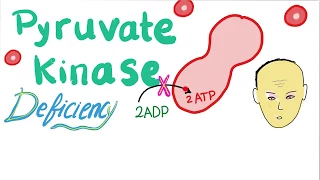
because they can ask you a percentage or a probability to pass this disorder on this is an autosomal recessive enzyme deficiency that causes extravascular intrinsic hemolysis extravascular meaning it is not going to be in the blood vessels specifically so what happens in this disease well let's talk about the pathogenesis in this case we have a defective pyruvate kinase enzyme this enzyme is very important because it allows for a very important irreversible step in glycolysis the conversion of PEP into pyruvate and that's important because it is needed for the production of ATP now when you do
not have proper functioning pyruvate kinase so you have a deficiency in pyruvate kinase you are not going to be able to produce adequate amounts of ATP so let's write that down a decrease in ATP is very important now when it comes to your red blood cells what happens with a decrease in ATP is that the red blood cells gonna become very rigid and the fact that it is very rigid is not good and it's gonna allow the red blood cell to be lysed easily keep in mind red blood cells normally are not Richard and they
shouldn't be rigid because when they go through the red pulp they have to deform in order to go through a structure called the cords of bill Roth okay this rigid II is not good for the red pulp on the right this down for you guys so you guys remember this we've already discussed this in our hemolysis basics video so you can check it out but the red pulp has these things called the I think it's both like this or cords of bill Roth and these cords of Billroth are sort of a sieve and our normal
red blood cells are gonna be able to deform and change their conformation just so they can go through a bit abnormal red blood cells like in pyruvate kinase deficiency I'm not going to be able to because they are so rigid and they're gonna get stuck in the cords Billroth and splenic Sage's will destroy them that's why you see extravascular hemolysis due to an intrinsic cause now you are also gonna see two levels of high levels of two through BPG and that leads to decrease in my global affinity for oxygen now overall this is a very
rare disorder you're not gonna see this often in the clinical setting but you need to know in for step one it is a very important cause of hemolytic normocytic anemia especially when it comes to testing for step one now the symptoms are very important when it comes to newborns you're gonna see hemolytic anemia and the severity is gonna range from mild hemolysis to life-threatening hemolysis you will also see pigmented gall stones because of the hemolysis that is occurring now in the physical exam in a newborn patient you might see jaundice and hepatosplenomegaly because of the
extravascular hemolysis remember we said that the moss is gonna occur in the spleen and the liver and because it says extravascular not in the red blood in the button sorry in DES in the blood vessels it's gonna happen in the spleen or the liver and lead to the plant hepatosplenomegaly when it comes to the labs and diagnosing these patients you're gonna see an increase in serum 2/3 BPG you're gonna see all the same things for extravascular hemolysis but we're gonna talk about some very important things number one in pyruvate kinase deficiency most likely you will
see a corrected reticulocyte count that is greater than or equal to three percent what does that mean well in anemia specifically hemolytic anemias you need to correct the reticulocyte count in order to see if the bone marrow is responding adequately to the decrease in red blood cells if you have a reticulocyte count that's right this the other corrected reticulocyte count that is less than 2% your bone marrow is having an inadequate response okay in this case it is greater than or equal to three percent it means you were going to have an adequate response normally
because there isn't a really no problem with your production of red blood cells your bone marrow and all the precursor cells are perfectly fine the issue is gonna happen in the spleen mainly due to the fact that your well your red blood cells cannot deform while they go through these the cords of Billroth and they're gonna get destroyed that is one of the main things that's gonna happen due to the extravascular hemolysis you may see normal 2d crews haptoglobin because you're not gonna have hemoglobin in circulation and that hemoglobin is not gonna bind to haptoglobin
so you will see you will problems in normal hemoglobin haptoglobin you might see normal to increase LDH like lactate dehydrogenase and you're gonna see an increase in indirect bilirubin that is very important you can see indirect bilirubin is gonna increase now the peripheral blood smear is gonna show no Sphero sites but they are gonna be positive for a kind of site and we're going to talk about that in a second but what you need to know is that is what you need to know is that kind of sites are mainly associated with pyruvate kinase deficiency
disease okay that is very very important now the diagnosis can be confirmed with a RBC pyruvate kinase assay so you can look at the amount of pyruvate kinase a patients have in the red blood cells and based off of that you can determine whether or not they have a deficiency in pyruvate kinase now these are a kind of sites like we said earlier they are gonna be found in your peripheral blood smear and they're also known as burr cells these right here are it kind of slide some things to remember they look very similar to
a campus sites which are spur cells like the spur that look like Spurs on a cowboy boot but the one thing that sets them apart is the fact that they're projections right here you see these projections are gonna be more uniform so you can have uniform projections in it kind of sites they are different than account sites also because they are smaller they are also smaller in size than a can't those sites these are going to be associated with end-stage renal disease liver disease but in our case you definitely need to know what for pyruvate
kinase deficiency this is a probably the most high yield association for a kind of sites now when it comes to treatment of pyruvate kinase deficiency you can do blood transfusions and one thing that you always need to watch out for and from now on you should always be thinking about this is that you need to chelate iron because these patient can have AI an iron overloaded state okay you need to watch out for iron overloaded state like hemochromatosis which can have very detrimental effects to the liver and to the mental status of a patient so
blood transfusions are important with iron chelation therapy especially if they are iron overloaded a splenectomy can also be done for very severe cases because the the red blood cells are being lice in the spleen so you can do a splenectomy what will you see when you have a splenectomy how jolly body's okay that is very very important don't forget that all right so you're gonna see how jolly body is with a splenectomy and then finally you can also give supportive therapy with folate and with that being said we have covered pyruvate kinase deficiency don't forget
this is an autosomal recessive cause of hemolytic normocytic anemia let's write this down autosomal recessive hemolytic normocytic anemia HMA thus we're gonna write hn8 in this case you have decreased pyruvate kinase which leads to decrease ATP okay and you're gonna have increase to 3 B P G and that's going to lead to increase lysis plus you're gonna have decreased hemoglobin o2 affinity okay also you need to understand that this is all gonna happen extravascular lee so you will see extravascular causes of hemolysis and the symptoms associated like decrease sorry normal haptoglobin and in this case
you're gonna have an adequate bone marrow response because the bone marrow is not messed up when you're treating these patients you can give blood transfusion and it's protecting me in very severe cases and with that being said thank you so much for watching our video on pyruvate kinase this deficiency don't forget to Like comment and subscribe to our channel you can follow us on social media on Twitter and on Instagram Instagram at Mad medicine and Twitter at its Mad medicine and you can listen to these podcast listen to these lectures as podcasts for free this
is mad medicine and we will pop up