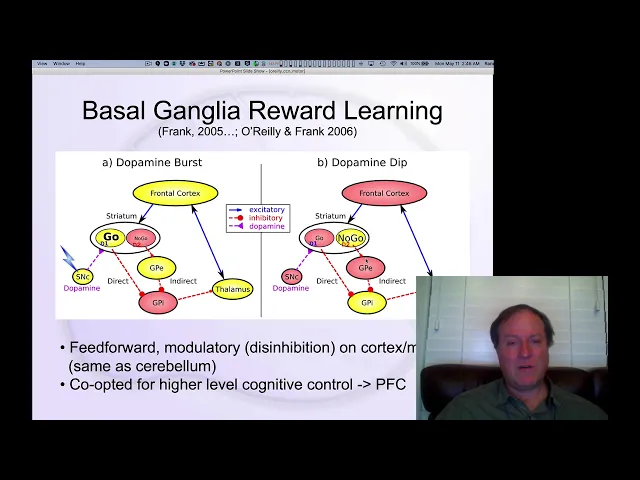
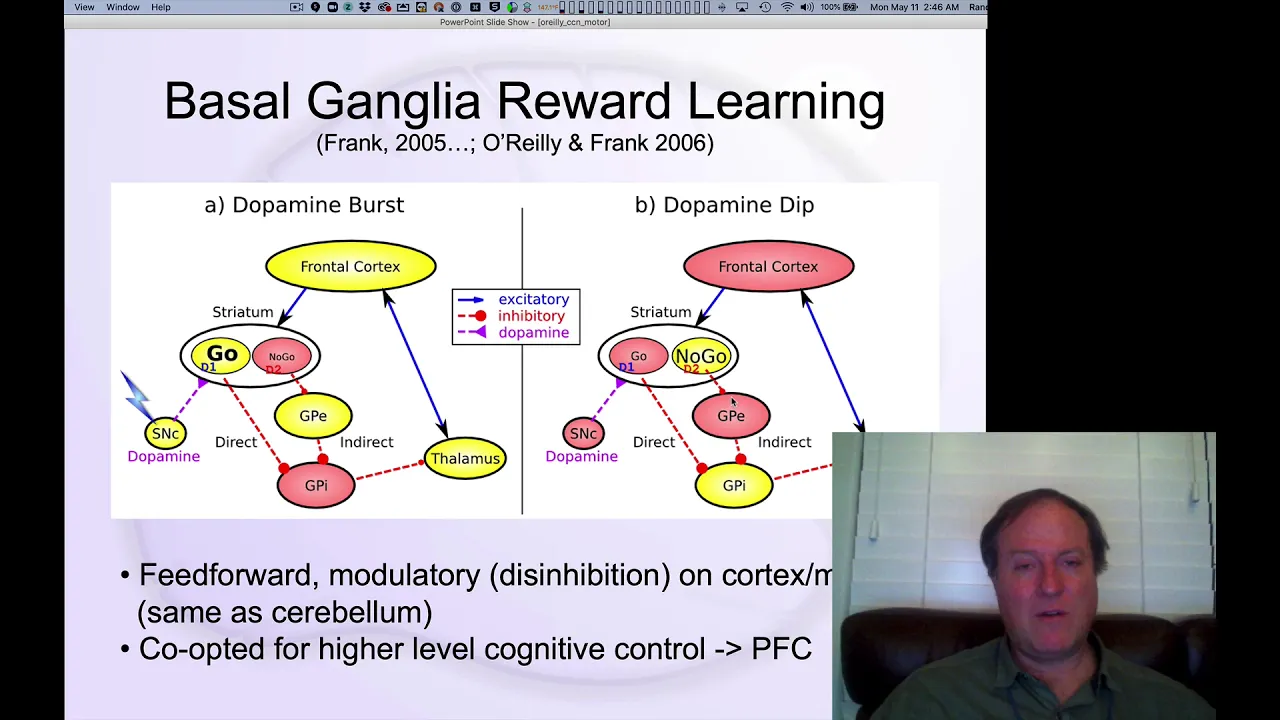
okay now we can talk about dopamine in more detail and how it drives learning in the basal ganglia in the way that we discussed with this law of effect and the basic idea is that their dopamine neurons which are located in the substantia pars compacta SN C just different from the SN R this brain area sends all these dopamine projections into the striatum and there are d1 receptors on neurons that make up the direct pathway and d2 dopamine d2 receptors on the no-go pathway and dopamine has opposite effects on each of those different types of
receptors so if you get a burst an extra amount of dopamine coming in again as a result of an unexpected positive outcome some kind of reward that was better than expected that results in a net excitation of the go neurons and also an increase in the synaptic connections of those neurons from the frontal cortex and so this kind of drives LTP long term potentiation of those synapses and therefore makes it more likely next time that you will drive that same go decision given that it led to a positive outcome the previous time now the time
differences in these kind of you know when you receive the dopamine relative to when you make the action is one of the most important and challenging aspects of this whole circuit there's always some delay at least and so how exactly the system works to manage that delay is still a very active topic of research in any case it has to has to do it one way or another and the logic very much makes sense so now let's take the complementary case where you get less positive outcome or maybe a negative outcome relative to your expectation
and now you get less activity of these dopamine neurons on this red color what that ends up doing is actually making the no-go neurons more active and drives synaptic plasticity into the synapses into those no-go neurons and again the logic is if you chose something last time that choice led to a negative outcome then what this is doing is saying next time we're going to learn more activity in this opposing no-go pathway so that it will make us less likely to make that kind of go choice so this is very much an opponent processes tug-of-war
this balance between the overall weight of go on the one hand and no go on the other and that really decides ultimately one that we decide on this action or some other action and one thing that's important to subtle detail is that that no go is really a kind of referendum or a vote about that original action that we took we actually had to take the action in order for the response this dopamine signal to sort of be applied to that particular action and therefore there is really an association between these go and no-go neurons
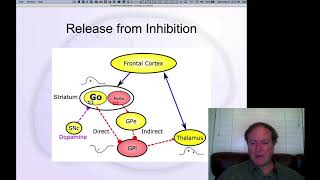
they're kind of about that same action so it really is this kind of battle about that same choice so the d2 receptors are responsible for driving this and when those no-go neurons do get activated in the context of a situation where maybe you've now accumulated several negative outcomes that no-go pathway as opposed to the NGO pathway has this effect of inhibiting a population of neurons in the GPE that were previously active as shown here they're now not active and that is removing inhibition on the Jeep I and therefore making the GP I'm more active and
therefore less likely to get dis inhibited from the co pathway and kind of keeping the brakes on so to speak keeping that inhibition on the thalamus preventing that from opening up and therefore kind of saying no let's not do this action some other action can can maybe which has less of this no-go opposition might be able to break through and and open up the circuit but this particular action that's getting a lot of no go in this case doesn't and so that's really this balancing act between the go and the no go we actually developed
some of these early models Michael Frank was a student working my lab at that time and he's gone on to do a really amazing amount of work on these different circuits really validating and extending and providing a lot of evidence consistent with this overall idea which is at this point stood the test of time pretty well so one idea also that we developed was that the same circuit which had been described earlier by a number of researchers in the context more specifically an action selection our kind of overall contribution was also to extend this up
into the level of high level cognitive functions in particular the idea that you would kind of update a plan which is really maintained in working memory as a result of this go versus no-go gating and we'll look at that in Chapter ten in the context of kind of executive function and working memory how those two concepts are interconnected but for now we'll just think about it in the context of this kind of action selection is more concrete choices of what are you actually going to do