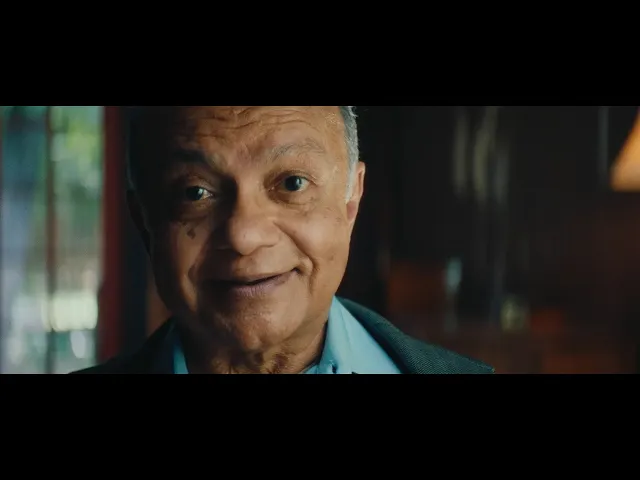
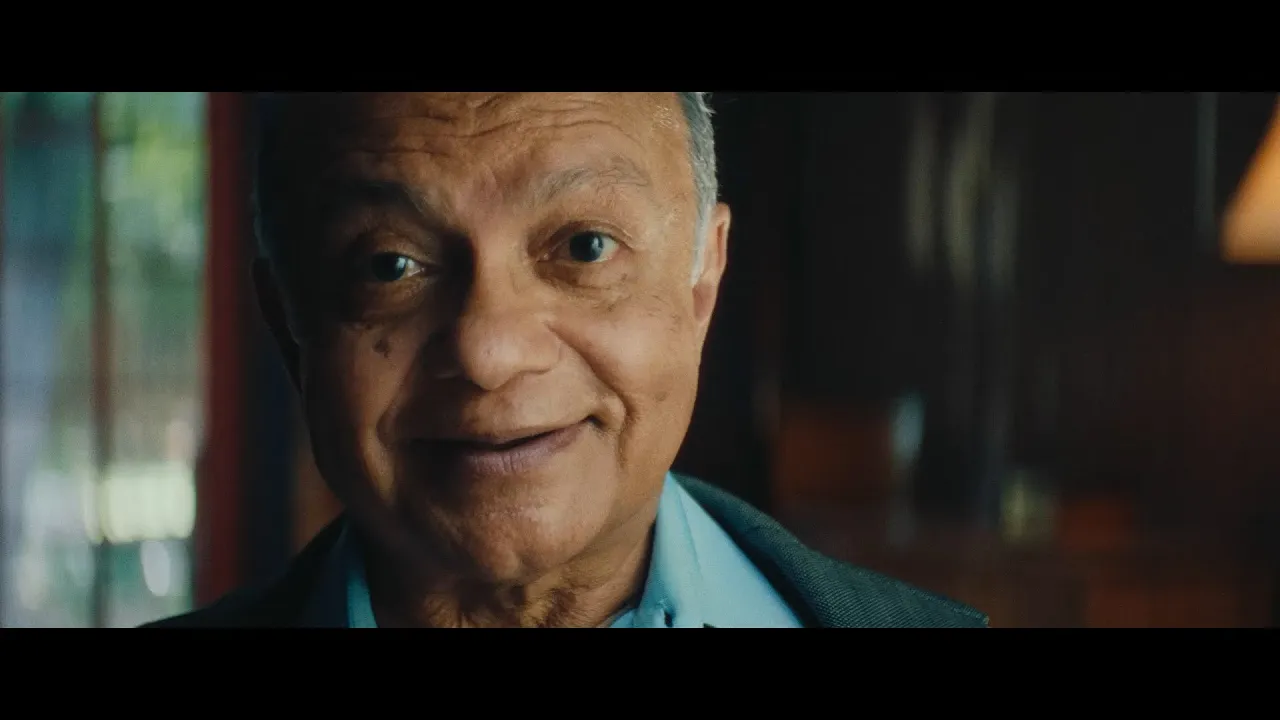
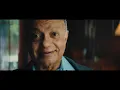
For somebody like me born way up in the mountains of Nepal, a very remote village, five days walk from the nearest bus stop. . .
Optimism has to be your destiny. In those days, you want water? Walk all the way to the river.
That was the job of women. Hours and hours spent, my mother fetching that water. It was so precious.
There was no school, no health post. So, as a little boy I went to Kathmandu, the capital city of Nepal. Wow.
Electricity! By the standards of my village everything was glittering, yeah. I saw a white Jeep that said U-N-I-C-E-F, UNICEF.
UNICEF, what is UNICEF? As I would trek back to my village, I would see along the road porters carrying big bundles of pipes. Pipes for water supply.
I said, "Wow! " They were liberating women. UNICEF.
Another occasion, similarly, carrying these big corrugated iron sheets. Roofing material for schools in the villages. And, vaccines.
It was very exciting. A whole bunch of kids going there, lining up for vaccines. Who does it?
UNICEF! I thought, “Wow! ” In this world that sometimes seems very selfish and cruel and uncaring, there is an organization that is caring.
That focuses on the most vulnerable. And has a track record of success. So, now as I think about UNICEF providing those things for the last 75 years, it's not just the water and the medicine and the roofing sheets for the school, but really transforming the lives of people.
Hope. My name is Florence Nettey. I’m a single mother.
And a grandmother too, as well. There is Covid here in Ghana. I am very scared of the virus.
People are dying. And I’m looking for my second shot here. I’m looking for it.
Me and a mother in America, we are the same. She’s a human being. I’m a human being.
But we the Africans, we lack the vaccine. The problem here—we don’t have enough. That’s why.
We are praying for it. I have to protect myself so that I can take very good care of my children. Well, who cares about those people dying in Africa?
Well, let's take care of ourselves. We can do everything by ourselves. The hell with the rest of the world.
No sir, we don't live in that world. That world is gone! When it comes to pandemic, epidemic diseases— smallpox, polio, measles, or COVID-19— no country is safe until all countries and people everywhere are safe.
If the disease remains in one part of the world it is bound to come to your place also. It's in our hands and power to solve this problem. We have no right to be pessimistic.
UNICEF is the largest distributor of vaccines in the world. We have respect, trust, legitimacy, and therefore things that UNICEF can do, not many other organizations can do. My name is Kul Gautam.
Former Deputy Director of UNICEF. How did it begin? Ah, that's an amazing and inspiring story.
In human history, great crises have come. Great wars have come. Periods of great disappointment, despondency.
Hopelessness. But, humanity has always risen. After the war ended, peace came.
The UN Charter was signed. UN came into existence. Then the question: What do we do with UNRRA?
We still need to provide a lot of relief and rehabilitation. They said let's disband UNRRA, and they created two organizations. One was to deal with the millions of refugees.
And then let's establish another organization called UNICEF that will deal specifically with children. Actor and comedian Danny Kaye. Danny Kaye became UNICEF’s first Goodwill Ambassador.
Later on, many other illustrious stars. Harry Belafonte. Pelé, the great football star.
Audrey Hepburn. Audrey Hepburn was the most beautiful, the most elegant, the most famous, the most— anyway, long story. Sorry, I made it too long.
They were able not only to mobilize money, but to mobilize public opinion, public sentiments. The sense of solidarity! If we, the so-called adults of the world assume the responsibility for children throughout the world, then perhaps our children can live in a more healthy, happy, and peaceful world.
The appeal was so powerful. UNICEF USA was the pioneer. And then USA adopted Trick-or-Treat.
Trick-or-Treat! Trick-or-Treat for UNICEF! Made it nationwide, and Trick-or-Treat mobilized millions of dollars over time.
That became the backbone of UNICEF's funding. Then in 1965, the Nobel Committee decided to award UNICEF the Nobel Peace Prize. So that was the highest honor that one could get.
Can you get any higher than the Nobel Prize? Yes you can. We'll come to that.
Ma! I'm coming! My dad.
He used to call me Nightingale. That’s why he named me Florence. He used to tell me, “In the future, you will be a nurse.
” “Just like Florence Nightingale. ” That was my dream. But, my dream didn’t come true.
It’s a long story, about love. I used to accompany my mom selling fresh fish at the markets. That is where we started, me and Joshua.
A very cute man. Nice. Calm.
And very gentle. I used to trouble him. Oh, I used to trouble him a lot.
But he loved me, so we got married. We had ten children. Ten!
He was an account clerk with a school. One day, somebody from school came and told me, “When your husband came to work” “he was not feeling well. ” “They have sent him to the hospital.
” So I rushed there. Pneumonia. He died.
If you don’t have money and you get sick. . .
That’s why we are praying for the vaccine. Ghana is a very hot country. Scorching hot.
When it comes to vaccines, the sun becomes our enemy. The very moment you leave the vaccines in the sun, I can tell you: You will lose everything. We need specifically to use the UCC.
That's the ultra-cold chain. I'm Dr Priscilla Wobil and I work with UNICEF Ghana. In the mid-70s, vaccines had to be distributed widely across the world and maintained at a particular temperature.
So, UNICEF and other partners had to build a global cold chain. The first cold box was a wooden box. The Luxembourg cold box.
It was first tested in Ghana, and it worked! It worked. To ensure that the vaccines that are manufactured reach every child, everywhere.
So, the immunization cold chain system that was built to immunize children is now the same system that is being used to vaccinate the world against COVID-19. COVAX, the coalition of partners that have come together to ensure that COVID-19 vaccines are manufactured and delivered equitably to all countries, quickly. Story, story, story.
Once upon a time. . .
time, time. There lived a man. And coronavirus.
Coronavirus came to enter the man and the man died. One day, one day, a virus killed everybody in the world. He said that all that thing is for me now in the world.
She said, "The virus takes over the whole world. " Face masks! Face masks!
Face masks! These are teachers, fathers, mothers, brothers, sisters. What happens when they are no longer alive?
Here in Ghana, less than 3% of the population have been vaccinated. Less than 3%. Fathers, mothers, brothers, sisters.
Here in Ghana, we are in the early stages now of this pandemic. One crisis after another crisis, humanity has survived. Why?
Because we have had inspiring leaders, inspiring teachers, inspiring personalities, who have shown us that the problems can be overcome. In 1980, UNICEF got a new leader, James Grant. James Grant, Executive Director of the United Nations Children's Fund, or UNICEF.
He sent out a message to all UNICEF staff all over the world. 13 million children die, two-thirds of whom could be preventable. Why were they dying?
Because they don't have the simple vaccination which is very cheap, easily available in US and Europe but not in poor countries. If we were to immunize all the children of the world, we could save a lot of lives. In 1982, Grant launched a child survival and development revolution.
He said, “By the end of the decade we should reach—” Must reach 80%. “—80% immunization. ” Eradicate polio, eradicate diphtheria, whooping cough, tetanus, tuberculosis.
A child survival revolution all over the world. We'll mobilize international support, make it a high priority. Do it on a massive scale.
Sounds like a good idea, if it could be done. I just wanted to tell you about my voice. I have half the vocal chords you have.
That's smoking! My name is Agop Kayayan. I was the UNICEF Program Officer in Guatemala.
I promised Mr Grant that I wouldn't smoke anymore. Jim Grant. He was my guru.
My professional father. One morning, I'm in the office and I get a phone call. Mr Grant is on the line.
He says, “Agop, I met the president of El Salvador. ” And I thought, “He does not call” “because he met the president of El Salvador. ” “There's something coming.
” I was the representative for seven countries and three of them were in civil war. El Salvador, a country no larger than Wales, is torn by civil war and terror. Grant asked the president of El Salvador if he was vaccinating children.
His answer was, “Mr Grant,” “you don't understand. ” “My country is at war. ” “The vaccinators do not want to go into areas” “where it was dangerous.
” If you don't vaccinate, children and women are paying the price of the war. So, Jim says, “Agop, you are going to do it. ” “Stop the war.
” I couldn't say no to him. So, I went to the Archbishop in San Salvador. I just said it very straight, “Monsignor, we are proposing a truce” “so that children could be vaccinated.
” And he said, “I don't think it's going to work. ” “We have tried many times, truces. ” “I don't see why they would accept it from you.
” And I, you know, what argument can I give the man? So I said okay, you know what though? Maybe because of children they will accept.
You see? UNICEF had the trust of government people and the guerrilla. Credibility.
You build it. Brick by brick. You know, you do things right thousands of times and then people say, “These guys we can trust.
” Both sides, guerrilla and army, both sides accepted our proposal. Put down the guns and provide full service to children. I was jumping of happiness.
Yes, yes I did. Like, it was happy. Yes.
And so, every year, twice, for two days each time, for six consecutive years, the war stopped completely. Each time, more than 400,000 children were vaccinated against five deadly diseases. For the very first time in history war has been stopped for children.
We called it “Days of Tranquility” for a good reason. Now, we have shown proof that it can be done. How can we sustain it?
How can we improve it? And saving lives is only one part. What's the point of saving them if you cannot improve the quality of life?
It is not just the quantity of life, it is the quality of life. What do we need to do for quality of life? Remember, I asked, “Can you get any higher than the Nobel Prize?
” Well, I'll tell you the whole story. The Convention on the Rights of the Child was adopted in 1989. Every child shall enjoy the following rights.
They have a right to survival. They have a right to their name. They have a right to health, education, to be protected from harm, from violence, abuse, exploitation.
Forever. And Jim Grant said, “Okay now,” “call for a world summit for children. ” This weekend, when more than 70 of the world's leaders sit down together here in New York, it will be the first time a world summit for children be held.
From north and south, east and west, Asia, Africa, Latin America, Europe. That became the largest summit in the history of humanity and it was a tremendous success. So, there you see, UNICEF followed the principle that said children should be at the center of humanity.
Because they are the future of humanity. If there's a devil chasing you, would you stop? My name is Cornelius Williams.
Associate Director, Child Protection. Since early 90s, the world is now a more complex place. In high income countries, in low income countries, everywhere.
At UNICEF, we are on a mission. We work in over 190 countries. We are the partners of governments.
When there's that devil chasing after us, the dark side of humanity. Panic and pandemonium at Kabul Airport— We owe it to those children. Do not let this planet die!
Climate change has had a major impact— This is not a job in a cigarette factory. It's not a job in a bank. It's about humanity.
UNICEF today, we have the technical capability, the infrastructure, and the knowledge to continue to make a difference for children. We have to roll up our sleeves. And do it.
Nothing stops us. Nothing. Would you stop?
Yes. I’ve been doing very hard work because of my children. And I’m proud God has seen me through.
Five of them have been to university. Yes. Very proud.
So now, I just look after the children and my community. Look after them well. Even though I’m a single mother, I have to give them everything they need.
Everything. I love everybody. I love everybody.
Everybody in this house. Oh yes! Anything at all you need, when you ask and I have, I will give you.
And that’s why I want to work. So that I can provide every day. Thank you!
Welcome! But, I’m very scared. Scared of the virus.
I hope the world sends the vaccine so that they will protect the people of Ghana. It will protect the people of Ghana. That’s my prayer.
Because, if you have, you have to give. I recall going to the villages of our neighbors. Walking, walking, walking up and down the hill.
When the sun is about to set in the evening, you just go and knock on people's door and say, “Look, the night is coming, we are on our way. ” “Would you be kind enough to let us stay? ” They will let you stay.
You stay there overnight. And then, early in the morning, you start walking. Today as I look back I say, “Oh my God!
” The generosity of the people. They had so little, but they shared. If you have generosity, if you have trust, if you have a sense of solidarity, optimism is your destiny.
We are luckier than all of our predecessors. We now have the technology. We now have the communications capacity.
We can reach everybody! Especially now. It's a fact of life.
You are not safe until the whole world is safe. That is the key. No matter how powerful and how rich you are, we live in an interdependent world.
Children should be everybody's business. Film stars and rock stars! Presidents and prime ministers and kings!
And they should be your business. That if we, the so-called adults of the world, take on the world's problems of children, I think perhaps the world would be well on its way to understanding itself a little better and perhaps our children can live in a more healthy, happy, and peaceful world.