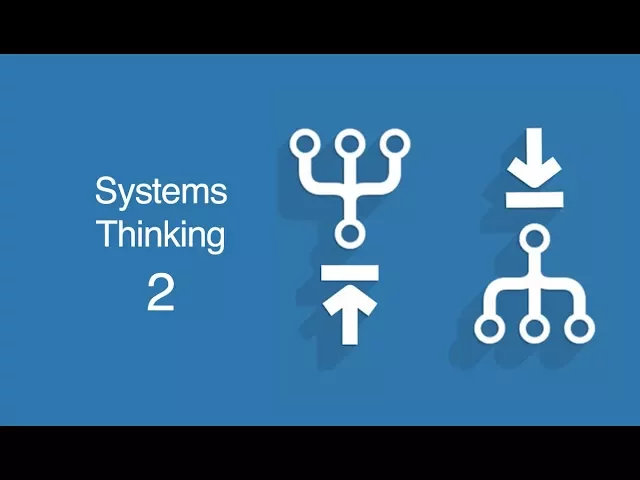
in this section we're going to continue our discussion on analysis and synthesis digging a bit deeper into the distinction between the two the first thing to note is that the methods of synthesis and Analysis are not mutually exclusive they should both be a part of any well-developed model but each will have particular relevance depending on the type or properties of the system we are dealing with thus it should not be a surprise to us that physics is the home of the reductionist approach where they are often dealing with inert static and decomposable systems whereas ecologists
that deal with highly interconnected and dynamic systems are much more inclined to systems thinking so some of the primary questions we will be asking to determine the type of system we are dealing with and thus the appropriate method of reasoning will be firstly is it primarily a component-based system or does it serve some common function that integrates the various elements is it isolated or connected is it a linear deterministic system or a nonlinear non-determinate system and is it static or dynamic we will be covering many of these topics in more depth later on in the
course so we will just be touching on them for the moment firstly are we dealing with an actual system or simply a set of things when we wish to talk about a composite entity that is to say a group of things we can describe it as either a set of objects or system the difference here being that a set is a group of objects that share no common function thus we call a group of Cups on a table a set of cups as they exist independently from each other in contrary if we take the human
body again it is a composite entity but this time the elements have been designed to serve some common function and thus we can call it a system and we need to use systems thinking to properly understand it secondly how interconnected is the system analysis starts from a component-based view of the world and builds a description based upon the properties of these components synthesis in contrary focuses upon the relationships between Parts thus from a systems thinking perspective we are often interested in connectivity I.E answering the question what is connected to what and thus is best suited
to systems with a high level of interconnectivity thirdly Are We dealing with a linear system or are there feedback loops analytical thinking searches for direct linear relations between the cause of an event and the effect thus we call this linear thinking systems thinking is more inclined to see events as the product of a complex interacting of parts where relations are often cyclical with feedback loops is the system primarily static or dynamic analytical methods often describe entities in terms of static structures with limited reference to their development within time systems thinking takes a more Dynamic view
of things often contextualizing entities in terms of The evolutionary forces that have shaped them and thus seeing the process of development as an important phenomena with which to understand the world lastly are we dealing with a system on the micro level or the macro level analysis breaks things down into parts and thus analytical thinking typically focuses upon analyzing and optimizing subsystems in a belief that we can improve the whole system by simply optimizing all of its subcomponents if we are dealing with a system on the macro level what we sometimes call the global level we
need to use systems thinking to get a vision of the whole system and an understanding of how the parts interrelate to achieve Global functionality