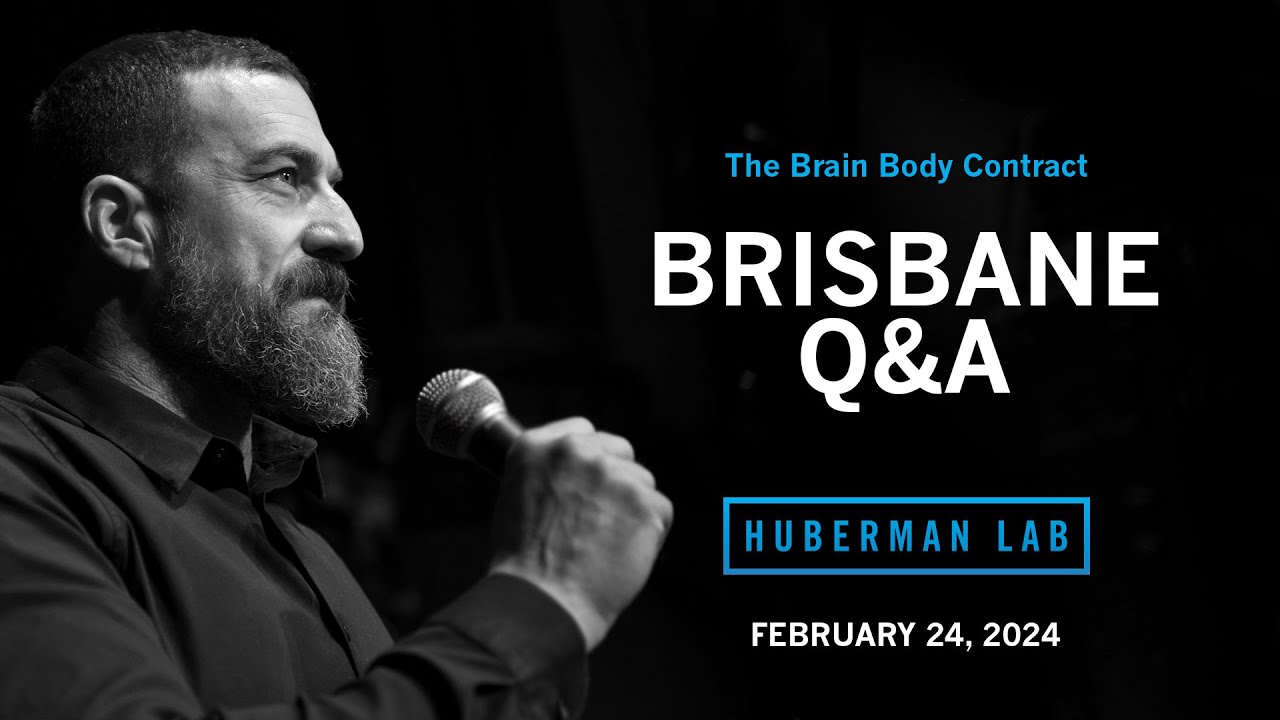
Welcome to the huberman Lab podcast where we discuss science and science-based tools for everyday [Music] life I'm Andrew huberman and I'm a professor of neurobiology and Opthalmology at Stanford School of Medicine recently the hubman Lab podcast hosted a live event at the Sydney Opera House in Australia the event was called the brain body contract and featured a Lecture followed by a question and answer session with the audience we wanted to make the question and answer session available to everyone regarding regardless if you could attend so what follows is the question and answer session from the
Sydney Opera House in Australia I also would like to thank the sponsors for the event they are eight sleep and ag1 eight sleep makes Smart mattress covers with cooling Heating and sleep tracking capacity now one of the Key aspects to getting a great night's sleep is to control the temperature of your sleeping environment and that's because in order to fall and stay deeply asleep your body temperature actually has to drop by about 1 to 3° and in order to wake up in the morning feeling refreshed your body temperature actually has to increase by about 1
to 3° eight sleep makes it extremely easy to control the temperature of your sleeping environment at the beginning middle and Throughout the night and when you wake up in the morning I've been sleeping on an eight sleep mattress cover for nearly 3 years now and it has dramatically improved my sleep if you'd like to try eight sleep you can go to 8sleep.com huberman to save $150 off their pod 3 cover eights sleep currently ships to the USA Canada UK select countries in the EU and Australia again that's 8sleep.com huberman the other live event sponsor Ag1
is a vitamin mineral probiotic drink that also contains adaptogens and other critical micronutrients I've been taking ag1 daily since 2012 so I'm delighted that they decided to sponsor the live event the reason I started taking it and the reason I still take it every day once or twice a day is that it ensures that I meet all of my quotas for vitamins and minerals and it ensures that I get enough Prebiotic and probiotic to support gut health now of Course I strive to consume healthy Whole Foods for the major of my nutritional intake every single
day but there are a number of things in ag1 including specific micronutrients that are hard to get from Whole Foods or at least in sufficient quantities so ag1 allows me to get the vitamins and minerals that I need probiotics prebiotics the adaptogens and critical micronutrients to try ag1 go to drink a1.com huberman and you'll get a year supply of vitamin D3 K2 and five free travel packs of ag1 again that's drink a1.com huberman thank you to the Sydney Opera House for hosting us and for making this event [Music] [Applause] [Music] possible what are the latest
findings on the physiological mechanisms behind stress's impact on the body and brain and what are some practical tools or techniques for managing stress Effectively well um thank you for that question I'll I'll um deliberately not repeat what I said earlier about physiological size panoramic Vision Etc and raising stress threshold because we covered that um already but I think that one of the the most interesting findings two most interesting findings in the in the field of stress in the last five years or even three years I think the the work from my colleague Ali Crum at
Stanford she's been a guest on the Podcast she works on mindsets uh is the following um result uh students Stanford students that is come into the laboratory they view a I think it's a five minute movie about how awful stress is for the mind and body all the things it does like deplete your immune system make you miserable uh deplete certain aspects of the the reproductive axis and on and on and then a separate group comes in and watches a video also five minutes also true about all the things That stress can do to enhance
performance both cognitive or physical like excess or additional energy additional cognitive power access to certain memory sets albeit narrow memory sets Etc and what you find is that the results Point directly to the fact that whatever you believe about stress provided the information you have is true is what happens so if I tell you that stress improves your memory Focus attention one observes that if I tell You that stress depletes your immune system Etc one observes that so this is something that we don't quite yet understand as neuroscientists and the psychology of it makes more
sense frankly than the mechanisms but it's becoming very clear that what we believe about a given phenomenon strongly impacts how it shapes our response to that so I find that very interesting now of course you can't delete information about stress being Bad for you so what does that mean if you want stress to be uh enhancing as it's called there's literally now called the stresses enhancing mindset that the thing you can do is to learn more about how stress can be enhancing we're not talking about lying we're not talking about placebo effect we're talking about
real knowledge based in fact that one can absorb and I find it amazing and wonderful that the mere learning of Something can actually change how we respond to something at a core physiological level the second I think very important set of findings on stress relate to a structure that I've talked about recently on the podcast and I talked about with um the one and only David gogins most people presumably have heard like he's on his way he running here right now from from Central America um yeah that guy I'll tell you that guy is every
bit as intense as he comes Across I met him for the first time in 2016 at a at a gathering in uh it was in Silicon Valley which're just doing a little bit of work for this company at the end of the day he leaves for minute and he changes into his shorts and his shirt he's like I'm going running I got to go to the airport I'm thinking I'm going to go running then I'm going to go to the airport he was running to the airport seriously and we're like 14 miles from the airport
which I realized 14 miles for a marathon are no big deal but he's got his bags and I'm thinking to myself this guy he's nuts and I love him I mean he's really he's really that guy it's it's it's actually very refreshing you know the the Rick you know I think one reason we love the Rick Rubin and the the David goggin is they truly are different but from one basic standpoint is they just don't give a they just do what they're going to do and they trust that They're doing right for them and for
the people around them and it's awesome it's really awesome I think that it it again brings about that you know that word that you know doesn't come about very often for me but you just kind of stuns you into like behold David God Rick rubben the Cuttlefish whatever you know so but I talked about this with David there's this structure in our brain and these are recent discoveries not by my Lab I wish I had discovered these but actually a colleague of mine at Stanford Joe parvey who's in the department of neurosurgery has made these
beautiful discoveries about the anterior mid singulate cortex the anterior mid singulate CeX it's a structure in the brain that has a lot of subdivisions but when Joe put a little stimulating electrode into this area because he had patients that needed neurosurgery and they probe around asking questions what Do you feel how do you feel what are you going to do and sometimes they hit an area I've seen these experiments they're unbelievable stimulate an area and the person says you know I feel like I'm about to go into a rage they like okay let's back off
let's move over here anterior mid singulate cortex they stimulate and the patient the person says I feel like I'm heading into a storm you go oh that doesn't sound good and they say no but I'm ready I'm Leaning in a different patient you stimulate their anterior mid singulate cortex and the person says I feel like I'm going to get up out of my chair and do something really really difficult okay so this is interesting across multiple people you're seeing the same general kind of forward Center of mass kind of response leaning into Challenge and challenge
specifically and then there's now scores of studies in the just the last 3 to 5 years showing that For instance people who successfully overcome a challenge of any kind fitness challenge cognitive challenge interior mid singulate cortex expands or at least increases its Baseline levels of activity you see people that fail to meet that challenge less inter mid singulate cortex activi there's a bidirectionality of the response and on and on and it seems that doing things that are difficult that we don't enjoy or that we have to push ourselves to Do grow and enhance the activity
within this anid singulate cortex and the beauty of it is that it generalizes that the anid singulate cortex can be applied or the growth of it can be directed towards lots of different things which is I think a call for you of course seeking pleasure seeking Comfort seeking relaxation seeking sleep every night seeking sunlight in the morning Etc but also deliberately seeking out challenges that is challenges for us the importance Of doing hard things in a safe manner psychologically and physically safe manner of course is truly beneficial toward our ability to manage ourselves in what
would otherwise be called stress so I think those the work of alium and the work on the ENT mid singulate cortex by parvis and a bunch of other labs I think are the two areas where I um feel like things are happening really quickly we're making big strides as a field and we're moving away from uh kind of Conjecture about how to U better ourselves uh in lots of different ways can you talk about time perception why is it that in some instances time moves very slowly while in others it seems to move very fast
thank you tonight has been so fun thank you I've had fun too um this is something I'm trying to do more of not necessarily lives but that too but um someone recently uh who I I love and admire very much said to me we're gonna Have so much fun and I thought whoa like behold no one's ever said that to me no one's ever said that to me all my years growing up I I mean I mean I love with with all due respect to my parents I can't remember anyone ever turning to me and
saying we're going to have so much fun so I'm trying that that to me just kind of blew me away I'm think yeah like you're allowed to have fun so time perception is a topic that I am you know as obsessed by as I am many other Topics um but one that is really near and dear to my heart because I've always been struck by this observation that is certainly not uniquely mine that you know if you're sitting waiting for an appointment at the doctor's office it feels like time goes by really slowly like really
slowly whereas if you have a really full day with lots and lots of activities it seems like time went by really fast like Oh my God I can't believe that so much time has G by sorry so much has happened excuse me but not a lot of time has gone by which means that our frame rate on life is highly Dynamic and in fact it is and in fact it's set by you guessed it our visual system at least for cited folks for people who are low vision or no vision and by the way I
I always reference that because my laboratory has worked on low vision no vision um issues For a number of years it's through the auditory system but for sake of generalizing now and simplicity we'll talk about the visual system so it is a fact that when we focus on things up close think of watchmaker think about looking into your phone our perception of time is more fine grain that is our frame rate is higher okay so more frames per second than when we view things at a distance you might think well how could that possibly be
how could that possibly Be but it makes perfect sense you know when we think about the time space coding in the brain we need to Anchor ourselves to something the rising and setting of the sun of course the you know I mean unless you're a flat earther you know we're going around the Sun now what's that no someone we got no flat earthers One Flat earther in the audience let okay cool um uh yeah just I don't think that's what they were saying but um but we need to Anchor ourselves In time and our visual
system is the way that we anchor ourselves in time we have facts about past present and future so we have knowledge but at an unconscious level we need to Anchor our frame rate set our frame rate and so this is why if you go down to Bondi and you lie back and you look up at the clouds and the clouds are kind of moving in an unpredictable way whenever we're looking at a landscape which has some lack of predictable features like waves or Rustling of trees where you could predict that if the wind's blowing this
way that the trees going to go this way and then back again but you're not not really in a mode of trying to anticipate just how far in the same way that for instance if you call an Uber you're waiting on a text message you know if you're ever waiting on a text message you notice you'll F slice okay dot dot dot when's that thing coming when's that thing you're fine slicing time as your Level of autonomic arousal goes up your frame rate goes up as your level of autonomic arousal goes down so you're sleepy
or if you're viewing things that have kind of an unpredictable aspect to them then your frame rate expands your the passage of time changes or your perception of the passage of time changes this is why one of the reasons why I love Aquaria you know and one of my favorite things to do since I don't have a fish tank at home Right now but that's going to change soon is I'll go on YouTube and there's this beautiful live video of this aquarium in Japan and I'll just zone out it's like the most relaxing thing ever
and every once in a while a whale they have a whale shark in an aquarium every once in a while a whale shark will go through and you go like whoa and then it disappears and then the little fish and the kelp and things like And it's immensely relaxing what it does is it slows your frame rate down and then I find that resets me after just five or six minutes to go back to doing this you know High frame rate type stuff which is what we're doing when we're texting when we're typing when we're
social media by the way is tuned to a frame rate that's really interesting that keeps us engaged just up to the point where then we want to swipe to the next thing it's it's the algorithms are Are designed uh and by the way I have a somewhat benevolent semi benevolent view of social media I think it' be used for good I think it' be used for not good um I think you know limiting one's time on there is good but there's some there's some good content on there for sure a lot of my life is
spent on there indeed so frame rate is set by where you're looking the further out you're looking the larger the longer sort of time bins your capturing bigger time bins okay Less resolution closer in and the more you're trying to predict the next outcome sort of fine grain analysis predicting what we call dpos duration path and outcome what's going to happen for how long and what's going to happen is something that you're thinking about and wondering about then frame rate goes up and there's actually a wonderful movie um a Hitchcock movie The Name Escapes me
at the moment in which Hitchcock understood this and it's a Movie that's only about 90 minutes it's long but in the background the sun rises and sets and the way that people move through the scenes of this movie gives you the Feeling by the end of this 90-minute movie that a full 24 hours passed it's really interesting you feel it in your body as if it was a much longer movie even though if you look at your watch that happens and now the Cannabis smokers again are thinking like yeah like where you sit there and
you're Like whoa that was a really long time you looking it's like three minutes went by and you're like whoa like wow psychedelics will do this as well um they certainly do they distort our time perception mainly through the deployment of large amounts of the neuromodulator serotonin which is intimately involved in kind of clock perception mechanisms there are a bunch of other things that can set sort of in trenic rhythmicity of our auditory system that also adjust our Frame rate I think one of the reasons why 40 Herz tones can be valuable for doing cognitive
work is that they tend to entrain the the certain circuits within the brain for doing the kinds of work that most people call work kind where you have to type things out think logically kind of if then kind of um analysis very different than say writing new sheet music or coming up with poetry where you know here again we can think back to the you know the Rick Rubin Thing or the you know being stationary right you like the W we're sitting with movement and the Brain going forward there's something about adjusting frame rate for
capturing new ideas versus implementing ideas implementation of ideas to be carried out on higher frame rate type time perception and now you can understand why our visual perception said about the distance of a laptop or phone would be uh good for that or a conversation you know remember that Whole thing of like looking at somebody's face and having a conversation as opposed to looking off into the distance walking and allowing one's gaze to go panoramic so hopefully now you're starting to sense some themes so that that's all I say about time perception now but of
course humans have throughout history and still now Frank Al um also embarked on a lot of pharmacology If we're honest in order to try and adjust frame rate for sake of Productivity but you know caffeine will injust frame rate in the predictable Direction but also things like alcohol and and various drugs like you know cannabis in order to adjust frame rate I'm certainly not suggesting you do those things I'm not a cop you do what you want just know what you're doing can you please talk about the jet lag protocol you followed when arriving in
Sydney oh yeah well this one was a little bit easier for me because Obviously it's not that far off it's just you're a full day ahead uh from where I live back home in California um but nonetheless I suffered tremendously from jet lag and once actually in 2017 I went to Abu Dhabi a 12-hour flip from uh where I was living at that time in the Bay Area and I was a wreck I could barely make it to the meeting I was crying I was like it really messes me up I I slept great the
first night and then just didn't sleep for two days I was a Mess so jet lag is something that I've really had to work hard on and there are a couple things worth noting and we've done a whole episode about this but I'll kind of hit a few key bullet points and maybe it's relevant to you even if you're not traveling at any point soon because many people are jetlagged without traveling because of the way that they stay up late in fact most everybody in the world now qualifies as a shift worker did you know
that and Here no disrespect only reverence and gratitude to the actual shift workers that stay up all night doing emergency work and Hospital work and caring for children and things like that throughout the night so I'm not trying to take anything away from them but we are all shifted Enough by virtue of artificial lighting and and uh electronic devices that we are effectively shifted and shift working because we're staying up engaging our cognitive systems in ways That frankly we didn't evolve to which I'm not saying is bad but it's just the reality okay what to
do for jet lag the key thing is this and actually this is very valuable in general for sake of sleep so this is something I haven't talked enough about on the podcast ask yourself what time you normally wake up without an alarm I realize there's some variance from dayto day but you know for me it would be about let's say 6:00 a.m. so let's say For you at 7 you know just get pick your typical wakeup time if you subtract from that number so for me 4: a.m. that almost with certainty is what's called your
temperature minimum your temperature minimum we could measure it you could put a thermometer in your mouth or if you come to the laboratory Unfortunately they have to do it rectally 4:00 a.m. would be my temperature minimum maybe for you if you wake up at 7 typically or around 7 it's Going to be 500 a.m. okay so we're not actually measuring your temperature in this kind of Gunk and this thought experiment what we're doing is we're trying to find a time so here's what's interesting if you expose your eyes not your skin but your eyes to
Bright Light in the 2 hours or so maybe 3 hours prior to that temperature minimum time so if you wake up at 7: a.m. 5 a.m. is your temperature minimum so in the two hours maybe three Hours prior to that you're going to shift your wakeup time and your toed time what's called a phase delay a shift in your circadian rhythm by about an hour interesting given that if you view bright light in the two to three hours after your temperature minimum you advance your clock meaning you pull back your clock to want to wake
up a bit earlier and go to sleep a little bit earlier by about an hour for every time You do that you think well okay I wake up in the morning at 7 and let's say I'm using you as an example or me at 6 and I usually try and get some sunlight in my eyes especially on overcast days etc etc you've heard me blab about this many times before on the podcast and elsewhere so how come I'm not going to bed earlier and earlier every night and waking up earlier and earlier every morning and
indeed you would you would Keep phase advancing your clock if you did that except that in the afternoon if you got sunlight in your eyes as presumably you did today it was beautiful sunny day on your way here you phase delayed your clock a little bit and as a consequence you wake up and go to sleep at more or less the same time every day it's an amazing mechanism and guess what viewing sunlight in the middle of the day does not do the same thing it doesn't shift your circadian Clock they don't tell you that
in school but they should they're telling you like all the other stuff the reason it doesn't do it is that middle of the day period is What's called the Circadian Dead Zone sounds very dramatic very ominous getting sunlight in your eyes during the middle of the day is great for mood it's evident that it's also important if it gets on your skin and healthy not burning amounts uh levels that would Induce burn that it can enhance testosterone estrogen levels Etc in healthy ways healthy ratios nonetheless that morning sunlight viewing after your temperature minimum advances your
clock makes you want to get up earlier go to bed earlier viewed before delays your clock makes you want to get up later go to bed later so this is very useful if you ever want to shift your clock at home before you Trav to get onto a new schedule for work or school or if you're Traveling what it means is that when you arrive in a new location like I did in Melbourne the other day believe me I practiced that for like at least an hour you know and with two aies and they kept
telling me I was doing it wrong until finally they're like no I'm just joking with you you got it right like the fourth time you guys have a wicked sense of humor down here the I'm tougher than I look the the the Key thing is that if you land you have to ask let's say at 8:00 a.m. local or noon local time the key is to ask yourself hm what does my body think what is my temperature minimum back from back home so for instance if you land at 5:00 p.m. but it corresponds to a
time before your temperature minimum and you go outside and you're like w W beautiful Setting Sun I'm supposed to get sunlight in my Eyes well guess what you might delay your clock if you want to go to bed earlier that's probably not a good idea whereas if you want to stay if you want to advance your clock you would view sunlight at a time that is corresponding to the two hours after your temperature minimum I realize it's a little bit tricky but that's all you have to ask yourself for the first three days first three
days that you travel to some location because then you can shift very Fast so what that requires is sometimes saying oh I don't want to shift myself so I'm actually going to wear sunglasses and a brimmed hat to avoid shifting because I'd like to be on the local schedule or in some cases you think oh I really want to wake up here and I'm in the perfect opportunity to wake up because it's the middle of the afternoon in Sydney and back home I would have just hit my temperature minimum and so I'm going to get
sunlight in my eyes Well that's going to wake me up and it's going to actually make me want to go to bed a little bit earlier so I can go to bed at local time so I'm not going to be up until you know 3:00 a.m. so you might have to work this out a little bit on paper but this is the way that military and this is the way that shift workers who are educated in the in the mechanisms of this stuff that's the way they do it it also helps to eat on the
local schedule because food is another What we call zeit Gaber another one of the timekeepers for the circadian clock so if you force yourself to eat on the local schedule that can help you shift activity can help you shift and social rhythms can help you shift as well but that temperature minimum and the role of light before or after the temperature minimum either delaying or advancing your clock that's the heavy hammer in this whole process so I did that and these days I do a lot of red light time In the evening when I want
to go to sleep and I don't mean red light panels like the expensive stuff that has a whole other set of uses what I'm talking about is just getting a red light like a party light we turn off the lights and put in a red light and that is known to reduce cortisol levels as opposed to other kinds of lighting so it only takes about half hour before you go to sleep or so you want to mellow out you just switch over to Red Light it's actually Very pleasant right um as long as you can
go about the activities you want to do safely just you know get a you put a red light up and by the way Rick's house is like all red lights at night no artificial lighting past Sundown guys like a plant can you elaborate on the science between psychedelic psilocybin and neuroplasticity uh yes um you know this is a topic that just a few years ago I was was like too frightened to talk About um I was afraid to lose my job frankly um you know these are still scheduled drugs in the United States although they
are being explored for therapeutic reasons mainly for the treatment of uh severe depression but among among other things smoking sensation Eating Disorders by the way anoria nervosa still is the the the highest morbidity of any psychiatric challenge it's just really tragic so you know like there there's a real need for Treatments that work and um psychedelics like psilocybin LSD to some extent um MDMA which uh technically is not a psychedelic it's an empathogen we could talk about that also called ecstasy um so uh these sorts of compounds are have been explored quite extensively in the
last few years and I've completely ramped my stance on them for for a couple of reasons I'll just come clean you know as as a kid um too young I I explored these things I do not recommend That uh I had some pretty bad experiences on LSD as as a young teenager um and I don't recommend it I think the brain is highly plastic that time in fact being an adolescent a kid or a teen is a psychedelic experience you do not need psychedelics and I don't recommend them um unless some very qualified clinician you
know can convince you otherwise I you know and there I would also you know seek a Second opinion but they they clearly have their role and I think a couple of things have changed my stance first of all there are a lot of ferally funded stud studies taking place at Stanford and Elsewhere on these compounds um second they for whatever reason and I don't quite understand the sociology of it but for whatever reason psychedelics are no longer uh associated with the kind of counterculture the way they used to be And are in fact heavily associated
with some of the veterans groups that are using these for PTSD with groups in the states groups like veteran Solutions which are doing amazing work with different psychedelics in including ibigan um iboga it's a 22-hour long psychedelic Journey I've never done it um truly where you close your eyes and and you get um essentially real life like recollection of your experiences but you have agency inside these Experiences um there's some cardiac issues with abigan that require constant monitoring of the of the heart but they're they've got some really impressive outcomes this is all worked by
my colleague Nolan Williams at Stanford so things like psilocybin we view a little bit differently nowadays what is psilocybin psilocybin if you look at it chemically looks a lot like serotonin a lot like serotonin and it Tickles that is it binds nearly selectively to a specific serotonin receptor and it seems to create more what we call resting state lateral connectivity which means more brain areas connected to other brain areas or at least talking to those brain areas after the psilocybin Journey as it's called as opposed to before now these Journeys and I have done them
as an adult um I did this as part of a clinical trial did was participated in a Psilocybin trial and I participated in MDMA trial um they can be terrifying while they're happening but often there's great Insight um from those experiences provided the right support is provided and it's they always say set and setting so I'm not providing all these like caveats about safety for for no reason or to protect me I'm saying to protect you I mean it it can be it was for me absolutely terrifying and then you do it Again as part
of these trials the second time I'm like okay this time moment is going to be good going boom terrifying it was a horrible but I learned a lot and there does seem to be an anti-depressant effect I wasn't clinically diagnosed with depression but prior to that but or after thank goodness but I think what we're seeing with these compounds and from my own experience if I may is That they allow us to see relationships between events of past and present and hopefully anticipate certain actions and changes into the future while experiencing the fullness of the
emotionality of those experiences in real time so as somebody who's done an immense amount of therapy um I can tell you that I I find Great Value in talk therapy I do um especially of the I think what's called Insight oriented psychoanalysis or or Psychotherapy doesn't have to be classic psychoanalysis not just support you need that not just Rapport you need that but insight as well is is the goal those three things but one of the issues is unless you get on the phone with your therapist or you talk to them in person in a
moment where something is really acute like it's really getting you right at that moment sad or happy or whatever it may be it's hard to experience the fullness Of that issue in that moment while also parsing it cognitively and it does seem that the psychedelics and to some extent MDMA allow people to get into the full amplitude maybe even enhanced amplitude emotionality of an experience and at the same time allow people to reflect and with the help of a so-called guide or the the therapist take notes in a way that lead to specific actionable outcomes
and I think that's the real value you can get Realtime experience with insight and of course you need need support as well and of course set and setting and safety are absolutely key so psilocybin seems to do that in one manner MDMA does it in a different way MDMA by the way we we know dramatically increases serotonin and dopamine but it seems to be the serotonergic effect that um is responsible for most of its therapeutic effect by the way MDMA is methylene dioxy methampetamine which isn't Necessarily saying that it's bad what's actually interesting is that
MDMA ecstasy provided that it's pure and in the appropriate dosage range does not seem to be neurotoxic as it once was thought to be the paper claiming that was retracted they accidentally were giving the subjects in that study uh Beth amphetamine not MDMA and right yes right and they retracted the paper but nobody talks about that paper but do you know it's kind of interesting do you Know where the um most of the data on the lack of toxicity of MDMA comes from there's a a beautiful set of studies that were carried out on subjects
who were exclusively from the church of latterday saints sometimes referred to as Mormons right Mormons are an excellent test population for a study like that because they don't do other drugs but MDMA is not on the no-fly list so apparently according to these papers and by the way I have a lot of friends Who are LDS and they're they're wonderful people the according to the these papers which I believe because they're published and peer reviewed and they still are in the literature you can find subjects in that Community not all of LDS are taking LDS
folks are taking actually I don't think but presumably no but people who have taken anywhere from one to two to 50 to over a 100 doses of MDMA in a short period of time and aside from a mild deficit in in attention and The people who have taken the large doses or frequent doses that is they there do not seem to be many cognitive deficits um that are detectable and certainly no um apparent neurotoxicity which is not to say go do MDMA as much as you like I think there is the potential for neurotoxicity if
it's taken too often and things of that sort so a lot to still figure out but MDMA um seems to have a slightly different um trajectory of than psilocybin it tends To be less um scary um although it it is very sympathetic uh arousing that is so people can get afraid or if the elevated heart rate Etc but the empathogenic component is really interesting because ultimately with PTSD it's really about developing empathy for one's self it's really about developing empathy for oneself and resolving one of the core issues of trauma which is often not discussed
which is that at an unconscious level at an unconscious Level trauma seems to be a confusion to the nervous system about who's responsible so that even if somebody knows and understands hey that was them they're the perpetrator I'm the victim somehow the nervous system gets confused about responsibility in a way that leads to triggering of some of the the negative feelings around that event or events as the case may be and MDMA seems to be able to intervene in that confusion and shortcircuit that Confusion through this self-empathy self-empathy is something that I think um deserves
more exploration in the years to come so lots happening there in the United States MDMA is um now being registered with the FDA for um for additional perhaps for legalization right now it's it is still illegal so if you take any of what I said tonight and go buy MDMA I'm not at fault okay getting in the sa about two hours before going to sleep really improves my Quality of sleep what's going on here ah love this this one can be pretty simple the relationship between temperature and sleep is a wellestablished one to fall asleep
you need to cool down by 1 to 3 degre you've probably heard me say that before to wake up you need to heat up by about 1 to 3 degrees and when you get into a sauna or you take a hot bath or even to a lesser degree you wash your face with warm water in the evening hands with warm water because of the way That the body Thermo regulates you actually end up cooling yourself off you think no I got in the sauna actually I've been going to the sauna at this place here um
recovery they have a wonderful sauna coal plune and then they have this bed where you float on the thing have you tried this thing this thing is so cool it's like a water bed but it like floats you that's amazing amazing by the way they don't pay me to say that I'm just grateful That they let me like sit in this bed I've was sleeping in there as much as possible but they shut down at night eventually and I got to go home so the the sauna is a great tool before sleep or or warm
shower or hot bath or warm bath for the following reason the brain area that controls Thermo regulation is the medial preoptic area which is operates like a thermostat so if you warm the external portion of the body the brain has to then what cool down Your core body temperature it doesn't happen right away but it happens as you get out of the sauna and maybe you take a a warmish shower or cool shower so what ends up happening is that you warmed up which allows you to cool down internally and then you're able to fall
asleep and stay more deeply asleep um that's probably what's improving your sleep in fact a kind of Mantra that I learned from the great Matt Walker who wrote The Great Book why we sleep and by The way we have a sleep series with the mighty Matt Walker coming out later this year we recorded six episodes all every aspect of sleep you can imagine he says and I hope I'm getting this right uh he says you need to warm up to cool down to go to sleep or to fall warm up to cool down to fall
asleep stay cool to stay asleep warm up to wake up there you go that's a a straight bite out of uh Matt Walker's um mouth so he deserves that um citation not me so That's what's happening when you get in the sauna now when you get into the cold plunge you're cold but guess what same thing the surface of your body is cooler those thermal receptors transmit information to the medial preoptic area of your body and your core body temperature eventually goes up provided you don't stay in there get hypothermic of course okay people are
always asking me I have a good friend um who uh just so happens to be straight edged he's Like never never even has sip of caffeine I I don't know it's a good thing because he's extreme and I he got a cold plunge and he went in for a minute and then the next day he's like I did three minutes and then pretty soon he's like hey Al I got a I got a sick I was like what do you do he's like I got naked in the cold plunge for 45 minutes I was like
well listen you know I'm like first of all thank goodness you don't do drugs and second of all like Easy Does It Easy Does It that the cold cold is a very powerful stimulus as is heat so you know you you know minimal effective dose you know you could have some fun with it but don't go wild I I still don't know why you got in there naked but who knows if we expose ourselves to the same stress over and over again do we release the same amount of adrenaline and its positive negative impact and
just becomes less receptive do we release less adrenaline and hence it's less Harmful it's a great question depends on the context typically you'd release less and less adrenaline and actually this relates to a really important fact about the the ever famous structure of the amydala which means almond I don't know why I told you that the um happens to be shaped like an almond the amydala um people associated with threat detection in danger but it's actually a novelty detector essentially and it's involved with a bunch of other brain Circuits that anytime we experience something novel
you know uh we have a elevated level of autonomic arousal like earlier tonight before the show there was a kind of a repeating and the first time I happened I'm like fire alarm like what's going on by the time it happened five times I was kind of like so that's sort if we I'd be willing to bet both amigdalas that had we recorded from my amigdalas he got one on each side of the brain you would find That that the first time was a big increase in activity lesser second third fourth fifth and you attenuate
you habituate so if if the stressor is one in which you don't care it doesn't have much relevance to you like that alarm um probably less and less adrenaline I'd be willing to bet however if with each subsequent exposure like somebody you really can't stand or something like that it's decreasing your life satisfaction and increasing your level Of cognitive or psychological stress then it would go in the opposite direction I think that's that's fair to say hey hey Andrew I like that I like that I like hey that's cool yeah the other day it was
really interesting every once in a while someone walk up and be like hey listen to the podcast which is always nice it's always nice to meet people and this kid walks up to me this was in Melbourne in the in the gym like this has never happened to me Before it was really cool he just walks up he goes hey Andrew I'm like cool like he just said that's it and he just walked away I was like right like I like cool and I was like that kid is so mellow it was really cool like
I was like we would have been friends actually friends with all the wild ones but it was a really interesting phenotype again human phenotypes fascinate me so if we run into each other on the street and I ask your name and we talk I'm genuinely Interested I'm not studying you I'm not taking notes or data but people are so different but hey Andrew okay so maybe it's him hey Andrew hey aie I found that I'm able to focus far better when I bounce my legs up and down while sitting on the balls of my feet
what's going on you got a lot of energy that's what's going on no I think you know um there isn't a ton of science on this but it's very clear as I mentioned Earlier that people have different um spontaneous movement rates and some people people you know some people are a little bit more jittery um if you look if you go into a uh a classroom of young children see them sitting around boys and girls let's say somewhere between 4 and 6 often times you'll notice that some of the kids can sit extremely still and
then some of the kids are like really like and there is a chromosomal Difference there the boy it's known that that boys have a slower development of the so-call top down inhibition from the forbrain that the prefrontal cortex which frankly we hear about over and over again many podcasts a lot of description of prefrontal Cortex its main job the best description I've ever heard of it anyway is from a friend who's a neurosurgeon at neurolink who came up through my lab Matt McDougall he's been on the podcast he The the job of the prefrontal cortex
is to send connections to the rest of the brain and say basically to the appropriate circuit so it's that's why people of the pre with damage to the prefrontal cortex for any reason or degeneration of the prefrontal cortex find themselves doing things or we find them doing things that are a little bit context inappropriate and in some cases dramatically inappropriate but in most cases just Kind of context inappropriate they don't suppress Behavior very well so you know it may be that a certain level of autonomic arousal brings us into that optimal you know some people
call it a flow State a flow state is a little bit of a nebulous thing I mean I have great respect for Steven Cotler and those that have talked about and written about flow but what I really can just say about flow as it relates to Neuroscience is that like backwards that spells wolf Like we don't really know that much more about like the neural basis of a flow state but for each of us we have these kind of tunnels that we like to be in um where we find that our level of focus and
action is just right and so I I I don't think I'm going too far out on a limb here how you by saying that if you if you find that you focus best when you can dispel a little bit of that um energy by moving your body that you're able to do your your best work that Makes sense to me I I don't do them so much anymore but for years I would do you know surgeries lots and lots of surgeries down the microscope dissecting retinas dissecting retinas like if you got an eyeball I can
dissect it I'm good at it um I can do them in my sleep and I would find that if I had a little bit too much energy that the forceps would jiggle a little bit and it wasn't a caffeine thing and a friend of mine who's a worldclass neurosurgeon Eddie Chang is chair neurosurgery at UCSF he's been on the podcast he said ah there's a solution to that that we learn in neurosurgery they're like the astronauts of medicine he said you know you tap your foot I thought oh that's kind of cool why would that
work he said well basically you've got some sort of anticipatory activity in an area of the brain called the basil ganglia which is involved in these go noo type actions like all of our actions are yes go and Noo don't do something else so flexor extensor this all kind of stuff very complicated but seamless for most most people and when you have a bit too much anticipatory activity you're getting ready to go like a like a sprinter out the blocks and you're you know you're doing something that's very important like a brain surgery in his
case or you know microsurgery in my case for research purposes that if you your activation state is too high that you Can dispel some of that energy by just simply tapping your foot or doing some sort of rhythmic activity with another part of your body appropriate to that context of course okay last question don't know hey Andrew yeah oh oh they skipped that one I guess that's the new thing I'll never forget when I got my lab for the first time you know I came up in an era when it was still pretty formal Neuroscience
you like you'd say hey Professor so and so and then they say you can call me Barbara and I'm like hey Barbara but before that no one you know need hey or that and I'll never forget that in my lab one my first graduate student who's now a professor he's very very talented scientist at the University of Utah and I got a text from him that just said she called me Andy she said hey Andy when are you going to buy us an espresso maker it was like the second day and I Was like whoa
times have changed so I think it's good I think the lack of formality is actually good at first I was like wait a second I waited my whole life to become a professor and now it's hey Andy but I think you know W with with the years I've realized that it's it's actually kind of nice I'm 17 years old congratulations man I wish I you didn't want to know me when I well I was a nice kid but I was just had a lot of confusion I'm 17 years old so you're in A psychedelic experience
of Youth what is your biggest advice on finding your passion oh well goodness gracious I think you you know I if I'm honest I I think we talked about a little bit earlier I think your passion is rooted in a feeling state that you've already accessed hopefully many times but at least one time earlier in your life when for whatever reason or circumstances you weren't thinking about what your parents Wanted you to do what was cool or not cool in school you were in a pure feeling state of yum that's really cool behold and so
I can't answer the question for you but I'll tell you yes continue to forage I do believe that learning is among the most wonderful things that we can do for ourselves but That if you spend some time in your memory banks that you'll be able to remember a feeling and maybe the feeling was about a board game you played or or something you observed or maybe it just came about through some other activity and the feeling is unrelated to the activity that's where it gets a little tricky and we're answering this question for a 17-year-old
but it's true for all of us this is where it gets a little trick is That sometimes we think it's the activity but it's not the activity I mean Lord knows I stay out of the Aquarius stores these days you know because if I go near one it's all over no it's it's that it's the it's the Delight in something that is very personal in fact I think is very unique to you to the extent that and I do believe this that it's not capable of being created by anybody else and that feedback from other
people about what we Should do or what we're good at while it can be useful it's merely a calibration point for saying like someone says maybe you should do this and you go or like me or like yuck those are all just calibration points on this like Compass to take you back to that feeling state so I apologize for not having a more concrete mechanistic works the first time works every time uh kind of you know instant tool like a physiological Sigh rather this this is going to have to be some self- exloration but the
good news is you're 17 your brain's still plastic the good news is all of us are capable of neurop plasticy throughout the lifespan and the good news is all of us are capable of introspection throughout the lifespan so even if you can't remember you can sense and if you can sense what you're doing is you're feeling what what is this I don't want to turn this into a neuroscience lesson But I'd be remiss if I didn't say that you're perceiving and feeling on the basis of converting physical information in your environment sound waves photons mechanical
pressure chemicals going in through your nose and mouth you're converting that into electrical and chemical signals that's what being and perceiving it really is it can't be anything else so there's something about the way that you're Wired Oscar that is different and leads you to say yum yeah yeah yeah yeah that that that and for me I've always associated with a certain physical sensation in this arm don't ask me why I don't even know and if you can sense into what it is that gets you going in that direction if any and all of us
do that then I really believe you can sense into your unique gifts or maybe you just need to sit back and think in deliberate complete sentences For an hour like Rick or one of those other Geniuses I don't have a better answer that's the best I can do thanks so much yeah thank you than you so much thank you thanks so much thank you thank you thank you so much so just as a as a final um note this evening I just want to thank everyone for coming out as Rob mentioned to you know come
out as far as I know there's no alcohol here people are here Amazing um an event with no alcohol on a Saturday night in this beautiful Sydney summer and where we talk science um thanks for letting me tell some stories learn some stories my my real wish my deep wish is that everyone do some level of introspection if not tonight in going forward and um I so appreciate that people are interested in the concepts around science and health and and the the real big big Wish For Me Maybe I'll even just call it an ask
is that I truly Don't develop the protocols I I I mind them occasionally I develop them but I mine them from the the rich sources of you know information in papers and and elsewhere and um put them into a format that I'm I'm deeply appreciative people uh enjoy digesting and hopefully apply but hopefully share and I certainly don't need attribution none of them are named after me intentionally because um that's not going to give any information about what they do or how they work and Last but certainly not least thank you for your interest in
science thank you to the Sydney Opera House trust for their hospitality and for making this event possible and last but certainly not least thank you for your interest in science [Music]