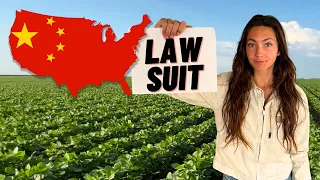
I never thought I was going to lose this much money this fast. For a large corporate farm and an adjustment period may mean one thing. If you're a small to medium-sized family farmer, it may mean something completely separate.
President Trump's trade wars affecting America's ports. Container shipment bookings are down nearly 50% from a year ago. Top US farm export to China is soybeans.
Fox 6's Ashley Sears shows us the impact right here on the Badger State. Some crashes allowed. All sparks and fire and steel.
Others are quiet. They unfold acre by acre, contract by contract, until a nation built on agriculture suddenly finds itself with full silos, idle trucks, and no one left to buy. This is that second kind of crash.
It is not on fire, but it is falling apart. As of today, June 3rd, 2025, American agriculture is facing its most devastating export crisis in decades. One by one, the global buyers who once turned to the United States for grain, meat, soy, and feed are now walking away.
The headlines say it all. Sorghum shipments down 94%. Wheat contracts canled.
Soybeans stalled in silos. Beef left without a market. And at the center of it all, farmers confused, betrayed, and increasingly desperate.
Before we continue, hit that like button to help us beat the YouTube algorithm and to show your support. This is not about one commodity. This is about a system collapsing in real time.
And it starts with sorghum. Last year, China imported over 1. 4 million metric tons of US sorghum during the first 2 months alone.
This year, barely 78,000. That is a 94% collapse. The kind of number that does not just hurt a business, it wipes one out.
For years, US sorghum was grown almost entirely for one buyer, China. From Kansas to Texas, farmers planted and harvested for a single overseas customer. But in early 2025, that customer disappeared.
Tariffs rose, licenses were frozen, orders stopped, the ships stayed in port, and now fields that were once among the most reliable profit centers in American farming have become liability zones. Farmers are scrambling. Some are rotating into corn or millet.
Others are trying to broker domestic ethanol contracts, but none of those options replace the billions once generated by Chinese trade. This was not a market dip. This was an erasia and yet it was just the beginning.
Across the plains, another storm has been brewing. At grain terminals in North Dakota, Montana, and the wheat belt of the central United States, exporters are witnessing something unprecedented. More orders being cancelled than created.
For the week ending May 22nd, net wheat sales were negative. The world is not buying American wheat. It is backing out.
the Philippines, South Korea, even unnamed importers, all walked away. They cited better deals from Russia, lower freight from Australia, faster turnaround from Eastern Europe. One exporter described it as market cannibalism.
Everyone is undercutting everyone else, and the United States with its higher costs and now uncertain trade outlook is being priced out. For wheat farmers, this is catastrophic. Many planted last fall with contracts already arranged, only to see those buyers vanish in spring.
Others are still holding unsold inventory from last year, hoping for a price rebound that may never come. And yet, even that pales in comparison to what China did next. On a single day in early March, Beijing retaliated against recent US tariff hikes by launching a new barrage of restrictions.
They called it routine. They cited pests and contamination, but the message was unmistakable. US agriculture was the target.
Overnight, China canled the soybean import licenses of three major American grain exporters. It suspended all log imports from the United States and it introduced new tariffs 10 to 20% on over $21 billion in American farm products. Soya, wheat, meat, cotton gone.
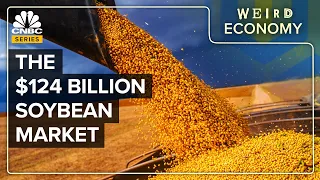
For soybean farmers, the blow was existential. Half of all US soybean exports go to China. Without that buyer, there is no fall back.
Brazil is already expanding to fill the gap. Argentina is picking up new clients. Meanwhile, in the US, soybean prices are falling, inventory is rising, and storage is filling fast.
In Iowa and Illinois, grain elevators are taking in more than they can sell. Farmers are asking how much longer they can hold out, and for many, the answer is not long. But the worst may still be coming.
In Nebraska, Georgia, and Wisconsin, meat processors are sounding the alarm. Their export licenses to ship to China are expiring. Normally, those licenses are renewed automatically.
This time, they are not. As of now, 2/3 of all American meat plants registered to ship to China are at risk of being delisted. No license means no shipment.
No shipment means no revenue. And when you are shipping perishable goods, beef, pork, poultry, you cannot afford to guess. Already port delays are rising.
Containers full of meat are being held up in Shanghai. Chinese customs agents are escalating inspections. Some containers are being rerouted.
Others are being rejected entirely. Joe Schuler of the US Meat Export Federation put it bluntly. This is dire.
The risk involved in shipping right now is unacceptable. For ranchers, the problem is snowballing. Many had finally stabilized after the disruptions of 2020, only to now face another cliff.
Beef raised for Chinese buyers has no other home. Pork processed for export cannot just pivot to domestic markets without a price collapse. Poultry is in the same trap.
Meanwhile, the ports that once funneled billions in US agricultural goods to the world are now falling silent. In Oregon, agricultural export volume is down 51%. In Tacoma, it is down 28.
In Los Angeles and Savannah, both ports key to grain and meat exports. Volume is down double digits. Even East Coast facilities like Norfolk are losing traffic.
Logistics companies describe the situation as a choke hold with fewer imports coming in due to tariff retaliation. Fewer containers are available for exports that creates a domino effect. Goods cannot move, contracts cannot be fulfilled, exporters lose leverage, and farmers lose hope.
The impact is everywhere. In Kansas, a sorghum farmer is storing last year's harvest in makeshift bins. He had a deal with a Chinese importer, now gone.
In Montana, a wheat cooperative is slashing jobs. Too many buyers canled. Too few came back.
In Iowa, a meat packing facility just told its second shift not to return next week. The orders dried up. In rural Missouri, a soybean farmer explained the reality.
We are growing food for a world that no longer wants to buy from us. That sentiment is spreading. At the American Farm Bureau, President Zippy Duval issued a warning.
For the third straight year, farmers are losing money on nearly every major crop. With tariffs rising and markets closing, we are facing a burden many farmers may not survive. But this is not just a trade dispute.
This is a systemic shift. During the 1970s and 80s, the United States controlled over 80% of global soybean exports. Today that number is under 30.
In wheat it, it has dropped from 44% to just 11. America's dominance in agricultural exports is not just shrinking, it is evaporating. Part of that is due to rising competition.
Brazil now leads in soybeans. Russia is the new wheat king. Even Vietnam is expanding its rice and pork exports, but the rest is due to perception.
Buyers see the United States as unstable. Tariffs change, licenses vanish, policies swing. Why risk it?
And so they look elsewhere. The consequences are cascading. Fertilizer prices are up due to new duties on Canadian imports.
Equipment costs are rising. Farm input loans are tightening. All while commodity prices drop.
The math is brutal. Farmers are paying more to grow food and getting less for selling it. And even when they can sell, the shipment may not go through.
The contract may fall apart. The buyer may find a cheaper deal elsewhere. Meanwhile, federal aid is stuck in debates.
Subsidy programs take months. Emergency relief is tangled in bureaucracy. Crop insurance does not cover trade policy.
And yet, every day, the silos fill higher. Before we continue, hit that subscribe button to show your support to the channel. Analysts now fear a second farm crisis, one that could rival the collapse of the 1980s.
Then it was debt and inflation. Now it is trade and market loss. But the result could be the same.
Ghost farms, empty towns, equipment repossessions, generational farms sold at auction. And it is not just farmers, grain haulers, port operators, feed manufacturers, a lenders, rural clinics, all are connected to the health of farm exports. When the orders stop, the layoffs begin.
When the shipments slow, the funding dries up. When the buyers leave, the system weakens. From the 94% collapse in sorghum exports to the wave of canceled wheat orders.
From China's targeted strikes on soy, logs, and meat to the frozen approvals for meat processing to the choked ports of Oregon, Tacoma, and Savannah, America's agricultural crisis is not coming. It is here. And unless something changes fast, it is going to get worse.
If you found this video insightful, hit the like button, subscribe, and ring the bell so you never miss what comes next. Drp a comment below which part of this farm export collapse shocked you the most.