Welcome to week two the of Christian ethics. As we start to walk through this, we're going to begin to see a more clear picture of what it is to be a Christian and to live with ethics. So this week we're going to talk about the image of God and human responsibility.
So let me let me give you kind of the big idea and and it's this. Ethics begins with identity and not rules. Often times we think of ethics as being the rules and regulations, the social contracts that help us to stay with inside the social norms.
But the reality is Christian ethics does not start with rules. It starts with created identity. Human beings are made in the image of God to represent him.
And so ethical question is this. Are we being faithful representatives to our maker? What is our use of power?
What is our use of work? What is our use of words or or relationships? Do those reflect God or do those things fall into a category that I like to call idolatry?
Because idolatry is anything that takes the place of God. Power can take the place of God. work, words, relationships, these things instead of reflecting God often times take the place of God.
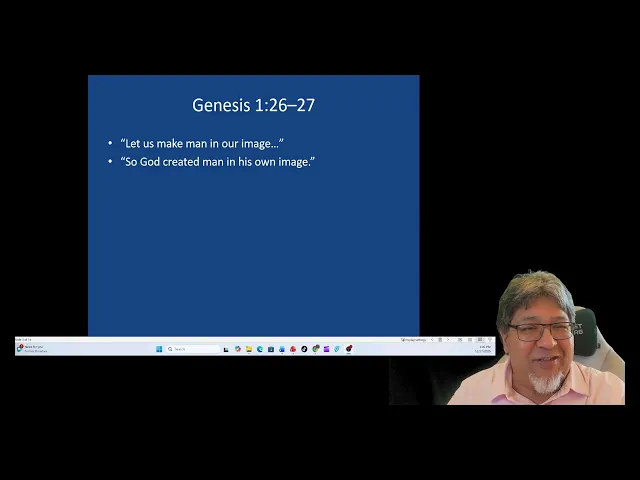
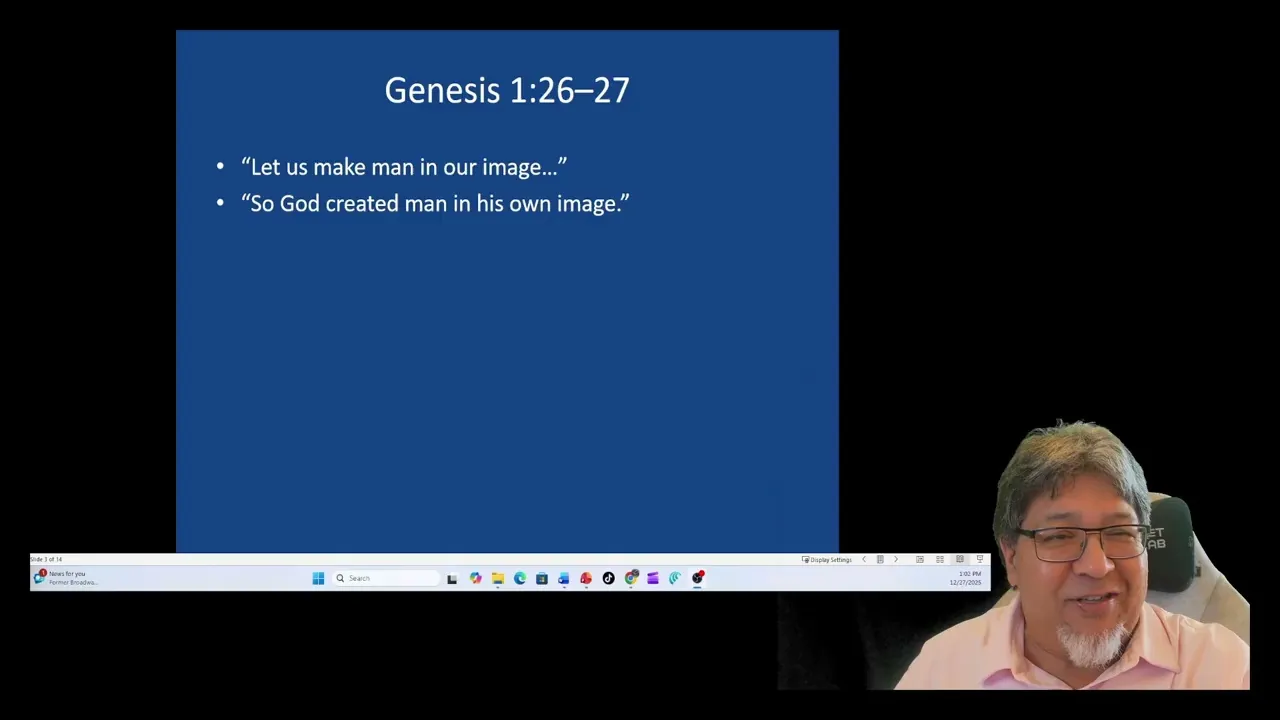
And so let's look, let's begin this week's journey by looking at the first thing which is Genesis 1 26-27. And just to shorten it, we won't read it, but it says, "Let us make man in our image, after our likeness. " And verse 27, "So God created man, in his own image.
" We really don't know what that means because we haven't thought that through. Ethics begins with identity and with calling, not moral performance or ruleskeeping. And so I want you to keep this scripture in mind as we begin to walk through uh this lesson on Christian ethics.
Again, we're talking about the image of God and human responsibility. We are made in the image of God. And so we have these assumptions just like I have assumptions when I come home and you know I have an assumption that the house will be open and I can go to my chair.
I have an assumption that I can turn the TV on, that my dog will come over and that I will have uh a time of rest. I have these assumptions. We have assumptions also.
We assume ethics is about something added later on to life. Something that goes like this. Rules are bolted onto life.
But if you look at the book of Genesis, you have to understand that Genesis does not treat ethics as kind of an add-on. We have this idea of life and wisdom and power and all these other things. And the add-on is they have some rules to keep us in line.
But God establishes this thing called identity first before he begins to instruct us. And that order is the first moral lesson. You don't behave any way that you want to.
You behave according to your relationship with God and you behave according to your worth. You live out of a calling that you've already been given. Now, let me stop there for a minute.
If you're a believer in Christ Jesus and you know Jesus as your Lord and Savior, all of you have been giving a calling. I was given a calling to be a pastor for years and then plant churches and then pastoring again and then being a professor. That's a calling that God had already given me.
You also have a calling and your life has to be lived outside inside that calling inside God's identity. But when life gets to be just rules, then what will happen is you'll start to become defensive because either you will be performative or you'll hide or you'll begin to compare yourself to others. See, when you have these rules and they're they're set up in this hierarchy, either you're going to perform and you're going to be miserable, or you're going to hide and you're going to be miserable, or you're going to begin to compare yourself to others and then you really be miserable because there's always somebody bigger, stronger, smarter, better looking.
So, ethics has to become and begin with identity. People can actually be formed. You can be formed by God.
You can learn faithfulness without living in this self-justification uh justifying yourself. You can live in the graciousness and the wonder and the beauty of God and not have to even worry about yourself. So let's let's look at a couple things.
Let's look at what God said. He said, "Let us make man. " Huh?
Genesis 1:26. This is the first ethical ground we see in God's word. God initiates.
Humans don't generate themselves. You don't generate yourself. They don't define themselves.
They don't authorize themselves. So ethics is not about your human willpower. It's about God's claim on the creature he made.
God has a claim on your life. You belong to God and he has a claim on your life. And you have to understand that we talked about covenant.
God has bound himself to us. We are bound to him. My wife and I have been married for 48 years.
She has a claim on my life. God made you. And if the creator begins with let us make, then the creature begins with this sentence.
I belong to him and that changes the emotion. In fact, it takes all the emotional out of it. And then it takes the emotional temperature out of it because it removes two things.
Pride because there's nothing for us to be proud about and despair because there's nothing for us to despair because we are going to do things in the power of God. And so there's nothing for us to to despair at all. And you can't stand alone.
You have to stand in the power of God. And pride can't stand because worth was not earned. You will never live your life the way that God wants you to if you think that your worth is earned.
In other words, if you're performance-based, you can never be a performance-based Christian and understand what God is trying to say to you because you will always make your life transactional. I do something and then God does something for me. I do this for God and then I expect him to do something else for me.
But when we when we take ethics and we connect it to relationship, pride and despair go away. And pride can't stand because again your worth is given. Your worth is given.
It isn't earned. And despair can't stand because worth is given. Before failure even existed is Isn't that pretty wonderful?
Before failure even existed, worth was given to you by God. So being an ethical reflection with God's ownership of human life takes all the pressure off of you. You need to reflect on that.
It's not your human performance that God God wants. Now, understand something. There is image before instruction.
God said something and here's here's the thing. Let's make man in our image after our likeness. And so that's a if you miss that, if you miss what that means, you're going to miss the whole message of what God's trying to say in the Bible.
Image means representation. Let us make man. Let's make man so he can represent us.
In the ancient world, an image was placed wherever a ruler a ruler wanted his authority to be visible. If he wanted his authority to be vis visible in the city, he would put an image of himself there. That image wasn't the ruler, but it made the ruler present.
Genesis is telling us human beings are placed in the world to make God's rule visible, not by domination, but by faithful representation. And that's why ethics is not merely a right versus wrong thing. Ethics is a question of resemblance.
Does this action that I'm about to do sound like God? Does it have his fingerprints? Does it have his ideas?
Does it sound like God? It's not merely right or wrong. Does this represent God faithfully in my name in my neighborhood?
Does it smell like God? Does it move life towards truth towards neighbor good? In other words, does it move your life towards making sure your neighbor's life is good?
Or does it move life towards a thing called distortion? Because I want to tell you that outside of Christ, outside of our image, outside of our relationship to God, everything is distorted. Does this choice represent God faithfully?
That's Christian ethics. Does this choice represent God faithfully? Now, the second thing God said is this or so what the Bible says to us is so God created.
So God created. Isn't that amazing? God created.
And if you understand what that is, that power is entrusted to his representatives. Now, createdness sets limits. There's no doubt about it.
We are dependent beings. We have to depend on God. We live under meaning before we ever feel meaning.
We live under, now listen, I know this is going to be hard. We live under meaning before we can feel meaning. In other words, we live in God.
We don't live within the emotional constructs that the society puts up. And then we when we live in God and begin to build our obedience through understanding identity, then there the the feelings will come. But the modern assumption is that ethics comes from personal preference.
In other words, I can do things as long it's my as it's my personal preference. See, being created doesn't invent moral reality. Being created doesn't invent moral reality.
it responds to it. So when one of my students says my my truth, this is my truth, I always laugh because there's only one real truth. If your truth matches up to God's truth, then it's truth.
But so often my truth is just my personal preferences. So, Genesis quietly says you're created and it's creature truth. Not as an insult.
God's not insulting you. He's not saying that you're don't have worth, but that's just the reality. We respond to the creator's design, not self-defin under pressure.
In other words, we respond to the word of God and to the things of God because we have relationship with him. And so we don't have self-defined rules and regulations that are pressured or put upon us by a society or even a pastor for that matter if he's if it's outside of God's word. We have to reject this thing called autonomy.
We have to reject that because there is no autonomy for a Christian. We can't live and move and breathe in and in and of ourselves. The Bible, Paul said, Ephesians, we move and breathe in Christ.
We move and breathe in him. And that's always the starting point, the moral starting point. We have to submit to God's created order.
And so what we have to understand is ethics begins with created identity. God created a family. He wanted a family.
He wanted you in the family. He brings you into the family and you have an identity. People will often say to me, "Well, I'm a pastor.
" No, that's what you do. I'm a father. No, that's what you do.
I'm a this, I'm a husband, I'm this, I'm that. Those are things you do. But what you are is a child of God if you know Christ as your Lord and Savior.
And so our lives, our ethics are faithful responses to the calling. Remember we talked about God has given each of you a calling to a calling. It's not a strategy for selfjustification.
And that's something we have to understand. So if we think through this, God made us in his image after he said, "Let us make man in our image after our likeness. " Genesis 1:26.
And that means that we are images. We are images of God. And that doesn't give us a choice.
But what it does do is it shows us and it moves us towards representing God faithfully. Now when I say God doesn't give us a choice, what I'm saying is this. You have the choice to disobey God.
But if you're going to obey God in ways that are pleasing and are going to be effective, then you have no choice but to represent God faithfully. Because when we represent God faithfully, he does the work. He do he empowers us.
We can't do it in and of ourselves and we know that. But we have to represent God faithfully and he will do it and he will work in us. And then God so created God created.
That's a wonderful thing because creation tells us that we have power entrusted to us. We are his images. He created images.
And so as we are his imagers, we also have been entrusted with authority. And that authority has to show itself out in a faithful response to the calling that God has given you. And God has given every single one of you a calling.
And so you can't take that calling and be effective unless you have decided that you're going to faithfully represent God and have this thing called Christian ethics. And so God calls us to be faithful and follow him faithfully. And when we do that, then we begin to get our hands and our minds around what Christian ethics.
So having identified the fact that Christian moral life is a faithful response to uh calling and not a strategy of self-justification, we we have to move a little bit to the image of God. And so there there are three words that we want to think through and one is representation and then power and then responsibility. You see, being made in God's image entrusts human beings with real power that must be exercised under God for life and your neighbor's good.
Let me say it again because we don't we don't really understand that being made in God's image entrusts human beings with real power that must be exercised under God for life and the good of our neighbor. Real power. You do have real power.
Now the anchor to that in scripture is Genesis 1:26 and 27. And we have to understand that God said, "Let us make man in our image. " And then in verse 26, he says, "Let them have dominion.
" And then verse 28 said, "God bless them. " And so let let's look through that and think through that for a minute. Let us make man in our image.
And we talked about the three words which are representation, power, and responsibility. Let us make man in our image. U that's an amazing that's an amazing thing about representing God.
We're made in the image of God and that's the representation that we have. an incredible responsibility to represent God because we're made in his image. And then he said, "Let us have dominion.
" That's power. The God has given us dominion. And then God blessed them and said to them, "Be fruitful and multiply.
" And that means that we have to absolutely understand our responsibility. You see, the book of Genesis ties image and dominion together. And that what that means what that means for us is that power is not accidental for humanity.
It's part of their vocation. It's part of the work that God's given them. But dominion is not ownership.
Ownership belongs to God. Dominion is delegated authority under God. We have nothing without God.
We have no power. We have no mental capacities. We have nothing without God.
And the ethical danger is when delegated power forgets that it's delegated. In other words, we forget who we are. We forget why we're here.
We forget all kinds of things and we allow our own ego to get in the way to think that we are something. Now, we are something in God. I'm not trying to tell you uh that there's this worm theology, but what I am saying is whatever we have has been delegated to us by the living God.
And stewardship turns into control and dominion when we begin to protect ourselves. when we begin to forget where we came from. And so the governing section is this.
The governing in in this thought that we're in, the governing scripture is Genesis 1 26-28. You know, God starts out and says, "Let us make man in our image. " Power begins in God's decision, not our capability.
We had no capability of having power. What matters is we have to understand that because our power is delegated, it has to remove all it has to remove all of the illusion that we are right, that we are powerful in and of ourselves. Authority is not morally valid just because it's strong.
In other words, you might be strong, but it's not valid that you can just do whatever you want in any way that you want. It's moral accountability. And we're morally accountable to God because God has entrusted us with his image, with this power, with this responsibility.
And because we are a mood, we bear the image of God and we have the power that God gives us, that makes us answerable to the one whose image we bear. In other words, God said that we are responsible to him. One of the things that I learned as I was growing up was that I had accountability.
And my one of the great things that my parents did in over the years was to realize and realize that they had an accountability to God and that I had accountability to God as a child. And so when I would do things that are wrong, my mom would tell me, "Son, you've not just sinned against us as your parents, but you have an accountability to God. " And and so we're as image bearers, we have to understand that power makes us answerable to the one whose image is being carried.
So if you don't grasp that then you have you're not going to understand how to properly use the influence that God has given you. You're going to act like you have permission to do whatever you want. And you're going to stop treating influence as stewardship and start you will start treating influence with the idea that you are the arbitrator or the judge.
You have to treat authority as entrusted accountability not personal entitlement. Let me say that again. You have to treat the authority that God has given you as entrusted accountability, not personal entitlement.
And then he goes on in the scripture and says, "Let them have dominion. " Now, dominion is real. It's a real thing.
God has given us dominion over the earth uh over the the the the fish and and the plants and the earth itself. And we haven't been really good stewards of the earth. We have polluted.
We have killed one another. We have treated each other with injustice. But don't ever pretend that you're powerless.
Humans shape environment. Humans shape outcome. Humans shape life with their neighbor.
And that's why ethics is required because power now please you must students you got to understand this power multiplies consequences. The moment that we admit dominion, we admit the moral reality that our decisions affect people. I don't mean to crush you or to make you afraid of relationships and decisions, but the effects of your decisions are real.
Dominion means that you can bless or you can crush. Either way, your choices matter. And that's really something that you have to understand.
Your choices matter. And so you have to think through as someone who is a Christian who understands Christian ethics that you evaluate choices by their effect on life, not only by the intention. In other words, you evaluate your decisions on what outcome is going to happen.
What is the effect? Is it a positive effect? Is it a negative effect?
Is it going to build somebody up? Is it going to tear somebody down? Either way, your choices matter and they affect people and you have to be careful of your intentions.
And then in verse 28, God blesses and commands and frames that dominion. See, the direction of the power, the direction of the responsibility is set by God. Blessing isn't a pat on the head.
It's empowerment aimed at fruitfulness that's going to glorify God. When power is used mainly to secure your self-interest, to protect yourself, to guard your status, to guard your image, to preserve your advantage when you take the power of God that God has given you, whether that is to speak or to be a husband or to be a wife or to be whatever is influence in influential. and you use that to protect yourself, to secure yourself, to guard your image, to preserve your advantage.
You're no longer doing what God has called you to do in dominion. He called you to faithfulness. In the Christian ethic, the Christian ethic is how should I live?
God has called me to faithfulness. And fear will always find a justification. When we live in fear, when we live outside of the life that God has made us, we'll begin to justify ourselves.
And that's the whole idea of Christian ethics. It's to call you back to the place where you are inside of the world that God has made. It calls you back to the trajectory or to the place of blessing.
It calls you to live in the life that God has made. It causes you to live outward, not inward. In other words, everything that you have, everything that you do is for others.
And that's really hard for us. See, you see, we we often think that life's about me, about what I want, about what I like. what what do you want?
What do you like? That's that's an interesting thing. Uh is what you want for others.
God has given you many many gifts. We we have this gifting from God and we think it's for me to get rich or to build my influence or my authority or my power and it's not. It's it's to glorify God and to be fruitful so that others will be blessed.
Adam and Eve were put in the garden and the garden was to be expanded through their e ethical work so that people would be blessed so God would be blessed and it's way beyond self. And so dominion is framed by blessing and command. It's the dominion is f framed by the blessing that God has us and the command that God has for us and that command is it was to be fruitful and multiplied to bless other people and ethical power is aimed outward towards life.
It's aimed outward towards others not inwards towards control. And so um we have to realize that uh the image of God is is is is shared and we have to so let's let's look at that for a minute. Uh because the image of God is shared not ranked.
Um no person has more value than another person. And that's hard for us because we we all like to think we're more valuable than let's say the person in jail or the person that we don't particularly care for. We we all think I I'm obviously I have more value than them.
But the reality is that you will never meet a person that God does not love. You will never meet a person that God does not care for. And you will never meet a person that God not that God in the form of Jesus Christ, God the son, the second person of the Godhead, totally God, totally man, has not died for.
And there is dignity in humanity. And that forbids these things called the hierarchy of worth. It forbids that because the lowest person in your church, the one who uh takes out the garbage has just as much dignity as the pastor.
The one who watches the babies has just as much worth as the elders. And so the guiding principle really for us is Genesis 1:27. God created man in his own image.
In the image of God, he created him. Male and female he created them. You see?
And and so make sure you you look at this carefully. God created man in his own image. In the image of God he created him.
Male and female he created them. See the the text names differences but it denies hierarchies. It denies ranking.
See, the Bible refuses at its very foundation to rank people. Even though Adam had headship in the sense of an economy of labor or the economy of uh that relationship, he wasn't higher. He didn't have more worth than Eve.
And so the reality is that this is not just a nice idea. Oh, that's a nice idea that everyone has dignity. It's the moral backbone for understanding justice, labor, wealth, loving your neighbor.
If we don't understand that, if you don't understand that your neighbor has worth, that your neighbor is loved by God, then you're going to have a hard time being within the framework of the life that God has called you and I as Christians. Now let's unpack this a little bit so we begin to understand in the image of God he created him. Please understand this dignity is theological not social.
In other words, dignity comes from God. It doesn't come from society. It doesn't come from your mom or dad.
It doesn't come from the environment. Dignity is shown in God's word to come from God in the image of God. He created them.
If dignity is grounded in usefulness, then the weak become expendable. And that's never right. The weak are never expendable.
But if dignity is grounded in the image of God in the mongod, then the weak become protected. Our job in the ethics of Christianity is to protect the weak, to build up the weak. That's why God instructs us to take care of widows and orphans and those that are weaker, to bear one another's burdens, and thus fulfill the law of Christ.
Scriptures ethics doesn't begin with capability. It begins with God's imprint, the creator's imprint in our life in the image of God. And so, Christian ethics can never treat people as tools, whether for profit or for status or for convenience.
We just can't do that. We have to refuse any decision that treats a person as an instrument rather than an image bearer. And that's hard because people are sinful and they disappoint us.
We should never put anybody on a pedestal. Whether it's our dad or mom, whether it's our a pastor or a professor, we are all image bearsers and people are not instruments to be used but image bearsers to be loved and image bearsers to be protected and and image bearsers to be lifted up. And then he goes on in the Bible and he talks about he made them male and female.
That's that's that's amazing. Again, it's regulated. In the image of God, he created him.
Male and female, he created them. There is difference in Christianity. There is difference in the world, but that's not diminishment.
The Bible can name distinctions. Understand this. The Bible can name distinctions without creating a ladder of worth.
Human culture, whether that culture is Chinese or English or Portuguese, they love ladders. We We all love ladders. Genesis doesn't create a ladder.
Genesis says there's a shared image first and there are distinctions within that image but they are all secondary to the dignity that God gives us. In other words, the distinction is secondary to the image. I know in my life I would have been a lot better off had I known and looked at people as image bearsers and not annoyances.
The last ministry that I had in my life was a church in Northern California that was a recovery church. And I want to tell you that the church was 80% full of people who had been on meth, were getting off meth, had been in prison, had been in had had committed heinous crimes, had gotten out of prison, had come to know Jesus. And when they came into the fellowship at Woodland Bible Church, they weren't as smooth and nice as we would like to have in our church.
We all want churches where everything's roses and and every everybody is the same and we laugh and we sing wonderful songs together, but the reality is church is people that are fallen. And one of the things that I had to really grab of hold of as I began to minister there was that these people shared the dignity that I had. And I know that their the image the distinction was that their image had been marred by drugs and and profleate living.
But they were imagers. And as imagers, they were worthy of my love and my and my attention that they would grow in the grace and discipline of the Lord. And it was a wonderful ministry.
God bless that ministry. But I had to learn that. So, the person that comes in without good teeth and their skin isn't good and their hair isn't really great and they don't take as good care of themselves they should, they still have dignity and that's difficult for us.
And so, we need to honor differences without using it as a ladder to rank value. And then we have to understand that if we bear the image of God, we have a shared obligation. All of us have an obligation.
If the image is shared, then Christian ethics is never merely private. My choices do not occur in a vacuum. In other words, I don't do things in a vacuum.
My decisions aren't made in a vacuum. It is never I sin and I only hurt myself. That's just a fallacy.
Neighbor life, life with in the community of Christ is always present in the moral equation. And you have to understand the ethics isn't just how do I stay clean, it's how do I stay faithful towards others. So we have to ask a question and it's an important question.
Who bears the cost? Who bears the cost of this choice? You see, the image is shared.
Ethical life begins with equal dignity and ends excuses for devaluing others. Who bears the cost? We do.
We carry the obligation and we can never forget that. Even after the fall when man sinned, the image of God was destroyed. Was distorted but never destroyed.
The image of God was distorted but not destroyed. Sin distorts human direction but it doesn't erase the image of God. And and we have to understand that the responsibility that we talked about being an imager still remains.
It it's not taken away. Just because we're not what we were in the garden does not mean that the image doesn't remain. You see, we anchor that in in Genesis 5 1-3.
He made him in the likeness of God. And then Adam fathers a son after his image. You you see even after even after the the fall we're still made in the likeness of God distorted imperfect but the image remains.
Now, Genesis shows us as we study the book that after Eden, the image remains, the responsibility remains. There's still power. And one of the things that you have got to understand is that the Bible's really, really, really clear about this.
And I want you to I want you to grasp this. Sin does not make humans worthless. And so many times I've been frustrated in my life and I will say things like, "Oh my dear, what what what a waste of air and space.
" And that's just not true. God refuses the claim that sin makes humans worthless and it doesn't certainly doesn't make them harmless but the image of God remains and what happens is distortion begins to enter into life and that's why we have to have Christian ethics so that there's a formation in our life of how we should live. We don't live in immorality.
We get married. We shouldn't be living together. We don't live without God and without community.
We should be in church. And in that church, which is God's means of reaching the world, we should be loving our community and our world. formation is only possible through Christian ethics as we learn how we should live.
And we have to realize a couple things. We're made in the likeness of God. Let's go back to that because like I said before, the image continues to persist after the fall of man.
And that means that dignity continues to persist after the fall of man. Even though sin is real, even though the distortion is real, the dignity remains. And if you've seen a person who has come out of the gutter, out of prison, out of drugs, and you've seen them transformed by the power of God into this beautiful individual that loves God and wants to serve him, the dignity was already there.
It just blossoms and can be seen. And that's our job. Christian ethics for us is to get that person to that place where they blossom.
And so we can't despise people and we can't excuse people. Scripture doesn't do either. Even though the scripture grounds you in dignity, it does not allow you to deny depravity.
So we have to hold dignity and honesty together when eval when evaluating human behavior. So God goes on to say that man is made in his image after his image. Uh and we see that in Genesis 5:3 and image bearing continues through generations.
This means that human life continues to carry moral weight in history not just in the identic realm but ethics. It goes from Eden to today. And it's not just kind of some nostalgia about a lost world.
It's about true identity. And it's about obedience in a broken world. And so we need to treat moral responsibility as present tense.
In other words, the ethics that God gives us 2,000 years ago, the Bible still remains today. And it's not some kind of ideal world theory. It's about the theory that we have or the the real world present day that we continue the ethics that God has given.
And so we have to live with this thing called distortion. Distortion of the self. And what happens is as man falls there is an inward direction to man.
Now no longer is man looking outward towards the good of others but he's looking inward towards his own good taking care of himself and we have to keep that in mind as we as we live our own lives that our propensity is to take care of ourselves. So after the fall, the ethical issue is not simply that people break rules. The deeper issue is that there's this desire, this collapsing desire.
In other words, this corrupted desire of moving inward of preserving our self and making sure that our self is done first and not preserving our neighbor. And that that shows up everywhere. It shows up in our sense of control and our sense of concealment, blame, domination and ethics is required of us because without ethics we will try to control people.
We'll try to conceal our sin. We'll try to blame others uh for our sin. We'll try to dominate and ethics is really required so that we don't do that.
Because if we look in our world today, we can see that our world is really out of control in that area. So trace the direction of desire in your own life and trace the direction of desire in a biblical sense because that desire has gone from outward to self-p protection from faithfulness to faithful faithlessness and we have to we have a responsibility you know the the image endures in a fallen world and we have to understand ethics trains disorded desires back towards faithfulness. Ethics, get this, ethics trains distorted desires back towards faithfulness.
And so I I want I want you to think through very very clearly about uh the moral weight of being an imager. The the accountability, the push for justice because human life bears God's image. Justice is a moral requirement.
Did you get that? Justice. You got to get this.
Justice is a moral requirement and it's grounded in the dignity of man and the accountability of man to God. Genesis uh chapter 9 5 and six say I will require a reckoning. I I I will um God says for God made man in his own image.
Uh Psalms 88:es 4-6 says what is man that you are mindful of him? And he goes on to say, "You have crowned him with glory and honor, given him dominion. " So dignity has moral weight.
Harming people is very very looked down upon by God. People matter to God. In in Genesis 9, if we begin to tie this together, God begins to tie justice with the image bearer.
And harm is not merely some kind of social disorder. It's an assault on God's representation. Psalms 8 holds the paradox.
Humans are small yet entrusted. They are entrusted with honor and that honor creates responsibility. And when we have Christian ethics, that restrains the power in our life.
And that's really weighty. So we have to understand something. Number one, here's what God said.
I will require a reckoning. Don't forget that accountability is not an option. God demands it.
That means that ethics are not merely personal preference or just some kind of cultural contract. There is a moral seriousness. there is a responsibility to God built into the reality of being a believer in Christ Jesus.
So we have to understand that justice isn't just nice, it's required, it's necessary. And and then God goes on in Genesis 9 said, "For God made man in his own image. " And you can see he's beginning to connect that justice with man.
Justice is required because dignity is is real in people. It's real. Your wife has dignity.
Your children have dignity. Your mom and dad have dignity. Your neighbors have dignity.
And and that image makes life non-negotiable. It's non-negotiable. It's the moral foundation that protects the weak from the strong.
And so we have to let dignity, not power or not profit, set the moral limits. The dignity of man sets those limits, not power, not profit. We have we can't let those things be the deciding forces in our life.
And then God goes on to say uh crown God crowned him with glory and honor. And and honor is granted. It's not earned.
In other words, God granted honor to your wife. God granted honor to your children. God granted honor to you.
And it that means that it comes with responsibility, not entitlement. You're not entitled to throw your weight around. Psalms 8 is not flattering humanity.
It's locating humanity under God's mindful care and delegated trust. So we have to understand that leadership, if we're going to be leaders, that's measured by the safeguards that we put up, the moral dignity that we grant to people, not what we can accumulate. So um we have to just understand that uh the image gives life.
The image of God gives life. It's lifegiving. Uh it it has moral weight.
It it demands justice. It demands restraint. It demands accountability and the use of power.
And so Christ is the true image of God. It's our example. And we we can never forget that the Bible always goes back to Jesus and uh Jesus reveals faithful humanity and Jesus life reorients ethics as discipleship.
I want you to get away from the western conception of ethics and back to the biblical conception be because ethics are always going to resemble Jesus. You know, Colossians 1:15 says that Jesus is the image of the invisible God. The image has a face.
In other words, Jesus reveals God. Everything that God is, we see in Jesus. We see in that faithful imagebearing Christ.
He is the exact representation. He is God. And he lived in this fallen world.
And that means Christian ethics is not about trying harder. It's about disciplehip. But it's about knowing your Bible.
It's about loving your Bible. It's about living your Bible. In other words, the Bible didn't save us, obviously, but we're living the things of God.
We love God. And God never calls us to be like David. God never calls us to be like like uh Solomon.
God never calls us to be like Paul. God calls us to be like him. And he demands his lordship in our life.
And that shapes our character. So he's the invisible image of the invisible God. And he and Jesus shows us who God is.
And and ethics must be tethered to the character of God and revealed in Christ, not just some kind of abstract ideals. Let Christ define what good mean uh define what good means and not cultural uh society or our impulse. And the image of God is embodied in Jesus.
In other words, here we see the real thing about how God wants us to live, not theory. And uh we have to understand that he is the image. It's that image is applied to a person.
So ethics when we see Jesus becomes concrete and we don't just learn principles. We just don't learn principles. We learn a person in Christ Jesus.
And Christ makes ethics visible. Christ could have used his authority very differently than he did. But he spoke truth and he brought justice and kindness and love.
He showed us how people are to be treated. So when you're uncertain, you have to ask yourselves, what would faithful resemblance to Jesus look like here? In other words, how would how would Jesus handle this situation?
And maybe I need to go back and look at how he handled these kinds of situations. And ethics really becomes a a matter of disciplehip. If Christ is the true image, then that's who we that's who we are to follow and to pattern ourselves after.
And it's not just rulekeeping. It's very much deeper than that. Uh it's increased faithfulness, increased res increased resemblance of Jesus.
Not just increased certainty in the rules, it's increased certainty in Christ. And so Christ is the true image. And Jesus shows us faithful humanity.
And because Christ is the true image, Christian ethics is disciplehip. Faithful resemblance expressed in ordinary decisions. In other words, Jesus is part of every aspect of your life.
Okay. Let me let me talk to you real quick about your homework. I want you to read Genesis chapter 1 and 2 and Psalms 8 and Colossians 1 15-20.
So we need to understand that uh uh Genesis here's the reading assignment. Genesis 1:2 Psalms 8 Colossians 1 15 through 20. Now there'll be a short quiz.
It's true and false. It's not going to be that hard, but you will you will have a quiz this week. And I want you to understand that.
Now, next week, we're going to look at the fall and moral distortion. We'll explore uh sin and the distortion that sin brought and the moral struggle of humanity and how Christian ethics account for weakness, failure, and repentance without abandoning responsibility. And so, there are some words that you're going to have to look at like desire, trust, and power turned inward.
And we're going to kind of look through that as we begin to continue to lay the foundation and we'll be building on that with some very exciting things. And so just understand that I know that this sounds kind of unfamiliar to you, but once you begin to read it and understand it, I think uh it's going to make a real difference in your life on how you live and how you feel about God and how you feel about yourself. Uh let me pray for you real quick before uh I let you go today.
Father, I thank you for the students. I pray that you'd bless them and guide them today. May they be conformed to the image of Jesus Christ.
And I pray that you would help each and every one of them to study faithfully, to do their homework, do well on this quiz. And we pray in Jesus name. Amen.
All right. God bless you. I'll see you next week.
And do your homework. Do your reading. Don't worry about the quiz.
You're going to do fine. you're going to do is it's just true and false. If you've paid attention, you won't you won't have any problem.