Hey there guys, Paul here from TheEngineeringMindset. com. In this video we are going to be looking at how heat pumps work.
Now, there are a few variants of heat pumps but in this one, we're gonna be looking at a typical Air Source heat pump. These use a reversing valve to allow both heating and cooling modes. So first of all, the main components you are gonna have, with any system, you'll have an outdoor unit as well as an indoor unit, and then a couple of pipes which are insulated, just connect them all together.
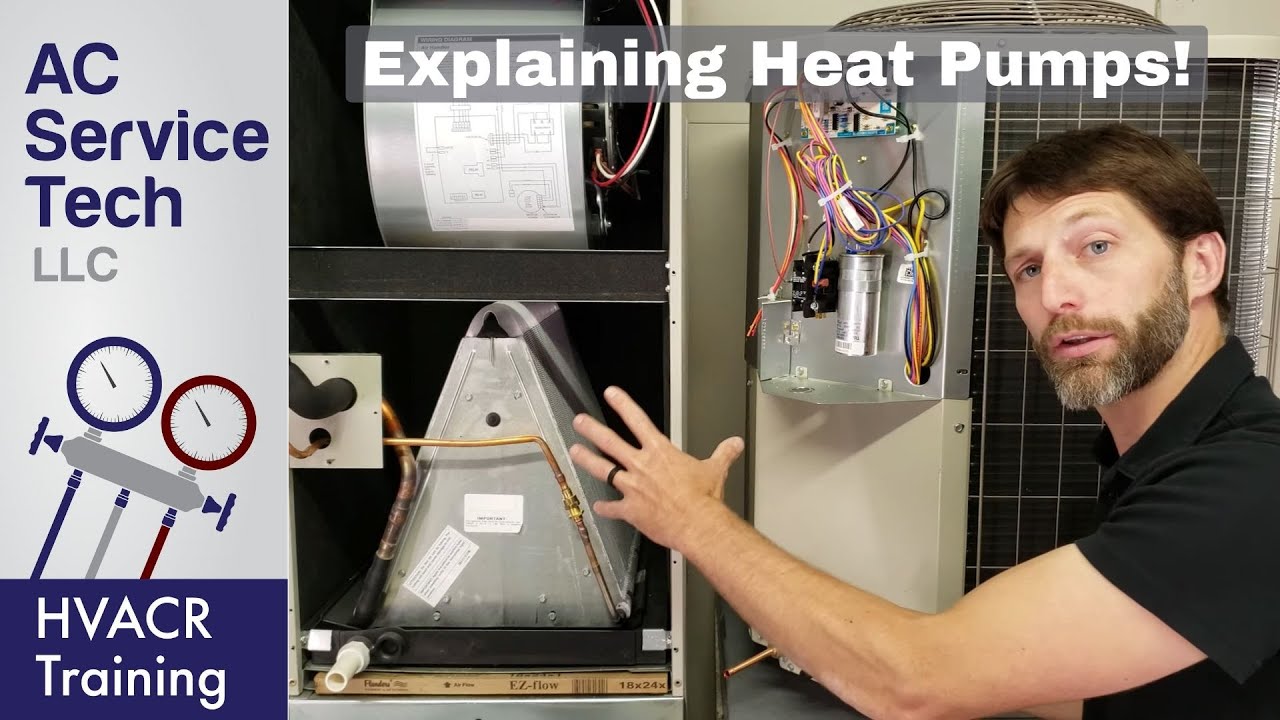
Now, you're heat pump system may look slightly differently, maybe it looks something like this, where you've got the carrier outdoor heat pump as well as your indoor furnace, and then that's just ducted off. So take that and distribute that treated air around the building or home. Now, essentially this system, it doesn't matter the configuration, it all works the same, so don't worry too much about that at the moment.
Let's have a look inside this unit to see the main components and how it works. So if we remove the cover we're gonna see something like this inside. I'll just label up the main components there so you can see what they are.
If we look at the indoor unit first of all. We've got the heat exchanger, then we've got the expansion valve and check valve, and we've also got a fan inside there. Then we've obviously got the insulated pipework which runs and connects to the outdoor unit.
And in the outdoor unit we've got the compressor which is the driving force of all the refrigerant around the system. Then we've got the reversing valve there. We've also got the heat exchanger on the outside, we've also got a much larger fan, and we've got a check valve and expansion valve there too.
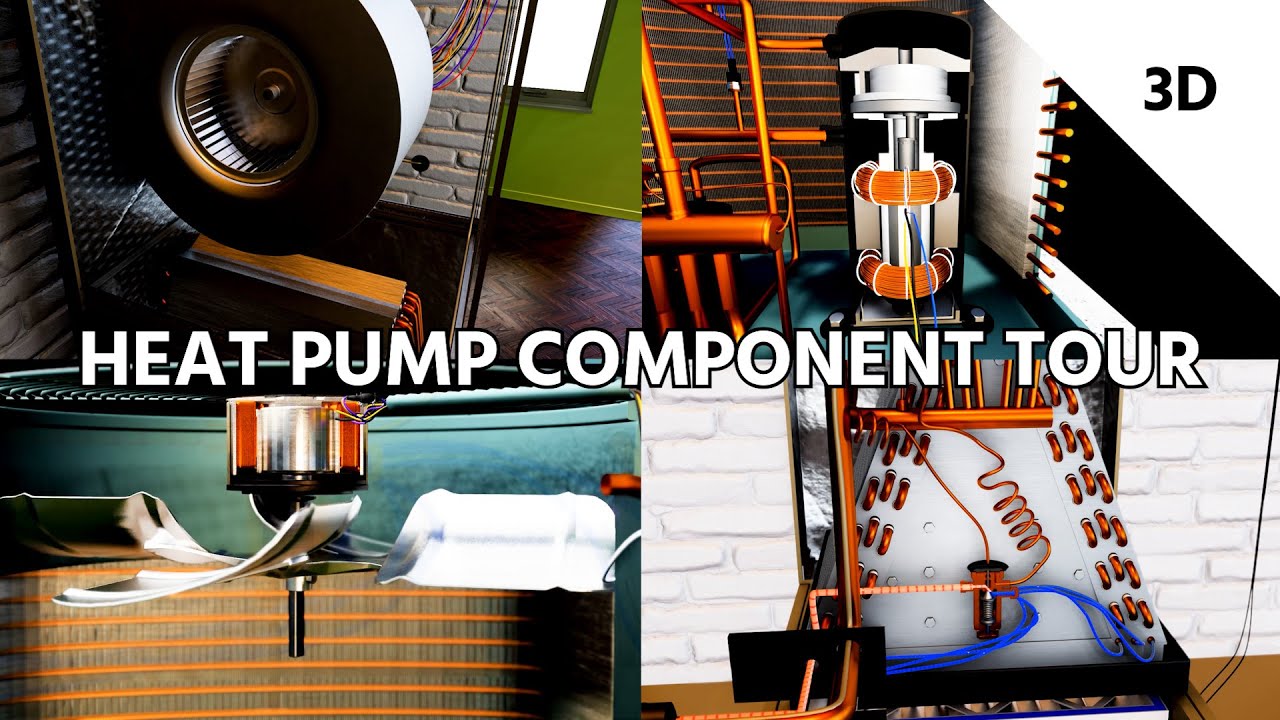
And then just to show you how the real components might look like, so in the outdoor unit we've got the heat exchanger coil there, we've got a check valve, we've also got the expansion valve over here but a bit tight for space there. So we've got a check valve up there and you can see in most of them, they'll have a direction of flow arrow on them. Then we've got the compressor over here, that's the scroll compressor in this case and it's the driving force of the refrigerant around the entire system.
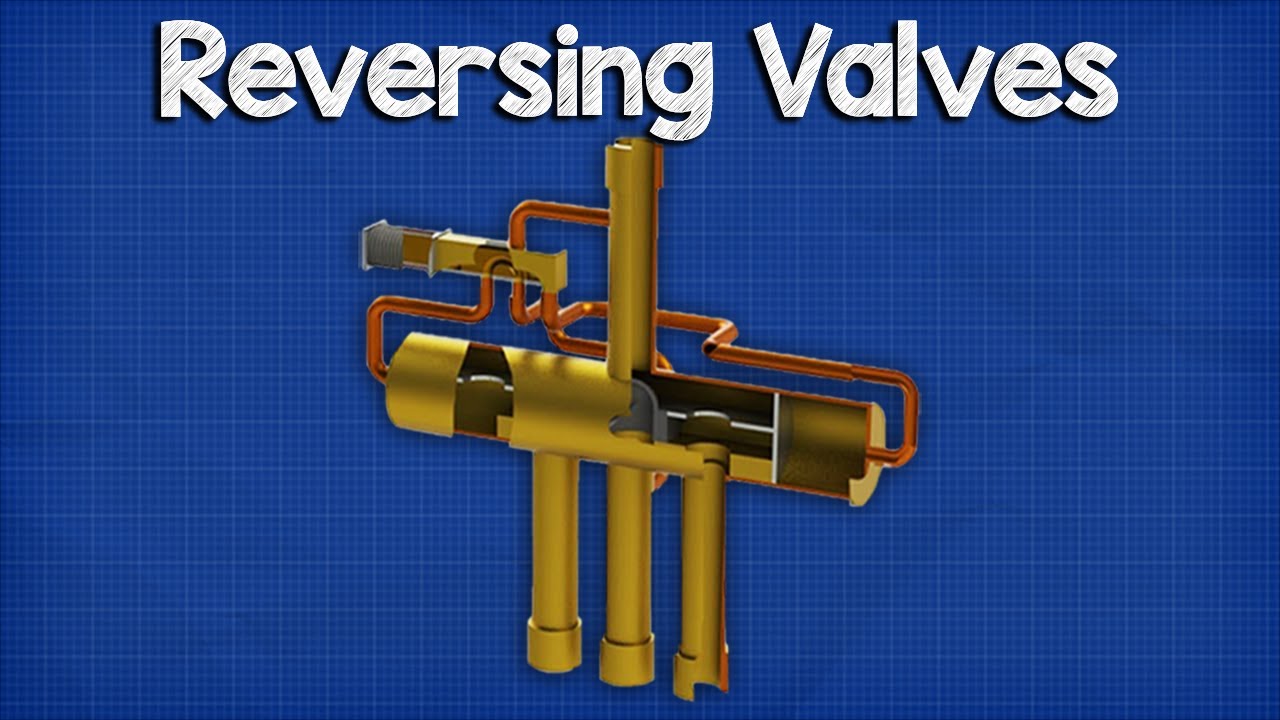
Then we've got the reversing valve here, that's a four-port reversing valve. We're gonna look at the details of how this works in another video. Then we've got the outdoor heat exchanger coil, and as mentioned, we've also got the expansion valve here, which is a thermal expansion valve with a capillary tube attached to that.
Now this is just an example of how the real world components might look. There could be a slight difference, but this is just to help you understand how the system works. So first of all we'll look at how the heat pump works in a cooling mode.
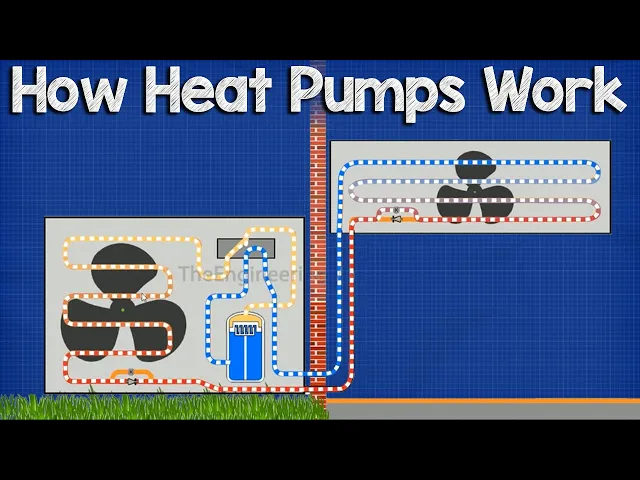
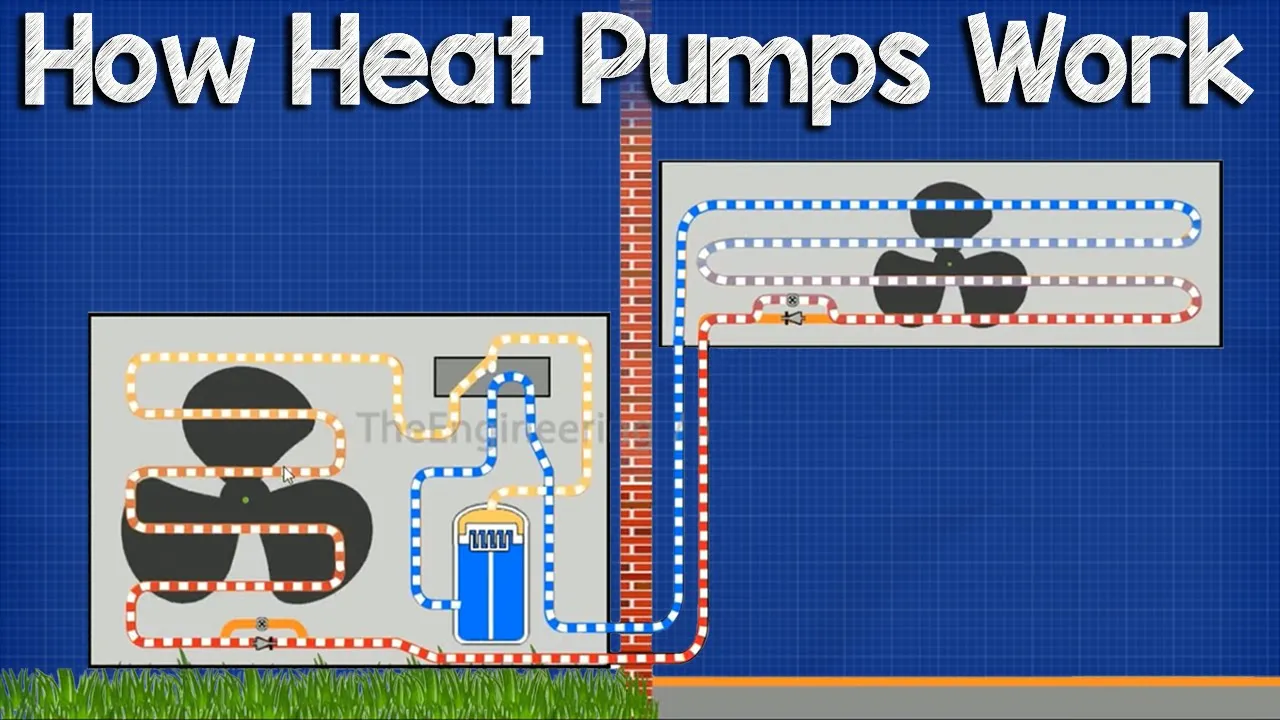
So as you can see, this is just working as a typical air conditioning unit where we've got the indoor unit acting as the evaporator and the outdoor unit acting as the condenser. Now, the refrigerant is leaving the compressor here, and that's leaving us a high pressure, high temperature, saturated vapor. And that heads off, straight up into the top of the reversing valve where the reversing valve will decide which direction it can flow to.
And in this case, it's being diverted and sent straight to the outdoor heat exchanger where the refrigerant will be condensed and it will give up some of its energy, and you can see these arrows here indicating, or showing, that there is air being pulled in by this fan, the outdoor air which is cooler than the temperature of the refrigerant inside the tubes. And some of that energy will be taken away to allow this refrigerant to condense. Remember that the refrigerant always stays within the tubes, it does not leave and the air does not mix with that, they are kept completely separately.
Now the temperature of this refrigerant as it leaves the compressor is much higher than the temperature of the air on the outside. And that is to allow heat exchange to occur. If the refrigerant and the air were the same temperature then no heat transfer would occur and the air conditioning system wouldn't work.
So the greater the temperature difference between the refrigerant and the outside air, the greater the heat exchange can occur. So that refrigerant, as it enters and passes around, it condenses and becomes a liquid so by the time it leaves here and passes through the check valve, so when the refrigerant leaves here and passes through this check valve it will be a high pressure, medium temperature, saturated liquid. And the force of all the refrigerant behind it coming out of this compressor is what's pushing that refrigerant all the way around to the other components in the system.
So in this configuration, the outdoor unit, which is acting as condenser, is there to reject the heat from the system, all the unwanted heat that it'll pick up from the indoor unit will be sent to the compressor and that will push it into the condenser where it will reject that unwanted heat into the air and push that off into the outside world. The fan is just there to help speed up that heat exchange and push that heat out into the world. Now, as that liquid refrigerant is being forced this way up into the indoor unit, it comes along and it hits the check valve, and you can see, it can only flow in the opposite direction, so that will not be allowed to pass through there, instead, it will head over and pass through the expansion valve instead.
The expansion valve will obviously expand the refrigerant so when it leaves the expansion valve it will be a low pressure, low temperature, liquid vapor mixture. And this will be pushed around this heat exchanger and that will begin to pick up some of the thermal energy from this wind, or the air that's being forced across the coil by this fan. So the refrigerant, when it enters into the indoor unit which is acting as an evaporator, it enters there as a liquid vapor mixture but the refrigerant has a very low boiling point so the temperature of the inside air within the building is enough to actually boil this refrigerant and turn it into a saturated vapor.
And that's still being pushed out by all the refrigerant that's been pumped behind it from the compressor so by the time it leaves, by the time the refrigerant passes through there and leaves the evaporator or the indoor unit, the refrigerant is gonna leave as a low pressure, low temperature, saturated vapor, and that's gonna head straight back around into the reversing valve which is currently set to divert the refrigerant off straight back into the compressor. And that refrigerant will then pass through the compressor and repeat the entire cycle. If we now look at how the heat pump would work in heating mode, you can see now, the evaporator is actually.
. . Sorry, the outdoor unit is acting as the evaporator and the indoor unit is acting as the condenser.
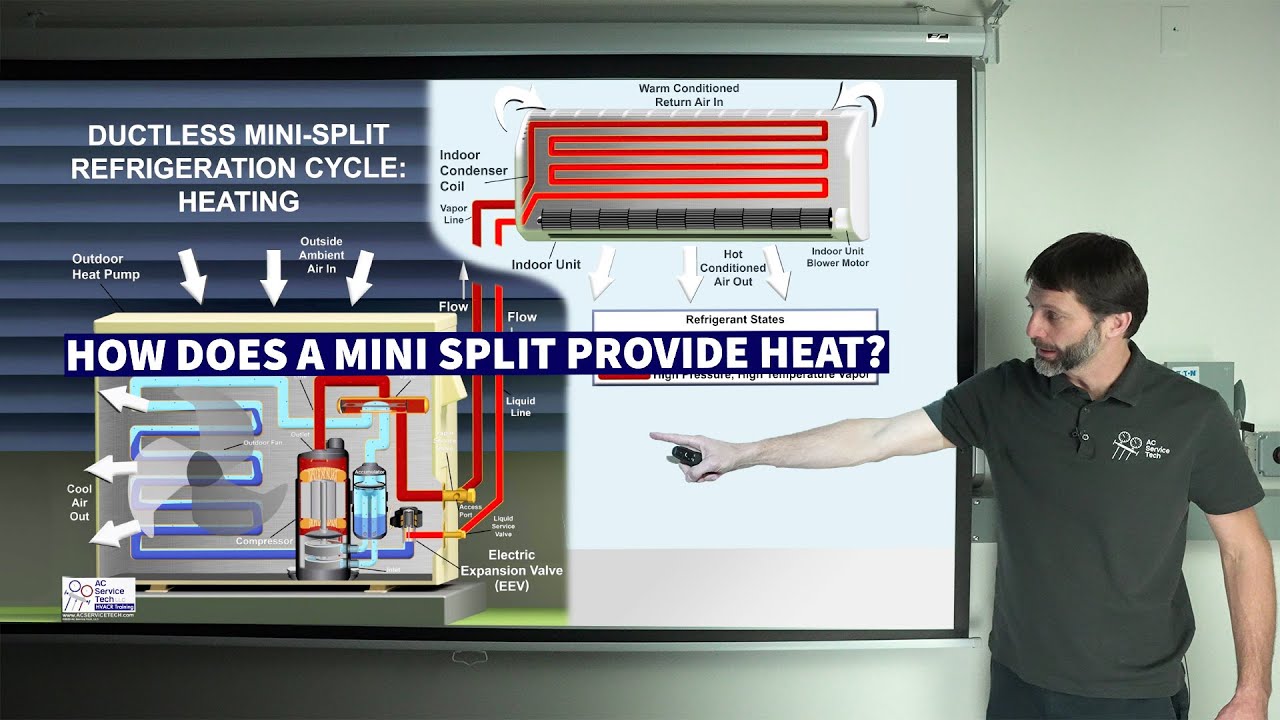
So the refrigerant leaves the compressor, again, as a high pressure, high temperature, super-heated vapor, and this heads straight to the reversing valve where, at the moment, it's being diverted straight towards the indoor unit instead of the outdoor unit. The refrigerant enters a condensor and it enters this as a high pressure, high temperature, super-heated vapor, and this will give up some of its energy to the air which is blowing across the heat exchanger by the fan. This condenses the refrigerant and turns it into a liquid.
By the time the refrigerant leaves the coil, you can see it comes along here and comes towards the check valve and expansion valve, and in this instance it's gonna pass through the check valve because the expansion valve will not let it pass that way, so it will flow through here. So that refrigerant, as it's leaving the coil, and it's passed through the check valve, it will leave there as a high pressure, medium temperature, saturated liquid. And this flows along this liquid line straight down to the outdoor unit.
And you can see here, the check valve will not let that pass so it's gonna go through the expansion valve instead. The expansion valve expands the refrigerant and when that refrigerant passes over the expansion valve it's going to leave as a low pressure, low temperature, liquid vapor mixture. And it's being pushed through this coil all the way to the other side, and it's gonna pick up some of the heat from this air that's being blown across it by the fan.
So that air, the outside air, which is blowing across the outside heat exchanger, that air has enough energy to boil the refrigerant again and that's gonna turn the refrigerant, after it boils it, it'll turn it into a low pressure, low temperature, saturated vapor. And that will then head straight towards the compressor where it will then pass through the compressor and then repeat the entire cycle again. So the refrigerant is picking up that thermal energy from all the air that's outside, taking that to the compressor, the compressor compresses it, and squeezes the air together and forces it out towards the indoor unit.
Now, a lot of people would say, well, what about in the winter time, the air is cold, there's no energy in there, how do you take energy from the air then? Well actually, that air still has a lot of energy in there and certainly enough to be extracted by a heat pump. As long as the air is above minus 273 degrees Celsius, then there is energy in that air which can be extracted, and obviously, we're not gonna be going down to that temperature in our climates.
Now the reason you can extract thermal energy from the air, depending on the temperature, that is because the boiling point of the refrigerant is very low. So if we look at water here, as we know, water boils at 100 degree Celsius, or there abouts, about 212 degrees fahrenheit. Now let's look at some refrigerants using heat pumps.
So, refrigerant R134a, which is very common, so that has a boiling point of minus 26 degrees Celsius, or minus 15 degrees fahrenheit. So that's very low. Then we've got R410A, and that has a boiling point of minus 48 degrees Celsius, or minus 55 degrees fahrenheit.
So obviously, you can see that there's a huge amount of energy in the air because the boiling points of these refrigerants are so low. So as long as you air temperature outside is above these boiling points then you can extract the energy from this air and move it across and into the inside of your building. But heat pumps generally work off of electricity, the compressor is powered by electricity, so the higher the temperature of the air then the greater the efficiency.
So, once you get down to kind of, maybe, just above this boiling point here, then it's not gonna be very cost effective or efficient to actually run this system. However, you can still extract energy. So it will work, it will just cost you quite a lot of money to run it at this temperature.
Alright, that's it for this video. I hope you've enjoyed it and it's helped you. Please don't forget to subscribe, like and share, if you have any comments please leave them in the comments section below.
And also, don't forget to check out the website, TheEngineeringMindset. com. Once again, thank you very much for watching.