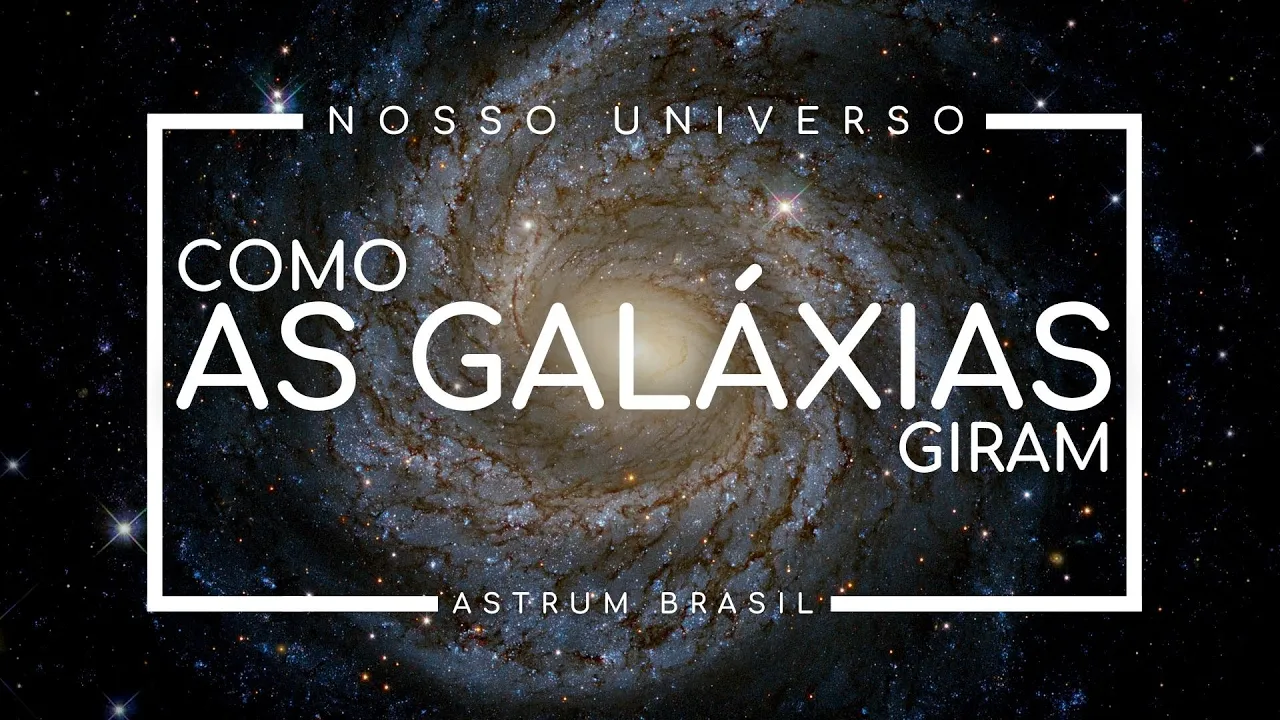
Most of us have seen pictures of galaxies; often objects of glorious appearance with spectacular colors and shapes. However, because they are still images, you may wonder how galaxies rotate. The first obvious thought is that they revolve around an axis, perhaps looking like something spinning that way here.
Would you be surprised if I tell you that this model is totally wrong? For starters, galaxies are not solid objects, but made up of millions to trillions of stars. Each star follows its own orbit, although at least they are often going in the same direction.
But in fact, one of the main reasons why a spiral galaxy does not orbit as the first example is that the angular momentum would wrap its arms in ever narrower spirals. In our observations it is not what we see, so something else is at stake here. The main theory is that these arms are caused by waves of density, which means that the rotation of a galaxy would in fact be so.
Here, the arms remain in place, or at least move extremely slowly as the stars and gas pass through them. Another theory is that the shock waves produced by supernovae and stellar winds are the cause of the arms. These theories may not be mutually exclusive and both processes may be at work here.
Density waves are potentially caused by the stars' own gravity as they orbit after being disturbed by another force. Since the stars have a gravitational influence on each other, a pattern eventually forms where their orbits meet around certain areas of the galaxy. Density waves are seen even in certain parts of Saturn's rings.
Here, you have a ring section that looks like the inside of a tree trunk. But this is not the case. In this region the ring is influenced by the gravity of small shepherd moons nestled within the rings.
What you are really looking at is a tightly closed ring, a bit like a vinyl record or LP. And, just like with a galaxy, this arm keeps the same shape, never getting tighter or looser. Within these arms is where most of the star formation occurs in a spiral galaxy.
Gas and dust within a galaxy also accumulate in these arms, which is why you often see star- forming nebulae dotting your arms. The arms are also brighter, not only because there are more stars here, but also because all the hot, young and bright stars are found in these regions. Since the hottest types of stars are short-lived, when they move away from the arms, many of them will have already burned.
Another interesting phenomenon to do with spiral galaxies is something caused by Dark Matter. At the beginning of the universe, when dark matter was more dispersed, stars within galaxies that are dominated by "normal" matter would orbit much more slowly around the outside of the galaxy than towards the center. However, today the stars are moving much faster near the edge of the galaxy thanks to the influence of dark matter.
Dark matter is mysterious because it can not be seen or observed in any other way than by its gravitational influence. Dark matter appears to have clustered towards the centers of galaxies over time, causing stars to orbit faster than they should around the edge of a galaxy, if only the gravity of normal matter were counted. Other theories also exist about why this could happen, but they would have to change the way we currently understand physics.
Anyway, how do we know about this change in the way stars orbit galaxies? Well, of course, when we look at extremely distant objects, we are in fact looking into the past. Stars within galaxies billions of light years away appear to orbit more slowly than stars much closer to us, and this increases the scale depending on the distance to the galaxy.
But of course, there are exceptions to the rule. Although most galaxies have stars that orbit like this, some were located with main outer arms. An example is NGC 4622, a bizarre galaxy that rotates in the direction pointed by the arms.
This was difficult to accept at first, until smaller inner arms were also found. This unusual galaxy probably experienced a meltdown in its not-too-distant past, which probably caused this phenomenon. Another exception to the rule is the Black Eye Galaxy, which has two counter-rotating disks of gas and dust.
The internal disk, where you can see all the dust streaks, rotates normally, while the gas on this external disk rotates in the opposite direction. Interestingly, the stars in this outer region do not appear to be orbiting retrograde, which means that it is just the gas spinning. It is believed that the gas is still being fed into the galaxy from the intergalactic medium, or that this galaxy has also merged with another extremely gas-rich galaxy.
The last thing I wanted to show you today is the other important category of galaxies: elliptical galaxies. Elliptical galaxies contain stars that are generally much older than those found in spiral galaxies, because the dust strips in these galaxies have run out, meaning that star production has virtually stopped. In these types of galaxies, stars are very independent of each other, following their own elliptical orbits.
Sometimes, galaxies can exhibit characteristics of both types of galaxies, these are known as Lenticular Galaxies. These galaxies have rings of dust that have not yet been fully depleted and look rather ghostly. The formation of stars appears to be a determining factor in keeping the spiral arms defined; because, once the star building blocks are exhausted, we see examples of spiral galaxies losing their definition.
Perhaps the Lenticular Galaxies are the intermediate point between the Spiral Galaxies and the Elliptical Galaxies. So that's it. How galaxies rotate.
Thank you so much for watching. If you liked this video leave a like and subscribe to the channel. This helps a lot to give relevance to the channel and spread the content to a much larger group of people.
Do you want to know what is happening in Astronomy? Discover our social networks: Facebook, Twitter, Instagram and Sparkle. Special thanks to our supporters.
If you want to help the channel with donations, check out our page on the apo. se platform. I will leave all links in the description of this video.
Thank you very much, and until the next video.



![Journey to the Andromeda Galaxy [4K]](https://img.youtube.com/vi/-ybiXR2WCFQ/maxresdefault.jpg)