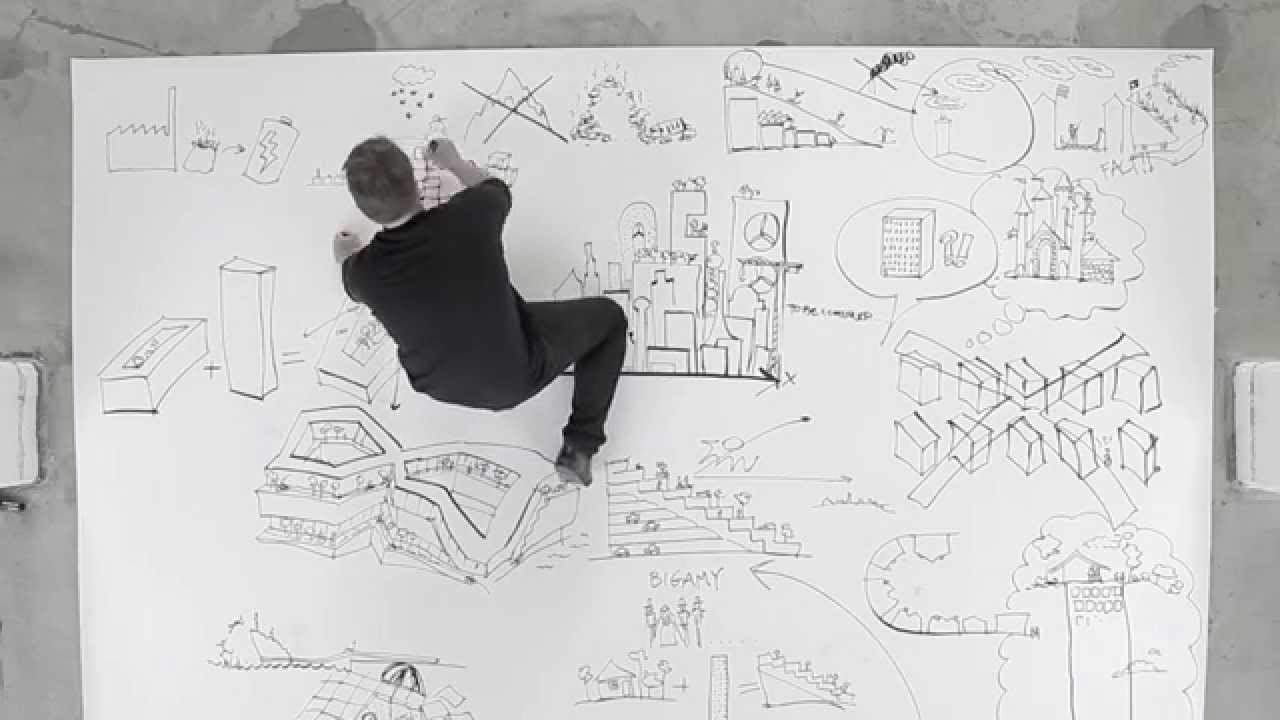
really mentally you always try to start with a you know a clean sheet of paper um or that could be a clean computer screen or a or um or a model shop which has just blocks of foam so so you know what is the start of a of of a project I think that um you know you immerse yourself in all of the things which are important to the project so that's the place the people um those needs the building answers needs some of those needs you can Define you know you can Define the uh
the climate of a place but how do you define the spirit of a place so a lot of the things you can quantify but some of them uh you can't I mean what is the if you're designing for a company you know what is the culture of that company what is the culture of the place so research is important you try and find its values of course yes You observe you listen um and um and and out of these various forces generators um you start to explore a range of possibilities excuse me just one second
so in a way you're you're building up a picture you're building up uh and and projects are very diverse I mean how do you put into the same conversation something like you know a massive viaduct in in um in you know in the south of France in a wild terrain how do you talk about designing a table which may find itself in any kind of location and you've no idea where that location might be or a building which is very very specific to you know to a company or to a city as a public place
the reichstag for example now what what are the things that all of these different projects have in common it's very much a philosophy it's the way that you approach a design challenge is it a kind of spiritual thing also so when you have all done the researches and all and of course it's of the spirit of course yes yes I think it's it's um you know you whilst you are involved with that project and that may be you may be very very close to its Inception you you may be working as part of a wider
team you might be coming in on that project when the germ of the idea is coming together or you might be on the building site and certain things still have to be decided the color of this the shape of that at that time you are totally immersed in it nothing else exists you may be working on however many projects but at that point in time it is you know you are totally captured by that project and you live it you breathe it it's in your head um uh it can be you know in the middle
of the night that that that experience still still continues it's it's um and then uh you move to another project you have to remember that my role on these projects is different now from when it was at the you know 40 years ago in the early days of of where I would be you know doing perhaps um immersed in every aspect of the of the project of course I relate very very closely with all the project but I'm you know it is um it's a large company with an extraordinary um wealth of of talent you
know we have graduates from all over the world the average age of the of the company is 32 and a half we have 45 nationalities uh we work in 22 countries so you know the teamwork is is is important but we have a shared sense of values that is the thing the philosophy the values the beliefs those are the things which tie the projects together and which gives them a very very strong personal it there is any evolution in in the project so that um so that you may be looking say at one building you
look at it in isolation um but when that design finally emerges you model it and so on you can then often relate that to a history of projects and the chances are that it's different but it it learns from the experience of the those other other projects it doesn't copy them but it it it advances the state of of design so if we've been interested in issues of sustainability over nearly 40 years we celebrate our 40th birthday this year um so we plan for the next 40 years which is very exciting but but the theme
of sustainability is I'll be talking this afternoon I'll be showing that maybe you know in the 1970s there were things that we we felt we wanted to do but we didn't have the technology it wasn't available then there was a building for a headquarters for a company called Willis Faber it was a very early um project in with with a very strong ecological agenda but it was also about lifestyle so it'd have swimming pool sunlight would pour in it would have a central space and I I have very very strong recollection of a sketch at
the time and I showed that the the ideal would be that this would be enclosed in a kind of bubble three-dimensional bubble and I wrote on the sketch unfortunately we don't have the technology now to be able to do this and then this afternoon I will make a a jump from that to the library of the Free University in Berlin where the technology was available and this building is as a library not as a office headquarters but is um demonstrably um uh sustainable in terms of the reduction of energy working with nature and I can
show a sequence of the of but in the end those Technologies are not an end in themselves they're a tool um and like anything like a pencil um you know if somebody is highly creative that pencil becomes you know almost like a a spiritual extension of themselves if they don't have those qualities then you know I think that um yes inevitably you're aware of the extent to which in the future buildings will be able to harness energy and will be self-sufficient we can see more and more moves in that direction and without question um as
we've seen it in other artifacts that that will happen there's always that that balance um in the end uh you can dream um as we all do the spiritual dimension of a project um but it's a in a real world with time limits with the constraints of budgets with many different parties involved in a project of course you have to balance that and likewise if you have to do that in a single project then if it's a company which is a global company then of course yes you're always balancing balancing you're always seeking to have
the most creative opportunities but you're also um in that real life situation your your delivering um and and in a way your reputation the reputation of the company is on its ability to be able to to deliver and and to Aspire you're you're known especially in Berlin raar as a quite strict um negotiator is it for you so important important that the line of your work is always visible would you say about yourself um I don't do there are things I don't do any compromises it's a very interesting question and and um and it Demands
a kind of long answer which we don't have time for um I believe that on the Reich stag we um we were working with the politicians the body politic and we were trying to stretch the boundaries so we were saying you know it should have public space It should be socially responsible it should be ecologically responsible it should be um uh it should show a new possible relationship between the politicians and the public you know who they're serving so these were very radical things now you might say well um therefore you never a compromise but
compromise is a strange word I remember that the first competition that we won was for the reichstag with the big roof you may remember it and you know circumstances changed when that competition was announced with a huge uh need for space the political realities had moved on and the project was cut down now at that particular point I remember people saying you still have an appetite for the project how can you because you'll be compromising and I remember saying well I don't think it's a compromise you know circumstances have changed the needs are different I
think that we should work just with the shell of the right St and we have to do the best thing that's possible I don't feel that's compromise some of my colleagues felt it was um if I look back now I have no I have no regrets on it but but depending on how you use the language yes you do you do have to be accommodating do you sometime think about well this might be fashionable for 10 years and in 10 years the people won't like it anymore no I think that you have to somehow find
the inner core values so the building hopefully will have a great lifestyle but it will also um be timeless and the test of that in the end is only time and therefore um if I show projects this afternoon which date back to the early' 70s if you visit those buildings now how well do they weather over time well hopefully thank you