You're sitting in your car outside Target at 9:47 p. m. on a Wednesday, staring at your banking app, trying to figure out if you can afford the $43 worth of stuff in your cart without overdrafting.
Toothpaste, laundry detergent, a birthday card for your nephew, basic stuff. Um, and while you're doing poverty math in a Target parking lot, your coworker Sarah just posted photos from her second vacation this month. Cabo again.
She makes the same salary you do, same job title, same paycheck, same rent in the same city, but somehow she's sipping margaritas on a beach while you're rationing toiletries. So, what the hell is going on? Is she secretly rich?
Did she inherit money? Is she drowning in credit card debt behind Instagram filters? My name is Nick.
And the answer is going to make you unreasonably angry because it's none of those things. R Sera made one boring financial decision six years ago, spent maybe 30 minutes setting it up, and then literally forgot about it. That decision is currently worth $43,000.
In 34 years, it'll be worth $2. 8 million. And the decision costs the same amount you probably spent on Door Dash last month.
If you're tired of watching people who make the same money somehow have completely different lives, hit that subscribe button because today we're going to talk about the math that nobody bothered to teach you in school. Let me introduce you to two people. Person A, we'll call her Jessica.
She's 28, makes $65,000 a year, drives a 2019 Honda Civic she bought used, and her investment account has $47,000 in it. Person B, Amanda, also 28, also makes $65,000, drives a 2024 BMW 3 Series, and her investment account has $3,200 in it. Um, both think they're doing fine.
Both think they have basically the same life. Let's fast forward and watch what actually happens. At age 35, Jessica has $162,000 invested.
Amanda has $31,000. The gap is noticeable, but Amanda's not worried. She's still young.
Um, at age 45, Jessica has $535,000. Amanda has $94,000. Um, now Amanda's starting to panic, but she's got two kids, a bigger house, and even less margin to save.
At age 55, compound interest has officially gone vertical. Jessica has $1. 52 million.
Amanda has $218,000. Amanda is googling how to catch up on retirement at 55 and realizing she needs to save 40% of her income. That's not happening.
At age 65, Jessica has $4. 32 million and retires wealthy. Amanda has $461,000.
She's doing the math and realizing she's working until 72 minimum. Same starting point, same salary. Um, one of them is financially free, the other is trapped.
Um, what did Jessica do differently? She invested $500 every single month starting at age 22. That's it.
$500 into an S&P 500 index fund, automatically withdrawn on the first of every month. And then she forgot the account existed. She checked it maybe once a year, said, "Cool, it's still growing.
" And went back to living her life. Um, Amanda spent that same $500 on a car payment for her entire 20s and 30s. She always had a car payment.
That's the entire difference between $4. 32 million and $461,000. Now, you're thinking, "Okay, Nick, $500 a month is a lot of money.
Where am I supposed to find $500? " Here's where this gets uncomfortable. You already have it.
You're just spending it on things that won't exist in 40 years. The average American spends $273 per month on subscriptions they barely use. Yeah.
Netflix, Hulu, Disney Plus, Spotify, gym memberships they haven't visited in 8 months, apps they forgot they signed up for. That's $273 right there. Then there's dining out and Door Dash, another $280 per month average.
Add those together and you're at $553 without even trying. But here's what that money really costs you. That $280 restaurant budget, if you invested it instead, becomes $632,000 in 30 years at 10% returns.
You're not spending $280 on dinner. You're spending $632,000 on dinner. That $273 subscription budget becomes $616,000.
every single month you're choosing between keeping Netflix and Door Dash or retiring 7 years earlier. Most people don't even realize they're making that choice. Let me show you the math that breaks people's brains.
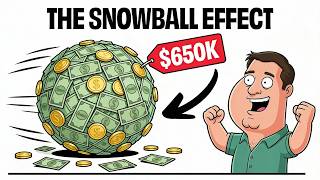
Like, if you invest $500 every month for 40 years in an S&P 500 index fund, you end up with $3. 16 million. Out of that $3.
16 million, you only contributed $240,000 of your own money. The other $2. 92 million, that's 92.
4% of your wealth, came from compound interest. You planted $240,000. The market grew it into 3 million.
After 10 years, you'll have about $12,000. After 20 years, $379,000. After 30 years, $1.
13 million. The first $100,000 takes about 10 years of grinding. But going from $1 million to $2 million only takes 6.
7 more years because your money is now making more money than you're adding. Wait, it gets stupider. Someone invests $5,000 per year from age 25 to 35.
That's 10 years. $50,000 total. Then they stop.
Never add another dollar. At 8% return, they'll have $787,000 at age 65. Um, someone else waits until 35 and invests $5,000 every year for 30 years straight.
They contribute $150,000 total, three times more money. They end up with $611,000. The person who invested for 10 years and stopped beats the person who invested for 30 years by $175,000.
That's compound interest punishing the person who waited even though they did everything right. They just did it a decade too late. Here's where you're probably getting nervous.
But Nick, what if the market crashes? This is the objection that keeps smart people poor. So, let's kill it with data.
The S&P 500 has returned approximately 10% annually since 1926. That's almost 100 years, including the Great Depression where the market dropped 86%. World War II, the 1970s stagflation, the dotcom crash, 2008, and COVID.
Like, through all of that, the average return is still 10%. Uh, after inflation, about 7%. Still enough to turn $500 a month into $1.
3 million. But here's the part that should make you feel better. The S&P 500 has never produced a negative return over any 20-year period.
Not once in history. If you invest consistently for 20 years, you have always made money. Over 30 years, the worst return was 4.
3% annually. Every single crash has recovered. The 2020 COVID crash recovered in 5 months.
2008 took 5. 5 years. And here's the secret nobody tells you.
If you're investing $500 every single month, crashes are your friend. When the market drops 30%, your $500 is buying shares at a 30% discount. Dollar cost averaging automatically buys more when prices are low.
You don't have to time anything. There's data from JP Morgan showing that if you invested $10,000 from 2003 to 2022 and stayed fully invested, you'd have $64,844 if you missed just the 10 best days out of more than 5,000 trading days. Your return drops to $29,78, less than half.
And seven of those 10 best days happened during bare markets. If you panic sold during a crash, you almost certainly missed the recovery. The S&P 500 survived the Great Depression, two world wars, 911 and 2008.
But sure, it probably can't survive you putting in $500 a month. You're the thing that finally breaks capitalism. So, if the math is this obvious, why are 46% of American households sitting on zero retirement savings?
Why is the median 401k balance for people aged 55 to 64 only $88,000? This is where we need to talk about what's actually stopping you. And it's not the math.
It's your brain. Your brain is actively trying to keep you poor. Not because it hates you, um, but because it was designed 200,000 years ago when the biggest financial decision was whether to eat the berries now or save them for tomorrow.
Your brain has no framework for understanding sacrifice $500 today to have $3 million in 40 years. So, it just says, uh, no, eat the berries. And, um, you end up financing a $60,000 truck.
Uh, there's something called present bias. You'd rather have $500 today than $50,000 in 40 years, even though the math is screaming that you're being an idiot. Then there's loss aversion.
The pain of losing $100 is 2. 25 times stronger than the pleasure of gaining $100. This is why um people obsessively check portfolios during crashes and sell at the bottom.
Research shows people who check their accounts once a year or never are far more likely to build wealth. The less you look, the richer you get. And then there's lifestyle inflation.
Every time you get a raise, you immediately upgrade your life to match. nicer apartment, better car, fancier restaurants. Research shows 78% of people say they'll increase savings when they get a raise.
Almost none actually do, unless it's automated. Your brain sees extra money and immediately allocates it to slightly nicer versions of things you already had. Um, but here's what makes me angry about all this.
You know who's making money off your [snorts] inability to save? Everyone. The financial industry makes money when you panic and trade.
They make zero dollars when you buy one index fund and ignore it for 40 years. That's why they'll never tell you the solution is boring. Car dealerships extend loans to seven or eight years so monthly payments look affordable.
Every advertisement is designed to convince you that your $500 belongs with them, not in an index fund. They're stealing your retirement $500 at a time and most people never notice. Okay, you're probably thinking this only works for rich people.
Let me introduce you to a janitor who died with more money than most doctors. Ronald Red was a gas station attendant and janitor in Vermont never made more than $20,000 a year. He'd show up to work in a jacket held together with safety pins.
Drve a 2007 Toyota Yarus with rust eating through the doors. His co-workers joked about how cheap he was. Uh, one guy said, "If Ron earned $50 in a week, he'd probably invest $40 and live on $10.
" Um, Ron died in 2014 at age 92. His lawyer called the local hospital about his will. The hospital was probably expecting $5,000.
Ron left them $4. 8 million. The library got $1.
2 million. His estate was worth over $8 million. The same co-workers who made fun of his rusty Toyota had been working alongside a multi-millionaire for decades and had no idea.
Ron just bought dividend paying stocks every single week for 70 years, never sold. He could have retired at 50, but he liked his job. That's what financial freedom actually looks like.
Sylvia Bloom was a legal secretary in Manhattan who took the subway for 67 years. When lawyers placed stock orders, she'd quietly buy smaller amounts of the same stocks. When she died, she had over $9 million and left $6.
24 million to charity. Grace Groner bought three shares of Abbott Laboratory stock in 1935 for $180. She reinvested every dividend and never sold.
When she died in 2010 at age 100, those three shares had become $7. 2 million. Fidelity now has 595,41K millionaires.
Average contribution rate 14. 1% of salary. Average tenure 26 years.
That's it. The flip side, the median retirement savings for Americans aged 65 to 74 is $200,000. Social Security pays an average of $1,976 per month.
One in five Americans over 65 is still working because they have to. Um, these people worked 40 or 50 years and they're broke. They didn't fail because they were lazy.
They failed because they spent the $500 on car payments and restaurants and things that seemed important but don't exist anymore. People will spend 40 hours researching which $1,200 phone to buy and zero hours figuring out how to turn $240,000 into $3 million. The phone will be worthless in 3 years.
The investment will be worth millions in 40. But hey, at least the camera has good night mode. You know what's wild?
Um, Ronald Reddd died with $8 million. The average doctor dies with $1. 2 million in debt.
Turns out buying a $90,000 BMW every three years costs more than actually being successful. Um, now let me tell you about the fee scam stealing $200,000 from your retirement. If you invest $500 a month for 30 years in a lowcost S&P 500 index fund with a 0.
03% 03% expense ratio, you'll have $1. 124 million. In an actively managed fund charging 1% annually, you'll have $915,000.
Same money, same time, $29,000 difference. That quarter million went to the fund manager for underperforming the index. The funds you want are Simple Fidelity 500 index fund, FX AIX 0.
01, 015%. Vanguard S and P500 ETF VO 0. 03%.
Um, Schwab S and P500 index SWPPX0. 02%. Pick anyone.
They all track the same index and cost almost nothing. Yeah, Mike. Here's what nobody tells you about the $500 you think you don't have.
The average new car payment hits $748 per month in 2025. That payment isn't $748. It's $1.
69 million over 30 years at 10% returns. You're trading $1. 7 million for the privilege of driving something that loses 20% of its value the second you drive it off the lot.
Every $100 per month you invest becomes $226,000 in 30 years. Every $3. 33 per day becomes $250,000.
The money's there. You're spending it on things that'll be gone in 30 years instead of on being a millionaire. Let's talk about accounts.
Roth IRA, you contribute after tax money. Everything grows tax-free forever. The 2026 limit is $625 per month.
On a 1. 13 million portfolio, you save roughly $150,000 to $200,000 in taxes. If you're making under $153,000 single or $242,000 married, max this first.
Um 401k pre-tax contributions. So if you're in the 22% bracket and invest $500 monthly, your paycheck only drops $390. And if your employer matches, which 85 to 98% do, it's free money.
Most common match is 50% on the first 6%. If you make $60,000 and contribute $500 monthly, your employer adds $150 free. So, here's what you actually do.
Step one, open a Roth IRA at Fidelity, Vanguard, or Schwab. Takes 20 minutes. Step two, link your bank and deposit money.
Step three, buy one SNP500 index fund, FX AIX, VO or SWPX. Step four, set up automatic monthly investment of $500. Step five, forget the account exists.
Don't check it every day. Let it compound while you live your life. Look, I can show you all the math.
I can tell you about um janitors who became multi-millionaires and doctors who died broke. Um none of it matters if you don't actually do it. And here's the thing about compound interest.
Every day you wait, the math gets exponentially worse. Right now, $500 a month for 40 years gets you $3. 16 million.
Wait one year, you need $520 per month. Wait 5 years, $690. Wait 10 years, $1,50 per month.
The target moves away faster than you can catch up. There's a version of you that exists 40 years from now. That person is checking their account, seeing $3.
16 million. They're planning retirement. They're not worried about money.
They're not working at 73. They're free. And there's another version.
40 years from now, trying to afford medications, working part-time because social security isn't enough. One emergency away from catastrophe, wondering where the money went. Whilst the answer is car payments and Door Dash and subscriptions that seemed important in 2026, but don't exist anymore.
Both of these people are you. The only thing that determines which one becomes real is what you do in the next 30 minutes. Open the account, set up the transfer, buy the fund, then go live your life while the math works in the background.
Or don't and spend the next 40 years wishing you had. The choice is yours.