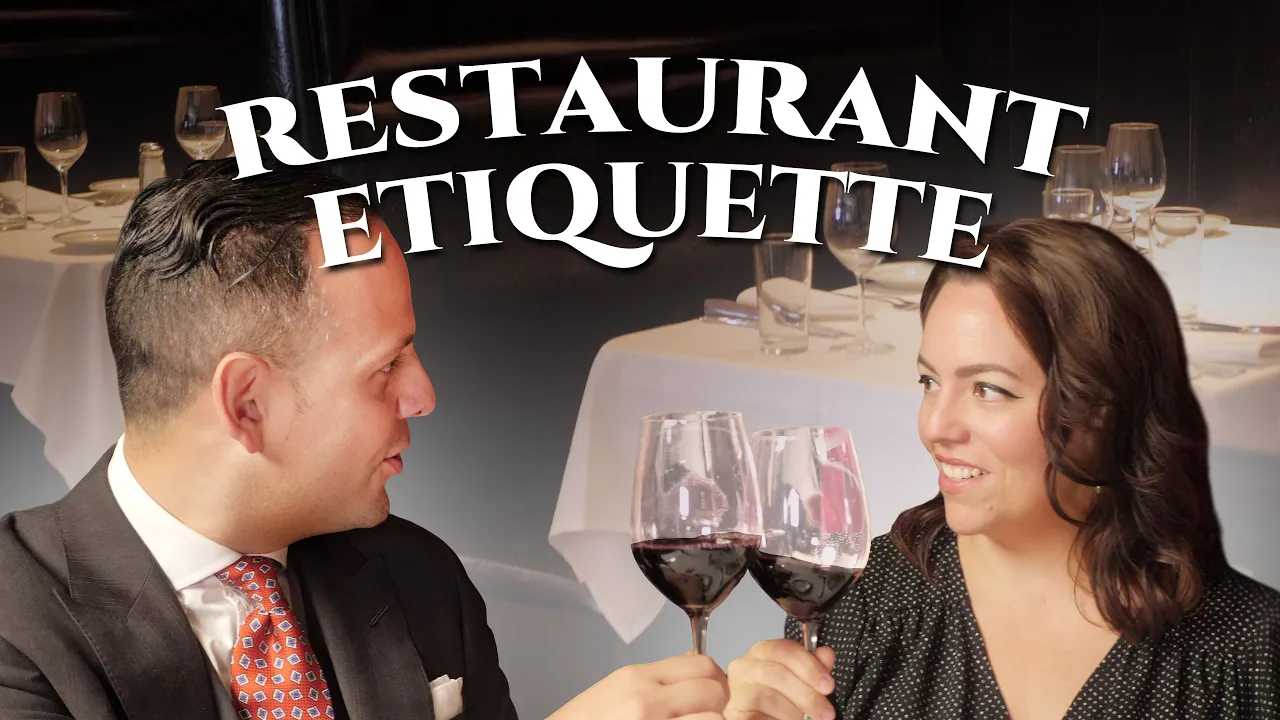
Welcome back to the Gentleman's Gazette in our ongoing series about etiquette. Today, we talk about restaurant etiquette or how to dine out like a gentleman without embarrassing yourself or committing any faux pas. Restaurant dining presents an interesting human dynamic similar to flying in an airplane, you're in a public space and you have to behave in a way so others around you are comfortable and you are, too.
Also, dining in a restaurant represents a lot of a person's etiquette and social skills and because of that, it's very popular with employers to take potential employees or key leadership people out to a restaurant to see how they behave. So without further ado, let's walk through the essential restaurant etiquette that you can apply for business dinner, celebrations, events, or dates. Before you even step inside the restaurant, there are a few things to consider beforehand.
Rule number 1, make sure you can afford it so you don't stretch yourselves too thin, financially. Eating out isn't cheap, especially in a group situation, it can be sometimes awkward to split bills or come up with something so just going to a restaurant with a mindset of ordering water and the cheapest appetizers won't always work. Ideally, budget for eating maybe a small appetizer, and main course, and a beverage.
Also, make sure you have enough for a tip according to local conventions. In the US, that's anywhere from 15 to 25 percent. If you realize this restaurant is not within your budget, either decline the invitation or try to find another restaurant if that's in your power.
You can simply say "I can't make it" or if you're comfortable, you can say "Honestly, it's not within my budget. I'd be more comfortable with going to X restaurant or spending X at the most. " Also, if you've specific food preferences like gluten-free or if you're allergic to seafood or anything else, make sure the restaurant can accommodate that because having a long ordeal with the waiter isn't the best solution.
Most importantly, make a reservation. It's the easiest way to skip a line. If the restaurant doesn't accept the reservation, it's maybe not the best place to go out for a business dinner or a date because it's completely embarrassing to wait with a business guest or a date and you have zero control about how long it's gonna take or not.
So once you've made a reservation, it's important to show up on time. Restaurants typically can just give your table away after 15 minutes and even if you run late, it pays to call them because most restaurants will hold your table. At its core, showing up on time mean you respect other people's time and value it and don't just look at yourself as the most important person in the room.
In today's day and age, it doesn't really matter if the man or the woman enters the restaurant first, though, some women may like it if you hold open the door for them when you walk in. So if there is a host, when entering the restaurant, the host will always lead then followed by the lady, then followed by the gentleman. Traditionally, if there's no host, the gentleman takes the lead, walks in first, and pulls away the chair for the lady so she can sit.
In more traditional places like Germany or Austria, you're more likely to see this kind of etiquette today. In the US, not necessarily so. Two, dress accordingly.
Obviously, at the Gentleman's Gazette, we're big sticklers for that but honestly, in this day and age, it's not that hard to look appropriately dressed for a venue. So what does that mean? At nicer establishments, you should skip the jeans and the sneakers.
Other than that, you're probably going to be fine even without a jacket. These days, most establishments require a jacket or have an even more formal dress code, will have loaner jackets but honestly, you don't want to wear a jacket that's a size too big that's been worn by sweaty people before you. Three, what about coats and hats?
If you live in a colder place, in the winter, it can be really uncomfortable to have people around you throw the two coats over the chairs or in the benches, it just gets crowded and it's uncomfortable. Traditionally, the gentleman takes the lead, helps the lady to take off her overcoat then takes off his and then goes to the waiter and hands them over to them so they can put it up in a wardrobe. If some of the restaurants ask if they can take your coat and hat, just hand it to them, they may hand you a little ticket so you can get it back afterwards.
If no one asks you to take your coat, simply ask where you can hang them. Most restaurants will have a place for that. Ideally, outerwear is away from the table so it doesn't get in the way.
If you're leaving, in a good restaurant, they'll hand you the coats at the table. If that's not the case, as a gentleman, you quickly walk to the wardrobe, you put on your overcoat first and then you help the lady into hers. Four, meeting your fellow diners.
Let's say you're already waiting at a restaurant or maybe the other party is late and you're already sitting, as soon as you see them, you get up from your seat, you stand up and you shake their hand. If you arrive in advance of your dining mates, maybe because they're late or simply because you made it there earlier, you always stand up to greet them and come over. Most Western cultures, that means you give them a handshake, sometimes it means a hug, but it all depends on the culture you're in so be aware about the local habits.
In any case, never stay seated and just give them a handshake because that's not the proper way to do it. Of course, a nice smile also goes along with it and it's much better than someone just stoically looking at you and giving you a handshake without any pressure whatsoever. Five, how do you sit at restaurant?
At home, you may be slouching or just sitting in a way that's comfortable for you. At a restaurant, ideally, you should sit upright but it shouldn't look uptight. So what exactly does that mean?
Ideally, you sit on the entire chair, you have both feet firmly on the ground, and you can lean back and just make sure you're open and not slouching. Your arms should be kept close to your body and not wander around the table. You can totally rest your hands on the table but only up to about the wrists, further down, is traditionally not acceptable.
Under no circumstances should you have your elbows on top of the table. Six, how should you engage with the staff at the restaurant? Chances are you've experienced an unfriendly server who gave you the feeling that you should be lucky to dine in his or her presence.
Regardless of their behavior, it's always best if you react in a calm and polite manner. After all, you belong there, don't give them a reason to think otherwise. If the server has a nametag or if they introduce you with their name, then that is what you should call them.
If you don't know their name or for some reason you forgot it and you want to catch their attention mid dinner, make sure to seek eye contact and give them a very discreet hand gesture. It doesn't mean you should be waving or snapping your fingers or whistling at them, less is more. Also, keep in mind, just because you're paying for a meal doesn't mean you can treat staff like they're worth less than you or in a disrespectful manner.
Confident men always treat others with respect no matter if they're the janitor or if they do any other part of work because it's important and they're just confident enough in their own abilities. To learn more about that, please check out our video on 16 things confident men never do. As always, remember the tone makes the music.
Seven, how and what to order? Ideally, the entire table should have the same number of courses. If you aren't super hungry, talk to the server to figure out what appetizers or entrees are in the smaller side.
A good server will always be able to tell you if something is big or heavy or light and small. If you've been invited as a guest to a restaurant, don't take advantage of that and order the most expensive item on the menu. Instead, mirror with your hosts' orders.
If he orders three courses in the mid-price segment, you'll do the same. If they insist on you ordering first, I would always ask the host if they can recommend anything, if they've been there before, if not, ask the server what's a popular item that's in a medium price range and go from there. Once you've made your selection, close the menu and put the menu down.
In a good restaurant, that is the subtle hint for the server that you've made your choice and he will come to your table. Often, slow service for you at better restaurants are simply based on that little fact that people have their open menu, the servers think they haven't decided yet whereas the customer thinks "Oh why aren't they serving me? " Ideally, you should order off the menu without modifications.
Chefs often put a lot of effort in to the delicate flavors and the combinations of meals. If you just change it out and want a fried chicken on top or ketchup, it just throws it all off. Now, if you're allergic, it's a different deal but again, ideally, you're required to make sure that they can accommodate you before you even visit the restaurant.
Even though the restaurant is not your personal chef, in the US, they will likely try to accommodate your requests to the best of their abilities. On the flipside, in Europe, they might just tell you "no that's not what we do" and they may even tell you if you don't like it, leave. Eight, keep your phone off your table and don't look at your watch all the time.
If you do so, you send a clear message that you have other things on your mind and and that the time with this other person is not important to you. That also means don't pull out your cell phone to quickly check on something or just quickly send a text or check on that email because when you do that, it takes your attention away and it takes a while before you're fully present again. Nine and probably the biggest part, table manners.
If we go through the whole spiel, it'd probably take us 45 minutes, however, we've already done an extensive video about table manners all of which applies here too so please check out that video here. Now, in a restaurant, there are typically a few modifications. First of all, while at a private home, the silverware for the entire meal will be laid out on the table, that's not the case at a restaurant.
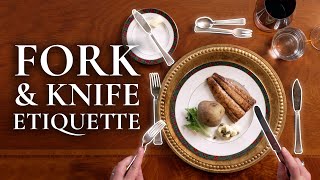
Typically, servers bring you the appropriate silverware for your course, may be the spoon for the soup or a steak knife for the meat. If there is a lot of silverware on the table, it means you start from the outside and work your way in. Also in the US, you will often find two forks and one knife; that means they'll bring you another knife for your main course or sometimes they want you to reuse your knife.
Personally, I always like to have new utensil for every course so I don't mix any flavors. If you need more silverware, simply ask, they are always happy to accommodate you. Just like with many things in life, it pays to understand the culture you're in.
For example, in the UK, it is unacceptable to point the tips of your fork up while you eat. While in Continental Europe or in the US that's perfectly normal and acceptable. There's no absolute right or wrong, it is just something that developed historically over time and it's good for you to be aware of it.
Also historically, the material of blades would give potatoes and particularly fish, an off flavor and because of that, in Europe, they developed a fish knife which was made from a different material and didn't create any off flavors, same with the potatoes. And to this day, it is the proper etiquette to cut your potatoes with your fork and to use a fish knife with fish. Now, in the US, I haven't really observed this kind of etiquette.
Today's blades are all made of stainless steel, there's no off flavoring and so the original reason is not really valid anymore. That being said, when you cut your potatoes with your fork, it leaves an uneven edge which makes it easier to absorb the sauce that comes with it. Now, no matter how you eat or what direction the tips of your fork are pointing at, the fork always moves your food to the mouth and not your mouth to your fork.
Frankly, I find this rule to be the most difficult part of dining and restaurant etiquette because there is a tendency to naturally want to lean forward and meet somewhere in the middle. Also, if you remain upright and you just move your fork to your mouth, it is a lot more difficult to balance and so it always pays to put a napkin onto your lap. For more details about this please check out our table manners video here.
Next, let's talk about timing. You should never start eating or drinking until everyone has been served. Typically, the host or the person who invited you will have the first sip out of the glass and maybe say a toast or thanks you for coming.
When you toast and clink, you say cheers. In Germany and Austria, it is essential to look into each other's eyes, otherwise, the legend goes that you'll have bad sex for seven years. I don't know of any empiric studies but I always look into the other person's eyes because it creates a more personal connection.
If your glass has a stem, you always hold them by the stem because that way, the clink sounds nicer and the wine or beverage doesn't heat up as quickly. If you eat soup, chances are it comes out very hot. If it's too hot, don't just blow on it because it may end up on your neighbor's tie or face and it's just very unpleasant.
Also, never slurp your soup or make any loud noises and even if the soup was really delicious, you don't angle the bowl and try to get out every last drop. Leave the bowl on the table, just eat with your spoon and remember, spoon moves through your mouth not your mouth to your spoon. Honestly, it sounds easy but if your spoon is filled to the brim, chances increase dramatically that you spill.
So try to give yourself a little bit of leeway so you don't make a mess yourself. If you like to learn more about restroom breaks, how you hold your spoon when you eat soup, and what to do with the silverware mid dinner, please check out our table manners video here. We've got a lot of questions about what to do when you drink alcohol.
Frankly, we did another video about how to drink like a gentleman. I highly recommend it. In a nutshell, the two most important rules are 1, know your limits and 2, don't give in to peer pressure and don't pressure others to drink more than they want.
When you order a bottle of wine, a taste test pour is usually offered to the person who ordered it. In this stage, you simply try to determine if the wine is corky and at the right temperature. This is not about whether you like the wine or not.
If the wine is corky, it will smell like a wet dog or wet cardboard and you can smell it distinctly. It actually results from a mold that's reacting with a cleaning agent of the bottle. If you think the wine is corky and it smells like wet cardboard, offer your server a taste test.
Most of the time, they will just take the bottle away and bring you a new one. If you order wine by the glass or if you order champagne, there's typically no taste test involved. A few decades ago, it would have been considered to be a faux pas to order a red wine with fish dishes.
In this day and age, things have changed a bit. At the end of the day, you can order whatever you like but if you want to follow traditional wine etiquette, especially as the host, here is how you should pair wines with food. First, lighter wines are always served before heavier wines.
Dr ones are served before sweeter ones. Younger ones are served before older ones and whites are served before Reds. If, for whaterver reason, you don't want to drink alcohol, a simple "No, thank you.
" is all you need. No explanation necessary. After you sit down, it is typical in higher-end restaurants to receive an amuse-gueule or an amuse-bouche, it's usually a bite-sized appetizer from the chef that sets the mood for evening.
The worst thing to do is to say "oh but I didn't order that" Just accept it for what it is and enjoy. Let's talk about complaints. If you feel a need to complain, do so politely and calmly with your server.
If the service is the issue, ask to speak to a manager. So how about sending back food or cocktails? You're totally within your right if the restaurant misrepresented something that was on a menu.
For example, your curry contains peanuts even though it says it would be made with cashews or think about you're getting undercooked chicken or a really well-done steak when you ordered medium-rare. Also, if the cocktail that was braced as being boozy taste like a daiquiri, you can return it. On the other hand, if you just didn't read the menu or you didn't know what something was and you didn't ask and you ordered the crudo and you end up with raw fish, then you're exactly getting what you ordered even though you may not have known that and sending that back is just unfair to the restaurant.
Now in the US, most servers will ask you after the first few bites how everything is tasting and if you're honest and you say you don't like something, typically, they will take it away and offer you something else. Typically, there's no charge for that and you can take them up on that but if the fault is on your end, you should eat it and not complain. So what about kids?
Dining with kids is never easy and in certain situations, it's downright impossible. That being said, I have a two-year-old toddler and we still want to go out and dine so that means we don't go out when she's sick or cranky because ideally, your children should be able to sit down during the duration of the meal and they should be able to have an inside voice. Kids running around the restaurant pose a risk to the staff and they ruin the experience for the other diners.
Also, if you want to go out with your kids, the white tablecloth restaurant is not the best choice. Maybe the lower end restaurant where things are not as neat is much better suited to that. If you're concerned that it might be difficult, maybe takeout is the better option for you.
Now, once the meal is over, who pays the bill? The old rule of the gentleman always paying the bill for the lady is a bit outdated these days. It's best to have a very clear understanding upfront if the host invites you or if everyone pays for themselves.
In countries like Italy, it's totally normal that at the end of the meal, you split the total sum by the number of heads even though some people may have drank more and consumed much more expensive meals than others. Again, understanding your culture and surroundings is key. As a rule of thumb, I'd say always expect to pay for yourself even though someone may have invited you.
I find it to be particularly true in the US where invitation doesn't mean that they're going yo host and pay for it. That being said, I'm of the firm belief that if you invite someone to a restaurant, you should always pay for it. Also, if you or your partner odered significantly more than the other diners at the table, never just suggest to split the bill because that may be uncomfortable for them.
Whenever you pay, do so discreetly. With a credit card, it's always discreet but don't wave your Benjamin Franklins one after another because that is just posing. If you're the host, maybe even arrange to pay beforehand or giving your card beforehand so nothing has to actually happen at the table.
Now, what about tipping? It's definitely controversial for many reasons and in some cultures, it is completely unacceptable while in others, it is expected to the degree of 20 or 25 percent. In the US, I'd say there are very few circumstances where a tip is not appropriate.
It has become an industry standard and the servers even pay taxes on expected tips. Unless your food or service were truly and outright terrible, you should probably tip still 10 percent even if you received unsatisfactory service, 15% for good service, 20% for exceptional service. Sometimes, people take the percentage post tax but you can also do it pre-tax.
Also let's say, you have a very regular meal but you ordered a $500 bottle of wine then the work the server had wasn't really more than if you had ordered $50 bottle of wine. In those cases, you may feel like you want to adjust the tip so it's more representative of the work that was done. Likewise, if you go to a restaurant with your two kids, the total bill is $50 but your kids threw rice all over, you may want to tip 15 or 20 dollars even though that's a lot higher but you just made a mess and they have to spend a lot more time cleaning it up.
If you travel abroad, try to understand a tipping cultures. In Germany, it's okay to round up and more is not expected. In Japan, it's downright rude and people won't accept your tip even if you offered it to them.
Once you've paid, depart in a reasonable amount of time. In the US, typically, restaurants have multiple seatings a night so I would say 30 minutes after you paid is a good time to leave. If they're not busy and there are many open tables, you can stay as long as you want.
Finally, last but not least, let's look at the online reviews after you visited the restaurant. If you're unhappy with something, it's best to voice a concern in person. Also, if the restaurant has the menu online and you know an entree costs $80 on average, it's unfair to complain that the restaurant is too expensive because you know exactly what you're getting from the get-go and even if they don't provide prices, you know that a two-star Michelin restaurant is going to cost you a little bit of money.
Typically, such restaurants also don't offer gigantic portions so expecting that and complaining about it just shows that you have no clue about this kind of establishment and it's not really helpful to the people who frequent this kind of a restaurant. Same goes for the wait. If you don't have a reservation and others walking after you and they got a table before you, it's because they planned ahead, that's life.
Also, give people specific feedback rather than general feedback. So instead of saying this pizza was great or awesome you can say this pizza had a really thin crispy crust with a low acidity tomato sauce and just the right balance between mozzarella and prosciutto di Parma. By the way, you can find our video on superlatives here.
In today's outfit, I'm wearing a combination of brown grey and blue tones it starts with a mid brown herringbone jacket with patch pockets I'm combining it with a light blue flannel cotton shirt and it is combined with a printed jacquard silk tie from Fort Belvedere with rotating diamonds and the colors of the blue are picked up in my two tone linen pocket square with cross stitching around the edges. You can find both items in our shop, just like the gray and blue socks from Fort Belvedere, which pick up the color of my pocket square, my tie, and my shirt. My slacks are part of a navy suit.
They're pleated with double inverse pleats. They're navy which provide a nice contrast to my jackey, my shirt, my socks, as well as my brown chukka suede boots. The cufflinks I'm wearing are lapis lazuli Silver Eagle Claw cufflinks that pick up the blue tones, but bright enough contrast in the cuff to see them, so they stand out.