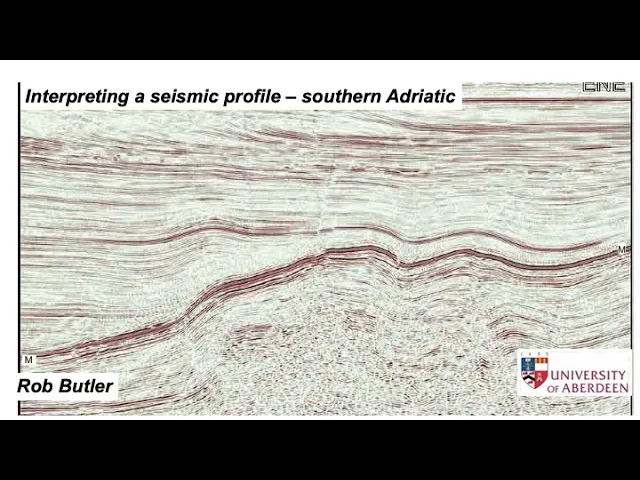
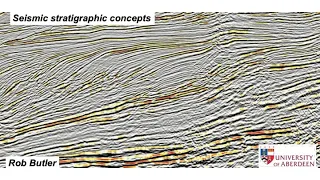
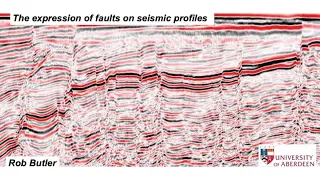
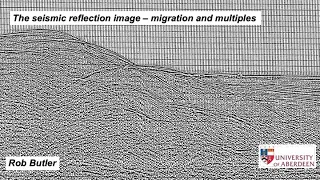
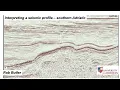
well this seismic profile comes from offshore uh southern italy in the southern adriatic sea and it shows some pretty neat um stratographic architectures so let's have a go at interpreting it well on the profile there's picked out the m reflector which is actually the top of the messinian so the the uppermost myoscene uh in the this part of the mediterranean so all this stuff on top is applied quaternary anyway let's pick the um machining reflector it's this really nice high amplitude package coming through here like this just run it all the way across like this
little fault which i was popping another potential little fault there doesn't do very much does it doesn't really destroy the reflective continuity so we can take that across and we can just pop these little faults in something like that okay let's keep going and i can see another really prominent reflector that runs across here let's pick it it's it's really prominent here so let's take that to the edge of the profile take this one all the way across just picking it in brown all the way through here getting some little tiny faults i'm barely going
to worry about those coming all the way across and the interesting whoops and the interesting thing we can see is the separation between the brown and the blue reflectors decreases from left to right how does it achieve that well let's pick some more reflectors in the interval well it's pretty transparent in this area but we can start over here we can see that this reflector comes along whoops and comes along and converges pretty much in here with the m reflector so it's on lapping and we can see the same sort of patterns occurring in here
maybe um let's pick another reflector across comes up oh it's slightly folded isn't it just be guided hard to see where that goes we'll leave it for a minute let's take this one across take this all the way across it's running pretty much parallel to the brown reflector maybe continuing through here it's getting quite close now hard to tell through there so i think these packages in here if i had to be interpretive about this is that they come down like this oops not quite that dramatically to on lap onto the m reflector so if
a package of material in here which is on lapping the blue reflector okay so the blue reflector is folded but so too are these on lapping sediments and indeed the brown reflector coming across here so i'm now going to move up to a shallower part and see we can find where the folding has died out because the shallow structures in here are the shallow strata are essentially undeformed and horizontal i reckon that if i take a horizon through here this looks like it's not doing very much is it it's basically just tracking all the way
across well as we come to here maybe it's slightly faulted it's slightly obscure through there but i think it's pretty good it comes all the way across so basically the defamation is done and dusted by the time the green horizon that we just picked was deposited okay so this package in here where the lower horizon the brown is folded and the green is not it's clearly a growth succession where the stratum deposited as the fold was growing we'll have a look at that in a minute let's move now to the shallow part of the section
where the rocks are undeformed but they're still not horizontal and we'll just look at this part of the section next well i'm just going to pick the top surface in here darker green we can see it comes down through here and perhaps we take some of the reflectivity down here we can take these reflectors down like this into this sort of position here and i can see it do the same sort of thing in here where the reflectors come off this top surface are inclined and then converge down like this so we've got a package
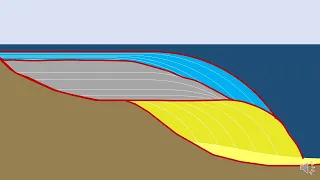
in here where the strata reflectors are downlapping converging downwards onto a gently inclined slash horizontal surface that's pretty spectacular there isn't it comes out a bit higher there's another one in here that comes down perhaps something like this so we've got a package of strata in here that are defined by kleiner forms like this and a pretty spectacular top lap surface in here as the strata pinch out upwards something like this so a package of material that's prograded out from left to right so just label that up so we've got we've got progradation out like
this of the package of glider forms and we can see towards the toe sets in here otherwise where the client forms converge downwards we've got a package out here that's essentially aggradation at the foot of the cliniform so relatively deep water and a package here above the client forms which is aggradation that is at the top sleek line forms that presumably represents a relatively shallow water environment okay let's turn our attention again now to slightly deeper in the profile and in these positions in here we have this growth succession i'm just going to pick some
reflectors through it just to see what's going on see that the fold there comes and goes pretty gentle through here isn't it and then comes and goes like that so we can see that this pick i've got through here is sort of intermediate between the brown and the light green in terms of its folding another fold cut layer comes up through here folded more like the brown layer this one isn't it so we come along like this yeah it's pretty folded isn't it something like that so in here we can see that the strata thin
across the fold and expand across the fold into the syncline again in here what can we see well it's pretty subtle the folds tapering out we get a slight expansion in the syncline relative to the anticline as we go across or we could do this a bit more carefully as we go across in here but either way this succession in here is the growth sequence otherwise it's in kinematic well what about the package below the brown and just above the macinian marker in here where there was onlap you might think that this was synkinomatic also
with respect to the folding but this on lap surface goes right across the folds with the same sense and as we look at some of the shallower section in here as we picked it we can see that the strata retain thickness as we go across individual structures so this is a pre-kinematic package with respect to the folding pre well let's just look a bit deeper and below the end reflector and see what's going on and i'm just going to pick this horizon here just to see what it does with respect to the m and it's
looking pretty parallel to it through there slightly faulted of course coming around here slightly more skirt through these places so these sediments directly underneath them reflector show no evidence of thickening and thinning across the folds so again that also is part of the pre-kinematic succession with respect to the folding so i'm just going to put that pre again but i'm going to be clear now this is fold pre-fold pre-fold we can complete this to say that this package up here is post fold now we're not going to confront this here but within the deeper part
of this session it looks like there's a bit more going on the imaging is really obscure but there's clearly some defamation down in here but presumably most of this defamation apart from the regional folding that we've already picked there's some defamation in here and some complexity that predates the messinian and this late massinian strata that we picked out in orange which otherwise seals it so there's question mark in here early structures and by early we mean pre endomcinion that marker package that goes over the top okay well let's now summarize this onto a chronostratigraphic chart
and for that we'll just reframe the view okay so now we can plot a chronostrate chart down in here using the seismic interpretation from above just to illustrate how the stratigraphy works well normally i'd start with the shallow and work deeper but this time i'm going to start doing it slightly differently let's start off by putting an m reflector on so here is our messinia or top machining horizon that goes all the way across the profile like that and it's underlain by that orange horizon which also goes all the way across it's deposited everywhere and
remains everywhere across the profile so here's the pre macinian pre-onlap geometry okay well i'm actually going out of the plot on the brown horizon which also goes all the way across just so we can space out this diagram appropriately i'm just going to put it in here so brown goes all the way across the profile what about the package in here between the messinian and the brown reflected as this prefold package which on laps well we can see these reflectors on the left hand side pinch out but extend progressively further across the profile as we
go to younger strata so we can just show that on here like this just schematically something like that oops that should be parallel horizontal of course misdrawn put that all the way across here this last one goes pretty much all the way across presumably pinches out somewhere on the side so in other words we've got an on lap surface through here in geological time like this and this is no deposition as the strata pinch out against the top machining reflector let's just tidy up some of these arrows so on lap therefore the mercenius strata were
tilted before the deposition of this earliest plyocene package that comes over the top strictly then we don't know what the time gap is in here time gap in fact so we might want to expand that out we don't know what the age of these are the younger than the machining we don't know how much younger there may be a gap in time during which the tilting occurred so tilt here right now let's move up section we'll put the light green horizon in now in the chronostrate chart i'll just put it in across here which marks
just above the top of the deformation that created the folds so that's that marker now let's think about what goes on in here in this interval which is the syn folding package well if we look in detail in here we can see we haven't really picked any intra-formation lung conformities or pinch outs of the strata the seismic image isn't brilliant but we've certainly been able to correlate some of the system and some of the strata across all the folds so i'm tempted to think that all this package in here is just simply deposited all the
way across it's just there's different thicknesses so i'm not going to pick any internal laps or anything like that in there they may be but they're really subtle and not continuously recurring on the flanks of the folds but i will label this as syn folding there's just there'll be differential aggregation which builds up different thicknesses thin on the crests of the folds the anticlines thicker in the synclinal axis okay now let's consider the shallow section i'll just reframe this a minute okay so we're going to go up into this package here of the clinic forms
in this progradational aggregation relationship which lies above the light green reflector and we can see that we've got um at the bottom up here we've got some reflectors i'll just put them all in green one that somebody go all the way across that lie just above the light green and have that relatively high amplitude that we can see high frequency and high amplitude character and then we can see that there are some other reflectors in here that clearly downlap onto that surface and as we come across we can see that they also have top lap
relationships like that as we come across but as we keep going some of these top lapping packages run out right there across the basin what was the basin floor to be aggravational and then we can see that in these packages in here they're deposited all the way across by the time we're up in here they're just on klineforms so quite a complicated succession in here let's just annotate this down we've got two areas of non-deposition a non-depositional position in here okay so that's why they're nd for non-deposition and another one here nd where these um
cliniform packages pinch out against the downlap surfaces so in detail quite complicated form so sometimes you can accumulate sediment on top of the clinoforms at other times not um and so you can have aggregation and degradation there similarly sometimes the sediment can run out across the basin floor but other times it's pinned to the base of the client forms so there's quite complicated depositional packages developing in the shallow part of the succession in here okay so let's just label those final lap relationships down lap here and top lap so we've got a variety of lap
relationships that we can identify on our profile what's interesting is there's no evidence for erosional unconformities in here there's sediment accumulation there's no erosion there's just differential sediment accumulation as the structures developed through tilting folding and then the development of this shallow water system building out across the area finally housekeeping let's just label up the chronostrate diagram old young this is why plyo quaternary that's mercenian down in here so that's how it works and we can see from the orientation of the seismic that this is west south west this is east north east so we
can see that this shallow water progradation package is prograding relatively in here towards the east northeast from the west southwest there's our simple cartoon chronostrike diagram that illustrates the stratigraphic relationships that we've interpreted on the seismic profile from the southern adriatic