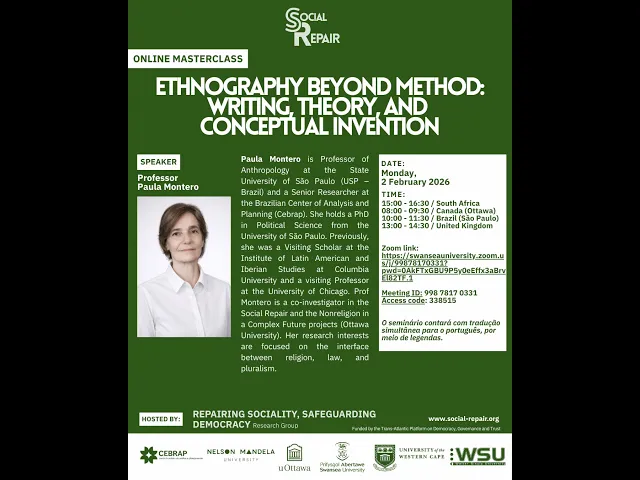
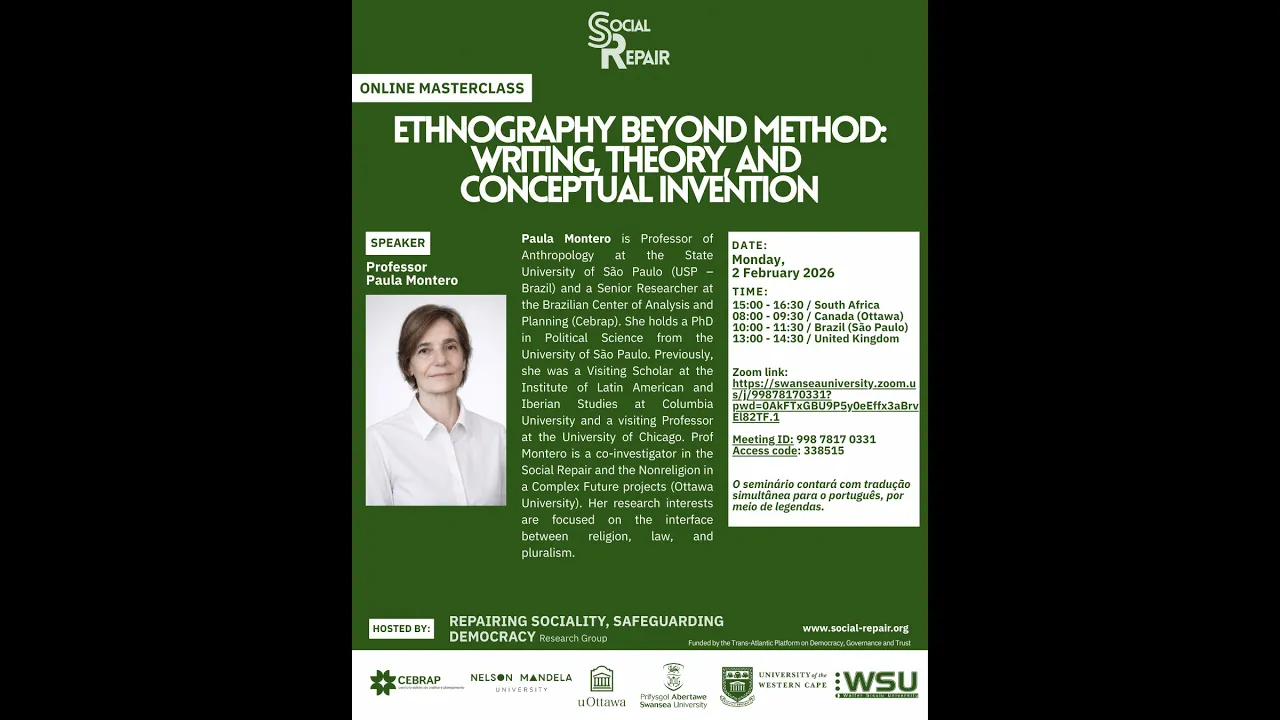
So, welcome to everybody that's joining us. Uh, our apologies for starting a little bit late. My name is Christopher Nevesten. I'm the lead principal investigator of this project. Um, this is our third master class and it's with uh Prof. Paulo Montero who uh uh Dr. Borges who's one of our posttos will tell you about um shortly. Uh I just wanted to share with you uh a few thoughts about um our project what it's About. So um this is a project that's funded by the transatlantic platform and it's the long title is uh repairing sociality safeguarding
democracy transatlantic north south narratives and practices of deep equality and we are a research consortium uh we bring together universities across four countries and uh these are in South Africa we've got three universities the university of the western cape where I am based Nelson Mandela University and Walter Sula University and then in Brazil uh from where uh Prof. Montero will be speaking today. She's attached to the State University of Sa Paulo and to Cramp the Brazilian Center for Analysis and Planning and then we also have the University of Ottawa and Canada and Swansea University in
the UK that forms part of our consortium. So briefly what our project is about as I think most people um and if you do not know about this then I don't know you've been Living under a rock somewhere but uh as we can see um worldwide uh we are in very um dangerous times. We are in very difficult times. We are seeing a very dangerous politics playing itself out and we're seeing um over the past number of years um heightened levels of of social polarization, political polarization and certainly all of those also spring from economic
um polarization in the form of um extreme levels of soio economic inequality Across the world. and uh with with this politics that's pulling people apart that's um great creating um massive social polarization across countries and it's very interesting to see how similar these dynamics are whether you're in the global south or the global north or uh where wherever you might may find yourself even uh in in countries that are that are regarded as as more authoritarian or countries that are regarded as more democratic and so forth You you find these extremist um discourses and actions
driving a particular kind of um politics and our project uh wants to make um sense of of of this phenomenon but um there's already many many studies happening in this regard. So what we're particularly interested in um is what people are doing on so-called ground level um in actually counteracting this politics of social polarization. So what people in or ordinary everyday Situations are doing to actually counteract what political elites um are busy with. And we are drawing on Lori Bean uh from Otawa University's concept of deep equality and southern African concepts such as Ubuntu but
also concepts other concepts from Southern Africa as well as from Brazil and and um Britain and Canada to make sense of the political and social dynamics in everyday situations where people are counteracting as I say these social Socially polarizing uh discourses and activities and in fact repairing the social fabric and constructing community through cooperation through uh across historical and and new fissures. So if you want to find out more about our project and you are interested uh in also connecting with us um if you are working on on similar projects or or or similar themes
rather please uh follow us on on social media. We're across most of the platforms except Elon Musk's Platform. I have to point out but most of the other platforms and uh we are also um uh available via our website um ww.sorepair.org. So, so do do check out our website and um and do look out for following um events uh this year which will include another number of seminars and another master class and for last year's events um which include four seminars you can visit our our website and now over to Gileri that will tell us
a bit more About uh Prof Montero and what she will be speaking about today. Thanks, Gilami. Okay, >> thank you Chrissy. So Paula Montero, as many of you that are here know, she she's a full professor of anthropology at the University of S. Paulo here in Brazil, and a senior researcher at the Brazilian Center for Analysis and Planning, the Sebrai. She is also one of the principal investigators in our group and the leader of the Brazilian team and Her work focuses in the intersections of religion, race, law and pluralism. And of course, she has a
longstanding interest in ethnography which we will definitely see coming up in today's discussion. So, so I will now turn things over to Paula. She will speak for I don't know around 60 minutes, 60 minutes and then we will open the floor to the audience. Please feel free to write your questions and comments in the chat during her Presentation. And if you prefer, you may write in Portuguese and I will translate them into English. And you are also very welcome to turn on your microphone and at the end of Paula's presentation to share to share your
comments or ask questions. Okay. So Paula, please if you want to start. >> Thank you Gilami. I would like to share my PowerPoint. How do I do that? I send a request to you. Uh, no. I I think you just need to to to click share here. >> Yes, I did it. And then >> let me see. N do you want to to help this? Because today N is the one. >> Oh, yeah. I allow the screen sharing. >> Okay. And and from my side, Lynn, um can you just make sure that this is being
recorded as opposed to um producing a transcript because this is due to be uploaded to to our website. >> Yeah, it's recording to the cloud as we as I did start the recording at the start of the meeting. So, we should be fine. >> Okay. Excellent. Thank you. >> Yeah, thank you. Uh let me check that Paul can share. Try again. Paul, I did enable it when you um when you requested it. >> I have to do something. >> Uh if you like if you start sharing then it may work now. >> Share. Where is
it? At the bottom of your screen in the middle. Yeah, I see the uh I'll see our screen and then I have to I have to I have to let me see. >> Yeah, there you go. >> Huh? I click in my in my PowerPoint. What do I have to do? Are you seeing that? >> Yeah, you can see if you make that your PowerPoint. Yeah. >> Okay, it's done. Okay, >> great. Good morning everyone. It's a pleasure to be here with you today. I would like to begin with thank you all of you who
are joining us online uh for your presence and engagement and I would also like to thank the organization of this master class Christie Gilleri Sophia Ninan for the invitation and for creating the conditions for this conversation. Let me start with a point that won't surprise you. any anyone here as we all know eography is very much a child of the colonial project. Historically it took shape precisely at the moment when European colonials empires were at their height administratively, scientifically and morally between the late 19th and the 20th century. This is the period of territorial expansion
of The cons consolidation of European nation states and of an increasing need to govern populations that were c culturally classified as others. That contest creates a strong demand for detailed knowledge about customs, beliefs, language and ways of organizing social life. and ethnography emerge precisely as a response to that demand. In this sense, ethnography takes shape as a particular way of producing knowledge about difference. It combines Direct observation with careful description and a claim to scientific authority. But at the same time it is deeply embedded in the political and epistemic asymmetries that characterize the colonial situations.
Saying that ethnography is a child of the colonial project does not mean of course reducing it to a mere instrument of domination. Rather it means recognizing that his Very condition of possibility possibility are entangled with colonization with colonialism. Enography becomes possible because colonialism produce access to territories to populations but also because it establish a symmetries between the position of observer and observed. This is central. It's precisely this relationship that becomes the most sensitive epistemic Problem in ethnography. In the classical arrangement that enog ethnographer the ethnographer is someone who can move across spaces who has the
freedom to travel, to record, to classify and to translate other ways of life. And all of this is done for an audience back there back home for a metropolitan academic and often state oriented public. This colonial lineage shows up in at Least three key ways. First in the production of otherness, ethnography develops as a form of knowledge focus on society label as traditional, primitive, nonliterate categories that only make sense within an evolutionary and imperial way of imagine history. Second, in the tight link between knowledge and government, ethnographic desript descriptions often fed directly into colonial politics,
civiliz Civilizing missions, legal reforms, administrative inter interventions, even when this happened indirectly or without any explicit intention on the part of the adnographer. And third, in the kind of epistemic authority ethnography establish, long-term fieldwork and participant observation come to legitimize a scientific voice that speaks about the others and very often on behalf the other. In this lecture, I would like to focus on this third dimension that I I I say I want to frame it in a very simple way. At its core, the history of ethnography can be read as an ongoing effort to deal
with a basic problem. How to produce truthful statements about others when the relationship between the observer and the observed is both asymmetric and situated. Now, organizing that ethnography is a child, recognizing that ethnography is a Child of the colonial project does not mean abandoning it or dismissing it altogether. Rather, it means taking its history seriously and subjecting it to a process of a critical historicization. That's what I want to do uh here to today with you. It is precisely this awareness of ethnography's origin that help us make sense of its internal tensions between description and
interpretation, Between empathy and objivation, between proximity and distance. And it also helped us understand contemporary efforts to ethically and political rethink fieldwork practice. In fact, modern ethnography takes shape through a rather ambiguous movement. We have to recognize that on the one hand, it remains a hair of a colonial regime of knowledge production. on the other it has become one of the Main sites for the reflexive critic of this that very regime. What is really at stake here is not simply gaining access to the other point of view. The deeper issue is the legitimacy of the
knowledge produced through this relationship. In other word, my question here is under what conditions can the observer's presence, position, and language become a source rather than an obstacle to ethnog ethnographic truth. It is through this ongoing work or questioning and reworking the relationship between the observer and the observed that ethnography acquires it is specific historic historic historicity. Not just a method but also a form of writing and a way of doing theory. With that that in mind in this master class I've organized the discussion around a map of four major ruptors. Each of these mo
moments reconi Reconfigure how eography has been thought and how it was practiced within anthropological theory. I will show how each rupter here represented by an author I take as a key reference reshape the status of the data the field the author and theory itself. This is not meant to be an exhaustive history for of anthropology, not a complete chronology of authors. To address these questions, I want to Propose an analytical itinerary organized around shift in how ethnography has come to conceptualize the field, the description and the action. I will start with a fantasy table of
the major ruptures in ethnography from the 20th to the 21st century and then impact for you the models and ideas that emerge from it. This is the synthesis synthesis table With Malinowski. participant observation becomes consolidated as a methodological foundation of ethnography. It is closely tied to the idea of of objectivity describing native life. At this point, eography is still largely understood as a technique. You go to the field, you observe directly and you report what you see. A first major shift happens a few decades later with GS in the 60s and 70s. Here eography is
no longer just about observation. It is redefined as thick description that is an as the interpretation of culturally stated meanings. So the movement is clear. We shift from seeing to interpreting, from collecting facts to producing textual meanings. And this shift already begins to challenge the idea that eography can transparently represent cultures, Societies or native point of view. A second rupture pushes the critique even further. Ethnographic writing itself become a focus of analysis rather than being treated as a neutral medium. It is examined as a situated from the rhetoric of the rhetoric shaped by power relations,
authoral positions and natural narrative conventions. This is where reflexivity enters the scene. It is the explicit acknowledging of the Historical, political and discursive condition under which eo ethnographic knowledge is produced. The central shift here is from the idea of neutral representation to ethnography understood as a situated practice of annunciation. A third rupture concerns the very idea of the field. The field is no longer conceived as a bounded localization site. Instead, it is approached as a network of connections, circulations and multiple scales. This is the model of multi-sighted ethnography where re researchers follow devices, practice, discourses
and actors across different contexts paying systematic attention to institutional, transnational and historical mediations. The key shift here is from a closed local setting to relational and scholar configurations. Finally, a fourth ruptor transforms how we think about data itself. Data are not longer understood at Something like something were simply collected as if they were already there waiting for be. Instead, they are seen as something produced through practice. Reality is treated as perform multiple and relational. The analytical focus shift to the device materialities practice and ontologies in action. The central move here is from data as a
reflection or of reality to data as the effect of ontological practices. Well, this is the general overview. With this overview in mind, let me now slow down and unpack what is at stake in this shifts. The question that was that will stay with us throughout this effort is a simple one but also a demanding one. What does it mean to do ethnography under contemporary conditions? Of course, each rupture I mentioned does not replace or erase the previous one. Instead, each one displaces the theoretical and methodological problems that organize field work and give meaning to what
eographers actually do in practice. Taking together these four ruptors make one thing clear. Ednography is not just a technical map. It is a historical changing intellectual practice in which writing theory and empiricism are constantly being reworked in relation to one another. By following these transformations, we can begin to see ethnography as a distinctive way of producing critical knowledge about the social, one that is shaped by history, but also capable of critical engaging with it. Let me begin with situating Malinowski as one of the key figures in the invention and stabilization of what we now recognize
as eography. Malinowski is widely seen as the main Architect of the canonical model of ethnographic fieldwork in the early 20th century British anthropology. This reputation is closely tied to his research in the Troan Island during the first world war and to the publication of organot in 1922. At the time, most anthropological knowledge was still being produced as at a distance through rep reports written by travelers, missionaries, colonial Administrators or by scholars working from their desk. Malinowski famously criticized this mode of knowledge production with what he called veranda anthropology. In this model, the observer remained physically
removed from the social life he claimed to describe. Settle in the house of a colonial agent agent or on ships spacing passing through. The observer Summon native interlocator who were line up to provide bits of pice of information often fragmented taken out of contest and deeply shaped by colonial power relation. Against this regime of indirect observation, Melanowski proposed a very different method. One on the researchers prolonged continuous and immer immersive presence in the everyday life of the society being studied. The key methodological innovation here is a redefinition of the observer's position. The ethnographer is no
longer a distant collector of information, but someone who regular and systematically involved in ordinary activities following practice, routines, interactions, and events as they unfold over time. This kinds of immersion makes it possible to witness what Malininovski Call unique events that is singular that singular moments that do not simply repeat themselves and that not only intelligible through longterm co-presence. As a result, the nographer emerged as the only authorized authorized witness of these scenes. And it is precisely this position that grounds his epistemic authority. Within this framework, ethnography is Understood as the situating, recording, understanding, and description
lived moments. theory is expected to emerge gradually from the researchers growing familiarity with native with native interlocators and from the relationship of trust built in the field relationship that are meant to turn social interaction itself into a condition for knowledge. So the relation between observer and observe is therefore conceived as asymmetric but also epistemic epistemic epistematically productive. Proximity is not seen as a threat on the contrary is what generate and guarantees knowledge. From this way of thinking about ethnographic observation, often described as dialogical, but is still firmly under the researcher's analytical Control, emerges a specific
understanding of the researcher encounter. This understanding in turn gave rise to the methodological principle that shapes much of British social anthropology anthropology from the 1920 through the 1960s. This is especially true of the functionalist and structural functionalist traditions associated with figures such as Radkip Brown, Aan Pritchard, Fords, Gluckman and later Victor Turner. These principles can be outlined in five key key points parts. There is the central role of empathy as a condition for understanding. Second, the requirement that the adnographer learn and master the local language. Third, the priority given to observation and to closely following
practice rather than relying on formal questionnaires. False a strong commitment to ind inductive reasoning. Analytical categories are not imposed in advance but are expected to emerge from the social sustained engagement with concrete situations. And finally, the recognition that the native point of view matters even if it is eventually organized, translate and systemized by the analyst. The ethnography that takes shape during this period period focus above all on Process of social interactions, conflicts, alliance, negotiations and what later come to be called social dramas. These moments are treated as privileged sites where the social order reveals itself.
Over time, especially from the 40s and the 50s onwards, this tradition began to place increasing emphasis on this symbolic dimension of social life. Myth, rituals and classificatory system Become key points of access to what is understood as the native point of view. So symbolic anthropology operates on the assumption that meaning are encoded in coherent cultural systems and these systems can be analytically analytically described. From this perspective the epistemological problem of ethnographic truth appears to be resolved. Empiric empirical proximity guarantees access to the other point of view while analytical Distance secure its scientific translation. The promise
here is one of transparency. If I stay long enough is I observe careful enough I can see how things really are. In this model, the field is a place, culture is a totality and observation is the foundation of truth. This conception proved to be enormous productive, but it also rests on a strong and fragile assumption that there Is a direct correspond correspondence between place, group and culture. This canonical model of ethnography associated with Malinowski was decisely displaced with a word of with the work of Clifford Gears especially from the late 1990s onward 1960 onwards he
questioned the way ethnography is done. The critique here is not aimed an empirical immersion at empirical Immersion itself. Gear is not saying that being there for a long time does not matter. What his question is the assumption that proximity gives direct access to the so-cal native point of view. And if this point of view were a preexisting culture content that could simply be observed, recorded and then translated by putting interpretation and a demographic writing at the center of the Discussion. Gave the epistem epistemological problem reframes it. It is not longer primary a question of how
to be there but of how to make something intelligible through language that never appears to us as raw data in the first place. As a result, the focus shifts. Observation is not longer treated as the main guarantee of truth. interpretation become constitutive operation of anthropological knowledge And this and with that attention move from experience itself to credibility of the author. In this view, it is not experience at such that guarantees knowledge, but the way that that experience is rendered intelligible. For this reason, the term proposed by Clifford Gears should not be understood as a mere
refining refinement of classical ethnography. It represent a much deeper reformulation Of the the epistemological problem that sustain it. In the meal noskin and structural functionalist tradition, the relationship between observer and observed was organized around a stable division of labor. Natives provide live meanings while anthropologists were responsible for rendering and explaining them analytically. Eographic truth is in this framework Rested on the belief that cultural meaning was already there embedded in practice in rituals and myths waiting to be correctly grasped by the observer who was sufficiently enclosed a methodological discipline. gives breaks with this epistemic economic by
arguing that meaning is not something that can simply be extracted from social experience. Rather, meaning is constitute in and through the act of interpretation itself. Gear's well-known defining of culture as web of significant significance that woman's humans themselves are span and in which they were suspended carries a crucial epistemological implication with concrete methodological consequence. The anthropologist in this view does not observe meaning directly. Rather, the anthropologist interprets interpret interpretations. In other words, there is no direct access access to meaning itself. What is available are meaning are meanings that are already being produced and circulated by
social actors. This is a very important chip. As a result, the relationship between observer and observe is no longer framed in terms of priv privilege access. It becomes instead a problem of symbolic mediation. This reformulation displays the axis of Ethnography in at least three fundamental ways. First, it undermines the idea that eographic authority can be secured simply through empirical co-presence. Being there still matter of course, but is no longer enough. Second, it make explicit that ethnography is a practice of writing. Not writing as a secondary act, but a record that comes afterward. Not a record
that comes afterward, but writing As the very site where meaning is produced, organized, and stabilized. And third, it transformed the stages of the so-called native point of view. This point of view is no longer treated as a unified or coherent perspective of the world. Instead, it becomes intelligible only through analytical constructions that are always partial, selective, and situated. In this sense, G's contribution is not about replacing one method with another. It's about denaturalizing the very idea of method as a solution to the problem of anthropological truth by showing that enography does not simply describe cultures
but produces interpretive readings of the social world world. In doing so, Gears inaugurates a new regime of reflectivity. In this regime, the relationship between observer and observed is understood as being mediated by language theory and conventions of writing. This is the first major rupture. The idea of transparent till gives way to interpretation. At the same time, GS leaves something important intact. The assumption that culture can still be presented as a coherent totality. And it's precisely from this point of tension that more radical critiques of ethnographic authority becomes possible in the years that followed. These critiques
often open ways of Further redefinition of the field data and theory. These reformulations will shape the subsequent ruptors I've mapped. They also shift the problem from observation to inscription. Once the field is no longer understood as transparent, the question shift to ethnographical writing. How does it operates and which was these effects? This is where the second rupture begins. What later comes to be called anthropological postmodernism. a broad Field of critics of classical realistic anthropography associated with authors such as George Marcus Paul Rabino and George Fiser. This set in motion a sustained reflection. This reflection shaped
and the rules go governing the relationship between author object and read reader in eography. At this point, what is at stake is no longer only the question of epistemological access to the other. The focus shifts to The discursive condition under which this other become credible within the anthropological text. This shift brings into view what we more might call the metapragmatical level of ethnography authority. As we can see in his critique of the Malininovskio model, Gits already displays the problem from observerial to representation by asking how eographic description produce plausibility By treating culture as text. G
show that every ethnographer constructs author authoritarial self. This self is attuned to the specific kind of textual practice they adopt. This move opens the door to what later becomes known as the reflexive turn in debate on representation during the 1980s and 1990s. These debates were often summarized under the label of the crisis of representation. The ethnographic monograph is no longer taken as a transfer window onto a cultural reality out there. Instead, it is recognized as a situated construction. Ethnographic authority in this context is no longer grounded solely in lived experience. It is rather understood as
a textual and rhetorical effect for authors such a James Clifford. However, Gear does not go far enough. Although he problematized Interpretation, he still preserve a separation between observer and observed and continues to treat culture as a discrete, homogeneous and self-containing totality. But this rarely correspond to the fragmented, contradictory and historical layered ways in which in which culture actually appears in the field. Clifford's argument is that the style of classical ethnographic writing is what produce this kind of reality effect of Culture. That is this impression as a non-mediate mediated access to cultural reality. In this style,
a number of textual convention help sustain this reality effect. For instance, the anthropology often withdraw from the text when describing what they do. Concrete individuals disappear, replaced by a generalized people. A unified native point of view is assert. A local concept are treated analytical in ways that reaffirm the author linguistic and interpretative competence. The result of these uh techniques is a series of transformations. What was what was a fragmented experience in the live in the experience of the anthropologist become an integrated hole. What was a situated communicative process turns in autonomous object. Interaction anthropological interaction
is converted into description and dialogue is converted into monologue. At this point something fundamental changes. Eographic authority no longer rest on live experience it tell but is understood as a textual effect. In this critical reading of Marice Gol works, James Clifford illustrates this problem by focusing on the decite decisive role of Gre's Privileged informant Ogo. He shows how this role was central to the construction of what come to be known as the dugen culture as a coherent and totalized symbolic system. The pro prominence of this figure raise basic question about the geographic encounter. In fact,
we often do not know how interactions actually unfold in these encounters. Under what conditions dialogue took place, how interlodctors understood the research and on in what Grounds they decided who to reveal, what to reveal. Critics of Grio have suggested that Okotei's knowledge was closer to what of a theo theologian in the in this field. In this sense, it it was different from that of an kind of average informing. Critics argued that his initiatory expertise help it help it to stabilize a systematic image of doggon culture, one that owns as much to ethnographic Intervention as to
local practice themselves. From this diagnosis, Clifford draw a broader conclusion. In a postc colonial context, the anthropologist can no longer claim an epistemic epistemically priv privileged position in producing culture about the other. Anthropological knowledge is intrinsically relational. Fudo unfolds unfolds as an uneven Dialogical encounter shaping by collaboration, a symmetry, conflict and intrusion. These dimensions they then can no longer erase in the name of neutral description. Nor can they justify by the attempt to r rescue a supposedly disappearing culture what what Clifford famously call eographics pastoral nostal nostalgia. But if culture is in part construct through
the text a new question Immediately follows. What happens to the field? It is precisely this problematization of ethnographic authority that opens the way for a third rupture. In this moment, the field is no longer understood as a single bounded empirical location. Instead, it is reconfigured as a set of scales connection flows. This sh this shift calls for new anal analytical strategies. Strategies capable of following people discourses and institutions across different context from the 1990s onward. This move on is systemat systematicized most clear in the work of judge Marcus with the formulation of what he calls
multi-sighted eography. This third rupture displays the very idea of the field. Once the field is no longer conceived as an empirical bounded location, the conditions under the ethnographic log Knowledge is produced and profoundly transformed. The researcher is no longer the first or even the primary agent responsible for turning culture into writing texts. The ethnographic field is saturated with texts produced by many different actors, local communities, institution, medias, experts, socalled natives write about themselves. They read, they commented and often critique early anthropological accounts. This erode the distance that once separate societies imagine as without writing from
those that claim the authority to describe them. It also dissolve the monop monopoly of ethnographic abscription. In this context, the world no longer appear as a collection of distant and discrete cultms. Instead, the question of who defines individuals, groups, collectivities and cultures Become central. This is why George Marcus puts puts it the anthropologist must learn to see the system from all sides. That is to follow the multiple positions, multiple mediations, multiple interests involved in the constitutional of social problems. Classical categories such as tradition, community, kinship, kinship systems or ritual can no longer function on their
own as a stable Organizing principle of explanations. They tend to freeze social formations that are in fact produced in fragmented relation and historical contingent ways. Marcus also notes that the nographies built around oppositions. Those this those that built around oppositions like resistant versus accommodations often up end up refining communities as if they were stable entities. In some cases they even turn into implicit form Of political interventions of propaganda ill equiped to capture the complexity of contemporary social life. By contrast, Marcus proposed that ethnography observation should take serious the constit constitutive tension between diversity and homogenity
rather than treating them as analytical separable. One of the most v visible effect of this reorientation Is the growing complexity in the spatial dimension of eography. Multi-sighted ethnography is no longer organized around a single location. Instead, it follows objects, practice, discourse, and actors across multiple interconnected spaces. Hudor in this sense no longer assumes a closed community. It operate through relational scholar and historical mediated configuration and systematically incorporates Institutional transnational and infrastructural dimensions. It is no longer a matter of staying in one place but of following connections. Process like the formation of identities make this movement
especially clear. Identities are not primarily produced through observable activities concentrated in one located. They emerge simultaneous across different sites through different agents and from different purpose legal, media related, Political. Where a person lives and their relationship with the neighbors are related is only one condition among many and it is not always the most decided factor of shaping contemporary forms of belonging. In this sense, multi-sighted ethnography shift the focus of analysis from social unities presumed to be given to process distribute across time and space. And it's important to be clear here. Multi-sighted does not mean is
studying everything. It means identifying and following strategic connections. This shift from the field as a place to the field as a relation and a processful configuration does not mean does more than expand the empirical scope of eography. It also puts pressure on the very distinction between context, actors and mediations. By following connections, objects and practice across sites, multi-sighted ethnography shows that what we call the social does not preexist the relation that compose it. Read it. the social emerge from eterogeneous and stable stables unstables association and is precisely this moment that prepares the ground for the
force rupture where with Bruno Lur the focus shift shifts from circulation across context to the analysis of networks of Association that produce humans nonhumans and collectics. This final section of Bruno Lour will be organized around four main points. First, I will look at the his critique on the very notion of the social. Second, I will turn to the question of what actually makes a group exist as a group. Third, I will discuss his critique of the idea that the social itself can be treated as the source of Action. And finally, I will focus on his
attention to what we might call vernacular metaphysics. That is the way actors themselves define what is X and X, what what matters in practice. So let me start with a simple question that frames this section. In the field, if the field is made is made up of networks and circulations, what does is still mean to explain the session? Lur's answer is quite radical. He challenged the very notion of society at is has been used almost automatically in the social science study. Much of our analytical mental software, he says, assumes a pre-given social context, a specific
domain of reality in which events simply take place. Society actors are then treated as if they were located inside this social world and could therefore report on it as privileged informants. But the social does more than provide Contests in his perspective. It also function as a form of causality invoking the social dimension often often becomes a kind of explanatory shortcuts. one that replace careful description of practice, mediations and concrete relation with a readym made explanation that has to be criticize. In this regime, the social stop being something we need to investigate and becomes what does
the explaining Effort and that for Lur is precisely the problem. As he famous put its social should the social should stop being what explained and become what needs to be explained against this use of the social as a given frame framework. Lur oppose a radical redefinition from him. There is nothing specific or intrinsic about the social order as such. Society must be Treated as a stable context within which things happen. States cannot be treated as a stable context. What social scientists often take for granted are connections that have already been stabilized and and naturalized. Lur
reversed this logic. He argues that social is not a priority a a priority domain an a priority domain but the particular type of connections in the making. The task of researcher then is No longer to explain phenomenal through the social but to follow the process through which people, things, institutions and form of knowledge associated in the construction constitution of a collective whether we are talking about law, talking about religion, science or polit In this sense, ethnography does not aim to produce an external theory of the social. Instead, it learns from the actor's own Theories, from
the ways they themselves explain how association are formed, maintained or undone. This in turn reshapes what counts as action, what counts as relations and collective. From this perspective, LUR also rejects the organization of anthropological work into separate layer such actors, methods and fieldwork design in advance to produce social explanations. Drawing in his theory of actor actor Network he suggests that the ordering of the social should should not be anticipated by the analyst. It should be left to the act actors themselves understood at those who through their practice provisionally define groups, relations, objects and curses of
action. This implies this letting go. This implies letting go of explanatory shortcuts such agency, structure, Consciousness, systems. Not because these notions are wrong, but because they tend to function as stabilizing device that obscure the process of association. What actually association at work? Rather than starting from these categories, ethnography should focus on sources of uncertaintity. The instability of group, the Distribution of action between humans and non-humans, the fragility of fact and the active role of things. To describe ethnographically in this sense means following how entities are constit continuous compose context and reordered in practice without deciding
in advance what count as an actor, what count as an action or even what count as dissoci. One of the key consequences of these reorientations Is the way it reshapes the eographic research. Take as its empirical focus. Latur captures this shift with a simple but powerful question. The issue is not which group we should study but what makes this group exist as a group. This is very important for this kind of Eography. Much of social science, LUR says, begins from already consolidate aggregates, members of church, races, classes, organizations, movements. This grouping are treated as social
entities simply because they are visible, nameable, and seem well defined. Social theories often precede as the as the existence of such group were independent of the continuous and Ethogenous work of counts or actors and devices activists, state agents, religious leaders, experts, media statistic, documents and classificatory systems that make groups. Against this approach, Lu propose decises decisive methodological shift. The first moves of research should to be to select a group that take it not to select a group take it for granted but to investigate The series of interventions, mediations and practice through which the group becomes
visible, stable and operative as a collective. In other words, the empirical focus moves some supposedly given entity entities to the processes through which these entities are constantly compose, maintain and contest. From this perspective, ethnographies follow actors in their own ways of forming, sustaining and the limiting groups. It starts from The assumption that actors have a reflexive language about what they are doing. This is very important too. Actto nectar theory therefore invites the researcher to take native vocabulary seriously. It also invite us to observe the resources through which actors themselves try to stabilize the social and
draw boundaries whether they invoke tradition, law, kingship, science or morality. A group in the sense that does not exist by itself nor does it preede the work of that the work bringing it into being. This is why ethnography observation must attend to spokespersons, people's institution or device that define what the group is, what it should be and what it has been. To describe a group then is to follow practical operation through which it is const claimed represented and made rec recog recognizable. For instance, how it names itself, how it justify its existence, how we draw
its lines of inclusion and excl exclusion, and how these definitions are negotiated and contested over time. >> Paula, sorry, but could you start wrapping up so that we have enough time for discussion? Okay, let me go to let me go to the 90k. So in this uh in this register the analyst task is no longer to decide on event what actors really are nor to rescue from the supposed social illusion. In instead the task is to recover the multiple work worlds that were built together through their practicification, observations and aligning. Analy an analyzing action then
does not mean locating its origin in stable sources but following the controverses Through which action is distribute, negotiate and redefine. Lur points even though we can never know in it's for the social is not is no longer a domain of cause. It becomes what is composed through association among humans and nonhumans. The field is no longer a place or or a set of sight. It becomes the tracing of controverses, mediations and trace. Action is no Longer an attribute of subject of systems. It becomes a distribute narrated and contest. In this register, edography does not aim
to reveal what reality what reality lies behind practice. It aims to describe how actors themselves define, justify, and stabilize what counts as action, a group, and a common word. This is an effect of a profound predefined gesture. Explain less, describe better, presume Less, and follow more. Let me conclude with a simple observation. We live in a world saturate with description, diagnosis and justifications produced by actor themselves. Revisiting the course I outline here is essential for rethinking about eographic practice under contemporary conditions. These are conditions marked by the intense circulation of knowledge, a plurality of regime
of legitim Legitimacy and the constant presence of a reflexive actor who produce their accounts their own accounts of the social world. I tried to suggest throughout this lecture that the cannot loan presume to know in advance what cooperation conflict and social repair are. This at this point these reflections directed directed uh dialogue with the aims of our projects By privileging the language narratives and criteria mobilized by the act of themselves. Ethnography inspired by this trail is well sustained to mapping vernacular understanding of cooperation. It is also well suited to mapping and process of social repair.
This requires suspending readym made categories and following by actors themselves define and following how actors themselves define what it what it means to collaborate to repair Relations and to share to share a share world. Revisiting despair is not merely a theoretical exercise. It is a methodological condition for reproducing ethnography descriptions that are able to account to the complex complexity complex complexity and moral inventiveness of contemporary lines. In this sense to do ethnography today is less about explaining the world and and more about learning how to describe it together with those who are Continuing remaking. With
that, I'd like to bring this master class to a close and thank you about with your attention and engagement. Thank you. >> Thank you. Thank you very much Paula for your presentation and it was excellent and really engaging. I'm sure it will lead to very interesting discussions today and unfortunately we don't have much time but before before moving on to the questions and comments I just would Like to acknowledge the large the very large audience joining us today. We even have many participants from Brazil who have likely taken time out of their summer holidays to
be here with us today. and we really appreciate your interest. So now I will open the floor to questions and comments. Please feel free to turn on your microphone to ask your questions or to write them in the chat. We uh uh please Morgani please. >> Hi everyone. Thank you so much Paula was really really really uh interesting as ever. Thank you so much. I just wanted to ask a quick question because as you said and it was really interesting to uh to dive up in Lour's work uh because he invites us to follow actors
and controversies without uh imposing an external explanatory vocabulary. But in doing so, I just wanted to maybe I'm a bit curious for you to Uh to go maybe a bit deeper into details. How do you see the role of the researcher being transformed? Um yeah, that was about about it. Thank you. Can I answer or I >> I I I think I think you can answer and we can go on to the other questions. >> Thank you, Morgan. Um, I think that uh what Marcus uh tried to to teach us is not to impose our
sociological or Anthropological uh concepts on people and to go to the observation Trying to trying to to discover where collabor collaboration is, where cohesion is, where solidarity is, where community is, where uh social repair is. And we we try to to observe and to listen If they are uh saying this kind of things and in which which which vocabulary if if these are their own problems or not or or if we are imposing a problem to them. So if cohesion is not a problem for that why we are asking them to explain cohision to us
we have to to listen if they are feeling that they they are a group if they are saying they are they they see themselves as a group or defending themselves as a group or in in which terms they are Doing that because we have the tendency to to put things in their mouths and take what they are saying to explain what we want to explain and that's it's a big problem I think of our kind of explanation >> thank you so much >> okay great we have many questions uh here in the chat Becky Becky
is asking if If every actor has agents, how do power dynamics play themselves out in exercising such Agents? >> Can you say it again? >> If every sorry if every actor has agents, how do power dynamics play themselves out in exercising such agents? the dynamics playing outside of the agencies. Is that he's saying there is a dynamic outside the actors? >> But Becky, if you want to open the microphone like I I don't want to to say What you are trying to ask. >> I I want to fully understand your question because for me there
there is no uh action without the actors. I don't I don't I I'm Are you saying the same thing I'm saying? >> No. Can you hear me Paula? >> Yes. >> Yeah. I was saying that there is a point to make that everyone has agency. So then what I wanted to check then in Terms of exercising that agency, how do power dynamics play themselves out? In other words, let's say the two of you, the two of us have agency to do something and then I happen to have more power than you. Would you still be
able to exercise your power? I mean your agency if you don't have the power that I have. So it's in that context. >> Yeah. If I if I understand fully your question uh I I can answer as the first of all We don't know who the actor is previously. So an individual is not an actor per se. The actor who is an actor depends on what you are trying to observe. It depends on on the problem you are trying to analyze. So not everyone is an actor. A an individual, an object, an institution or a
kind of relation dynamic, a net of relation is an act for your Question, for your problem and not in per se. And your problem is to analyze in which quality they are action they are acting. That is in which way the way they say, the way they move, the way they write, they way do present themsel in public do something that appears to be a reality of the world and then they are an actor. So not everybody is an actor per se. An actor is Is the result of your analysis of the problem. I don't
know if I'm clear enough in my answer. >> Okay, Paul, first of all, could could you please stop sharing your >> fine, but I I'm lost here in I I was asking how to do that because I I what I have to do to to stop sharing. I think I think I think you need to click share and then I don't know maybe it to appear something like stop sharing something like that. >> Yeah I'm I'm not because I I I wasn't able to I let me see >> I I will talk in Portuguese people
it's not bad language. Okay. Maybe >> share. No. Uh, Gilami, I mean, on my side, I'm not seeing Paulo's screen, so I think um I don't think it's a I don't I don't know if it's a problem for everybody else. Um, but I'm I'm just noticing that we do Have a few more questions, including from uh UWC. Prof. Kelly Gillespie has just asked a very uh interesting question, I think, from a South African point of view also in terms of our uh historical uh background in terms of the development of of the field of anthropology.
And I I would love for for Paula to respond to that. >> Okay. >> Okay. So, >> go ahead because I don't know how to do It here. >> Okay. Okay. Anyway, uh so uh K is asking uh sorry, wait a minute. talking about the rich history of Marxist anthropology and its much earlier commitments to multi-sighted and internationalist ethnography as you may know but this has been this h this rich history has not been very studied And this tradition has been very >> much much studied. Yeah. Okay. >> And this tradition has been very critical
to the to the Lurian turn and which flattens social action into methodological individualism. Could you talk a little bit about this about this Marxist anthropology and its earest commitments to mosted and internationalist? Okay. Thank you for the for your Question. I have to confess that uh my preference and and my anthrop my eography work to nowadays is much more Luran than Marxist one. So I have a bias here. I like the way LU proposes our kind of uh observation. So, uh what I tried to do was not uh a really uh a historical a historical
effort but to try to to tr to bring to our project the problems lur put uh because egnorphy is a is a a very important tool of our of our project. So I have I wanted to to think about how to do it in our collaborative project and uh the idea that uh first the group is not there just waiting to us to to describe it is very important to me. Of course, we choose a group and we try to to to to work within group, but we have to pro to put on our uh
horizon of of reflection what a group is and why that group exist as a group because that's part of our problem of of observing the group. So For one m multi-sided uh observation uh they they say to us that a group exists because a lot of multiple movements of multiple dynamics that makes a group that makes a group uh appear as a group. For instance, you have to have an agent that's a spoke a spokesman of the group. If your group has no spokesman, the group does not exist. A group has to be to have
visibility. Who who gives Visibility to the group? The media, the journals, what a conflict, a contradiction. The group has to to have engagement. People around them, white people engage. I think the Marxist ethnography is much about a rational action about consensus power about being and and I don't think that works to nowaday as a kind of eographical uh observation because uh What action does is not only a rational and a political political statement. It's much more complex. Okay, great. So, we are running over time. I will have to do the horrible thing of choosing two
more questions and we have many great questions here and thank you Sophia for question. Yeah. So, but I will ask Hafel's question. He he's asking if you could elaborate a little bit on the advantages and challenges of when a person is at the same time a Researcher and a native of a given field. You know, >> I think that uh of course my my my class was longer than I could uh detail all these things. But uh what I think is important to to take in into account is that the the native the native is
not longer a native because they they also talk about the world. They Have theories about the world. They they know the anthropological literature. They know they went to the university. They talk to the media. They write to the media. They they know what they are. They have a theory about what they are doing. So our traditional position that we are outside looking in them as they they can be described it's impos this position does not exist anymore. It's an illusion that we can have this Kind of observal position. So we have to truly interact with
people and we have it's in the what we will describe is the result of this interaction and not not something that is outside of this interact. So the the epistemological problem is what we do when we interact with people, what we are producing, what we are hearing, what what kind of discourses we are producing, what they are saying and what is the result of our interaction when when we are interacting In which position I am put in. I am they are talking with me as a a native. They are talking me is as a white
people. They are talking me as a friend. They are talking me as an enemy. All these things are in the in the basket of our of the questions that we have to to make when we are talking with them. >> Okay. And I think this will need to be our last question. Sorry. Sorry about that guys. But how can ethnography keep its validated and ethical grounding In an era where artificial intelligence while not essential intervenes in social life? >> Wow. Thank you for that. That's very difficult to to to respond to that because I I
don't know still I don't know how artificial intelligence affects what we are doing. So maybe we'll be immersed in a in a ground that uh artificial intelligence will be everywhere but it's uh it's not the case uh for our for our For our observation in this project at least. Maybe if you choose another kind of observation site, this will be the case and it will be very interesting to to make this question again. Thank you. >> Okay. So, so thank you everyone. people are are here saying that the chat people are saying that's very good
that there I have some some message that were directed only for me saying that this was great and asking you Paula to to Write more about this subject but I know that you have many many writings about this and and yeah thank you so much people from being Here.