previously we discussed an optical instrument known as a telescope and we said a telescope is able to magnify objects that are found very far away from the telescope now we're going to discuss a second type of optical device that is capable of magnifying objects but those objects are found very close to the microscope rather than very far so a microscope is able to magnify a very small object so microscope is an optical device capable of enlarging or magnifying objects that are found very close now we're going to discuss a special type of a microscope known
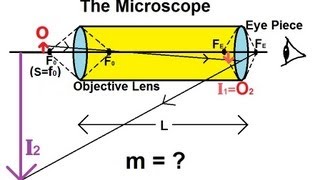
as a compound microscope and a compound microscope is a microscope that consists of a system of two convex or converging lenses one of those lenses is known as the objective lens and the second lens is known as the eyepiece or the eyepiece lens so let's begin by looking at the following description of our compound microscope so we have lens one our objective and Lens two our eyepiece so the objective lens is essentially the lens that inputs all those rays of light that bounce off our object so let's suppose we take a small object as shown
by the small purple Arrow labeled o and we place it just beyond very close to the focal point of the objective lens so this is the focal length this is the focal point of the objective and this is where our object is placed so for all approximation purposes we can assume that the object distance is approximately equal to the focal length of the objective this will become important in step three when we discuss the total magnification so the object is placed just beyond the focal point of the objective next all the Rays of light essentially
bounce off our object uh move through and refract inside our objective lens and then they converge at a single point and that's where our image is formed let's call that image image one or i1 so notice that this image is a real image because it's found on the opposite side of where light is coming from the image is inverted because it points in opposite direction and notice that the image is slightly enlarged compared to our object and also this image is found relatively far away from the objective lens so the object is placed just beyond
the focal point of the objective the objective lens for forms an inverted magnified real image far away from that objective lens next we essentially take our uh knob next to our eyepiece and we turn that knob and we move that eyepiece so that the focal point of our eyepiece is almost exactly at the point where the image is formed this will become important in step one and step two when we we discuss the total magnification so the eyepiece is then adjusted so that the focal length of the ey piece is close to the image formed
by the objective lens next the eyepiece lens then uses image one formed by the objective lens to create a second image that is virtual magnified and enlarge so it's found all the way to the left side of the objective lens so it's virtual because it's found on the same side as where light is coming from it's inverted because it points down compared to the upward direction of the object and it's much enlarged as seen in the following diagram so if we want to we can use the ray diagram as shown by these orange arrows to
find the position of image one and image two as shown in the following diagram and finally the eye essentially uses this second image it treats the image as if it was the actual object and it creates the final image of that object and puts it exactly on the retina of that eye and so what the microscope does is it essentially magnifies into stages this object so the person can observe all the detail found on that particular object and that's exactly what a compound microscope does so now let's discuss the total magnification of this particular compound
microscope so to find our final or total magnification of a system of two convex lenses as in this case we find the individual magnifications of each one of these lenses and then we multiply them out and that gives us the final total magnification so let's begin with step one in step one we want to find the individual magnification of the objective lens so the objective lens essentially acts as a converging lens so that basically means the magnification of the objective lens given by lowercase m o is equal to the image distance this image distance divided
by the object distance which is given by this quantity now remember when we were adjusting our IP piece we said that we're essentially moving the eyepiece so that the focal point of our eyepiece is on the same plane as our image so we're basically assuming that the eye is relaxed so that image one is exactly on the focal point of the eyepiece so that basically means that if we want to find the image distance to find this image distance we essentially take L which is the distance from the objective to the eyepiece lens and we
subtract this and that will give us the image distance of image one so we replace di with L minus Fe where Fe is the focal length of the eyepiece NL is the distance between the two lenses and D is the object distance so this is the equation for the magnification of the objective lens let's move on to step two in step two we essentially want to calculate the magnification for the eyepiece lens the eyepiece lens essentially acts as a magnifying glass it acts as a simple magnifier and so the magnification given by uppercase E of
the eyepiece is equal to well we're making the assumption that the image caused by objective lens is formed exactly on the focal point of the eyepiece and so that means this virtual image will be found infinitely far away and the equation becomes n divided by the focal length of the eyepiece so we obtain this equation in our lecture on magnifying glasses and simple magnifier so n is the near point of this part particular I and F is the focal length of our ipce so we're assuming that image 2 is formed at infinity and the N
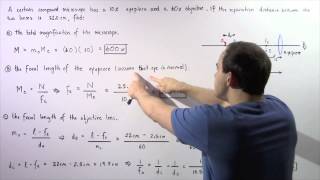
is equal to 25 cm for the normal IE so finally we move on to step three in step three we essentially calculate the total magnification by multiplying the magnification of the objective lens by the magnification of the eyepiece so so this or this multiplied by this and that's exactly what we get in this equation so lus Fe / D multiplied by n / by Fe now let's make some further approximations so remember we're assuming that this distance L is much larger than the distance uh Fe or the distance fo so we're assuming that the distance
between our two lenses is much greater than the focal length of either one of our two lenses so that basically means L minus some very small number is approximately equal to l so that basically means we can replace this um L minus Fe with simply L now in this step when we said we're taking our object and placing the object very close to our focal point of the objective we're placing it very close in fact for all approximation purposes the focal length of the objective is approximately equal to the object distance so that means D
is approximately equal to fo so we can replace d o with fo and the magnification of our compound microscope when we make these assumptions is approximately equal to l the distance between our two lenses multiplied by n the near point of our I which is assumed to be 25 cm divided by the product of the focal length of each one of our two lenses