Welcome back. If you haven't watched part one of this series, I want to encourage you to go back and start there because in that episode, we laid the foundation of what dying to the flesh actually means and why most believers are stuck in the same cycles year after year. Today we are going deeper.
Something that might be a little bit uncomfortable. Most of us think the reason we are not growing spiritually is because of spiritual warfare, demonic oppositions, attacks from the enemy, people working against us. And yes, those things are real.
But honestly, most believers are not losing because of demons. They are losing because of attachments. Things they will not let go.
things that they are not always sins in the obvious sense, but things that quietly feed the flesh, strengthen self, and slowly weaken your sensitivity to God. Jesus did not just call us to avoid sin. He called us to die daily.
And death is not emotional. It is a decision. In Luke chapter 9:23, then he said to them all, "If anyone desires to come after me, let him deny himself and take up his cross daily and follow me.
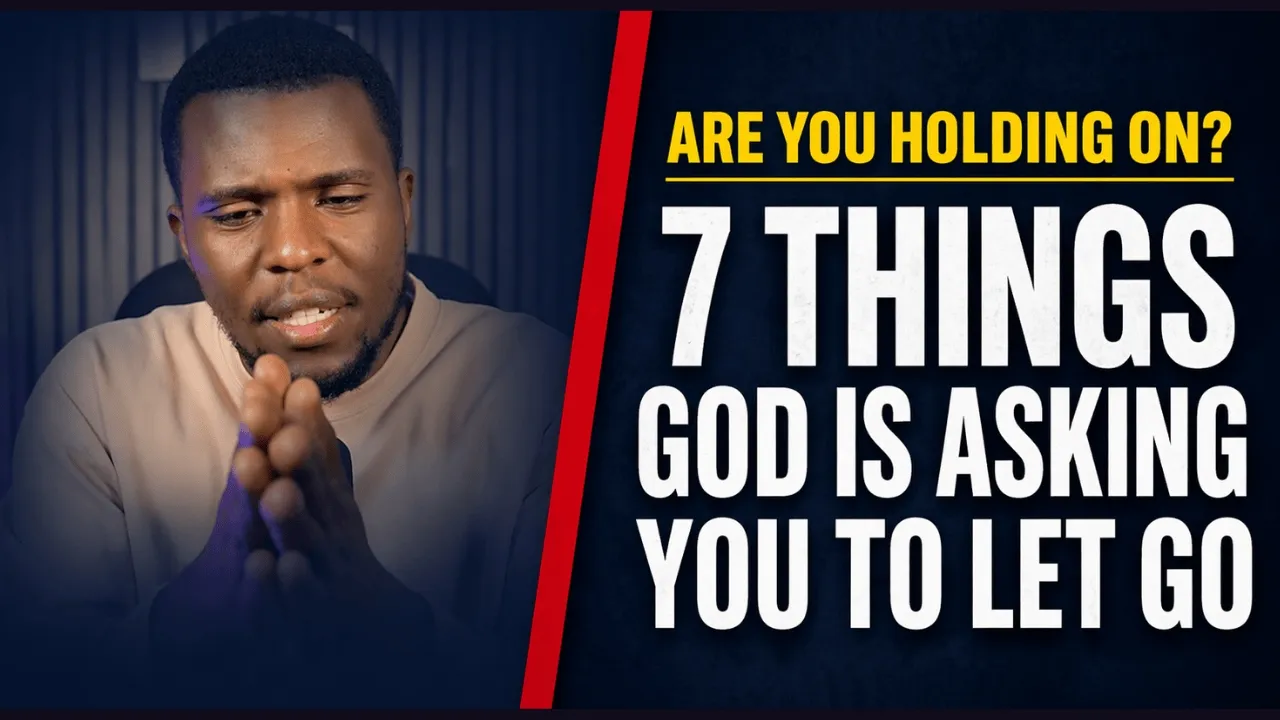
" So today, I'm giving you seven specific attachments that Jesus made clear. You must let go if you actually want to grow. These are not obscure theological points.
They are things most of us are dealing with right now in real time. And the reason they are hard to let go of is not because they are obviously sinful. It is because most of them feel reasonable, even justified.
That is exactly what makes them dangerous. The first thing you must let go of is yourself, your will, your way, your preference. Start here because everything else builds on this one.
The greatest enemy of your calling is not Satan. It is self. And most of us have never really been taught to take that seriously because in a culture that constantly tells you to honor your feelings and follow your heart, dying to self sounds almost abusive.
And look at what Jesus actually said. He did not say improve yourself, manage yourself or even discipline yourself. He said deny yourself.
That is different thing entirely. Denying yourself means there are moments when what you want, what you feel, what you prefer, none of it gets the final vote. Self does not always show up as rebellion.
Sometimes it show up as preference. I just feel like this is not for me. I am not comfortable with that.
That is just not how I am wired. Those statements are not always wrong, but when they become the framework for your obedience, that is the flesh negotiating with God. Think about a man who knows he's supposed to lead his family in prayer, but consistently avoids it because it feels awkward.
He's not in sin. He just finds it uncomfortable. But that discomfort is the flesh negotiating.
And every time he honors the discomfort instead of the obedience, the flesh gets a little stronger and the spirit gets a little quieter. Selective obedience only doing what aligns with your personality, your comfort level or your preference is still form of disobedience. God did not call you to follow him when it feels natural.
He called you to follow him at all cost. You cannot follow Jesus and lead yourself at the same time. Never.
We must obtain grace. The second place we need to die is family opinions. You must let this go.
When loyalty replaces obedience, this one is sensitive and I want to handle it carefully because when you say you need to let go of your family opinions, I am not saying disconnect from your family or dishonor your parents or treat the people who love you as obstacles. That is not what this means. What I'm talking about is the pattern where a person knows what God is asking of them.
He has clarity, has peace, has confirmation and still will not move until the people closest to them understand and approve it. That is where loyalty starts replacing obedience. You must learn to die from family opinions.
Family can love you deeply and still limit you. Not because they are evil, but because they cannot see what God showed you. They are working with a version of you.
They know. They remember your past failures. They have a picture of what a safe, reasonable life looks like for you.
And when God calls you into something that does not fit that picture, then your love will often feel like resistance. In the book of Luke 14:26, it says, "If anyone comes to me and does not hate his father and mother, wife and children, brothers, sisters, yes, and his own life also, he cannot be my disciple. " The word hate in the original context is about comparative priority, not actual hatred.
It means when your love for your family and your obedience to God come into direct conflict, God has to win. The pattern to watch for is delaying obedience to explain it to your family first. Needing their approval before you move.
Letting familiar voices consistently override divine instructions. Learn to let go family opinions. Hear this.
I know someone who spent 3 years waiting for their parents to understand a calling before they finally acted on it. The parents never fully understood. But by the time they stepped out, three years of momentum had been lost.
God was not waiting for the family to agree. He was waiting for the person to choose. The people who love you most are often the ones God has to ask you to love most wisely.
Which sometimes means moving when they don't understand trusting God to handle the relationship. If God has to compete with your family's opinion, you will lose access to your obedience, we must let go family opinions. The third thing you must let go of is money, security, control, and comfort.
We all know money is not evil. Scripture is clear on that. It is the love of money is the root of all kinds of evil, not money itself.
The problem is not the resource. The problem is what happens when the resource becomes your primary source of security, motivation and ambition. The flesh loves money because money removes the felt need for faith.
When your account is full, trust comes easy. When your account is empty, suddenly the call feels a lot less clear. That tells you something important about where your actual foundation is.
Matthew 6:24 says, "No one can serve two masters, for either he will hate the one and love the other, or else he will be loyal to the one and despise the other. " You cannot serve God and Mmon. The practical patterns is to watch for only obeying God when it makes financial sense.
Fear of giving, measuring every decision by profit instead of purpose. But there is a deeper one that does not get talked about too much. Some people cannot follow God not because they lack money but because they are emotionally dependent on financial certainity.
They need to know the numbers work before they will trust God with a step. I've watched people turn down clear assignments from God because they could not see how it could have paid their bills. And I understand that it is a real tension.
But what they are really saying is I trust money more than I trust God to provide. That is a form of idolatry and it is one of the most socially acceptable ones in the church. The question is not whether you have money.
The question is whether your money has you. You can tell by how you respond when obedience costs you financially. Where money leads, God becomes secondary.
The fourth thing you must let go is your image, your reputation, your perception, how you are seen. The flesh is addicted to being perceived correctly. And this one is especially active in believers who are in the kind of visible role, teachers, leaders, preachers, people who have built something because the longer you build something, the more there is to protect.
But this is not just for leaders. It is for the person who will not take a bold step of obedience because they are afraid of looking foolish. It is for the person who overexlains every decision so no one gets the wrong impression.
It is for the person who avoids being wrong in public so strongly that they stop taking risks entirely. Jesus was misunderstood constantly. His family thought he had lost his mind.
The religious leaders called him blasphemer. His hometown rejected him and he stayed obedient through every single one of those misunderstandings without stopping to manage the narrative. In John 5:44, how can you believe who receive honor from one another and do not seek the honor that comes from the only God?
That verse hits harder than it looks. Jesus is saying the desire for human approval is actually blocking faith. You cannot fully believe and fully seek to be perceived well at the same time because the moment obedience threatens your image, you will choose your image.
The practical test is this. Is there a step of obedience you are avoiding because of how it will look? Is there something God has been asking that you keep pushing back on because you cannot afford the perception cost that is image management running your spiritual life.
protecting your image. Revelation requires obedience that is willing to look wrong in the short term. If you are managing your reputation, you will always stop short of the places where God does his most significant work.
You cannot be concerned with reputation and still carry revelation. The fifth thing you need to let go is emotional attachments, people, seasons, and feelings you will not release. This one is one of the hardest ones to talk about because the things we are emotionally attached to are not always wrong things.
Sometimes they are genuinely good good relationships, good seasons, good versions of life that God blessed. But when God signals that a season has closed and you keep trying to hold it open, that attachment becomes a way. The flesh holds unto what the spirit has already released.
And the reason it does it because the flesh find its identity in what is familiar. For example, letting go of a relationship, a community, a role, a version of yourself that feels like dying. And honestly, it is.
That is the point. Philippians 3:13, "Brethren, I do not count myself to have apprehended, but one thing I do, forgetting those things which are behind and reaching forward to the things which are ahead. " Paul is writing from prison and he's talking about letting go of his own spiritual resume, his credentials, his past accomplishment, his religious identity.
He's saying even the good things from the past cannot be what I hold on to because they will slow down what God is doing now. The hardest deaths, crucification of the flesh are not sinful things. They are meaningful things.
The friendships that was real and good that God is clearly asking you to release. The ministry season that bore fruit but God has moved on from the version of yourself from 5 years ago that people loved but that God is no longer asking you to be. If you are making decisions out of emotional loyalty to something that has already served its season, if you don't let go, you will drag yesterday into tomorrow.
And you cannot move forward while facing backward. Grief is a legitimate part of releasing something meaningful. You don't have to pretend it does not hurt, but grief and obedience can coexist.
You can feel the loss and still take the step. There are some things God will let you release emotionally. The sixth thing you must let go is control.
The need to understand everything before you obey. Control is one of the most spiritually dressed attachment on this list because it disguises itself as wisdom. It sounds like I just want to be responsible.
I want to be sure before I act. I need clarity before I commit. But none of those things are wrong in themselves.
But when they become the conditions for your obedience, they are actually control operating under a spiritual disguise. The flesh wants explanation. The spirit requires trust.
And those two things are not the same. Every major move of God in scripture involved someone stepping before they had the full picture. Abraham left a destination.
Moses confronted Pharaoh without speech prepared. Peter stepped out of the boat without understanding physics. Proverbs 3:5-6 says, "Trust in the Lord with all your heart and lean not on your own understanding.
In all your ways acknowledge him, and he shall direct your paths. Lean not on your own understanding is not a command to be foolish or impulsive. It is a command to hold your understanding loosely to know that what you can see is not the full picture and that God is asking you to move based on what he sees not what you can currently verify.
The pattern to watch for delaying obedience until complete clarity comes. Needing to know the outcome before you commit to the process. Anxiety that spikes the moment things feel uncertain or unresolved.
If God has to give you a detailed explanation and a guarantee before you move, you're not walking in faith. You are walking in a managed risk. Faith is not stepping when you understand.
Faith is stepping when you do not and trusting that God's track record is more reliable than your ability to figure out everything out in advance. If you need control, you will resist surrender. The seventh thing you must let go, comfort, is convenience and familiarity.
I want to end on this one because it is the quietest of the seven and probably the most widespread. Comfort does not announce itself. It does not feel like sin.
It just slowly narrows the range of things you are willing to do, the difficulty you are willing to sit with, the sacrifice you are willing to make. And over time you look up and realize you have not moved in years. The flesh grows strongest in comfort zones.
Not because comfort is seen, but because the flesh thrives wherever there is no pressure, no stretching, no demand. And God rarely does his most significant work in environments of ease. He moves in stretching.
He shows up in the hard seasons. God will build something real in the place of difficulty. Hebrews 12:1 Now no chastening seems to be joyful for the present but painful.
Nevertheless, afterward it yields the peaceable fruit of righteousness to those who have been trained by it. That phrase is doing a lot of work. It means the discomfort is not the enemy of your growth.
It is the environment of your growth. Every season that asked something difficult of you, every assignment that stretched you past what felt safe, every obedience that required you to sacrifice something comfortable, those are not things that happened to you. They are things that built you.
The pattern to watch for consistently choosing the easier path, staying in a role, a church, a relationship or a routine because it is familiar and safe rather than because God is still asking you to be there. Avoiding any obedience that costs you rest, reputation or convenience. So many people are not stuck because of resistance.
They are stuck because they are comfortable. And comfort is a very effective cage because it does not feel like one. You will not find your assignment in the place where everything is easy.
Most of the time, God is found at the edges. The place just past where your comfort zone ends. Comfort will keep you safe, but it will also keep you small.
Let me bring this home. Every one of these seven things, self, family opinions, money, image, emotional attachments, control, and comfort, they are not all obviously sinful. Most of them are neutral at the surface level.
Some of them are even good things. But when they compete with God, when they become the reason you hesitate, delay, negotiate, or stop, you are feeding your flesh. And anything that feeds your flesh will eventually fight your spirit.
The two cannot grow at the same time. The question is not whether these things are bad. The question is which one is currently getting more of your loyalty than God is.
Galatians 2:20, I have been crucified with Christ. It is no longer I who live, but Christ lives in me. And the life which I now live in the flesh, I live by faith in the son of God who loved me and gave himself for me.
Paul does not say I am managing myself. He says I have been crucified. That is a settled transaction, not an ongoing negotiation.
And yet he wrote that from a real life, a life with real pressure, real loss, real difficulty. Dying to the flesh is not a spiritual feeling you arrive at once. It is a daily posture that gets expressed in small choices.
Choosing obedience over preference, faith over control, purpose over comfort. If you do not let these things go, they will not stay neutral. They will shape your decisions, dial your discernment, and quietly delay the things God has been trying to build in your life.
So, let us pray. Lord, I bring these seven things before you honestly. The self-will I have dressed up as wisdom.
The family approval I have treated as permission. The financial security I have trusted more than I have trusted you. The image I have protected at the cost of obedience.
The people and seasons I have held and to pass their time. the control I have insisted on instead of simply trusting the comfort I have chosen over the call. I surrender each one of these to you today.
I do not want to negotiate with obedience anymore. Build in me what only grows through dying to flesh in Jesus' name. Amen.
Dying to flesh is not losing your life. It is finally living the one God designed. I hope this helped you.
Don't forget to subscribe, like, and drop in the comment section. I obtain grace to let go in Jesus name. God bless you.