Your partner confesses saying she loves you. But you're in disbelief for whatever reasons you have. You're torn between the two competing propositions, creating a painful conflict in your mind.
She loves me, No. She loves me not. However you do not have strong enough evidence if she does or does not.
But you're generous. You give her the benefit of doubt at the moment until definite evidence comes up in front of you. You are actively looking for a piece of evidence and voila!
She cheated on you. Once is enough for you and you dump your partner for good. So the name of this tragic movie is called null hypothesis significance testing.
Well sorry about this terrible voice acting. I think I found the perfect song matching this story but the copyright claim is just killing me. So I couldn't just insert the background music for you to make it more interesting but I tried my best.
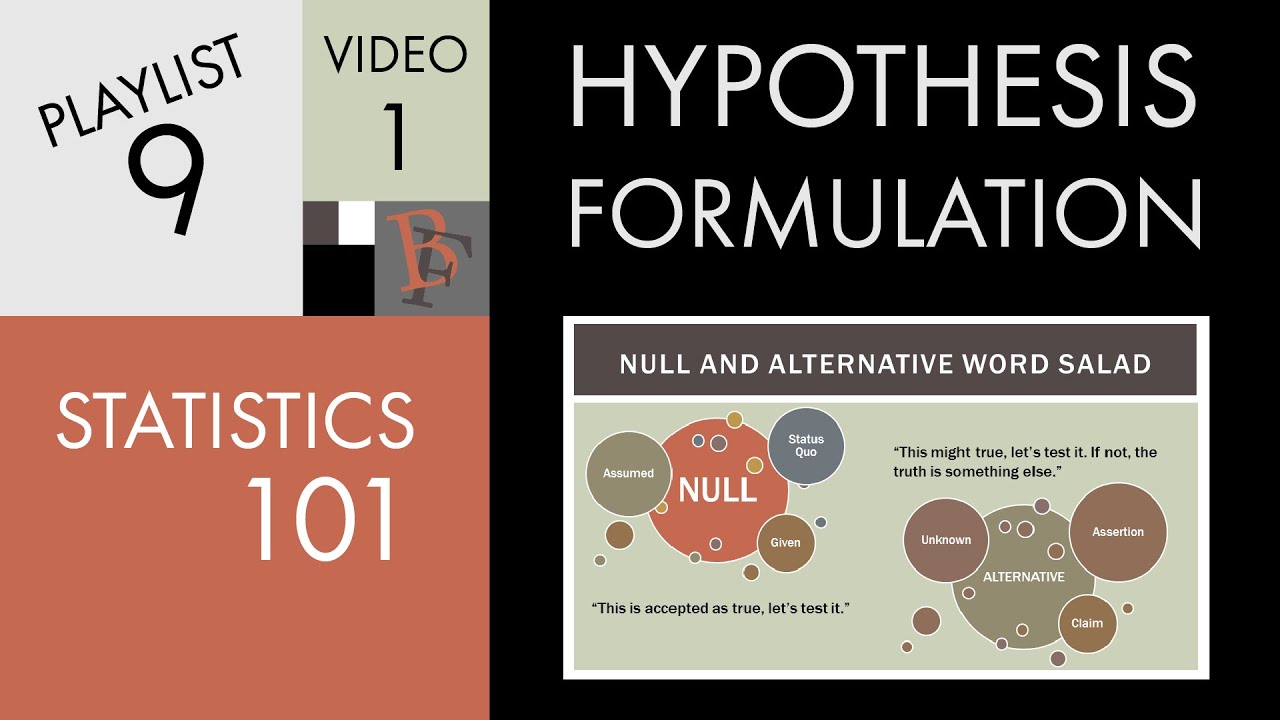
Anyhow in a nutshell the null hypothesis significance testing is all about making a proposition statement, claim, argument to be tested against the counter proposition, statement, claim, or argument so typically the hypothesis you want to test, as a recap, and support is called the alternative hypothesis or H1 and the counter to the alternative hypothesis is called the null hypothesis or H naught. so in this previous story your supporting hypothesis is that she loves me not so let's say that is your supporting hypothesis you're in disbelief and the antithesis right h naught is that she does love me right so this pair comprises all the possibilities meaning they're mutually exclusive (sorry exhaustive, I mean to say) they are and then exclusive to each other. So once you have the hypothesis set up then you need a decision rule which hypothesis you will choose based on the kind of evidence you will collect and how likely to observe such evidence under the assumption that h naught or the null is true.
So in essence, you are giving the benefit of doubt to the null by a very generous margin compared to the H1 so therefore to reject the null then you need a very strong or extreme evidence that is highly unlikely were the null hypothesis true. So the evidence of choice in the story is the cheating episode and the rule of decision is the the number of cheating episodes which is pretty much up to you to decide how many cheating incidents will be enough for you to dump someone who says I love you. Well I don't know about you but you know once should be more than enough for me however I know a friend who still thinks that he loves his partner even after he knows his partner is a serial cheater.
So now you go out and looking for the evidence or data and once you have the evidence then now the ball is in your hand. You decide which hypothesis is supported based on the decision rule you set in place before you collect the data. So if you if you change your mind after the evidence then you're breaking the rule of the null hypothesis significance testing.
So statistical hypothesis testing is really a kind of a decision-making process using statistics and this statistical hypothesis testing is typically used in research wherever a sample statistics is calculated from measuring the variable or variables of interest. So to make the decision using this process, comparison is the key. So you want to compare if your sample statistics of interest is different enough from the status quo considering the sampling variation.
So here the status quo represents the null hypothesis when nothing happens right so when no change is assumed then where is your statistics basically the location of your statistics. How likely it is that you see this statistics at that location. That is the comparison you're going to make to make the decision and the decision rule is basically the probability or the likelihood of observing the statistics at a certain location.
So we're going to use that as a decision rule so that is the essence of the statistical hypothesis testing. To give you a kind of a different spin on the and the statistical hypothesis testing I'll give you some other example and by the way this is the personal confession of my drinking behaviour okay? So the story goes like this.
I woke up with a terrible headache so it was one of those extremely rare nights I got totally drunk like a dog. I just don't remember what happened last night and now I realise that I lost my phone but I have no clue where my phone is but my theory is it should be somewhere in the house because that's where I find my phone most of the time when I'm home and sober so only (once) in a blue moon very unlikely event, once in a blue moon, my phone would be found outside the house. So to find my phone I use my wife's phone to infer the location of mine.
So I hear the faint ringing telling me that it is somewhere outside the house. So in this story, my null is that the cell phone will be in the house so that is my default position assuming that nothing happened right? I know that it's in the house because it is almost always say 95% of the time, if not 100 percent, in the house when I'm home and sober but wait!
However unlikely it may sound, it is still possible that the cell phone is somewhere outside the house because I was drunk as a dog so that is your alternative hypothesis. So hypothesis testing is very similar to this process of finding the location of the lost phone. So you have a pair of hypotheses about the possible location of the phone and based on the mental model of the house and the surroundings, you know how likely each hypothesis will be true.
So for example you assigned a 95 percent of chance that you will find your phone in the house. So based on your hypothesis, it is highly unlikely that you will find your phone outside the house and that's why you assigned very small fraction of the likelihood that you will find the phone outside the house which is in this case 5% and please note that the likelihood here is closely related to the location of the phone. So in other words, the further away the phone is from the house, the less likely it will be found.
Now you ring the phone to collect the data and you hear the ringing and you decide the phone is indeed outside the house no matter how unlikely it was, based on where the sound is coming from. So null hypothesis significance testing is about making a decision about the unobserved location of a parameter inferred by the sample statistics based on a certain decision rule. So with NHST, we'd like to know whether the sample statistics is "significantly" far from the usual or typical location or it is still within the margin of error centered around the typical location.
So to make such a decision we need to calculate how likely the sample statistics is to be found in that location. So in null hypothesis significance testing we have a mathematical model relating the likelihood of the statistic to occur as a function of different locations of statistics. So one such example is the sampling distribution as we have learned previously.
So the most likely location of the sample means is where the population mean is according to the properties of the sampling distribution. And as the location of the sample mean moves away from the centre to the tail ends, it becomes more unlikely to observe such extreme statistics which is described by the sampling distribution. And in the context of research, we assign highly unequal weighting between the null and the alternative hypothesis.
So we allow very generous margin for the null whereas only tiny margin for the alternative to make it very difficult to support H1 against H naught. So we will only be able to support our alternative hypothesis when the sample mean falls outside of the 95% confidence interval. We will have more chance to talk about the reasons behind this unequal weighting between the two hypotheses later on.
nd by the way you can think of the 95 confidence interval as a GPS signal so the middle dot here is the approximate whereabout of the sample mean and the radius ofA the faint blue circle represents the uncertainty about the current location and by the GPS data. So next week we will go over the steps running the null hypothesis testing in much more detail with an example.