Good day, Professor Norma and Steam College. My name is Carlos Eduardo Ru Sanchez and today I am here to defend my research project titled oral production and spontaneous use of simple present tense in sixth grade English foreign language classrooms. Um this project was develop as a part of the linguistics emphasis in English at the CNC in Bota.
I would like to express my gratitude to my advisor professor Normas Garcia FA for her guidance throughout this process. The key words defining this study are EFL language context language transfer simple present tense speaking in EFL and spontaneous language use. This research follows a qualitative approach within the SAU research line of education and pedagogy.
Okay, let's continue with the statement of the problem. The core of this research stems from a significant gap between detecting between theoretical grammatical knowledge and the actual ability of the students to communicate orally in many classrooms. We observe that what I what I call the illusion of fluency.
Um so some or mostly of the students acquire some information in a theoretical form but when it's time to produce to give a product with that information they have a big gap and they can use it the information in an oral or spontaneous form. Seed graders successfully memorize basic vocabulary and grammatical structures often performing with high accuracy in writing exercise and formal assessments. However, when they then encounter the reality of paralysis when these same students are asked to speak spontaneously h they often freeze.
We see symptoms like prolonged pauses, deep insecurity and paralyzing fear of making mistakes in front of their peers. This gap exists because of a lack of a practice in real context and a high level of anxiety regarding oral performance. Let's continue with um the objectives to address this problem.
The general objective of this study was to analyze how cooperating learning strategies can strengthen fluency and self-confidence in oral expression of six grade students. Um some of our specific objectives included um were analyzing the difficulties students face in speaking English h in a school setting and how the simple present manifests during classroom activities. Um the second uh objective specific objective was observing how students use the present simple tense when participating in oral communicative activities and fi and finally describing uh the specific ways in which students use the tense during their oral interactions.
So this is the literature review. We got some key theories in in our theoretical framework or was built in four of pillars of second language acquisition. First we have a sten crashian input hypothesis which emphasizes that learning occurs when students are exposed to knowledge slightly above their h current level in a meaningful context.
The students learned just being exposed to mostly of information and their brains acquire all that info and they learned with that hypothesis. Next in second we got a Mel swine output hypothesis that for her was crucial to this study because Swain argues that h producing language is an essential h learning mechanisms because it forces the student to notice gaps in their knowledge. This creates an output loop where the student attempts to speak notices on linguistic wall applies conscious attention h to the form and finally produces the more precise sentence.
For example, some students try to produce in oral form and they being aware of their own mistakes being a pay attention that the they need some or a new vocabulary to cover that gaps. Third we look at Larry Selinker concept of inter language introduced in 1972 and selling defines this as a linguistic system separate from both of native and target language. In this theoretical review, it's very interesting because Lori Selinger say that students prefer give the communication instead of being um successful in grammatical forms.
Erh, we view errors and not as failures but as part of an evolving timeline toward accuracy such as moving from he go to he goes to the park. And some students prefer say he go to the park making a mistake but that mistake isn't a real mistake because we can find and identify that the students uh find have a knowledge introducing the subject the verb and the complement instead of the verb isn't in a good conjugation. Finally, we got Michael Long's interaction hypothesis reminds us and that while input is important, interaction is the spark.
Yeah. Through uh through negotiation meanings and receiving per feedback, grammatical structures are cemented into active memory. For example, the students prefer interact between each others.
Yes. in pairs and they are feel more comfortable receiving feedback by her or their classmates. Now we are going to continue with the methodology.
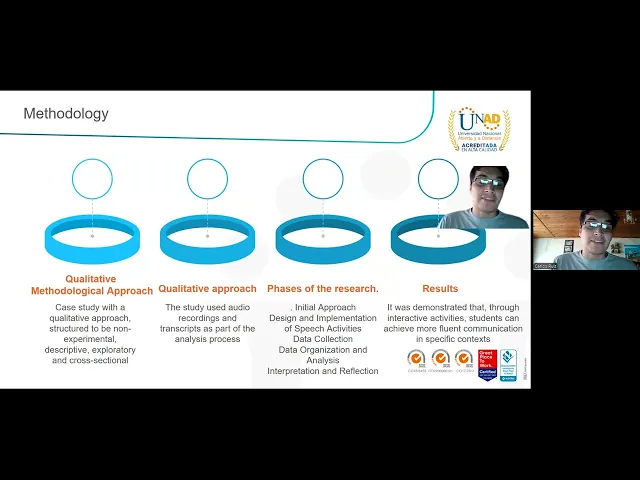
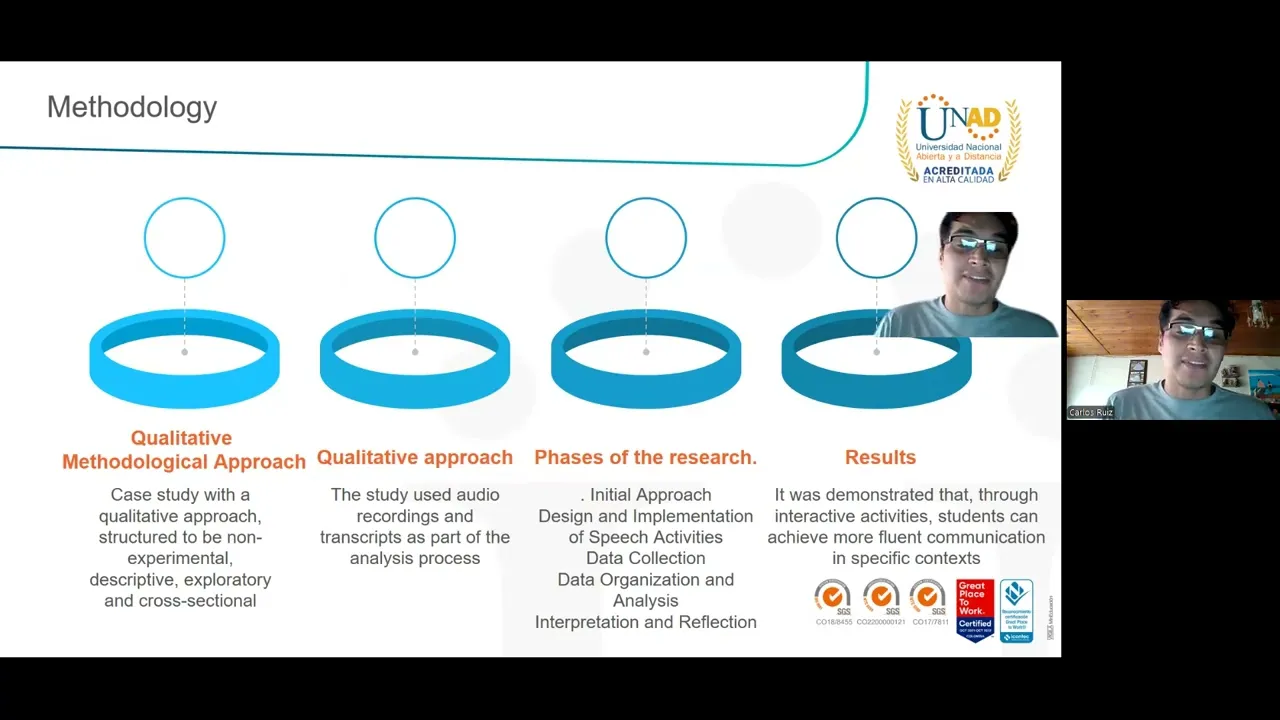
This uh research employed a qualitative methodological approach specifically a nonexperiment descriptive and exploratory case study. The population consisted of approx 25 sixth grade students aged 11 to 12 and at an A1 basic profy level with a formal EFL institution. These students showed high interest and integrating digital tools into their learning.
The research was structured in five phases. The first phase was the initial approach in which we identified the context, the population and the necessities of the students. Then the second phase was the design h and implementation of speech activities.
These activities must include um the simple present rules to be h graded. H in third place we got the data collection which uh you utilize audio recordings and transcriptions of that audio recordings. Then we got the data organization and analysis in group.
We heard constantly uh most of one time uh the audios trying to identify the mistakes h the hesitation of students etc. And finally uh the interpretation and reflection of that data. Okay.
The results and findings um our findings revolved that oral performance is intrinsically linked to students emotion emotional state. Yes. H as crashen say to us h the effective filter is very important in this part if the student feel comfortable with the activities and with the feedback they produce in a better form.
We observed h that students frequently post during oral production reflecting a significant difficulty in organizing ideas spontaneously. While the students recognize and strive to use the simple present tense, their performance is often inconsist and superficial. For example, most of student ex exhibit hesitation and nervousness which directly impacts their fluency.
Yes, effective falter. H. However, the data also demonstrate h that interactive activities allows students to achieve h more fluently communication in specific context.
Interestingly, students employ various uh strategies uh to maintain communication despite their linguistic limitations. H interaction effective filter h output hypothesis and input hypothesis. Now let's continue with the discussion.
H in the discussion of these results um it becomes clear that a pure theoretical um lecture-based approach limits the learning of the simple present. We must also reconsider the role of the net language. H yeah the use of Spanish can be a natural and positive support tool rather than just a mistake.
Some students prefer give some information in Spanish instead of staying in silence. The research achieved is uh its primary goal demonstrating that interactive activities help sixth grade students use the simple present in communicative context including rules like third personal uh part third person singular. So let's continue with the conclusions.
H there is a significant gap between theoretical knowledge and actual communicative competence. Yeah. As I start um these speech this defending students have the entire information in theoretical form but there is a big a huge gap between this info and what they produce.
Effective English learning depends on more than just memorizing rules. It requires the creation of a safe interactive environment that transfer passive knowledge into spontaneous communication. So h this was um the defending of my h research.
So these are the main references. Crash and Stephen H Swain Solinker and Michael Long. Thank you so much.