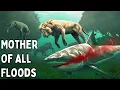
The Mediterranean Sea is one of the most well-known geographical features on the entire planet. People want to live there, travel there, party there, and it even has its own diet named after it. But while it may seem like a paradise today, the Mediterranean has actually been through a lot and has also put the world through [music] a lot.
A lot of pain, that is. As despite its chill vibes, it was in this sea that a catastrophic event took place like no other before or after it. As it was here that the largest flood to have ever occurred happened.
as far as we know of being of such immense proportion and violence that it had a massive impact on evolution in the area it might have even changed the whole world as we know it no boats involved and this great flood is known as the Zancen flood the name isn't supposed to be some sort of cool sounding nickname rather it refers to the period in which this event transpired the Zancen stage which was the earliest stage of the plyene and began roughly 5. 33 million years ago it was a time when things were a bit warmer and wetter than now yet overall it's unequivocally best known for harbor bring this massive natural disaster. Although, ironically, before we can dive into this flood, and yes, pun intended, we have to first take a look at what happened right before it, which was something that is the exact opposite of flooding.
A great drought or drying, you could say. Today, if you want to go from, let's say, Italy to Morocco, and don't want to take a plane, you're going to need to hop on a boat. But starting between 6.
5 to 6 million years ago, give or take, right before the Zancane began, using a boat would get you nowhere but stuck. And instead, you'd have to bust out some boots. Cuz believe it or not, the Mediterranean Sea wasn't well seeing, as it was undergoing what is now referred to as the Missinian Selinity Crisis, also known as the Logar event.
Many decades ago, scientists studying the region began to notice something rather odd beneath the waves in the Mediterranean. sediments along the seafloor. And specifically, it's the abyssal plains that contain traces of evaporate minerals.
Not something you'd expect to see along the abyssal plains, which in the case of this sea, can lay up to 5,100 m or over 16,000 ft below the surface, about eight times greater than the distance your typical hot air balloon flies up with tourists. And what this heavily implied was that once upon a time, somehow the Mediterranean Sea had dried up. But how does something that could submerge the entire US in waters taller than the Empire State Building even go dry?
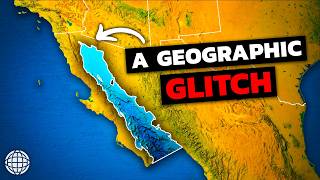
Well, the culprit seem to have been tied to the Strait of Gibralar. Now, if you don't know, this is a narrow straight that connects the Atlantic Ocean to the Mediterranean Sea and currently separates Europe from Africa. It's rather deep for a straight with its lower points being about 900 m or 2,950 ft [music] down, allowing for a large amount of water to flow through it.
However, it remains very narrow with its narrowest point being just about 9 mi or 14 km long. Essentially a fingernail length when it comes to geography. And this turned out to be a major weak point for the Mediterranean Sea.
As 6ish million years ago, this straight well rather the precursor to it more or less suddenly closed, severing the link between the sea and the ocean. The reason why is not fully yet understood, but the general consensus is that tectonic activity and climate change resulted in the close. And let's just say this proved to be catastrophic for the Mediterranean.
As compared to most bodies of water, it is situated in a rather warm and dry pocket which started a cycle of partial to nearly complete desiccation. In [music] other words, the sea started to rapidly dry up with the sea possibly losing the equivalent of 29 dead seas every single year. Then it's possible that within just one millennia or 10,000 years, the Mediterranean essentially turned into a near empty bowl, resulting in endless abyssal plains that were exposed to Earth and hyper dry, creating unimaginable sights and train with there really being no direct comparison on Earth right now.
[music] So we can't tell what this empty sea would have looked like exactly, but we know it would have come across as a bit apocalyptic and very metal. Of course, it wasn't so metal for the animals that have been living within the Mediterranean, as this disappearance caused uh some major headaches for them. In fact, this event is a bit of a forgotten extinction event on a continental scale, [music] which according to some studies has even been touted as being the actual deadliest extinction since the dinosaurs asteroid, at least based on certain numbers.
As the fewer were an animal that relied on the Mediterranean at the time, there was a pessimistically slim chance to survive this dryup. With 90% of endemic life having perished as the waters evaporated, including, by the way, all coral species at the time. Additionally, Mediterranean fish, mollisks, and any mammal took a major hit as well.
And even animals living alongside the coasts paid a heavy toll, and where water had once been now would have lied massive deserts of salty peaks, valleys, and [music] caverns, bearing really more similarity to an alien desolate world as opposed to Earth. And it sure would have felt more like a hostile xenoplanet, [music] too, as the topography of the seas floor made for some uncomfortable weather with the lowest points of the basin likely creating extreme weather through something known as adiabatic heating. And the most extreme studies have found that in the summer, walking on the lowest points of the Mediterranean's basin would have been 80° C or 175 degrees Fahrenheit.
Hot enough to melt the bottom of your shoes and to cook you alive, rendering it inhospitable to human or really any life except for extreophiles. And while this was the highest estimated possible temps, we do know that at the very least, whatever little water remained in this basin was only able to reach a minimum of 35° C or 90° F, as certain deposits formed in them only show up at specific temps. So, all in all, this place was definitely not somewhere you'd want to find yourself.
And that's before factoring in that you also had massive powerful sandstorms that swept dust, sand, and other particullet [music] across the dried plains, which were also incredibly harsh given how low down they were, making the lowest natural points on Earth currently look pretty laughable. And this could have also resulted in the air being thick, soupy, and full of noxious gases which sink. Meaning, before being cooked to death, you might have just died from trying to breathe.
And all in all, the Missinian solinity crisis killed many walks of life and did not lead to a paradise by any means. Yet, surprisingly, it would actually prove to be massive for modern life and evolution. As despite the odds, animals still managed to cross the bar and dry lands leading to a funnel interchange between Europe and North Africa.
And we know that hippos, elephants, bovids, rodents, camelids, and possibly even giraffids made their way across these plains. And that's just the start of it. Who knows what else did with the end result allowing populations to occupy areas that would have been otherwise inaccessible.
[music] And crazily enough, there's even a chance that at some point animals started to live amongst the plains themselves, at least in the more mild parts that weren't low down, as eventually rivers started to flow more into the basin, including, by the way, the Nile River, resulting in some regions transforming into a very salty brackish water, much like the Caspian Sea of today, which could then in turn support some life around and in them. And though rivers like the Nile flowed into the basin, they did not escape the ramifications of the missing Mediterranean. As with the disappearance of the sea, many rivers were forced to cut down on the river beds, resulting in giant canyons.
And in this case, this would have happened to the Nile as well, with its water level dropping to extreme levels. Where near Asan, it would have been 200 m or 660 ft below the surface. While in what is now Cairo, the situation was even more dire, as demonstrated by a canyon that was discovered beneath the literal city, laying at a depth of 2,500 meters or 8,000 ft, which just for perspective is similar to how tall parts of the Grand Canyon is.
And thus, [music] of course, leading to its own monumental impacts in the animals that relied upon the Nile for resources. Yet in this area where water surely would have been scarce, I cannot advise you enough to actually steer clear from any visible blue as things were about to change and change [music] very very fast. Now, we don't know exactly why, but around 5.
33 million years ago, give or take, the straight to Jialter was suddenly opened again, reconnecting the Atlantic to the Mediterranean. And what followed is something I can only describe as simple physics, but led things to go to hell. As of now, the main hypothesis on this is that one of the freshwater channels that flooded the basin slowly started to erode at the sides and after enough time bore through the Mediterranean side straight into the ocean to the east and establishing a connection once again.
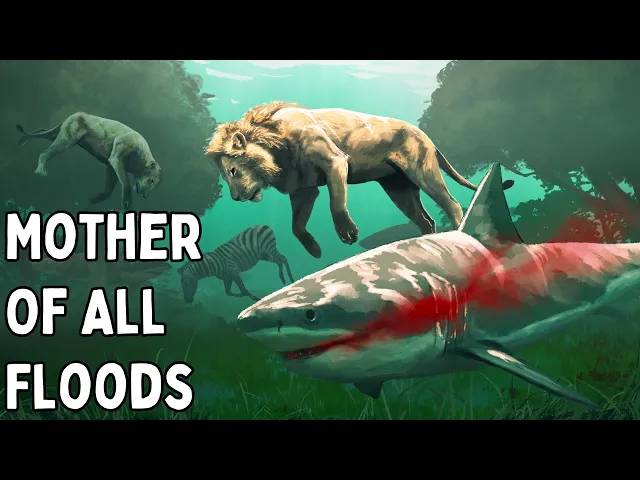
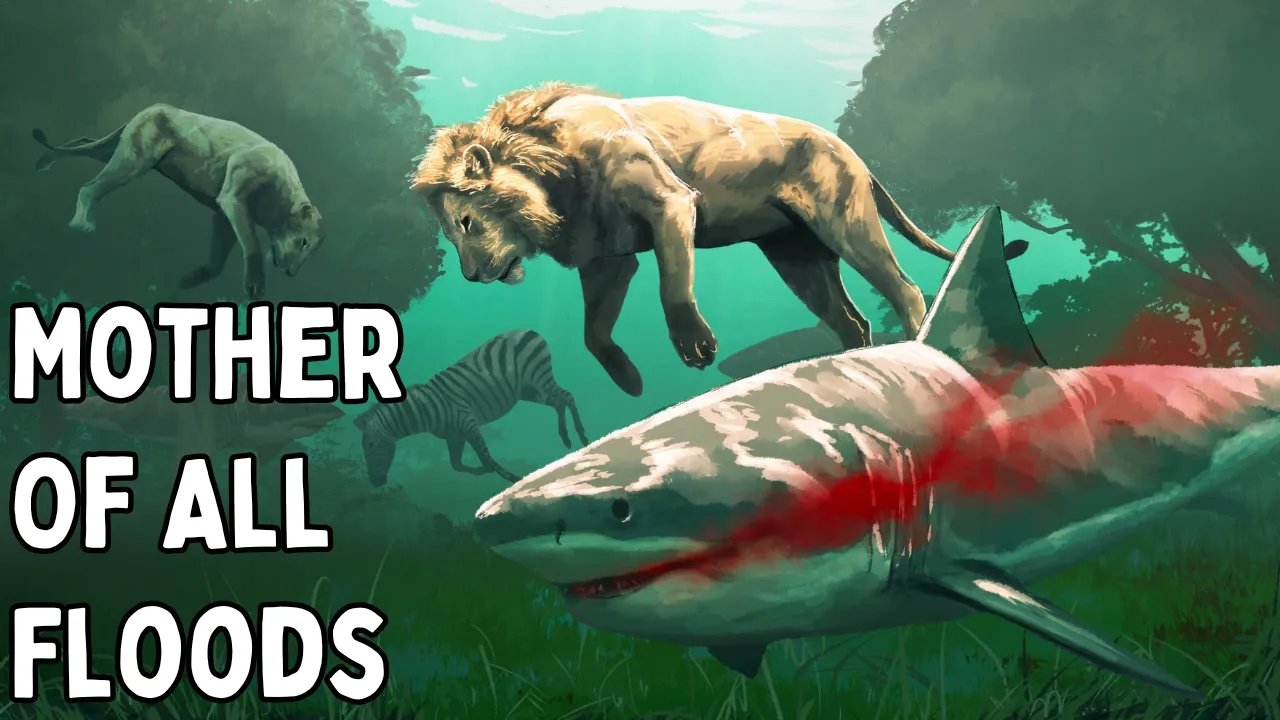
Now, this stream likely wasn't that abnormal in size, but very persistent. And it sure did cause a lot of problems as it led to what you've been waiting for, the Zancen flood, the largest flood of all time. And witnessing this event in person would have been so surreal that you'd probably have thought you were dreaming.
And when I say dreaming, I mean living a nightmare. And some recreations estimate that the flood could have rushed down a steep face of more than 1,000 m or 3,350 ft with a maximum discharge rate of around 100 million cubic meters per, wait for it, second. Yeah, that's about 3.
5 billion cubic feet per second. Now, obviously, our little brains are not used to comprehending such a large number, but here's an easier way to think about how insane this is. If you were facing the Zancen flood, it would be like taking on the Niagara Falls only 33,000 times over.
And another way to imagine it destructive power is that rivers severely impacted by the 2011 Japanese tsunami still only saw discharge rates that were about 8,000 times less powerful. And to truly match the Zancen floods force, it would take over a thousand Amazon rivers combined. In other words, the largest discharging river on Earth to match its ferocity.
And due to this monstrous force, large amounts of earth would have been completely sheared away by the crashing waves. And anything and everything caught amongst the abyssal plains and surrounding areas would have been completely eradicated. And if you think you had any chance about running these waves, then think again.
As the water is believed to have surged forth at 40 m/ second, so about equivalent to 89 mph, faster than the fastest highway in the US. And it wasn't just the simple rush of the water you'd have to watch out for, as the power generated was so high when it struck various parts of the Mediterranean basin that it triggered literal seismic activity with earthquakes following that were large enough to cause widespread landslides that in turn triggered their own tsunami-like events and leading to just that much more carnage. And even by other mega flood standards, the Zancen was a doozy, outclassing other mega floods like the Misola by an order of four times.
So truly one of a kind. And given all of this, you probably won't be surprised to hear that it actually didn't take the Mediterranean long to fill up once more with a refilling process for essentially the entire basin probably taking no longer than 10 years. Whereas, you know, it took a thousand years for it to empty out.
And something interesting about this great flood is that despite it happening on a massive scale, it's still one of those things that of course wasn't visible to the entire planet. And yet, the whole globe might have still been able to feel that at least happened as this flood possibly resulted in an extended cold [music] spell. Now I will admit that this aspect of the Zanclean disaster is a bit more unclear.
Yet historically it has been known that large floods can mess with the global weather. Take lake a gases for example a no longer existing massive proglacial lake that existed in north central America during the pleaene. During its massive existence it was being fed by the meltwater in the Laurentide ice sheet that was retreating at the time.
And this lake was freaking massive being as big as all the great lakes put together. But eventually it obviously collapsed leading to the formation of Lake Winnipeg, Winnipeg Osis, Manitoba, and the Lake of the Woods. And this thing was so big that the sheer amount of fresh water it emptied was enough to dilute the world's oceans and raise worldwide sea levels by up to 3 m or 10 ft.
And together, this combo essentially induced a 1,000-year period of unusual coldness, which is saying a lot, saying that the lake flooded during an already pretty cold time, the ice age. And while the Zanclean flood was not fresh water going into the sea, the amount of water removed from the Atlantic and deposited [music] probably still had a gnarly impact on the planet's climate for quite some time. However, just like the drying, ultimately the gnarliness of the Zancen flood wasn't all destructive, as it also had consequences that could be viewed by some as positive or at [music] the very least neutral.
For starters, if this flood didn't happen, then you could kiss the current version of the Mediterranean goodbye because it simply wouldn't exist. Nor would the animals that live within, humans included. And interestingly, some new animals that came with the flood didn't live in the Mediterranean prior to the salinity crisis.
As it was only after the Zancen that things like dolphins and great white sharks started appearing in the fossil record. And along with these two large marine animals, the expansion of this body of water led to an intense diversification, possibly resulted the way the flood eroded certain sediments, creating a thick soup of ooey, gooey, nutrient-rich waters, which in turn led to an influx of fish, corals, mammals, and the works. And honestly, the Mediterranean would likely never be at the levels of the biodiversity it has now if it wasn't for the Zancen floods.
So, it's like a wise man once said, no pain, no gain. And it wasn't just the marine animals that were impacted by the Zanglan floods, as ultimately the rising waters played a huge role in the way that certain terrestrial animals evolved. Today, the Mediterranean Sea is home to about 10,000 islands, each with their own unique wildlife.
And though the Zancen flood didn't create these islands, per se, with some like Sicily forming later on, it still is a situation where we wouldn't have such isolated land masses if the Masonian salinity crisis never ended. And thus it's largely through this flood that we got some of the Cenazoic's most unusual animals. For example, Sicily, Cit, and Sardinia were all reservoirs for some of the most interesting animals impacted by insular isolation.
And traveling to any of these places throughout the plyosene would treat you to some odd spectacles. This included, but was certainly not limited to, carnivorous otter the size of jaguars, miniature wolves that were absolutely adorable, the smallest known elephants of all time, including, by the way, the very smallest paleoloxon falconery, which not only could you have ridden like a miniature pony, but was also smaller from a height standpoint than literal birds that lived alongside with giant swans being a thing. In some cases, measuring 7 ft or 2.
1 m long and having 10 ft or 3 m wide wingspans. Furthermore, giant eagles, owls, and cranes were all found in varying islands at different points as well. And to match the teenytiny elephants that were impacted heavily by Ensler dwarfism, you also had just about every other mini mammal you could imagine.
As dwarf oroxs, goats, deer, and even many hippos call these numerous islands home. While on the flip side, giant rodents and reptiles that are usually small like tortoises became massive and were plentiful as well. And surely none of these strange walks of life would have existed if the Missinian crisis never ended or if the Zancen flood never occurred.
And this does all lead to an interesting question, which is that because tectonic activity hasn't exactly stopped and the straight of Jialter remains well so small, can we expect the Mediterranean to undergo a similar cycle once more? [music] And for my Mediterranean enthusiasts or anyone who lives there, I'm sorry to say, but the answer appears to be yes. While happening at a pace that would make a snail seem like a Bugatti, the African Nubian plate is actually crashing into the Eurasian plate, a bit more every single year.
And this process started about 100 million years ago and will continue to take millions of years to end. So, it's really hard to say what the end result will be, but in many models, the future ain't super bright for the Mediterranean as it could essentially be swallowed whole as the tectonic plates are consumed. Moreover, the straight of Jibralar would likely close much earlier if things really do start moving in the wrong direction and thus leading again to another salinity crisis.
And let's just say that would prove to be a major problem for humanity. As right now over half a billion people live in its basin and even more rely on it through the resources it provides and the impact it has on the global climate. So if it suddenly disappeared over a thousand years, we'd kind of be in for a hard time.
Yet that is the problem for tomorrow. Or rather millions of tomorrows in the future. But either way, not today.
Thanks for watching and until next time on Extinct.