[Music] can I have a very big round of applause for Dr Bjorn lomberg [Applause] [Music] [Applause] [Music] thank you thank you very much it's great to be here and thank you very much Hannah for for pitching my new book which I'm not Going to talk about at all now that's not entirely true I'll probably talk about it if you ask some questions but what I want to talk about really is to think about how we deal with this energy transition that we're trying to do and and Hannah was talking about how we want a lot
of good stories I'm actually going to challenge that a little bit uh because I'm I'm very much of a data guy I I used to teach statistics to a lot of freshmen uh people and everybody as you Might imagine hated it but it's really a good way to understand the world and you know I I tend to think that graphs are sexy so I'm going to show you a lot of them uh but fundamentally I want to tell you a story that I think we don't hear but we should if we're actually going to succeed
in doing an energy transition so look global warming absolutely it's real it's man-made that's not the point that I'm trying to make here but it's often vastly it's saturate them and that leads To really bad judgments because if you think this is the end of the world you're willing to do everything to tackle global warming and a lot of people do now so a recent OSD survey actually showed that 60 of everyone in the rich countries now believe that global warming will likely or very likely lead to the end of mankind unless we do something
about it that's just simply ridiculous I mean apart from being you know an incredible Stress on most people that's not what the U.N climate panel tells us all but it is what we typically hear so I'm just going to show you a very very few select sort of Snippets but you hear this all the time right guterres are you and Secretary General he tells us the world is facing a grave climate emergency every week brings new climate related Devastation floods droughts heat waves Wi-Fi Super Storms yeah we're in a battle for our lives and climate
change Is the biggest threat to the global economy this is sort of the standard conversation around climate change and I'm going to argue not only is it on uh untrue or mostly untrue but it's also very very bad for us to actually find the smart ways that we are going to fix this real problem so you know fundamentally I would love to walk through all of it but we just I just have 35 minutes and I want to make sure That we have lots of time uh afterwards for a q a so I'm gonna just
go very quickly through a few of these things and then what I want to do is to basically tell you how we should think about doing this smarter but you know please feel free if you have any of the other questions and on some of the other things I'm just going to show you hurricanes right because hurricanes are such great stories this is one of the points that that Hannah just mentioned This is how we sell stories in the world we don't sell stories with Statistics we sell them with stories and hurricanes tell great great
stories so that's why this is such a fun picture to show right it's Devastation it's you know a lot of people uh uh uh their lives destroyed possibly even drowned and and and and and dead but clearly this has a huge impact but is it actually true that we're seeing more and more hurricanes know if we look and and again we have Very poor data across the the whole world but we do actually have good data for the us since 1900 on land falling hurricanes remember we don't know how many hurricanes are out in the
in the open ocean we now know because we have satellites but we didn't know before so it looks like we have more and more because we get better and better at discovering them so for instance name storms uh probably uh so two years ago researchers estimated we saw nine more Named hurricanes then we would have in 2000 so not very long ago just simply because of better technology but if there was a landfalling hurricane so one that actually came on Shore it seems unlikely that nobody would have noticed it at least since 1900 because the
whole Atlantic and and uh Caribbean Seaboard was populated by then and if you look at that statistic we've seen more and more hurricanes know Actually the data show we've seen slightly fewer now a lot of people would argue but global warming will probably lead to Stronger hurricanes that's actually true so global warming will probably mean we'll see fewer hurricanes but stronger hurricanes fewer is better stronger is worse it turns out that overall stronger out competes fewer so overall we'll probably see more damage that's why global warming is a real problem but do we actually see
that now No and that's also why we struggle to actually even show the fingerprint of this if we look at the Hurricanes from major hurricanes so category three and above again we see the same decline we also see this when we try to recalibrate it it's very hard to get good data for the whole world uh probably we have it from 1955 it shows sort of the same uh progress but we don't we don't feel nearly as certain about this but the reason why I'm showing you this is Because the data doesn't confirm this it's
the end of the world I'm going to show you a lot more data on that but part of this is because we're just richer and much more resilient but this fundamentally undermines the conversation about this is the end of the world and I think it's important to undermine that because the end of the world means this is the only thing we focus on if this is if global warming is a as a meteor hurtling towards Earth Nothing else we do matters right that's the conversation that we have in much of the rich world the only
thing that matters is that meter or that turtleing towards Earth we just got to pull everything else aside and just focus on climate change that makes sense if it is a meteor hurtling towards Earth but it's not and I'll show you a lot of other graphs and I'll show you some of the economic evidence that indicate that this is not the case it's A problem not the end of the world and if it's a problem then we can start realizing oh wait there's a lot of other problems in the world climate change is one of
them but it's only one of them and we need to fix all of them in the 21st century and the rich world's sort of excessive focus on this one issue means that we end up ignoring a lot of other things that are very very simple and very cheap to do and where we could do a lot more good at much lower cost First and so that's really that sorry that was actually what my new book is about so I did actually slip a little bit of it and but what I want to talk about is
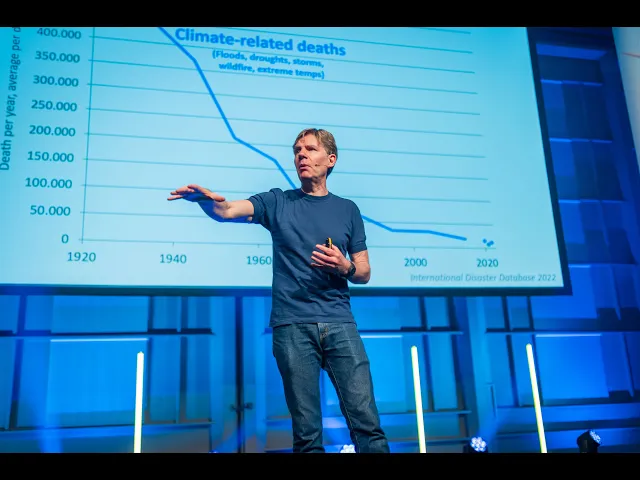
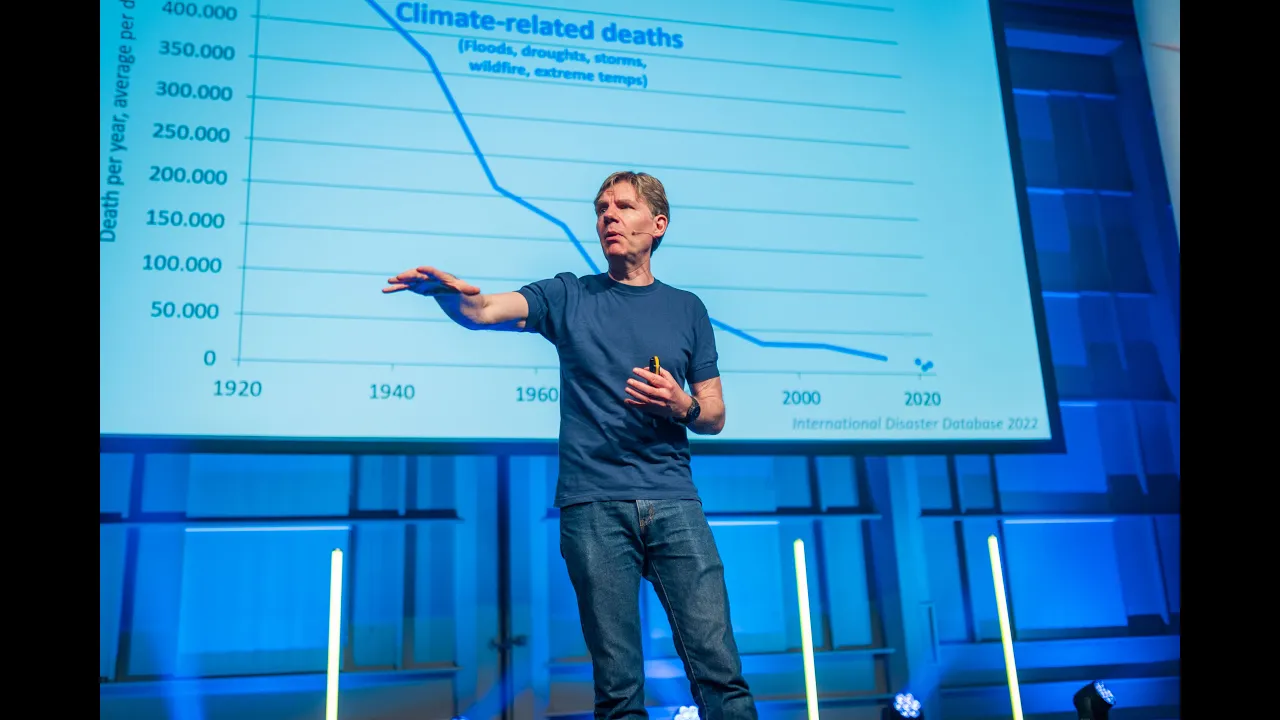
why are we then getting it so wrong on climate change why do we think this is the end of the world would argue it's a very to a very large extent because we miss that people adapt so yeah just take a look at how many people die from climate related uh deaths we have pretty good data over the Last hundred years again we're probably worse data back in time but it seems very unlikely that we would have missed really big stuff right so if we just look at climate related deficits uh floods drought storms wildfires
and extreme temperatures we have good data from the international disaster database and if you look at how many people died so obviously this is a wildly varying number so I'm going to average over decades to give some sense of a Proportion back in the 1920s so 100 years ago how many people died from climate related disasters like these turns out it was almost 500 000 people so half a million people died each and every year now most people would certainly if you look at the news media certainly if you think about how most young people
experience us through their uh their televisions what would you expect you'd expect this to be going up now I I admittedly I already sort of Gave gave it away because there's no space to go up right but what it actually does is it surprisingly drops dramatically last decade last full decade was at 18 000 people died each and every year in the 2010s we've seen a reduction of about 96 last three years and again that's not really any numbers uh it's not enough but they were actually even lower uh so last year was 11 000
people so all the stuff you hear on the news Translates in to these 11 000 people now mind you you don't hear about most of these many of these are you know floods in India and rap flash floods in Afghanistan and other places you never hear about you do hear about for instance the heat Dome do you remember two years ago in in the U.S and Canada you hear a lot about that you hear about the floods in Germany uh so there's a few of these that we actually hear but the whole point here is
we're not Well served if we just hear about a small fraction of it and believe this is what is basically eating up the planet we think the planet is dying more and more but actually what we see is a decline of somewhere between 96 and 98 over the last 100 years this has nothing to do or very little to do with climate has everything to do with the fact that as people get richer they get more resilient they get better at tackling these issues but of course what that Tells you is also who are the
most vulnerable people in the world those are typically very poor people very marginalized people people who live in Taco Bell in the Philippines and many other places the real issue here is if we want to help them how do we help them best one way of course and that's the standard argument is we need to help them by cutting our carbon emissions now so that they will have less they will still have More problem because global warming keep on going but they'll have slightly less more of a problem by the end of the century well
we could also focus on I don't know get them out of poverty if we did that they would be much much more resilient they would be just like this right I mean remember if a hurricane hits Florida sure a couple people die on a lot of damage but that's about it if the same hurricane hits Guatemala tens of thousands of people die you're their Economy is devastated it's fundamentally a question of being not rich or being resilient right and that's the conversation that we need to have again if you look at flooding so very clearly
one of the big problems of climate change is that sea levels just like everything else is when when the sea warms it'll it'll it'll expand and so we'll get higher sea levels we'll also have some runoff from Antarctic and Greenland but fundamentally what happens To human beings well if you look at these uh these again I'm just going to show you a a modeling exercise how many people have flooded we this is a very very weak argument right so this is really model generated this is one of the most quoted papers and it has uh
one of the big advantages that it runs pretty much all of the both uh physical and uh uh economic models to this they find that on average using all these models about 3.4 million people are Flooded each year today that has a cost about 11 billion dollars these in two thousand fifteen dollars I believe uh they're all inflation adjusted 13 billion dollars in die cost the total cost of 0.05 percent of GDP so this is not nothing but certainly not a huge issue but it is an issue and obviously it's a terrible issue for these
3.4 million people who are flooded I'm just going to show you the worst case warming with the highest population the highest GDP so the most stuff to be damaged right but they all show the same uh sort of pattern what happens if you have about a meter of sea level rise well if there's no adaptation you actually see this with no adaptation you end up with 187 million people flooded this was the headline in New York Times and Washington Post and pretty much any newspaper that you could possibly imagine the original data is Back from
2011 it was last uh last year I believe it was all again in both New York Times and Washington Post these numbers keep coming up they're they're very very well credited what they basically say is if you look at where everybody lives and you calculate what happens when sea level rises about a meter there's 187 million people within that area so they are going to get flooded they will have to move that's absolutely true if nobody does anything But remember of course it's very very unlikely that we're going to be standing here for the next
80 years and watch the sea level you know oh my God now it's up to my hip now it's I can't breathe anymore we don't act like that right we're not actually doing that we never do that what actually happens of course is we adapt and I'm glad to say you guys are the uh the country that I always use an example right because we you know that you can do that I I don't know uh If you know that uh ship hole airport actually is probably the only airport in the world that has on
its website that they used to be uh they're probably the only airport in the world that had that used to be a a site for a major naval battle but you don't kind of imagine that when you're in in chipple right I mean you guys have actually shown that you can do this so what have happens is this cost an enormous amount of money if we didn't do any adaptation it would Cost 55 trillion dollars uh David walls Wells the uninhabitable Earth uh quote at the high end of that 110 trillion dollars this would be
not the end of the world but it would be hugely costly about five percent of global GDP this would obviously be a catastrophe but it's also important to say this will never happen all of the studies show that of course rich people will not let this happen and even richer people as we expect the World to be over the next uh 80 years will even more not let this happen What will actually happen the researchers also did that and just notice you probably almost can't see it we'll see virtually nobody die and nobody getting flooded
uh from uh from uh from a one meter seal of a rise with adaptation we expect about 15 000 people to get flooded each and every year it'll have higher costs yet but that's because We'll be much richer so there's much more to flood and we'll also have much higher die cost at these all annual costs but the total cost will be much much lower it'll almost be 10 times lower my point here is this graph shows you what's wrong with the current conversation if you think this is the answer to sorry this is what's
going to happen with climate change and this is pretty much what all media will tell you because it's a much more fun story we're All going to drown that's a much more fun story but it's just not true because in any realistic sense we're all going to survive we're actually going to have very very few people flood it now had we done climate policy as well instead of having 15 000 people flooded each and every year we would only have 10 000 people flooded so that's better climate change is absolutely an issue but the vast
amount of issue of course here is adaptation and we will do a lot of that The real question is how smart are we going to be about how effective are we going to be about it and so again we need to have a smarter and a more nuanced conversation about climate change if we're actually going to get to this so my main point here is simply to say we think this is the end of the world and that makes us do a lot of stupid stuff but actually this is not the end of the world
it is a problem and that means we start needing to say how Should we fix it so the current set of solutions don't fix it I've I've just uh uh put together and again uh given that I don't have all that much time I would love to have your questions afterwards uh but you know fundamentally we have a lot of people in rich countries that are trying to go renewable that's basically what the transition is being sold uh we're going to go next sir we're going to go netzer by 2050 or maybe even 40 or
30 or whatever the number is but the Reality is it's not happening so if you look at the global share of renewable energy uh over the last couple hundred years we have good data from 1800 in 1800 almost all of the world's energy except for the UK which was already started it's uh in Industrial Revolution was from Renewables so we were incredibly renewable we were probably about 94 since then we've tried to get rid of Renewables right for the last 200 years we've tried to get rid of Renewables and what we see here is since
1970 are thereabouts we had a pretty permanent here at around 13 14 this is almost ex entirely poor countries using bad fuel like wood dung cardboard whatever they could get their hands on to keep warm and cook that's basically where most of those 13 came from the whole energy transition all of the stuff that everyone talks about on TV and everything else is this little uptick this is what we've managed to do with an Enormous amount of trillions of dollars this is not nothing we're now at about 16 percent of of renewable energy that's something
but it's not very much I I would like you to just you know notice how impossible it's going to be to get to a hundred percent in 2050. we're not we're just and everybody knows that but a lot of people don't really want to say it right if you actually look and and again I'm going to show Share with you uh the latest estimate from uh the International Energy agency from the 2022 estimate what will happen if everyone does everything that they have promised to do in all of their political Realms remember this is vastly
unrealistic but if we assume that then we will get to just over 30 by 20 50. we're not anywhere near and and just notice and again I'm not going to claim that this has any linearity to it but it's certainly not exponentially going This way if anything and you know this very very well uh these are the easy one these are the easy presents to deal with as we get higher and higher up it's going to get harder not easier and so if you assume that this is linear which I think is pretty generous how
long will it take us to get to 100 well we'll get there by the end of next Century right we are not anywhere close to delivering on the stuff that we promise we think we Are because we talk ourselves into a frenzy because we say this is the end of the world we got to do something we think we're willing to spend an enormous amount of money on it but we're not really and we're not getting very far to a very large extent that's because this is only a conversation that's happening in the rich world
we have this conversation in Holland we have it in Europe we have it in the U.S we have in the rest of the OCD we have It a little bit in the Elites in India and China but not really India and China and certainly not Africa we don't have most of the missions on board because fundamentally we have shown that fossil fuel makes you rich renewable energy mostly that's costly that's why I think we really need to recognize that we're not going to solve this anytime soon one of the things I I put together last
year uh and and I think the surprise a lot of People because we think that we are that we're somehow going to be able to survive this because we have for instance a lot of batteries I just want to show you this one thing we're trying to do everything right without the appropriate technology so you know people have this idea that batteries somehow will come in and save us but let's just realize right now we have battery power enough to back up the entire and only the electricity Consumption of the world for about a minute
and 15 seconds by the end of this decade because we'll dramatically increase our use of batteries or our uh uh sorry our implementation of batteries will possibly get to a point where we'll have about 11 minutes of battery power we are not going to be able to power the world and you know very well if we actually actually want have just electricity 24 7 we will need this for weeks on end we need a whole different Kind of storage system obviously this works well I live in Sweden I come from Denmark you know we're fine
with lots of hydropower but if you don't have that you don't really have a good solution just with Renewables and certainly not just with uh uh with uh uh solar and wind as the only thing and again we need to be honest about what's the cost of this so uh there's there's fairly few there's a lot of sort of hand waving estimates out there uh there are very Few that are really good there's certainly no academic estimates of this so I'm going to use the McKinsey came out last year uh with their best estimate of
what this will cost and this is the most detailed version of it it'll gonna cost and this remember is only the production cost and it's only if we do everything smartly which if policy's ever been any guide we don't uh but if we do this it'll cost A 5.6 trillion dollars a year that's about 5.6 percent Of global GDP uh so that's almost a third of all the stuff that we're going to be spending sorry I'm not sure why I'm getting an alarm but anyway this is more than a third Global Tax intake of the
entire world we're talking about spending so much money that we would have to spend a third of all tax intake from every government in the world this is not going to happen right just take a look at how much this is going to cost so the Most costly one and percent is going to be from Russia uh I don't think we need to discuss whether Russia is going to be on on board with climate but even India and sub-Saharan Africa India is going to be spending about nine percent of their GDP every year that's three
quarters of their their their National Tax intake the entire Indian States Tax intake both regional state and federal they're not going to do that We're talking about money that it's just not possible to imagine for the U.S this is going to cost about uh 4.6 percent or about 1.1 trillion dollars this year and it's going to get more and more costly this is close to what the buildback better bill was expected cost which was of course is much much more than what actually got passed in Congress and this would be every year there's just no
way this is going to happen it is to use a fashionable world it's unsustainable We have not begun our journey towards NetZero and we can already see that this is going to lead to costs that are just simply not possible for most people to bear and this is in the rich World remember one study for the U.S shows that on average going Net Zero is going to cost each American about 11 000 per person per year by 2050. now this is not going to bring anyone to the poor house because we'll be pretty rich it'll
be about what 11 of globe of of U.S income but it is going to be a very very large bill and the question is are you going to vote for the guy who says I'm going to make you pay eleven thousand dollars are you going to vote for the other guy who says I'm not it's a very simple point right this is just not going to happen and at the same time and I just want to emphasize this what are the priorities for most of the rest of the world this we actually did this so
the un uh did this survey back In 2015 when the world was going to set its next set of global goals they asked people what do you actually care about what the answers was what and this is not surprising Education Health jobs corruption nutrition these are things that most people care about because their kids are dying from easily curable infectious diseases they don't have a good education there's lots of corruption no jobs and little food these are the things they care about not the One that came at the very bottom which was action on climate
change again this is not to say we're we're a smart civilization we can walk and chew gum at the same time we can actually do several things and we should do things on climate change but right now we're not doing it in the way that are sustainable we're not doing them in a way that'll actually make it possible for the rest of the world to do this or even for Holland and Europe and the rich world to Keep doing this so how do we do the smart thing well I'm going to share with you really
this is uh you may have heard of him William nordhaus he's the only climate Economist he's at Yale University is the only climate Economist to ever win the Nobel prize in economics and his main point this is really the main point from all of climate economics is to say climate has real costs this is the story that we always hear from climate and that's absolutely true but Climate policy also have real costs we need to recognize that we have to pay both so here's what he did and this is the best evidence that we have
so far these are all the estimates and weighted about how serious they are if you look out here how much temperature increase and what's the impact on global GDP and percentage uh in percent so we expect most of it to be negative that's why Global warnings are A problem these are all the best studies that are out there I'm not saying they're true they're Simply the Best studies that we have and this is nordhaus's estimate of how bad is global warming this is including uh that's a little disturbing this is including all the uh the
unknown start uh stuff but obviously we don't know what it is that we're not measuring but this is the best estimate that he has so fundamentally if we expect a four degree Temperature rise this will probably cost about four percent of global GDP it'll be worse for poor countries it'll be better for rich countries for instance in Denmark and Sweden will probably be in that benefit right but for the world as a whole this will be a negative so how bad is this well just to give you a sense in proportion the UN actually asked
me and this is crucial we estimate that the world will be much richer by the end of the century if it's Not global warming will be very little of a problem because the poor part of the world will not have become rich and hence not really be emitting very much CO2 so we estimate that the average person in the world will be about 450 as rich as he or she is today so today it's about you know eighteen thousand dollars per person per year and by the end of the century will be about 86 000
per person per year that's a fantastic world this is a world Where we've eradicated poverty where we've eradicated a lot of disease and all all these other problems that come with it because if you're rich you don't get many of these problems so that's fundamentally a great thing but of course this is not the right way to look at it because we have global warming global warming means that we will feel less Rich if we do nothing about climate change but just to give you a sense of proportion it's not Correct to say that it's
450 but it is correct to say that it's just slightly lower 434 percent this underscores the main point that I try to say this is a problem it's clearly a problem that we will only be 434 percent as rich as we otherwise would have been in 2100 but it's not the end of the world it's not a hundred percent reduction and it's certainly not a world that's not better it's a world that's slightly less better than it otherwise could have been That's a very different conversation of course it also shows us we should stop scaring
everyone with climate change and tell them this is the end of the world no it's a world that has a problem so again it's something that we should fix how do we fix this well Nord house estimate what are the costs of global warming if we do nothing in his model we'll end up with 4.1 degree Centigrade that's probably already too high but let's just go with that because that's What his model shows if we do nothing the total cost of global warming is going to be about 140 trillion dollars this is discounted back this
is over the next 500 years large number basically is what the point is right if we reduce this if we reduce the temperature the cost will be less this is not very surprising this is for his model only goes to 2.15 degrees we just can't in his model get it further down just simply because we still have a lot of People who want to get rich but fundamental what this tells you is the standard story that you hear in every newscast around the world lots of warning bad less warming good that's absolutely true if you
just look at the climate damage but there's also a climate policy cost and that's his main contribution to this point and and again I should just say he's the guy who got the Nobel Prize but a lot of similar models show very similar results if we Do nothing what's the policy cost uh surprisingly it's zero if we do something so if we get to 3.75 degrees the policy cost is about 20 trillion dollars if we try to get more the cost goes up the point is we rarely if ever have this discussion the more climate
policy the higher the cost this is not surprising this is not rocket science yes there is a benefit to doing something about climate change but There's also a cost we need to have the conversation about both so this is how you guys get a Nobel Prize right so you just simply put those two graphs together these are all the climate costs then you add the policy cost up there none a little bit more and more this is fundamentally the challenge for Humanity we have only had the conversation about the black bars but we really should
have the conversation about both the black and the gray bars His argument is this is the optimal outcome this is going to outrage a lot of people it certainly has outraged a lot of environmentalists because it feels like you're just you know trading off the world from money but of course this is not about money this is about stuff that we like this is about jobs it's about education it's about health it's about opportunity it's about all the things we like and climate change is part of that because climate Change is part of saying we
would like to not have things like more stronger hurricanes we'd like to have less flooding we'd like to have all these other things these are also about having more opportunity for the world and so this is he would argue and I think is a reasonable conversation or first starter for the discussion of saying we need to have that same conversation and unless we have that we might be able to get ourselves on Board for a little while we won't be able to get it to 2050 when it gets sufficiently expensive most even Rich voters are
going to turn off from this we're never going to get China India and Africa on board for this so how should we fix it I just have like three minutes left so I'm just basically going to say we have done a lot of work so we work with more than 50 of the world's best climate economists three Nobel laureates trying to estimate what actually works And what doesn't one of the things we do know doesn't work is the EU 2020 policy it's been very well studied and fundamentally what the research shows is that it's fairly
costly to do climate policy in the EU you do get some benefits because you reduce carbon emissions and that will help long-term impacts especially for the world's poor if you take all of those benefits in and all of the costs that the EU has paid the estimate the best estimate and again This is a very very wide estimate and we can have a discussion about that afterwards but it gives you a good sense of it is that for every Euro we have spent we have avoided three cents of climate damage not surprisingly that's a really
bad way to spend money because we could just have given the Euro away and done 97 cents more good if you look at the Paris agreement it's a little better mostly because we managed to get a lot Of poor countries on board so both India and China have made you know reasonably substantial promises for 2050 and onwards but it's still not very good most climate economists would argue that a smart carbon tax is a good idea it actually turns out that it delivers two dollars back in the dollar so it has significant cost to do
a climate uh uh carbon tax because it confers extra cost to the economy it makes it less profitable for instance to produce a lot Of energy intensive uh things but it also delivers real benefits because you actually stop using CO2 and hence you have less climate damage in the long-term future you can reduce damages but not very much and with a realistic carbon tax and certainly with an economically efficient carbon tax you'll only reduce some but not very much so the question is what is the real solution and that's what we found uh so fundamentally
what we found was this is All about Innovation which I think fits very well into the whole conversation about this uh this theme we actually found that if you do green energy Innovation for every dollar spent you will probably avoid 11 of climate damages that's a great investment we should be doing that and it also it fits very well with how we've learned everything in our world right if you think about it we've never solved Problems by telling people I'm Sorry would you mind being a little poor and a little less comfortable and a little
colder but at least we'll fix some of global boring you may say yes especially if you're going to work for a for for a solar or some other company but most people won't in the long run right we're not going to solve this problem by telling people to be worse off the way we've solved most problems in the world is through innovation there's a famous story it's not entirely True but it's a it's a great story I'm going to tell it anyway so back in the 1850s we were hunting whales to Extinction uh why because
whales have this blubber that is incredibly good to light up the world so basically most of Europe most of the North America Seaboard was lit up with whale oil it burnt very brightly very cleanly everyone who could afford it used it that's why we went and uh and hunted all the whales now the standard Sort of climate argument would be to but the whales please could you go back to the slightly less comfortable the more dirty the less bright light and live without would that be okay for you and most people would not say yes
it would just not happen what did solve the problem was somebody found oil in Pennsylvania and it turns out that it's much easier to get oil out of the ground in Pennsylvania than going out in the Middle of the ocean to shoot a whale especially because they only have a couple hundred kilos of of of of whale blubber right so the fundamental Point here is if we can innovate green energy to be cheaper than fossil fuels we've won if we can't we're never going to solve this problem so I hope this conversation has been at
least a starter I get that this is not probably what you'd rather hear but I think we'd probably be better Off with knowing what's actually out there and I look very much forward to your questions I'll look forward to a wonderful day thank you very much foreign thank you thank you Bjorn yes that is a bit of a uncomfortable data that we just looked at and um I'm just curious also for you because you're you're on a mission you know you have um all this data you've done all this Research um and and you're obviously
very passionate about what you're doing what are some of the main critiques that you face and how do you address them so one obvious critique is if this really is the end of the world so people will tell you did you guys ever see the uh I can't remember what the movie was the the whole Ice Age that kills everyone uh but yeah the whole idea of the Gulf Stream stopping or you know uh these big catastrophes the global warming actually led to that then clearly we should do a lot more and actually there's been
done a lot of studies on this and yes the the short answer is we should do more but surprisingly not all that much more uh but yeah there's this argument but if it if there's a tiny chance that this could ruin the whole world you know we don't have a Planet B so we should do everything we can but of course there's A lot of things that could damage the world yeah I'm just going to throw North Korea out there uh it seems like there's a lot of things that could go wrong in this world
uh bioterrorism there's a lot of other things that we should also be spending all of our wealth on so this was actually a big conversation between uh William nordhaus the guy who won the Nobel Prize and um another guy whose name I forget um uh he's he was a a climate Economist At uh at Harvard University they were arguing very much he was saying basically there's a fat tale of risks and that means we should be spending all of our money on climate uh but Nord house argument I I find that convincing is well there's
a lot of fat uh Tales of a lot of bad stuff that could happen in the world and we don't spend all of our money on it and if we weren't going to try to do it we'd have to spend all of our money on all of these things which Of course is impossible just to give you one example of this uh and and I think that was his best sort of uh experimental data there was back in the 1990s NASA uh uh made a program to to map 90 of all the meteors that could
be Earth Killers uh we know this we know that there are meteors that are large enough out there that they could actually eradicate all life in human uh all human life certainly on the planet so that would be a real issue uh to look At we should certainly be investigating that they showed that you could do I can't remember it was like eight billion dollars we could survey 90 of all these over the next five or ten years then NASA also did another uh estimate that they could find 99 of these Earth killers at a
higher price Congress decided to say we'd like the 90 but we don't want to pay for the 99 and hence the U.S Congress actually gave us an estimate of how much is it worth to Save the world we actually know and this is not surprising to anyone we're sort of willing to spend some to save the world but not a lot and that's how it is and it makes sense because global warming and meteors and everything else is not the only thing out there there's a lot of hidden dangers and probably most of them we
don't know anything about because we haven't studied them and nobody has you know there there's some you know point in saying if you Think about what came before global warming it was acid rain it was the ozone layer there's a lot of other scares out there and most of them are real in a sense but only some of them may make it to Media attention but there's a lot of other things we should have been worried about clearly covet being one of them yeah yeah so you're also an advocate of nuance Nuance if I can
say so yes um let's open the floor because I'm sure There's questions out there um who has a question I really see a hand raised right here and I think we have an Innovative well it's not that Innovative actually but we have a lovely lady with a microphone right here um yes right here please first question first of all thank you so much Bjorn has been an incredible talk we've been following you and well your Arguments for a long time with a group of friends And colleagues so it's really an honor to to hear this
I have many questions we'll see if we can do it but I'll actually go up to the one that has been shocking striking me the most because I see that in younger Generations in their in their teens in their 20s they have this climate fear that's something that probably we don't experience that much okay in a bit older Generations but I see that their emotions play a lot and you've already represented this and you will know that in the news we're all being scared about this right and even okay in Academia it's also something that
is popping up a lot so my question is okay very technically how much does um let's say changing your diet Vegetarianism can make us a change and also let's say avoiding flights how much can that change and how can you put this as an argument for the for the new generations to tackle this in comparison to now turning into green Energies these are some alternatives and how would you tackle this actually in terms of their emotions together with data well you're inside The station so yes thank you very much so fundamentally being scared is just
not a good thing right and you shouldn't need to say this but but uh there's a lot of people who are sort of like but but it makes us push for some good right sure but it's an incredibly inefficient way to push for good you know just simply having this fundamental sense of scaredness that's that's just no good because and Again this goes to the answer uh to your question most people can't do anything about this you know telling you that the world is nigh is a little bit like telling everyone hey you know what
you and your whole family has that Gene that's going to make you have cancer really early well good luck with that right I mean what are you going to do with that that's just a terrible thing to say and it's also not true it goes to the point that you say uh which is what Can I do obviously you can stop Flying uh actually that's a pretty big impact uh but again remember most people don't fly you know we're incredibly select group of people probably most of you guys have flown in here uh about 80
of all people in rich countries have flown at least once the the number globally is about 15 most people have never been on an airplane and most people would probably like to Be on one and and so again the sense of oh I can give up an airplane I'm sure you can but that's because you fly so much uh most people would love to be able to do it and of course again it goes back to that whole you know sort of whale bit of saying I'm sorry could you live without airplanes the solution has
to be that we actually make sure people have the opportunity to fly and do all these other amazing things but without the emissions and that's where Innovation comes in now I think and and again I'm I'm political scientist there's a lot of stuff I don't know uh and and you guys I understand a lot of you are Engineers I think you'd know that much better but fundamentally flying is probably the last thing we'll fix of all these things but it's again it's a couple of percent of emissions so this is not what keeps me up
at night uh the other thing about uh changing your diet uh yeah I'm a vegetarian actually Not because of climate but because I I don't want to kill animals so I decided to be a vegetarian back when I was 11. um and and so I'm so happy that so many more people are on to vegetarianism because it gives me much better options oh you're going to move me because you're worried about that something there okay yes there's a sinkhole there um so uh so uh you know vegetarianism is great But again you're not going to
get most people to do this you can get them to do you know be a little flexitarians every once in a while and that's great but the solution of course is to come up with stuff that's not meat but tastes almost like meat and then people are going to buy this a lot of the time sometimes they're not and that's fine you know we need to find Innovation to make this work but fundamentally and I think this is a really important thing Scaring people witless and I think a lot of people are scared witness is
just simply both bad science but it's also bad bad for Humanity look I mean we haven't gotten here by by being frightened of our own Shadows we've gotten here because we dared to do a lot of things now some things were really stupid you know nuclear bomb Springs to mind uh but but you know we can't undo these things and I don't think we can really imagine we're having that same Conversation now with AI and there's a lot of other conversations I think we should have all of those and yes we're going to screw up
some stuff but you know just trying to sell everyone no you can't do that is not going to work and as someone working in the media I have to completely agree that that also means bringing Nuance into the stories that we're sharing in the media can I sorry I know we should also have a question so uh if you if you know over The last 30 years uh crime in the U.S uh on all objective measures have gone down yeah uh it's about half the last couple years because of Corona maybe it's gone up a
little bit but fundamentally it's dropped dramatically every year when Gallup surveyed people in America do you think crime is worse or better everyone but no that's not true but very very large majorities believe crime is getting worse and worse and worse so you have this really really odd thing crime Is going down yet everybody thinks it's going up why because of more and more TV there is so much crime that you can fill every show of every hour with crime so just the fact that there's half as much of it simply means that there's still
lots to put on TV and that's the problem we have when you just put hurricanes after Hurricane after Hurricane and Earth uh earthquake whatever you put on there and just scare people withless sorry yeah Good question all right um let's go to the lady right here on the right side uh first of all thank you for your very interesting story and from my question I would also like to refer to what Hana told us in introduction that stories play a really big role in convincing us and I think we as humans are not as rational
beings as we would like to be in the end we are ruled by opportunity emotions and stories and of course your You talk to us about Nuance is very important but I feel that a lot of these politicians are also using the extremes to convince us to change something and therefore my question is do you think your nuanced view on this topic will ever become a big influence in our climate policies no I mean fundamentally I'm destined to lose you're absolutely right we're uh you know we're we're there there's wonderful statistic statistics that show That
if you show a picture of one uh one boy or a girl starving that has a much much bigger impact on people than telling there's a million of these guys starving I mean Stalin already said that you kill one person you know it's a tragedy to kill a million people it's just a statistic right I'm not sure he said it but it's a great quote anyway uh but I mean it's not that I made it up right but it's a it's a you know it's commonly attributed to him Um but so the fundamental point and
and and this is you know so I run a think tank called The Copenhagen consensus where we get together lots of economists to think about what are the smartest ways to deal with the world and and and we have a saying in my organization we you know as economists we'd love it to get be right we'd love everybody to do smart but we always tell ourselves this is not about getting it right it's about getting it slightly less wrong right so My my goal is simply in this world to get it slightly less wrong if
I can manage to get people to be slightly less uh slightly less dumb policies I'm I'm satisfied the mission to get it slightly less wrong I like that um okay um let's see who has a really critical question yes all right um right there the guy with the blonde Hair yes [Laughter] uh hi I'm Tom and I think you've done really great stories through data but I'm not really I don't really agree with it you talk a lot about direct climate damages like hurricanes and that adaptation is the way to solve it all but I
think adaptation also has really big downsides the biggest one that comes up to me is climate migration and the societal Strain that puts it on for example Europe how do you look on that and would that also because I don't think that adaptation will solve it all and we are really happy ending so let's build some dikes like we did in Holland and it's all fine if we get loads and loads of people migrating that also will be a very big problem that's a that's a great question and it's a good point it's very very
hard so there's no good uh data on on migration issues uh so you're Absolutely right if a lot of people decide for instance if Africa becomes too hot or you know flooded or whatever they decide to all migrate to Europe that's going to be a huge cost and so very clearly that's a that's a negative downside I'm not saying that by the way we should adapt to everything I'm saying we will end up adapting to a very large part of this and so the actual damages are going to be much less than what you would
expect sort of a naive thing of Just saying well you know if it floods everybody will have to move that was the main point of it that it's much less but it's not that it's going to be nothing and so we should fix it but it means we can fix it smarter and we can also take longer time to fix it on the migration bit uh the the simple point and EU talks about it but not really the simple point of course is Africa should be rich if Africa was rich people wouldn't want to move
right uh and we're in some sense Telling I I I know that you have and I have the advantage of having Mike sorry uh but you know fundamentally we know how to get most people Rich at a very large part of it is about having lots and lots of energy but we're telling you know what we'd like to have all our fossil fuels and you know look what happened with uh with the Russian invasion it was not like Germany said yeah okay we're just going to freeze a little more no they just Start building a
lot more gas instead what we're telling all of the Africans is you can't build new fossil fuel plants but of course that is what they need in order to get rich they certainly also need solar they also need wind but it's not nearly that proportion that it'll mean that they will not need much much more energy uh one of my favorite statistics I did this for for Wall Street Journal was that uh the whole nation of Uganda which is 44 Million people uh bigger than uh California uh has as much electricity as California uses for
heating its bathtubs there's something wrong in that world right uh and and again it's not to say that this is also something we should fix so the other part of the conversation and I'm sure we could have a long I should just say I'll I'll hang around here afterwards because I recognize that there's way too many questions so let's have a talk about This afterwards but fundamentally sure we should also fix this by doing climate policy but my argument is that right now we're just doing an incredibly ineffectively we're mostly doing it in rich countries
and so we'll actually not help Africa very much we'll help it a tiny bit what we should do was help Africa a lot with the things that they actually care about right now and make sure that we fix climate change but only over a century long uh uh uh time time Frame to answer your question okay you're going to find Bjorn afterwards okay great he's got to find it okay there's been some questions just to find someone there on the left maybe the lady in blue oh yes both of you you have a mutual I
think you've said some quite controversial things and for me it's to be honest it's not really in line with My own opinion about climate change and also not really what I think I read when reading the latest ipcc report and of course I've Googled you before this event we've been criticized a lot for misusing statistics in some sense so I was wondering what your answer to those critics is well yes there's certainly been a lot of critics I have made extensive answers to a lot of those people uh so uh so there's been a whole
book devoted with To me uh there's been a lot of people who've made made criticisms I find I mean and and this is not surprising it's very very hard to ask me to do I think they're smart and they're really good and in Tech they have integrity and I'm an idiot uh you know you can't be surprised that I'm gonna say no uh but but they aren't uh so you know fundamentally I mean um so there's there's very clearly a lot of emotion involved in this there's a Lot of uh uh uh sort of political
influence and a lot of uh uh intense uh uh uh sort of power over the over the whole uh what do you call the the uh the agenda setting opportunity so for instance for in in 2015 for the Paris agreement I did what I think is a very very uncontroversial uh model estimate I just simply ran the UN climate model with what would happen if everybody did the uh the Paris agreement and what happened if they didn't do the Paris Agreement and not surprisingly uh uh to 2030 which was what back then we were talking
about we were going to promise the difference was virtually zero you would barely be able to tell the difference by the end of the century this is not no different from Kyoto and everything else but war and you know I was basically using the same template that another very very well respected uh climate uh uh modeler Wigley had done for the Kyoto Protocol This became intensely under scrutiny so the journal who published it they got inundated by people who said you can't publish it uh one of the guys who sat on the board was uh
Nicholas Stern uh the guy who did the Sterner report in in the UK he threatened to resign unless one of his guys got to write a piece right after mine saying that this was Hokum uh I think it's a it's a terrible piece that he wrote it was basically hit job and there was no truth to it uh it was It was it was a setup but and this is what tells you I was not allowed a response I said at least if you're gonna you know skirt all Journal setups and just simply put in
this after after my article basically here's Bjorn's article saying that it'll only be a very small impact and here's a guy who says Bjorn is an idiot but no you can't say anything to that that that doesn't seem like a strong argument and and you know I I did put out uh obviously online uh Why this was not correct and I still think that holds I still think my argument is absolutely correct but it was incredibly inconvenient and I think that's the main reason why this is this is this is happening now am I am
I chair picking I really don't think I am I actually think I'm using the right statistics because very often I insist on saying we need to bring in the social impact on this you can't just say you know what will a meter sea level rise Mean without also talking about what will the impact of that be on human societies but you know some people will say oh but that diminishes the impact of climate because you're looking at the social impact and I'm like yes that's exactly the point that's the point I make that's what a
social scientist would say you can't say and this is what much of climate conversation is about assume that climate changes but nothing else does I get I get why you do that if You're a climate scientist and you want to make an interesting comparison that that makes sense but it's not a good way to inform our politicians so I would argue that a very very large part of the of the sort of criticism against me you know again you can't be surprised you're getting this answer but but I really honestly believe that it's untrue and
it comes from a place of of mostly people who are very very good-hearted and want to do good but have also been caught up In this very very narrow uh part part of the conversation yes we need to round up because of time um I'm gonna do one last short question on the right lady in red oh Mr in red sorry I'm thinking about that song that's probably it I would like to go back to the first statement you made today about how climate change is not the big emergency it is as we are told
And I feel like all your counter arguments are kind of based on like human based or Economy based and it kind of misses the whole point of nature-based impacts such as biodiversity loss bleaching of corals as we're currently experiencing drought in rainforests what's your view on that yes this is a very important point and you're absolutely right I almost exclusively focused my talk on humans and and and fundamentally the Point is this is not going to be a meteor for humans so you're you're right but what about everything else in the planet we share this
with a lot of other stuff well it's more buried uh and and if you look at most of these in estimates of what actually impacts biodiversity even the world sorry the World Wildlife Fund and many other organizations will tell you that climate comes far down the list of what influences biodiversity it's mostly About deforestation it's about human use of resources that we're encroaching in human uh on on natural uh resources that we have more transport around the world so we have more invasive species it's all of those things and those are things that when you're
rich you you're much better able to deal with so you know fundamentally uh if you know and again I'm making a very very sort of short cut version of this if you're poor you you have poachers in your Natural Parks but If you're rich you have lots of elephants right so the the whole point in a sense is to make sure that people get more resilient that is they get better off they stop being as poor then they can also afford to deal a lot more with their natural issues the other part I just want
to leave you with and I think this is a vastly underestimated point there according to a recent nature article there are three main indicators of Climate change two of them you've heard that's sea level rise and temperature the third one is that the world is getting much much greener because of global warming right because of CO2 CO2 is a as a as a fertilizer and we know from satellites certainly over the last 30 years that we have about what 15 20 more green stuff on the planet we're very likely by the end of the century
to have much much more green stuff now remember we've cut down a lot of green Stuff especially in Europe so it's not like we'll we'll probably be back towards uh you know 1500 by the end of the century but there will be a lot more green stuff by by sort of any estimate I would say that that's a good thing again I'm not making the argument that this is all good that would be a silly argument just like you know the people I'm counting are making climate is only bad I'm not saying it's only good
I'm just saying they're both goods and bads Overall there are more bats than good so that's why it's a problem but actually we have biodiversity problems we'll fix them mostly by getting people out of poverty and we have a situation where we'll have more biomass on the planet than ever before or sorry than we've had of you know 100 150 years because of more CO2 so that's not a totally bad outcome sorry I I know I have to shut up thank you So much for all of you very happy here a little bit longer so
please do a walk up to Dr Bjorn Lombard and ask your questions because this is a very uncomfortable but a very important discussion quick very one line um you want to make uh your mission is about getting it slightly less wrong one of the big Solutions is innovation there's a lot of people here that are really really good in Innovation what's Your advice to them when it comes to dare to lead I joked you made the point that we don't have simple answers and that's unfortunately this is not I wish all of you to come
up with these great ideas but this is really a long long race you're not going to come up with it today you're certainly certainly not today but you're not going to come up with the next five or ten years this is really a Century-long race and we're much better able a much better place if we can actually allow ourselves to see that but it'd be so much more fun if it's just one person that needs to come up with a great idea and then we're all done sorry that's a real down hey have a fun
day all right let's continue discussions uh give him a big round of applause Dr Bjorn Lombard thank you so much thank you so much [Music]