perate Krishna now we are going to talk about different types of donors their characteristics how do we recognize them how do we inspire them and how do we continue to inspire them so they will develop a longer lasting relationship with us so here are some terms that we should know that when we are raising money for a project there are certain type of donors that care about certain things so in general they care about two types of effects of their donations they want to see where their donations are going to go there is one called
intrinsic effect which is what difference their donation will make to a cause or to a public good public good is things like universities hospitals now in this case our iskcon so how is their donation going to be utilized that's the intrinsic effect and they also want to know the cause for which they are donating in other words they want to know the mission of iskcon the reason for our existence and what are we going to do with their money the second effect is called the prestige effect this is the value of recognition that they will
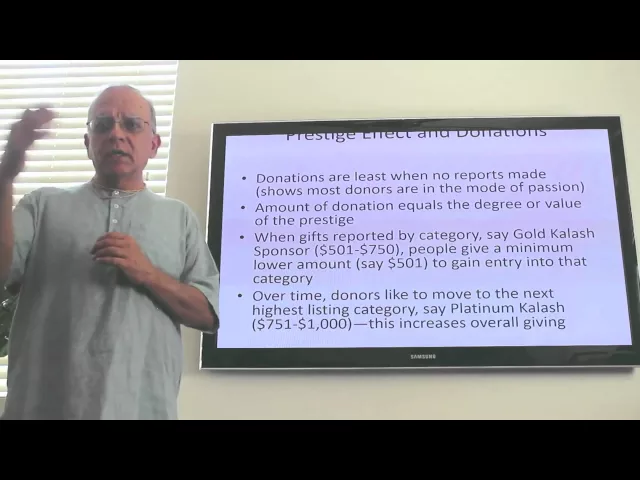
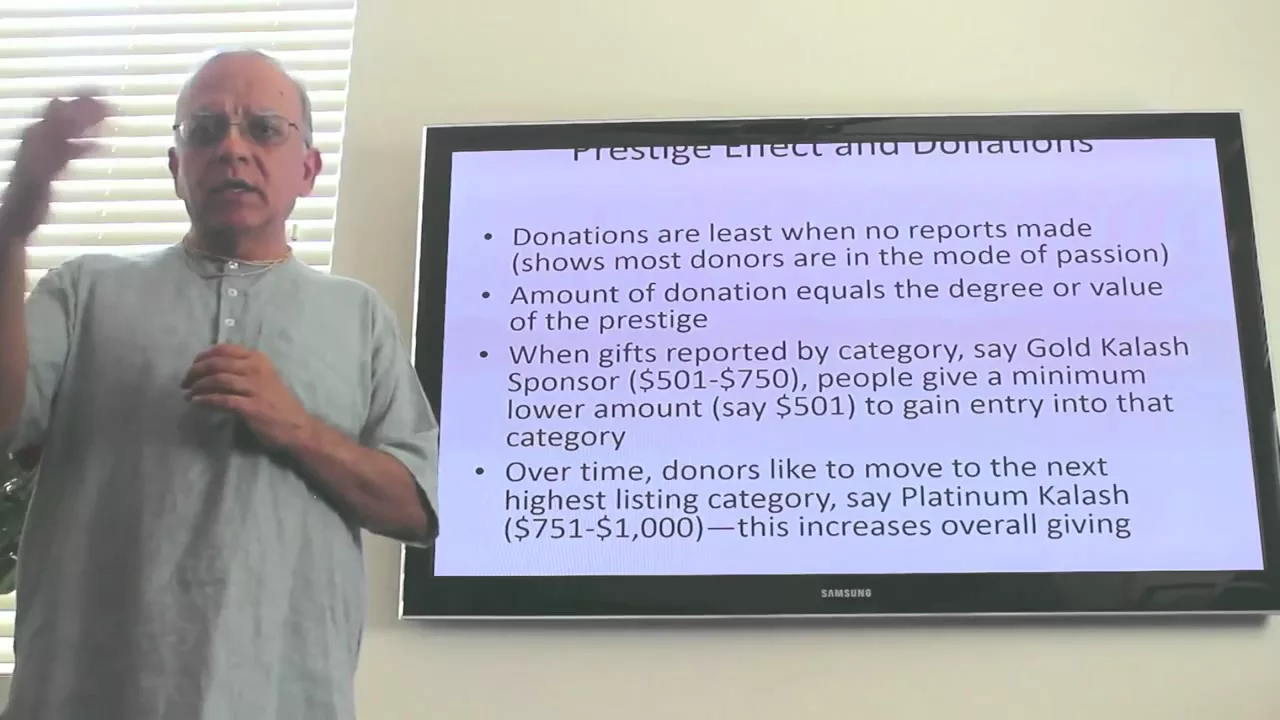
get from donating their money so for example if you name a building if you put a brick in their name if you put their name on the notice board on the donors board or it black so they have to recognize the value of that gift that they receive in return for the money that they donate donations are least when there are no reports made so when the donors do not receive a report of their donations meaning where they are utilized etc and they may be discouraged to donate so this may show that this section this
particular section may show that most of these donors are any mode of passion but as I said earlier our job is to graduate them out of these modes and facilitate their giving in a selfless way but this is to recognize when you initially meet a donor or when the donors are in their early stages this framework will help you recognize where they are at and how you can inspire them how you can cultivate them so they become self last owners at the end so when we're dealing with these donors here are certain things we should
keep in mind that we do not make any reports in terms of where the money was spent or when we do not put their names on the notice board etc then they may not be inspired to give as much and as I said earlier the amount of donation equals the degree or value of the prestige that they attach to the recognition that they get from giving their donation when gifts are reported by categories for example if you say that gold color sponsor anybody who gives in this range of 501 to 751 or 77 and fifty
dollars in that category donation in that category they will qualify a gold color sponsor for Jen marsh me for example and those who give 751 to a thousand they'll qualify for a platinum color the tendency is that they would like to enter the highest possible category by giving the minimum lower amount of that category but the good news is that over a period of time they would like to jump to the next category the next higher category for example they may be giving for gold colors for a long time and then they want to graduate
to the Platinum category so this increases the overall giving even though one might think that when we put categories in there people are paying the minimum lower amounts to enter the category but over time you will see that the their overall giving increases further because of the desire for status we notice that there are hardly any anonymous donors of major gifts and this is true even in iskcon even though we all understand that the charity can be given in different modes and giving it for a recognition or giving it for our name on the board
on the flag is in the mode of passion but still we rarely see anonymous gifts so something to keep in mind okay so that's about the prestige effect next is about signaling signaling is when we want to signal to our donors as to where we are at in terms of raising funds so signaling may be desirable may not be desirable if we are seeking leadership gifts which are called the seed sponsors for a major campaign then it may be desirable to signal for example it will when we signal that we have received a major donor
which is what happened in the case of tio VP we got one big donor for 25 million dollars then we wanted to promote we wanted to announce that gift or when we got a few major gifts we wanted to announce that and that reveals that we the organization has integrity that people value what we do it helps to reveal the quality of the organization and it also inspires other prospects to contribute it may not be desirable in situations when we are dealing with a different type of donor called the impact donors we'll get to that
in a little bit but just back to the leadership gifts the 8020 rule roughly applies in this category which means that twenty percent of your don't we'll give you eighty percent of the funds that you need for that drive so these are guidelines is not exactly twenty percent but the rule comes from an italian economist Pareto is called the Pareto principle the range may be anywhere from sixty to eighty percent of your donations come from anywhere from five to twenty percent of your donors and then on the other side about twenty to forty percent of
your donations will come from the remaining almost eighty percent of your donors but in his con as you know but female Tucker went door to door and he wanted everybody to participate so like that we may have campaigns and it's similar I heard similar pitch for tio VP that we want everybody to contribute but still to your VP also seems to be following this a twenty principle when they went on the road when they went public they have acquired some significant leadership gifts and some seed seed sponsors and that is fired other prospects to contribute
even now when they are going from Temple to Temple they start at the top and they for example the platinum sponsor gold sponsor the silver coin sponsor and then they go down to the bricks so now let's talk about the impact donors who are what kind of donors are they and then we'll talk about the warm glow donors next so the impact donor is one who wants to have an impact who wants to see a difference made by their donation so this kind of a donor is motivated to be either the first donor or the
last owner and he doesn't mind whether he's the first of the last as long as his donation or her donation makes a significant impact on the campaign significant impact on the campaign so contributions from such donors they are expected to be the largest when donors are not informed of how much other donors have given when the seed proportion or the leadership portion of a major campaign that we talked about when that approach is one hundred percent it is also seen that response from donors becomes lower because they think of they have almost raised the money
that they need and that process is called free riding so there there are people who might have given you but since they heard that now your campaign is nearing completion they don't feel inspired to give because they kind of get this feeling that they are not going to be able to make an impact is already done so the other type of donors are called the warm glow donors a warm glow donor wants to feel good about his or her donation so this person is motivated by the good feeling that they derive he or she derives
from making a donation not by the impact so the satisfaction for such donors is derived from the very act of donating they are not affected by how much other donors have given or not given nor are they affected by the cause to which they are donating so these people will in other words give regardless of the type of the project regardless of who else is given because they just feel good by giving okay so this is the two types of donors that we talked about impact owner and warm blood owner now here is another scenario
it is called the co orientation model so what's happening here in this case as you see in the diagram is that we have a fundraiser and we have a donor and there is a fundraising opportunity X so when the fundraiser makes a pitch to the donor when the donor has a positive relationship with the fundraiser we have a donor donor on this fundraiser and the fundraising opportunity so when you are fired up when you are inspired by your project when you are behind a project and you have a good relationship with this donor and you
are able to convey that good feeling that you have about that project and there is a buy-in from the donor the donor will develop a positive feeling about the opportunity because of his relationship with you or the other scenario is the donor because of the fundraising opportunity or because of not having faith in the fundraising opportunity or because of not being inspired by the fundraising opportunity he might develop a negative feeling towards you as the fundraiser so this basically this this the three parts of this model the three parts of this system they reach an
equilibrium so the donor develops a good feeling about the fundraising opportunity because of his relationship with the fundraiser and then the an equilibrium is reached the donation is made the gift is made or the donor will develop a negative feeling about the fundraiser not not about the fundraising opportunities he's not even attracted by that he develops a negative feeling about you and the relationship is snapped and then another type of equilibrium is reached then all three are kind of independent in an independent state so what's the lesson from this Cory entation model this model supports
the importance of building and maintaining strong relationships with our donors then we have a strong relationship with our donor we will be able to inspire them about a giving opportunity and would be able to inculcate this positive feeling about the fundraising opportunity in them and then donor will as a result feel good about giving and they a relationship with you will be further enhanced thank you very much rakish nuh