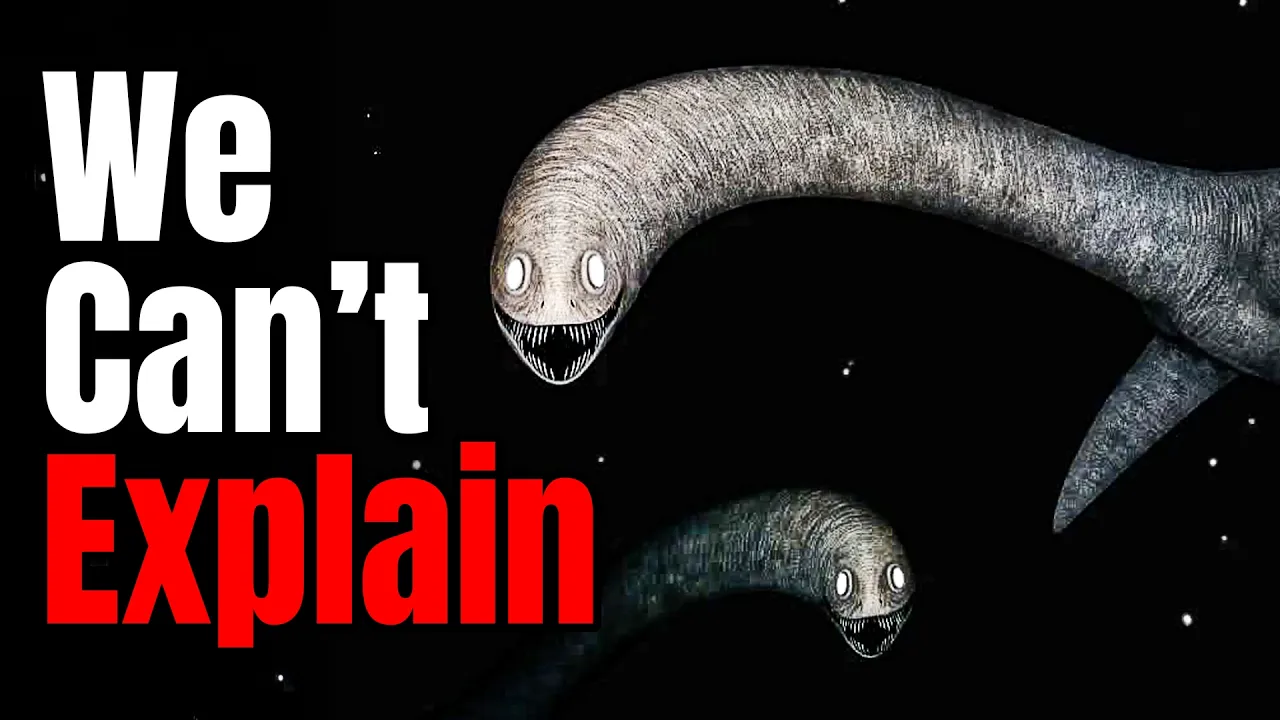
Prehistoric Ocean wasn't just dangerous. It was a liquid horror show where nightmare creatures with giant eyes stalked through eternal darkness. And some of these monsters are still alive today, lurking in places we've barely explored. Look, we think the ocean today is scary, which fair enough. It's got great whites and giant squids and whatever else is down there that we haven't found yet. But prehistoric Oceans, those were on a whole different level of nope. Picture this. You're in water so deep that sunlight gave up trying to reach you about half a mile ago. The pressure would
crush you instantly. The temperature is just above freezing. And in this pitch black bone crushing void, things were living. And not just living, they were thriving, getting weird, getting big, and getting really, really good at killing stuff. See, back then, the deep ocean was where Evolution went completely off the rails. No sunlight meant no plants, so everything down there had to get creative about dinner. Some grew massive eyes to catch the tiniest hint of light. Others just said, "Screw it." and went blind altogether. A few decided to even make their own light and wave it
around like some kind of underwater serial killer with a flashlight. And the really messed up part, these weren't just random monsters that showed up for a few Million years and then died out. In fact, they were already ancient when dinosaurs were still figuring out how to walk upright. And here's what really gets me. We only know about the ones that left fossils. Most deep sea creatures just dissolve when they die. Their shells get eaten by acid and they vanish without a trace. So for every horrifying prehistoric sea monster that we've found, there's probably a dozen
worse ones that we'll never even know Existed. Like imagine there are 12 creatures out there even more terrifying than the megalodon. The deep ocean back then was essentially a horror movie that ran for 500 million years. Starring creatures that would make HP Lovecraft throw up. Giant eyes staring through eternal darkness. Teeth that don't fit in mouths. Things that haven't changed their murder strategy since before your great great times a million grandmother was even a twinkle in some primordial Soup. Meet the Opthalmosaurus. This thing lived 150 million years ago and had eyes the size of dinner
plates. Not small dinner plates either. We're talking full-sized fancy restaurant dinner plates. Each eyeball was 9 in across, which is bigger than most basketballs. Now, you might be thinking, "Oh, big eyes. So what?" Well, those massive eyes weren't just for looking pretty. They were for seeing in complete darkness while diving deeper than most Nuclear submarines go today. This reptile could hold its breath for over 20 minutes and dive over 3,000 ft down into water so dark you couldn't see your hand in front of your face. Why would anything want to do that though? Well, simple.
Dinner was down there. The weirdest part is how good it was at this job. While other marine reptiles were splashing around in shallow water eating fish, Opthalmosaurus was down there in the void, using those massive eyes to Spot the faintest glimmer of bioluminescence. Picture something bigger than a dolphin, but built like a torpedo with eyes so big they had to be reinforced with rings of bone just so they wouldn't collapse under the pressure. And it wasn't even the only one doing this. We found these things all over Europe. So apparently diving into the abyss to
hunt tentacled monsters was a popular career choice back then, which tells you something About how messed up the Jurassic oceans really were. But what if you didn't even need massive eyes to be a nightmare? Phosphorus was only 12 ft long. In the world of prehistoric sea monsters, bats basically a minnow. But here's the thing about this particular minnow. It had forward- facing eyes. You know what else has forward- facing eyes? Owls, hawks, things that hunt and kill other things for a living. Most reptiles have eyes on the sides of their heads because they Spend their
time trying not to get eaten. Phosphosaurus. This guy had both eyes pointing straight ahead, giving it depth perception that would make a sniper jealous. And those eyes were huge. Not Opthalmosaurus huge, but big enough that they probably took up half its skull. So, I just think this little monster was nocturnal. While all the big scary mosasaurs were sleeping off their day of terrorizing everything in sight, Phosphosaurus was just getting started. It would cruise through the dark waters using those precision guided eyes to pick off glowing lantern fish and squid that thought they were safe in
the night. The really twisted part is how good it was at this job. We're talking about a reptile that figured out how to be an underwater owl 70 million years before actual owls even existed. It wasn't fast enough to chase down big prey in broad daylight. So, it just waited until dark and became the ocean's First serial killer. And get this, it lived in Japan. So, while T-Rex was stomping around on land, the waters of prehistoric Japan were being stalked by this small, precise killer with giant forward- facing eyes, just cruising through the darkness, picking
off anything dumb enough to light itself up. Talk about evolutionary specialization. Most mosaurs were built like buses. This one was built like a scalpel. And of course, some deep sea killers took a More direct approach. Viper fish have teeth so long they stick out of their mouth even when it's closed. These aren't normal teeth. These are straight up fangs that curve back toward the eyes because there's literally nowhere else for them to go. This fish has been perfecting its nightmare look for 15 million years. And honestly, it nailed it on the first try. The teeth
are so big that if a human had proportional fangs, they would be dragging on the Ground when you walked. But here's where it gets really messed up. Viper fish use these teeth by ramming into their prey at full speed. You'd think hitting something tooth first would mess up your skull pretty bad. Well, Viperist thought of that, too. They evolved a built-in crumple zone. The first bone behind their head is basically a shock absorber that keeps their brain from turning into soup every time they spear something. So, this fish just hangs out in the Dark, completely
motionless, waiting for something to swim by. Then, it fires itself forward and impales whatever was unlucky enough to be in the neighborhood. There's no chase scene. There's no fancy hunting strategy. Just pure brutal lethal efficiency. And the best part, they do this while glowing. Viper fish have lights all along their belly to camouflage themselves from below and a little fish lure on their back to attract prey from above. So, They're basically a floating death trap with a neon sign that says free food here. And they're still doing this today. Right now, somewhere in the deep
ocean, a viper fish is hanging perfectly still with its mouth full of fangs, waiting for dinner to come close enough to murder. They've been at it for millions of years, and they're not going to be stopping anytime soon. and they are really scary, but they're not that big compared to the goblin shark, which Is also still around today. The goblin shark looks like someone tried to design a shark, but had only ever had a description from someone who'd never seen one. Pink skin, flabby body, and a snout that looks like it belongs on a different
animal entirely. But that's not even the scary part. The scary part is what happens when it opens its mouth. The goblin shark can shoot its entire jaw forward about a foot outside its head. Just boom. Suddenly, there's a Second mouth where no mouth should be. Full of long needle teeth, grabbing whatever was unlucky enough to be nearby. This thing has been doing this exact same strategy for 125 million years. We know this because we keep finding fossil goblin sharks that look exactly the same as the ones swimming around today. While everything else is evolving and
changing and trying new things, the goblin shark was just sitting there going, "Nah, I'm good. This is working fine for me." And why would it change? It lives so deep that nothing bothers it. It just floats around in the dark, waiting for something to swim close enough to its face. Then it fires that jaw out and drags dinner back into its mouth. No chasing, no fighting, just pure mechanical efficiency. The weirdest part is that we barely ever see them. They live so deep and are so rare that most people who study sharks for a living
Have never even seen a living one. But they're down there right now, drifting through the darkness with their extendable nightmare mouths, doing the exact same thing they've been doing since before grass existed. And speaking of sharks, there's another nightmare shark still living today. Frilled sharks look normal until you get up close. Then you realize this thing has 300 teeth arranged in 25 rows, and every single one of them is shaped like a tiny Trident. When I say tiny, I mean each tooth is still big enough to do some serious damage. This shark is basically a
6- foot long swimming mouth that's been practicing the same routine for 80 billion years. It moves through the water like an eel, all wavy and smooth until something gets too close. Then it strikes forward and swallows prey that's half its own size. Whole. No chewing, no tearing it apart, just straight down the hatch. The really disturbing part is how Good it is at hiding. Frilled sharks live in caves and crevices during the day, then come out at night to hunt. They're almost never seen at the surface. So, for most of human history, we had no
idea they existed. We just kept finding their teeth in ancient rock and assuming they were extinct. Then, in the 1800s, some unlucky fisherman pulled one up, and everyone realized these things never left. They've been down there this whole time, slithering Through underwater caves and swallowing squid hole while the rest of the world moved on without them. And here's what really gets me. They're still doing it. Right now, somewhere in the deep Atlantic, a frilled shark is probably coiled up in some dark crevice, waiting for night so it can go hunt with the same 300 to
mouth design that worked perfectly fine when dinosaurs were still walking around. This creature was so good at its job that evolution looked at This 80 million years ago and said, "Yeah, that's terrifying enough." and just kept it the same way. But some deep sea monsters found even stranger solutions in evolution. Female angler fish carry around their own personal fishing rod with a glowing lure on the end. They sit perfectly still in total darkness, waving this little light around until something swims over to investigate. Then they open their mouth and swallow whatever was dumb enough to
Fall for the oldest trick in the book. That's not the weird part, though. The weird part is what happens when a male anglerfish finds a female. He bites onto her and then never lets go, ever. In fact, his mouth fuses to her skin, his blood vessels connect to hers, and he basically becomes a permanent sperm producing tumor on the side of her body. This has been going on for 50 million years, by the way. These things are ancient. That was 50 billion years of Males biting onto females and becoming living, breathing reproductive organs. The females
are totally fine with this arrangement because finding a mate in the endless black void of the deep ocean is basically impossible otherwise. Just like my dating life, the male doesn't even have a functioning digestive system once he attaches. He just hangs there getting all his nutrients from the female's bloodstream, waiting for her to need his services. Some females have Multiple males attached at once, which means they're swimming around with several zombie boyfriends grafted to their bodies. Evolution looked at the problem of finding mates in infinite darkness and said, "You know what? Let's just make all
the males into parasites. And it works so well that there are now dozens of different angler fish species all doing the exact same horrifying thing. The female does all the hunting, all the surviving, all the work while Carrying around what are essentially biological sperm banks that used to be an independent fish. It's the most one-sided relationship in the animal kingdom. And for some reason, both parties seem completely happy with it. But angler fish weren't the first to thrive in impossible places. To find that creature, we need to go back to the beginning. 430 million years
ago, the ocean floor was splitting open and spewing out water so hot it should have Killed everything from miles around. Instead, worms moved in and built cities. Now, these weren't normal worms. They were tube worms that figured out how to live next to underwater volcanoes by making friends with bacteria. The bacteria would eat the poisonous chemicals coming out of the vents and the worms would eat the bacteria. Everyone is happy except for anything that tried to live anywhere else on the seafloor because it was basically a Chemical wasteland. We know this happened because we keep
finding fossilized worm tubes and ancient rocks that formed around these volcanic vents. Thousands of tubes all clustered together around what used to be black smokers shooting out 700° water. The worms had no eyes, no mouths, and no way to catch food on their own. They just sat there in their tubes letting their bacterial roommates do all the work. In fact, they're doing the exact same setup In the exact same places with the exact same species of bacteria. 400 million years later, and tubeworms are still the only things tough enough to live right next to underwater
lava geysers. The really wild part is that these vent sites don't last very long. The volcano shut off, the chemistry changes, and the whole community has to pack up and find a new vent somewhere else. But somehow these worms have been playing this game of volcanic musical chairs for nearly Half a billion years. Most creatures spend their time trying to avoid getting cooked alive. Tubeworms spent 430 million years perfecting the art of living inside a natural pressure cooker and turning poison into dinner. And speaking of ancient survivors, some fish took hiding to ridiculous extremes. In
1938, a museum curator got a phone call about a weird fish that had been caught off the coast of South Africa. She went to look at it and immediately knew she Was staring at something that was supposed to be extinct for 66 million years. The Kissian had been playing the ultimate game of hideand seek. While everyone else was dealing with asteroid impacts and ice ages and whatever other disasters were happening on the surface, Kisakants just moved into some deep underwater caves and decided to sit this whole modern era thing out. Scientists have been finding Khalisanth
fossils for decades, going all the way back to fish That lived 360 billion years ago. They figured these things died out with the dinosaurs. Turns out they just got really good at avoiding people. They were hanging out in caves 600 ft down, coming out at night to hunt, and basically living the exact same lifestyle their great great great times a million grandparents have been living since before trees existed. The fish that got caught in 1938 caused such a big deal that they put out a reward for Anyone who could find another one. In fact, it
took 14 years to find a second fish that had supposedly been extinct since the Cretaceous period. That's some next level hiding skills right there. And when they finally studied living kisic ants, they found out these fish hadn't bothered to evolve much of anything in all that time. Same weird fins, same weird skulls, and the same weird way of giving birth to live babies instead of laying eggs. So, while Everything else was evolving and adapting and trying new things, Kisakans were in their caves going, "Nah, I'm good. I'll see you in a couple million years." But
other ancient creatures took a different approach to survival in the oceans. Imagine walking through a forest where every single tree is actually an animal. Well, that's what the ancient seafloor looked like when sea liies were running the show. These things grew 60 ft tall and swayed in the current with Their feathery arms spread out to catch food floating by. They weren't liies and they weren't plants. They were animals that just happened to look like underwater flowers. And they covered the ocean floor in dense forests that stretched for miles. Some of these underwater trees were taller
than a six-story building. All of them stuck to the seafloor by their roots and waving their arms around trying to catch dinner. The crazy part is how successful The strategy was. For hundreds of millions of years, being a giant underwater flower was apparently the way to go. Seally fossils are so common that entire limestone cliffs are made out of nothing but their broken stems and arms. Literally whole mountains of dead sealerly parts. Most of them got wiped out during the big extinction at the end of the Perian period. But a few species said, "You know
what? We're just going to move deeper." And they kept doing Their thing in the abyss. We didn't even know they were still alive until the 1800s when someone finally dragged one up from the deep ocean. Today, there are still sea lilies down there doing the exact same thing they've been doing for 300 billion years, standing around on the seafloor, waving their arms in the current, catching whatever floats by. They're not as tall as they used to be, and there aren't nearly as many of them, but they're still out there being living Flowers on the bottom
of the ocean. Talk about sticking with what works. Now, we're about to talk about my favorite prehistoric marine reptile, the Abyssaurus. Abyossaurus literally means bottomless lizard, which is probably the most metal name any prehistoric reptile ever got. And unlike most dinosaur names that sound way cooler than the actual animal, this one earned it. This thing was a plesaur that looked at the deep ocean. Decided that's where it wanted to Live permanently. Not just visit for hunting trips, but full-time residency in the abyss. So, it evolved the heaviest bones of any marine reptile ever found. dense,
thick bones that worked as built-in weights to drag it down into the darkness. Most marine reptiles had lightweight bones to help them float and swim efficiently. Aosaurus went the opposite direction and basically turned its skeleton into a lead vest. It wanted to sink and it Wanted to stay sunk. This thing had lungs the size of barrels to hold enough air for extended deep dives. Then it would just drop like a rock into water so deep that the pressure would crush a human instantly. down there in the total darkness. It would cruise just above the seafloor
with those massive eyes scanning for anything dumb enough to be wandering around in the void. Small head, long neck, perfect for darting forward and grabbing squid or fish Before they knew what hit them. This wasn't just some weird experiment that lasted a few thousand years. Abyssosaurus was doing this for millions of years in the early Cretaceous. While other plesiosaurs were splashing around in shallow lagoons, this one was hanging out in the deepest, darkest parts of the ocean, living a lifestyle that wouldn't be out of place in a horror movie. The name says it all, bottomless
lizard. It's also got like the coolest name of Any dinosaur out there. It's a marine reptile, but it's got the similar naming structure as dinosaurs. It literally went to the bottom and then just said, "This is my home now." But further north, things got even weirder in the oceans. Opthalmol lived near the Arctic Circle 145 million years ago, which meant it had to deal with months of total darkness during the polar winter. Most reptiles would have called that a dealbreaker. Athalmath saw it as a Business opportunity. This plesaur had huge eyes that pointed straight up
at the ceiling of the ocean. It spent its entire life staring at the surface, waiting for something to swim overhead so it could see the silhouette against whatever tiny bit of light was filtering down. When it found something up there, it would rise up from the bottom like some kind of underwater horror movie monster and grab whatever was unlucky enough to be swimming above it. But here Is the really weird part. Scientists have found rocks in this thing's stomach. Not fishbones, not squid beaks, but rocks. The name Opthalmouth means eye of the north, which is
pretty accurate considering it was basically a swimming eyeball that lived at the North Pole. But long before any of these monsters existed, something made a terrible decision. Trilobytes had the best eyes in the ocean for 200 million years. They had compound eyes with Perfect crystal lenses that could see better than most creatures alive today. Then some of them looked at the deep ocean and decided to throw all of it away. They just gave up sight entirely. They now had smooth, blank spaces where their amazing eyes used to be. No pupils, no lenses, nothing. They voluntarily
became blind and moved into the darkest parts of the ocean where they spent the next few hundred million years feeling around the mud for dead Things to eat. This wasn't some gradual evolutionary process either. These things had perfectly good eyes. Then their descendants just didn't. It was like something decided that seeing was overrated and crawling around blind on the seafloor was a better lifestyle choice. Obviously, there was an advantage to it. That is the whole point of evolution where new traits that emerge that are beneficial lead to the species surviving. So, there was a Reason.
And apparently, it worked out pretty well for them because blind trilobytes were everywhere in the deep ocean. Thousands of them all feeling their way around the darkness with their antenna, bumping into each other, stepping on dead fish, living their best lives without any idea what anything actually looked like. In fact, they survived multiple mass extinctions this way. If you can't see the asteroid coming, there's no point in worrying About it. The last trilobytes on Earth were probably the blind deep sea ones, still crawling around in the mud, still feeling for food with their antenna, completely
unaware that they were the final members of one of the most successful animal groups in Earth's history. Sometimes ignorance really is bliss. But today's deep ocean has its own version of unstoppable scavengers that look like creepy bugs. Giant isobods are what happens when you take a Regular pill bug and feed it nothing but protein powder and steroids for 30 million years. These things are the size of footballs and can go 5 years without eating. 5 years. That is nuts. They also look creepy as hell. There is a giant isopod in captivity that didn't eat for
half a decade and then died. Probably just to prove a point to humans that we don't deserve to keep them. They live on the deep ocean floor where food is so scarce that when something finally dies And sinks down to their level, it's like Christmas morning. Hundreds of these massive ocean bugs will detect the smell from miles away and come swarming over to the carcass like the world's most disturbing family reunion. Once they find a dead whale or fish, they'll gorge themselves until they are so stuffed they can barely move. Literally, it is like Christmas
dinner. Then they will just sit there for months, maybe years, slowly digesting their meal while Waiting for the next thing to die and fall from above. The weirdest part is how good they are at waiting. Most animals would starve to death in a few weeks without food. Giant isopods have turned waiting into an art form. They'll sit perfectly still on the seafloor, doing absolutely nothing for longer than most people have been alive. And when they do finally encounter a predator, they just roll up into a ball and wait for it to go away. No running,
no Fighting, just full-on defensive mode until the threat gets bored and leaves. They're essentially the ocean's version of that friend who deals with problems by pretending they don't exist. 30 million years of evolution, and their survival strategy is eating once every few years and hiding from their problems. But even those survivors look normal compared to what came next. Scientists found a fossil that looked like someone had bent a giant squid Shell into a paperclip and decided that was a perfectly reasonable way to live for 200 years. That's Diplomaceras. And yes, you heard that right. It
lived for 200 years. This thing outlived entire dinosaurs known to live long. While shaped like office supplies, there are very few things on Earth that can live longer than 200 years. I can only name like the Greenland shark off the top of my head. Not a lot of things have ever lived that long. Most Ammonites curled Their shells into tight spirals because that's efficient and makes sense. Diplomac looked at that design and said, "Actually, what if I just grew in a big U shape instead?" Then it proceeded to float around in the ancient ocean for
two centuries, looking like a 10-ft tall paperclip with tentacles. The shell shape was so weird that when paleontologists first found these fossils, they thought they were looking at multiple different animals that had Somehow gotten stuck together. Nobody could believe that one creature would voluntarily grow itself into that shape and then live with the consequences for 200 years. But apparently the paperclip lifestyle worked out great. Diplomaceras would float vertically in the water with its head hanging down from the bottom of the U. just hovering there and grabbing whatever swam by. And they did this for a
very long time. The same individual ammonite floating in the same spot Shaped like a paperclip for longer than Canada has existed as a country. They counted the growth rings in the shell and found 200 of them, which means this thing was already ancient when it was still alive. Evolution spent millions of years perfecting the spiral shell design. Then Diplomacer showed up and decided to reinvent the wheel as a pretzel. Yet, even that weirdness pales next to the ocean's first aliens, Charna. 565 Million years ago, before there were fish, before there were any sharks, before there
were basically any animals you would recognize, the deep ocean floor was covered in things that looked like they'd been designed by aliens who had never seen Earth life before. Charia was a 2 m tall feather made of living tissue that had no mouth, no stomach, no eyes, and no way to move. just stood there on the seafloor, swaying in the current, absorbing nutrients directly Through its skin from the surrounding water for tens of billions of years. No predators existed yet, so nothing bothered it. No competition for food, so it didn't need to hunt. No reason
to evolve quickly, so it stayed exactly the same, doing exactly nothing that for longer than complex life has existed anywhere else. These things covered the ancient seafloor in vast fields. Thousands of them, all identical, all motionless, all just standing there Absorbing chemicals from sea water while the rest of Earth figured out what evolution was supposed to be doing. They had fractal patterns built into their bodies that repeated at every level of magnification. Perfectly mathematical designs that wouldn't look out of place in a computer program. Except this was half a billion years before computers or math
or anything that should have been able to create patterns that precise even existed. When Charna finally went Extinct, it left no descendants. Nothing alive today is even remotely related to it. It was an evolutionary experiment that ran for 30 million years. Then it completely vanished, leaving only fossils to prove it ever existed. The deep ocean's first complex life forms were alien feathered creatures with fractal patterns that fed by standing perfectly still and absorbing nutrients from honestly there are probably millions more of animal species even Weirder we don't even know about cuz that is the scary
part about the prehistoric ancient ocean. There are so many species we've found and yet there are so many we haven't. There are probably monsters that once lived down there that we would think were aliens of how crazy they are. What do you think is still down there today? Let me know down in the comments. If you enjoyed this video, make sure to like this video and subscribe to the channel for more videos Just like this. And if you want to watch another video of mine, you should watch the video on the screen Prehistoric Ocean wasn't
just dangerous. It was a liquid horror show where nightmare creatures with giant eyes stalked through eternal darkness. And some of these monsters are still alive today, lurking in places we've barely explored. Look, we think the ocean today is scary, which fair enough. It's got great whites and giant squids and Whatever else is down there that we haven't found yet. But prehistoric oceans, those were on a whole different level of nope. Picture this. You're in water so deep that sunlight gave up trying to reach you about half a mile ago. The pressure would crush you instantly.
The temperature is just above freezing. And in this pitch black bone crushing void, things were living. And not just living, they were thriving, getting weird, getting big, and getting Really, really good at killing stuff. See, back then, the deep ocean was where evolution went completely off the rails. No sunlight meant no plants, so everything down there had to get creative about dinner. Some grew massive eyes to catch the tiniest hint of light. Others just said, "Screw it." and went blind altogether. A few decided to even make their own light and wave it around like some
kind of underwater serial killer with a flashlight. And the really Messed up part, these weren't just random monsters that showed up for a few million years and then died out. In fact, they were already ancient when dinosaurs were still figuring out how to walk upright. And here's what really gets me. We only know about the ones that left fossils. Most deep sea creatures just dissolve when they die. Their shells get eaten by acid and they vanish without a trace. So for every horrifying prehistoric sea monster that We've found, there's probably a dozen worse ones that
we'll never even know existed. Like imagine there are 12 creatures out there even more terrifying than the megalodon. The deep ocean back then was essentially a horror movie that ran for 500 million years. Starring creatures that would make HP Lovecraft throw up. Giant eyes staring through eternal darkness. Teeth that don't fit in mouths. Things that haven't changed their murder strategy since before your Great great times a million grandmother was even a twinkle in some primordial soup. Meet the Opthalmosaurus. This thing lived 150 million years ago and had eyes the size of dinner plates. Not small
dinner plates either. We're talking full-sized fancy restaurant dinner plates. Each eyeball was 9 in across, which is bigger than most basketballs. Now, you might be thinking, "Oh, big eyes. So what?" Well, those massive eyes weren't just for looking Pretty. They were for seeing in complete darkness while diving deeper than most nuclear submarines go today. This reptile could hold its breath for over 20 minutes and dive over 3,000 ft down into water so dark you couldn't see your hand in front of your face. Why would anything want to do that though? Well, simple. Dinner was down
there. The weirdest part is how good it was at this job. While other marine reptiles were splashing around in shallow water eating Fish, Opthalmosaurus was down there in the void, using those massive eyes to spot the faintest glimmer of bioluminescence. Picture something bigger than a dolphin, but built like a torpedo with eyes so big they had to be reinforced with rings of bone just so they wouldn't collapse under the pressure. And it wasn't even the only one doing this. We found these things all over Europe. So apparently diving into the abyss to hunt tentacled Monsters
was a popular career choice back then, which tells you something about how messed up the Jurassic oceans really were. But what if you didn't even need massive eyes to be a nightmare? Phosphorus was only 12 ft long. In the world of prehistoric sea monsters, bats basically a minnow. But here's the thing about this particular minnow. It had forward- facing eyes. You know what else has forward- facing eyes? Owls, hawks, things that hunt and kill other things For a living. Most reptiles have eyes on the sides of their heads because they spend their time trying not
to get eaten. Phosphosaurus. This guy had both eyes pointing straight ahead, giving it depth perception that would make a sniper jealous. And those eyes were huge. Not Opthalmosaurus huge, but big enough that they probably took up half its skull. So, I just think this little monster was nocturnal. While all the big scary mosasaurs were sleeping off their Day of terrorizing everything in sight, Phosphosaurus was just getting started. It would cruise through the dark waters using those precision guided eyes to pick off glowing lantern fish and squid that thought they were safe in the night. The
really twisted part is how good it was at this job. We're talking about a reptile that figured out how to be an underwater owl 70 million years before actual owls even existed. It wasn't fast enough to chase down big Prey in broad daylight. So, it just waited until dark and became the ocean's first serial killer. And get this, it lived in Japan. So, while T-Rex was stomping around on land, the waters of prehistoric Japan were being stalked by this small, precise killer with giant forward- facing eyes, just cruising through the darkness, picking off anything dumb
enough to light itself up. Talk about evolutionary specialization. Most mosaurs were built like buses. This One was built like a scalpel. And of course, some deep sea killers took a more direct approach. Viper fish have teeth so long they stick out of their mouth even when it's closed. These aren't normal teeth. These are straight up fangs that curve back toward the eyes because there's literally nowhere else for them to go. This fish has been perfecting its nightmare look for 15 million years. And honestly, it nailed it on the first try. The teeth are so Big
that if a human had proportional fangs, they would be dragging on the ground when you walked. But here's where it gets really messed up. Viper fish use these teeth by ramming into their prey at full speed. You'd think hitting something tooth first would mess up your skull pretty bad. Well, Viperist thought of that, too. They evolved a built-in crumple zone. The first bone behind their head is basically a shock absorber that keeps their brain from turning into Soup every time they spear something. So, this fish just hangs out in the dark, completely motionless, waiting for
something to swim by. Then, it fires itself forward and impales whatever was unlucky enough to be in the neighborhood. There's no chase scene. There's no fancy hunting strategy. Just pure brutal lethal efficiency. And the best part, they do this while glowing. Viper fish have lights all along their belly to camouflage themselves from Below and a little fish lure on their back to attract prey from above. So, they're basically a floating death trap with a neon sign that says free food here. And they're still doing this today. Right now, somewhere in the deep ocean, a viper
fish is hanging perfectly still with its mouth full of fangs, waiting for dinner to come close enough to murder. They've been at it for millions of years, and they're not going to be stopping anytime soon. and they Are really scary, but they're not that big compared to the goblin shark, which is also still around today. The goblin shark looks like someone tried to design a shark, but had only ever had a description from someone who'd never seen one. Pink skin, flabby body, and a snout that looks like it belongs on a different animal entirely. But
that's not even the scary part. The scary part is what happens when it opens its mouth. The goblin shark can shoot its entire Jaw forward about a foot outside its head. Just boom. Suddenly, there's a second mouth where no mouth should be. Full of long needle teeth, grabbing whatever was unlucky enough to be nearby. This thing has been doing this exact same strategy for 125 million years. We know this because we keep finding fossil goblin sharks that look exactly the same as the ones swimming around today. While everything else is evolving and changing and trying
new Things, the goblin shark was just sitting there going, "Nah, I'm good. This is working fine for me." And why would it change? It lives so deep that nothing bothers it. It just floats around in the dark, waiting for something to swim close enough to its face. Then it fires that jaw out and drags dinner back into its mouth. No chasing, no fighting, just pure mechanical efficiency. The weirdest part is that we barely ever see them. They Live so deep and are so rare that most people who study sharks for a living have never even
seen a living one. But they're down there right now, drifting through the darkness with their extendable nightmare mouths, doing the exact same thing they've been doing since before grass existed. And speaking of sharks, there's another nightmare shark still living today. Frilled sharks look normal until you get up close. Then you realize this thing has 300 teeth Arranged in 25 rows, and every single one of them is shaped like a tiny trident. When I say tiny, I mean each tooth is still big enough to do some serious damage. This shark is basically a 6- foot long
swimming mouth that's been practicing the same routine for 80 billion years. It moves through the water like an eel, all wavy and smooth until something gets too close. Then it strikes forward and swallows prey that's half its own size. Whole. No chewing, no Tearing it apart, just straight down the hatch. The really disturbing part is how good it is at hiding. Frilled sharks live in caves and crevices during the day, then come out at night to hunt. They're almost never seen at the surface. So, for most of human history, we had no idea they existed.
We just kept finding their teeth in ancient rock and assuming they were extinct. Then, in the 1800s, some unlucky fisherman pulled one up, and everyone realized these Things never left. They've been down there this whole time, slithering through underwater caves and swallowing squid hole while the rest of the world moved on without them. And here's what really gets me. They're still doing it. Right now, somewhere in the deep Atlantic, a frilled shark is probably coiled up in some dark crevice, waiting for night so it can go hunt with the same 300 to mouth design that
worked perfectly fine when dinosaurs were still Walking around. This creature was so good at its job that evolution looked at this 80 million years ago and said, "Yeah, that's terrifying enough." and just kept it the same way. But some deep sea monsters found even stranger solutions in evolution. Female angler fish carry around their own personal fishing rod with a glowing lure on the end. They sit perfectly still in total darkness, waving this little light around until something swims over to Investigate. Then they open their mouth and swallow whatever was dumb enough to fall for the
oldest trick in the book. That's not the weird part, though. The weird part is what happens when a male anglerfish finds a female. He bites onto her and then never lets go, ever. In fact, his mouth fuses to her skin, his blood vessels connect to hers, and he basically becomes a permanent sperm producing tumor on the side of her body. This has been going on for 50 million Years, by the way. These things are ancient. That was 50 billion years of males biting onto females and becoming living, breathing reproductive organs. The females are totally fine
with this arrangement because finding a mate in the endless black void of the deep ocean is basically impossible otherwise. Just like my dating life, the male doesn't even have a functioning digestive system once he attaches. He just hangs there getting all his nutrients from the Female's bloodstream, waiting for her to need his services. Some females have multiple males attached at once, which means they're swimming around with several zombie boyfriends grafted to their bodies. Evolution looked at the problem of finding mates in infinite darkness and said, "You know what? Let's just make all the males into
parasites. And it works so well that there are now dozens of different angler fish species all doing the exact same horrifying Thing. The female does all the hunting, all the surviving, all the work while carrying around what are essentially biological sperm banks that used to be an independent fish. It's the most one-sided relationship in the animal kingdom. And for some reason, both parties seem completely happy with it. But angler fish weren't the first to thrive in impossible places. To find that creature, we need to go back to the beginning. 430 million years ago, the Ocean
floor was splitting open and spewing out water so hot it should have killed everything from miles around. Instead, worms moved in and built cities. Now, these weren't normal worms. They were tube worms that figured out how to live next to underwater volcanoes by making friends with bacteria. The bacteria would eat the poisonous chemicals coming out of the vents and the worms would eat the bacteria. Everyone is happy except for anything That tried to live anywhere else on the seafloor because it was basically a chemical wasteland. We know this happened because we keep finding fossilized worm
tubes and ancient rocks that formed around these volcanic vents. Thousands of tubes all clustered together around what used to be black smokers shooting out 700° water. The worms had no eyes, no mouths, and no way to catch food on their own. They just sat there in their tubes letting their Bacterial roommates do all the work. In fact, they're doing the exact same setup in the exact same places with the exact same species of bacteria. 400 million years later, and tubeworms are still the only things tough enough to live right next to underwater lava geysers. The
really wild part is that these vent sites don't last very long. The volcano shut off, the chemistry changes, and the whole community has to pack up and find a new vent somewhere else. But somehow These worms have been playing this game of volcanic musical chairs for nearly half a billion years. Most creatures spend their time trying to avoid getting cooked alive. Tubeworms spent 430 million years perfecting the art of living inside a natural pressure cooker and turning poison into dinner. And speaking of ancient survivors, some fish took hiding to ridiculous extremes. In 1938, a museum
curator got a phone call about a weird fish that had been caught Off the coast of South Africa. She went to look at it and immediately knew she was staring at something that was supposed to be extinct for 66 million years. The Kissian had been playing the ultimate game of hideand seek. While everyone else was dealing with asteroid impacts and ice ages and whatever other disasters were happening on the surface, Kisakants just moved into some deep underwater caves and decided to sit this whole modern era thing out. Scientists Have been finding Khalisanth fossils for decades,
going all the way back to fish that lived 360 billion years ago. They figured these things died out with the dinosaurs. Turns out they just got really good at avoiding people. They were hanging out in caves 600 ft down, coming out at night to hunt, and basically living the exact same lifestyle their great great great times a million grandparents have been living since before trees existed. The fish That got caught in 1938 caused such a big deal that they put out a reward for anyone who could find another one. In fact, it took 14 years
to find a second fish that had supposedly been extinct since the Cretaceous period. That's some next level hiding skills right there. And when they finally studied living kisic ants, they found out these fish hadn't bothered to evolve much of anything in all that time. Same weird fins, same weird skulls, and the same Weird way of giving birth to live babies instead of laying eggs. So, while everything else was evolving and adapting and trying new things, Kisakans were in their caves going, "Nah, I'm good. I'll see you in a couple million years." But other ancient creatures
took a different approach to survival in the oceans. Imagine walking through a forest where every single tree is actually an animal. Well, that's what the ancient seafloor looked like when sea liies were Running the show. These things grew 60 ft tall and swayed in the current with their feathery arms spread out to catch food floating by. They weren't liies and they weren't plants. They were animals that just happened to look like underwater flowers. And they covered the ocean floor in dense forests that stretched for miles. Some of these underwater trees were taller than a six-story
building. All of them stuck to the seafloor by their roots and waving Their arms around trying to catch dinner. The crazy part is how successful the strategy was. For hundreds of millions of years, being a giant underwater flower was apparently the way to go. Seally fossils are so common that entire limestone cliffs are made out of nothing but their broken stems and arms. Literally whole mountains of dead sealerly parts. Most of them got wiped out during the big extinction at the end of the Perian period. But a few species Said, "You know what? We're just
going to move deeper." And they kept doing their thing in the abyss. We didn't even know they were still alive until the 1800s when someone finally dragged one up from the deep ocean. Today, there are still sea lilies down there doing the exact same thing they've been doing for 300 billion years, standing around on the seafloor, waving their arms in the current, catching whatever floats by. They're not as tall as they used to be, And there aren't nearly as many of them, but they're still out there being living flowers on the bottom of the ocean.
Talk about sticking with what works. Now, we're about to talk about my favorite prehistoric marine reptile, the Abyssaurus. Abyossaurus literally means bottomless lizard, which is probably the most metal name any prehistoric reptile ever got. And unlike most dinosaur names that sound way cooler than the actual animal, this one earned it. This thing Was a plesaur that looked at the deep ocean. Decided that's where it wanted to live permanently. Not just visit for hunting trips, but full-time residency in the abyss. So, it evolved the heaviest bones of any marine reptile ever found. dense, thick bones that
worked as built-in weights to drag it down into the darkness. Most marine reptiles had lightweight bones to help them float and swim efficiently. Aosaurus went the opposite direction and Basically turned its skeleton into a lead vest. It wanted to sink and it wanted to stay sunk. This thing had lungs the size of barrels to hold enough air for extended deep dives. Then it would just drop like a rock into water so deep that the pressure would crush a human instantly. down there in the total darkness. It would cruise just above the seafloor with those massive
eyes scanning for anything dumb enough to be wandering around in the void. Small Head, long neck, perfect for darting forward and grabbing squid or fish before they knew what hit them. This wasn't just some weird experiment that lasted a few thousand years. Abyssosaurus was doing this for millions of years in the early Cretaceous. While other plesiosaurs were splashing around in shallow lagoons, this one was hanging out in the deepest, darkest parts of the ocean, living a lifestyle that wouldn't be out of place in a horror movie. The Name says it all, bottomless lizard. It's also
got like the coolest name of any dinosaur out there. It's a marine reptile, but it's got the similar naming structure as dinosaurs. It literally went to the bottom and then just said, "This is my home now." But further north, things got even weirder in the oceans. Opthalmol lived near the Arctic Circle 145 million years ago, which meant it had to deal with months of total darkness during the polar winter. Most reptiles would have called that a dealbreaker. Athalmath saw it as a business opportunity. This plesaur had huge eyes that pointed straight up at the ceiling
of the ocean. It spent its entire life staring at the surface, waiting for something to swim overhead so it could see the silhouette against whatever tiny bit of light was filtering down. When it found something up there, it would rise up from the bottom like some kind of underwater horror movie Monster and grab whatever was unlucky enough to be swimming above it. But here is the really weird part. Scientists have found rocks in this thing's stomach. Not fishbones, not squid beaks, but rocks. The name Opthalmouth means eye of the north, which is pretty accurate considering
it was basically a swimming eyeball that lived at the North Pole. But long before any of these monsters existed, something made a terrible decision. Trilobytes had the Best eyes in the ocean for 200 million years. They had compound eyes with perfect crystal lenses that could see better than most creatures alive today. Then some of them looked at the deep ocean and decided to throw all of it away. They just gave up sight entirely. They now had smooth, blank spaces where their amazing eyes used to be. No pupils, no lenses, nothing. They voluntarily became blind and
moved into the darkest parts of the ocean where They spent the next few hundred million years feeling around the mud for dead things to eat. This wasn't some gradual evolutionary process either. These things had perfectly good eyes. Then their descendants just didn't. It was like something decided that seeing was overrated and crawling around blind on the seafloor was a better lifestyle choice. Obviously, there was an advantage to it. That is the whole point of evolution where new traits that Emerge that are beneficial lead to the species surviving. So, there was a reason. And apparently, it
worked out pretty well for them because blind trilobytes were everywhere in the deep ocean. Thousands of them all feeling their way around the darkness with their antenna, bumping into each other, stepping on dead fish, living their best lives without any idea what anything actually looked like. In fact, they survived multiple mass extinctions this Way. If you can't see the asteroid coming, there's no point in worrying about it. The last trilobytes on Earth were probably the blind deep sea ones, still crawling around in the mud, still feeling for food with their antenna, completely unaware that they
were the final members of one of the most successful animal groups in Earth's history. Sometimes ignorance really is bliss. But today's deep ocean has its own version of unstoppable scavengers That look like creepy bugs. Giant isobods are what happens when you take a regular pill bug and feed it nothing but protein powder and steroids for 30 million years. These things are the size of footballs and can go 5 years without eating. 5 years. That is nuts. They also look creepy as hell. There is a giant isopod in captivity that didn't eat for half a decade
and then died. Probably just to prove a point to humans that we don't deserve to keep them. They live on The deep ocean floor where food is so scarce that when something finally dies and sinks down to their level, it's like Christmas morning. Hundreds of these massive ocean bugs will detect the smell from miles away and come swarming over to the carcass like the world's most disturbing family reunion. Once they find a dead whale or fish, they'll gorge themselves until they are so stuffed they can barely move. Literally, it is like Christmas dinner. Then they
will Just sit there for months, maybe years, slowly digesting their meal while waiting for the next thing to die and fall from above. The weirdest part is how good they are at waiting. Most animals would starve to death in a few weeks without food. Giant isopods have turned waiting into an art form. They'll sit perfectly still on the seafloor, doing absolutely nothing for longer than most people have been alive. And when they do finally encounter a predator, They just roll up into a ball and wait for it to go away. No running, no fighting, just
full-on defensive mode until the threat gets bored and leaves. They're essentially the ocean's version of that friend who deals with problems by pretending they don't exist. 30 million years of evolution, and their survival strategy is eating once every few years and hiding from their problems. But even those survivors look normal compared to what came next. Scientists found a fossil that looked like someone had bent a giant squid shell into a paperclip and decided that was a perfectly reasonable way to live for 200 years. That's Diplomaceras. And yes, you heard that right. It lived for 200
years. This thing outlived entire dinosaurs known to live long. While shaped like office supplies, there are very few things on Earth that can live longer than 200 years. I can only name like the Greenland shark off the top of My head. Not a lot of things have ever lived that long. Most Ammonites curled their shells into tight spirals because that's efficient and makes sense. Diplomac looked at that design and said, "Actually, what if I just grew in a big U shape instead?" Then it proceeded to float around in the ancient ocean for two centuries, looking
like a 10-ft tall paperclip with tentacles. The shell shape was so weird that when paleontologists first found these Fossils, they thought they were looking at multiple different animals that had somehow gotten stuck together. Nobody could believe that one creature would voluntarily grow itself into that shape and then live with the consequences for 200 years. But apparently the paperclip lifestyle worked out great. Diplomaceras would float vertically in the water with its head hanging down from the bottom of the U. just hovering there and grabbing whatever swam by. And they did this for A very long time.
The same individual ammonite floating in the same spot shaped like a paperclip for longer than Canada has existed as a country. They counted the growth rings in the shell and found 200 of them, which means this thing was already ancient when it was still alive. Evolution spent millions of years perfecting the spiral shell design. Then Diplomacer showed up and decided to reinvent the wheel as a pretzel. Yet, even that weirdness pales Next to the ocean's first aliens, Charna. 565 million years ago, before there were fish, before there were any sharks, before there were basically any
animals you would recognize, the deep ocean floor was covered in things that looked like they'd been designed by aliens who had never seen Earth life before. Charia was a 2 m tall feather made of living tissue that had no mouth, no stomach, no eyes, and no way to move. just stood There on the seafloor, swaying in the current, absorbing nutrients directly through its skin from the surrounding water for tens of billions of years. No predators existed yet, so nothing bothered it. No competition for food, so it didn't need to hunt. No reason to evolve quickly,
so it stayed exactly the same, doing exactly nothing that for longer than complex life has existed anywhere else. These things covered the ancient seafloor in vast fields. Thousands of them, all identical, all motionless, all just standing there absorbing chemicals from sea water while the rest of Earth figured out what evolution was supposed to be doing. They had fractal patterns built into their bodies that repeated at every level of magnification. Perfectly mathematical designs that wouldn't look out of place in a computer program. Except this was half a billion years before computers or math or anything that
should have been Able to create patterns that precise even existed. When Charna finally went extinct, it left no descendants. Nothing alive today is even remotely related to it. It was an evolutionary experiment that ran for 30 million years. Then it completely vanished, leaving only fossils to prove it ever existed. The deep ocean's first complex life forms were alien feathered creatures with fractal patterns that fed by standing perfectly still and absorbing nutrients From honestly there are probably millions more of animal species even weirder we don't even know about cuz that is the scary part about the
prehistoric ancient ocean. There are so many species we've found and yet there are so many we haven't. There are probably monsters that once lived down there that we would think were aliens of how crazy they are. What do you think is still down there today? Let me know down in the comments. If you enjoyed this Video, make sure to like this video and subscribe to the channel for more videos just like this. And if you want to watch another video of mine, you should watch the video on the screen