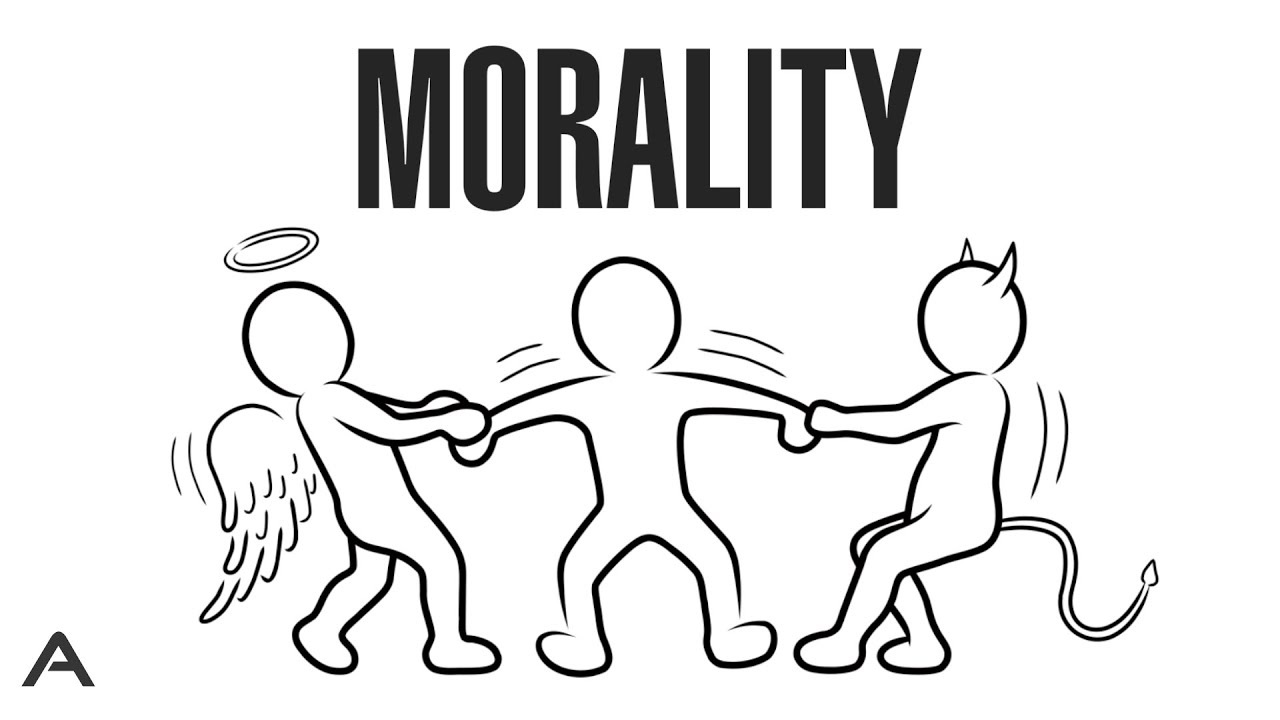
well morality for me is about action I'm an existentialist in some sense what that means is that I believe that what people believe to be true is what they act I hope not what they say and so there's lots of definitions of truth I mean truth is a very expansive word and you can think of objective truth but behavioral truth isn't the same as objective truth what you should do isn't the same as what is as far as I can tell people debate that but I think the reason that that has to be the case
is because think about it this way you're standing in front of a field and you can see the field but the field doesn't tell you how to walk through it there's an infinite number of ways you could walk through it and so you can't extract out an inviolable guide to how you should act from the array of facts that are in front of you because there's just too many facts and they don't have directionality and but you you need to know you need to know how not to suffer and you need to know what your
aim is and so you have to overlay that objective reality with some interpretive structure and it's the nature of that interpretive structure that we're going to be aiming at hard giving you some hints about it already we've extracted it in part from observations of our own behavior and other people's behavior and we've extracted it in part by the nature of our embodiment that's been shaped over hundreds of millions of years but we see the infinite plane of facts and we impose a moral interpretation on it and the moral interpretation is what to do about what
is and that's associated both with security because you just don't need too much complexity and also with aim and so we're mobile creatures right we need to know where we're going because all we're ever concerned about roughly speaking is where we're going that's what we need to know where are we going what are we doing and why and that's not the same question as what is the world made of objectively it's a different question requires different answers and so that's the domain of the moral as far as I'm concerned which is what are you aiming
at what and that's the question of the ultimate ideal in some sense even if you have trivial little you know fragmentary ideals there's something trying to emerge out of that that's it's more coherent and more integrated and more applicable and more practical and that's the other thing is that you know you think about literature and you think about art and you think those aren't very tightly tied to the earth they're empyrion and airy and spiritual and and they don't seem practical but I'm a practical person and part of the reason that I want to assess
these books on the literary and aesthetic and evolutionary perspective is to extract out something of value something of real value that's practical you know something because one of the rules that I have when I'm lecturing is that I don't want to tell anybody anything that they can't use because I think of knowledge as a tool it's it's something to implement in the world where tool using creatures and our knowledge is tools and we need tools to work in the world we need tools to regulate our emotions and to make things better and to put an
end to suffering to the degree that we can and and to live with ourselves properly and to stand up properly and you need the tools to do that and so I don't want to do anything in this lecture series that isn't practical you know I want you to come away having things put together in a way that you can immediately imply not interested in abstraction for the sake of abstraction rational well it's got to make sense you know because the more restrictions on your theory the better and so I want it all laid out causally
so that a and a fall or B follows a and B precedes C and in any way that's understandable and doesn't require a leap any unnecessary leap of faith you know because that's another thing that I think interferes with our relationship with a collection of books like the Bible is that you're called upon to believe things that no one can believe and that's no good because that's a form of lie as far as I can tell and then well then you have to scrap the whole thing because in principle the whole thing's about truth and
if you have to start your pursuit of truth by swallowing a bunch of lies then how in the world are you going to get anywhere with that and so I don't want to the uncertainty at the bottom of this or I don't want any more than I can get then that I have to leave in it because I can't get any farther than that and so it's gonna make sense rationally I want it I don't want it to be pushing up against what we know to be scientifically untrue even though science is in flux and
that's you know somewhat of a dangerous parameter I don't if it isn't working with evolutionary theory for example then I think that it's not a good enough solution so and then finally it's phenomenological modern people you know we think of the reality as objective and and that's very powerful but that isn't how we experience reality we have our domain of experience you know and it's this is a hard thing to to get a grip on even though it should be the most obvious thing for the phenomenal just everything that you experience is real and so
they're interested in the structure of your subjective experience and you say well you have subjective experience and you have subjective experience so do you and there's commonalities across all of those like for example you're you're likely to experience the same set of emotions you know we've been able to identify canonical emotions and canonical motivations and without that we couldn't even communicate because you wouldn't know what the other person was like you'd have to explain infinitely there's nothing you could take for granted but you can you know when phenomenology is the fact that in the center
of my vision my hands are very clear and then out in the periphery they get they disappear and phenomenology is the way things smell and the way things taste and the fact that they matter and so you could say in some sense that phenomenology is is the study of what matters rather than matter and it's a given from the phenomenological perspective that things have meaning that did it and eat you know even if you're a rationalist say an cynic and a nihilist and you say well nothing has any meaning you still run into the problem
of pain because pain undercuts your arguments and has a meaning so there's no escaping from the meaning you can pretty much demolish all the positive parts of it but trying to think your way out of the negative parts man good luck with that because that just doesn't work so phenomenology is and there are the Bible stories and I think this is true fiction in general is phenomenological and it concentrates on trying to elucidate the nature of human experience and that is not the same as the objective world but it's also a form of truth because
it is truth that you have a field of experience and that it has qualities the question is what are the qualities now ancient representations of reality were sort of a weird meld of observable phenomena things that we would consider objective facts and subjective truth the projection of subjective truth and I'll show you for example I'll show you how they've Mesopotamians viewed the world they had a they had a model basically the world was a disc you know if you go out in a field at night what does the world look like well it's a disc
that's got a dome on top of it well that was basically the Mesopotamian view of the world I mean that view of the world that the people who wrote the first stories in the Bible believe - and then and on top of the dome there was water well obviously it's like it rains right where does the water come from well there's water around the dome and then there's land that's the disc and then underneath that there's water how do you know that well drill you'll hit water what's under the earth obviously because otherwise how would
you hit the water and then what's under that this fresh water and then what's under that well to go to the edge of the disc you hit the ocean it's saltwater so it's a dome with water outside of it and then it's a disc that the dome sits on and then underneath that there's fresh water and then underneath that there's saltwater and that was roughly the Mesopotamian world and you see you see that's a mix of observation and imagination right because that isn't the world but it is the way the world appears it's a perfectly
believable cosmology from and the Sun rises in the Sun Sun sets on that dome it's not like the thing is bloody well spinning who would ever think that up it's obviously this comes up it goes down and then travels underneath the world and comes back up again there's nothing more self-evident than that well that's that's that strange intermingling of subjective fantasy let's say right at the level of perception and actual observable phenomena and a lot of the the cosmology that's associated with the biblical stories is exactly like that it's half psychology in half and half
and half reality although the psychological is real as well so so that and then to know that the biblical stories have a phenomenological truth is really worth knowing because you know the poor fundamentalists they're trying to cling to their moral structure and you know I understand why because it does organize their societies and it organizes their psyche so they've got something to cling to but you know they don't have a very sophisticated idea of the complexity of what constitutes truth and they try to gerrymander the biblical stories into the domain of scientific theory you know
creative promoting creationism for example has an alternative scientific theory it's like this just that just isn't gonna go anywhere you know because the people who wrote these damned stories weren't scientists to begin with there weren't any scientists back then there's hardly any scientists now you know it's it's really it's hard to think scientifically man it's like it takes a lot of training and even scientists don't think scientifically once you get them out of the lab and hardly even when they're in the lab you know you got to get peer-reviewed and criticized and like it's hard
to think scientifically so and however the people who wrote these stories thought was more like dramatists think more like shakespeare thought but that doesn't mean that there isn't truth in it it just means that you have to be a little bit more sophisticated about your ideas of truth and that's okay you know there are truths to live by okay well fine then we want to figure out what those are because we need to live and maybe not to suffer so much so so and so if you know that what the Bible stories and stories in
general are trying to represent is the lived experience of conscious individuals like the structure of the lived experience of conscious individuals then that opens up the possibility of a whole different realm of understanding and eliminates the contradiction that's been painful for people between the objective world and and let's say the claims of religious stories so okay